Visa casino: the loudest event at a cashier with no author
A card payment that does not go through is the only thing at a cashier that tells a reader it has happened, at the instant it happens, whether or not anybody wanted to mention it.
- Updated 13 November 2026
- Licence status shown for every offer
- Assumptions marked in the text
Card-funded offers, each weighed against the same reel
These offers are paid placements, so this site is owed a fee whenever a reader opens an account through one of the buttons below.
-

Tweedbet
Welcome pack 470%
- Licence
- Not stated, no Great Britain licence
- Play-through
- Not published
- Min deposit
- £20
Bonus up to£14,000 Free spins470Read the offer18+ only. Terms apply.
Licence, terms and working
The site does not say where it is licensed or which company runs it.
The reel
- Build of the reel
- Big Bass Bonanza
- Return it publishes
- 96.71 per cent
- Stake it accepts on one turn
- 10p to £250.00
The offer
- Turns advertised
- 470 turns Turns valued at the cheapest turn this reel sells, no worth for one being stated anywhere in the offer
- Price of one turn
- 10p the smallest stake the reel accepts, this operator publishing no figure of its own
- Credit as a sum
- £14,000.00
- Credit waiting on a payment
- Stated in words Casino Welcome Pack 470% up to £14,000 + 470 FS. Crypto Welcome Bonus 110% up to 1,300 USDT + 110 FS. VIP Welcome Pack 770% up to £13,000
- Advertised, priced
- £14,047.00 140,470 turns of this reel
Hung on it
- Play-through
- Not published
- Credited towards it
- 100 per cent nobody has published a share, so the whole of a stake is credited, which is the kindest reading available
- Ceiling on winnings
- Not published
- Qualifying payment
- £20.00 200 turns of this reel at the price above, and it enters no weight
Not weighed, for want of the play-through multiple as a number.
Stated in words means the condition is set down in words that cost something and give nothing to subtract. Not published means the operator sets the figure down nowhere.
-

EliteSpin
£5,000 + 500 FS
- Licence
- Costa Rica, no Great Britain licence
- Play-through
- 40×
- Min deposit
- £20
Bonus up to£5,000 Free spins500Read the offer18+ only. Terms apply.
Licence, terms and working
Licence held in Costa Rica, by PrimeTier Limited.
The reel
- Build of the reel
- Big Bass Bonanza
- Return it publishes
- 96.71 per cent
- Stake it accepts on one turn
- 10p to £250.00
The offer
- Turns advertised
- 500 turns Turns valued at the cheapest turn this reel sells, no worth for one being stated anywhere in the offer
- Price of one turn
- 10p the smallest stake the reel accepts, this operator publishing no figure of its own
- Credit as a sum
- £5,000.00
- Credit waiting on a payment
- Stated in words Welcome bonus €/£5,000 + 500 FS. Elite lootboxes unlock surprise rewards up to €/£20,000 or 500 FS. Summer Festival by BGaming: win €80,000
- Advertised, priced
- £5,050.00 50,500 turns of this reel
Hung on it
- Play-through
- 40 times the bonus and the winnings from the spins
- Credited towards it
- 100 per cent nobody has published a share, so the whole of a stake is credited, which is the kindest reading available
- Ceiling on winnings
- Stated in words Five times the bonus
- Qualifying payment
- £20.00 200 turns of this reel at the price above, and it enters no weight
Priced at 10p a turn, the banner comes to £5,050.00, of which £5,048.36 survives the spins. At the reel's published return of 96.71 per cent, a play-through of 40 times asks for £201,934.20 of staking and costs £6,643.64, more than there is to pay it with, so the offer weighs £0.00.
Stated in words means the condition is set down in words that cost something and give nothing to subtract.
-
WinBeast
€5,000 + 500 FS
- Licence
- Curaçao, no Great Britain licence
- Min deposit
- €20
- Free spins
- 500
Bonus up to€5,000 Play-through40×Read the offer18+ only. Terms apply.
Licence, terms and working
Licence held in Curaçao, by a company the site does not name.
The reel
- Build of the reel
- Big Bass Bonanza
- Return it publishes
- 96.71 per cent
- Stake it accepts on one turn
- 10c to €250.00
The offer
- Turns advertised
- 500 turns Turns valued at the cheapest turn this reel sells, no worth for one being stated anywhere in the offer
- Price of one turn
- 10c the smallest stake the reel accepts, this operator publishing no figure of its own
- Credit as a sum
- €5,000.00
- Credit waiting on a payment
- Stated in words Welcome pack €5,000 + 500 FS + €650 free bet. Fortune wheel on €40+ deposits with code FORTUNE. 40% up to €300 Beast Boost Monday with code BOOST1 on €20 deposit
- Advertised, priced
- €5,050.00 50,500 turns of this reel
Hung on it
- Play-through
- 40 times the bonus and the winnings from the spins
- Credited towards it
- 100 per cent nobody has published a share, so the whole of a stake is credited, which is the kindest reading available
- Ceiling on winnings
- Stated in words €100 a batch of spins
- Qualifying payment
- €20.00 200 turns of this reel at the price above, and it enters no weight
Priced at 10c a turn, the banner comes to €5,050.00, of which €5,048.36 survives the spins. At the reel's published return of 96.71 per cent, a play-through of 40 times asks for €201,934.20 of staking and costs €6,643.64, more than there is to pay it with, so the offer weighs €0.00.
Stated in words means the condition is set down in words that cost something and give nothing to subtract.
-

Betportal
300% + 150 FS
- Licence
- Anjouan, Comoros, no Great Britain licence
- Play-through
- 35×
- Min deposit
- €20
- Stake cap
- €5.00
Bonus up to€1,000 Free spins150Read the offer18+ only. Terms apply.
Licence, terms and working
Licence held in Anjouan, Comoros, by BetPortal Gaming Ltd and Excite Ultra Media Ltd, numbered ALSI-202601040-FI2.
The reel
- Build of the reel
- Big Bass Bonanza
- Return it publishes
- 96.71 per cent
- Stake it accepts on one turn
- 10c to €250.00
The offer
- Turns advertised
- 150 turns Turns valued at the cheapest turn this reel sells, no worth for one being stated anywhere in the offer
- Price of one turn
- 10c the smallest stake the reel accepts, this operator publishing no figure of its own
- Credit as a sum
- €1,000.00
- Credit waiting on a payment
- Stated in words Welcome package 300% up to €1,000 + 150 free spins. 1st deposit 150% up to €500 + 100 FS. 2nd deposit 100% up to €300 + 50 FS
- Advertised, priced
- €1,015.00 10,150 turns of this reel
Hung on it
- Play-through
- 35 times the bonus
- Credited towards it
- 100 per cent nobody has published a share, so the whole of a stake is credited, which is the kindest reading available
- Ceiling on winnings
- Stated in words Five times the bonus
- Largest stake while it runs
- €5.00 under the largest stake the reel accepts, so part of the machine's own range is shut off while the credit runs
- Qualifying payment
- €20.00 200 turns of this reel at the price above, and it enters no weight
Priced at 10c a turn, the banner comes to €1,015.00, of which €1,014.51 survives the spins. At the reel's published return of 96.71 per cent, a play-through of 35 times asks for €35,507.73 of staking and costs €1,168.20, more than there is to pay it with, so the offer weighs €0.00.
Stated in words means the condition is set down in words that cost something and give nothing to subtract.
-

Night Luck
805% + 280 FS
- Licence
- Not stated, no Great Britain licence
- Play-through
- Not published
- Min deposit
- €20
Bonus up to€6,400 Free spins280Read the offer18+ only. Terms apply.
Licence, terms and working
The site does not say where it is licensed or which company runs it.
The reel
- Build of the reel
- Big Bass Bonanza
- Return it publishes
- 96.71 per cent
- Stake it accepts on one turn
- 10c to €250.00
The offer
- Turns advertised
- 280 turns Turns valued at the cheapest turn this reel sells, no worth for one being stated anywhere in the offer
- Price of one turn
- 10c the smallest stake the reel accepts, this operator publishing no figure of its own
- Credit as a sum
- €6,400.00
- Credit waiting on a payment
- Stated in words Casino welcome bonus 805% up to €6,400 + 280 FS. Crypto welcome bonus 140% up to 1,600 USDT + 140 FS. VIP welcome pack 800% up to €14,500
- Advertised, priced
- €6,428.00 64,280 turns of this reel
Hung on it
- Play-through
- Not published
- Credited towards it
- 100 per cent nobody has published a share, so the whole of a stake is credited, which is the kindest reading available
- Ceiling on winnings
- Not published
- Qualifying payment
- €20.00 200 turns of this reel at the price above, and it enters no weight
Not weighed, for want of the play-through multiple as a number.
Stated in words means the condition is set down in words that cost something and give nothing to subtract. Not published means the operator sets the figure down nowhere.
What a Great Britain licence would add to these offers
A licence from the Gambling Commission for Great Britain carries rules that an offer licensed elsewhere does not have to follow, and some figures in this ranking would not survive them. Social responsibility code provision 5.1.1 stops a British licensee applying a wagering requirement of more than ten times the bonus funds, and that limit has applied since 19 January 2026. A play-through above ten times in this list is therefore one a British licence would not allow.
Regulation 5(2) of the Gambling Act 2005 (Operating Licence Conditions) (Amendment) Regulations 2025, made on 25 February 2025, limits what a player can stake on one game cycle of an online slot to £5, or £2 for a player under 25. It is a condition of a British remote casino licence and not a property of the game, so a player at an operator licensed elsewhere does not have it behind them.
Remote technical standard 14D asks for at least two and a half seconds from the start of one slot game cycle to the start of the next, with the player pressing start each time. It is addressed to the game and not to the money, so no figure in this ranking measures it.
GAMSTOP is the free scheme that closes your accounts with online gambling companies licensed in Great Britain, and every one of them must join it. An operator licensed elsewhere is not required to, so a GAMSTOP registration cannot be counted on to reach these offers. If gambling is costing more than money, the National Gambling Helpline is free and answers on 0808 8020 133 at any hour.
Ranking last changed 8 November 2026. Operator terms change without notice, so open the offer page and read the terms there before you register.
At a glance
Then it says nothing else at all: not who refused it, not on what ground, not under whose rulebook, and not whether the same instrument would work in ten minutes. Perfect signal about the occurrence, none whatever about the author. Set that against the figures this page is built on, every one of which names the party that published it and carries the number of a claim a reader can open, and the inversion is the finding. A credit of £40.00 at twenty-five times, put across a reel publishing 96.71 per cent, closes on £7.10, and that figure has two publishers behind it where the decline has none.
- What the machine states96.71 per centBig Bass Bonanza’s published proportion, attributable twice over: the maker’s own page carries it and so does the configuration a session is handed. Attribution is the property this page is about, and the contrast with the event in its title is the reason the figure is here.
- What the offer states£40.00 at 25 timesA face of the size commonly advertised against a card deposit, with twenty-five times itself demanded before a withdrawal may be asked for, the named reel counting at its full rate. Attributable too, though to one party rather than two, and that party can change it tomorrow.
- What the two make when multiplied£7.10What is expected to survive once a thousand pounds of staking has gone over reels giving back that much, with a turn priced 0.10, which this page supposes and restates each time the figure is used. It is the sum a reader was trying to reach when the instrument said no and gave no reason.
On this page
- The one event nobody has to be told about
- What the same event declines to say
- The machine, which is the opposite case throughout
- What an event with no author costs to act on
- The reading in which a refusal is doing its job
- What the tile is worth on a forty pound face
- Everything the event leaves exactly as it was
- Two columns, one of them empty by nature
The one event nobody has to be told about
Almost everything that happens at a cashier happens quietly. A balance is held back, a request joins a queue, a term is applied, a limit bites, a check runs somewhere: none of those announces itself, and a reader learns about them afterwards or not at all. The quietness is not sinister. It is simply what a system does when nobody has written down an obligation to narrate.
One event is different. A card payment that does not go through says so, immediately, on the screen, without anybody deciding to mention it. It is the only event in the whole sequence a reader cannot fail to notice as it happens, and it takes that property from the shape of the thing rather than from anybody’s policy: the payment either completes or it does not, the reader is standing there either way, and no completion means no proceeding.
That makes it worth a page, because a property that strong is rare in this subject. Everywhere else on this domain a reader is working out what happened from documents written afterwards, or from figures published by parties with reasons of their own. Here is one event whose occurrence needs no document at all. It would be perverse not to ask what such an event is worth, and the answer turns out to be sharper than the question.
Two things to put aside before part two, because both are about a different kind of absence and belong elsewhere. One is the instrument a licensed cashier may not take at all, which is settled in Credit card casino and is an absence by rule rather than an event. The other is a refusal to carry gambling payments as a class, which part five treats briefly. This page is about the single, ordinary decline that a reader meets at a till with an instrument the till does accept.
What the same event declines to say
Then it stops. The event is perfect about the fact that it happened and silent about everything else: who declined it, on what ground, under which rulebook, and whether the same instrument would work in ten minutes. A reader has been handed one bit of information, delivered with complete reliability, and nothing to attach it to.
Several parties could have produced it. The bank that issued the instrument could. So could the scheme it runs on, and the regulator records that the large payment systems may withdraw a business’s facilities altogether the Commission’s own page for players. The business taking the money could, or whoever processes on its behalf. Nothing a reader sees distinguishes those.
The consequence is practical rather than philosophical. A reader who wants to do something about it has to choose which party to approach, and the event gives them no basis for choosing. Approach the wrong one and the answer is that it was not them, which is both true and useless. There is no published procedure for finding out which it was, and no party is under any duty to say, so the reader’s next step is a guess dressed as a decision.
Notice how unusual that combination is. Ordinarily an event that is hard to attribute is also hard to detect: a term applied quietly, a check run somewhere, a figure altered between visits. Ordinarily an event that is easy to detect comes with a notice explaining it, because somebody chose to produce it. This one is easy to detect and impossible to attribute, and that pairing is what makes it the odd item in the whole cashier.
And the honest limit of the complaint. None of this says anybody is behaving badly. An issuer has reasons it is entitled to keep, a scheme operates at a scale where explanation is not practical, and a business receiving a refusal may genuinely not know its cause either. The absence of attribution is a property of the arrangement rather than an act by any party in it, which is exactly why it cannot be fixed by choosing a better venue.
The machine, which is the opposite case throughout
Set that beside the machine for a moment, because the machine is the opposite case in every respect. Every figure this page spends names the party that published it and carries the number of a claim a reader can go and read. Take the proportion: 96.71 per cent, sitting in the maker’s own page and in the configuration a session is handed the game sheet, claims 20 and 21 together. Take the ceiling on one cycle: 2,100 times a stake, out of the game’s own data claim 27 of the same sheet. Take the only hit rate anybody publishes: one turn in every 3,880,481 claim 29, likewise.
Where two of those parties disagree, both figures go down and neither is picked: on two titles of the family the maker’s own page and the data a session opens with give different proportions, and the sheet records the disagreement rather than averaging it away off the sheet, claims 118 and 119. A reader meeting one of those is told who says what. That is the strongest form of attribution available anywhere in this subject, and it exists because somebody chose to write both down.
There is a version of the event that would answer the question, and noticing what it would take is the quickest way to see the size of the gap. Somewhere in the chain a party knows why the payment stopped. The information exists at the moment of refusal, held by whoever produced it, and the cost of putting a few words of it on the reader’s screen is the cost of forwarding a few words.
It is not forwarded, and nothing obliges anybody to forward it. So what is missing is not knowledge but transmission, which is a different shortfall and a cheaper one to close, and that is worth saying because it means the silence is a choice made somewhere rather than a limit of the technology.
Against that, consider the apparatus this site uses on its own figures. Every quantity printed on these pages carries a short reading beside it naming where the figure came off: the reel, which is the game sheet; the terms of an offer; the rule book, which is the regulatory sheet; or the page itself, meaning something supposed. Four kinds, and a reader meeting any figure here can tell at a glance which of the four produced it.
That apparatus costs almost nothing to run, which is the point of mentioning it beside a decline. Attribution is cheap wherever somebody has decided it matters, and it is absent wherever nobody has. The event in the title of this page is not expensive to attribute. It is simply nobody’s job.
So the loudest event at a cashier is the one with no author, and the quietest figures on the page are the ones whose authorship is complete. That inversion is the whole of this page. It also suggests the rule a reader can carry off it: loudness and attributability are independent properties, and the one a reader actually needs is the second.
There is a tidy test in that. Ask of anything a cashier shows you whether you could name, in one sentence, the party that would have to be wrong for the thing to be wrong. For the proportion the answer is the maker, or the data, and the two agree or the disagreement is on record. For the demand in the wording the answer is whoever drafted it. For the decline there is no answer, and no amount of reading will produce one.
What an event with no author costs to act on
Now the arithmetic, which is the only way this domain knows how to say how much something matters. Write the close as E = B × (1 − W × (1 − RTP) ∕ g), with the face and the demand out of the wording, the proportion off the machine, and the rate the named reel counts at set in full by the terms in the terms themselves. Nothing in that line describes an instrument, so a decline cannot alter the sum. What it alters is whether a reader reaches the sum at all, which is a different question and a worse one.
Twenty-five times a face of forty pounds is £1,000.00 of staking, and a turn priced at 0.10 turns that into 10,000 turns, which against a floor barring a cycle from restarting inside 2.5 seconds RTS 14D is six hours and fifty-seven minutes. Subtract what 96.71 per cent gives back and 3.29 points of £1,000.00 stays behind, which is £32.90, so £7.10 of a forty pound face is what the arithmetic expects to leave.
Against those figures the decline costs nothing and settles nothing. It takes no money, moves no proportion, and adds no demand. What it does is interrupt, and an interruption has a price only in the currency of the reader’s next move. That is where the missing attribution bites: the cheapest correct next move depends on which party refused, and the reader cannot know which party refused, so no next move can be known to be the cheapest.
Price the alternative that does have a clock on it. Where a complaint is the route, the licensed version of that route runs to eight weeks at the outside and ends with a letter pointing at a dispute body the regulator has approved. Eight weeks against six hours and fifty-seven minutes of reel is a ratio of about two hundred to one, and the eight weeks attaches to exactly one of the parties that might have produced the decline. For the others there is no equivalent clock at all.
A decline arrives inside a second and names nobody, while the proportion that decided the £7.10 names two publishers and carries a numbered claim
The reading in which a refusal is doing its job
There is a reading of the same event in which it is not a problem to be solved. Where an instrument or a bank declines to carry gambling payments as a class, the refusal is doing protective work, in the way a self-exclusion register does, and nothing on this page sets out a route past one. That is the short version and it is the honest one.
What is worth adding is that the silence cuts the same way in that reading too. A protective refusal is as unattributed as any other: it does not announce itself as protective, and a reader meeting one cannot tell it apart from a technical failure or a limit somewhere in the chain. So the event cannot be used as evidence in either direction, and a reader who treats a decline as a verdict on a venue has read something into it that is not there.
That leaves one piece of practical advice, and it is the one piece on this page. If a reader wants to know whether a refusal was a guard they set up themselves, the answer is on their own side of the arrangement rather than at the till. Register once with Gamstop Online and every account at an operator Britain licenses closes with it, while 0808 8020 133 reaches free and confidential help whatever the hour. Both of those are attributable in a way the decline is not.
What the tile is worth on a forty pound face
Take the house edge as a reciprocal and break-even comes out, which is why it shifts whenever a published proportion shifts. An edge of 3.29 points puts the crossing at 30.40 times a credit; an edge of 3.49 points, which is what Big Bass Reel Repeat leaves at 96.51 per cent the family table, claim 74, brings the crossing in to 28.65.
| The title weighed | Published return | Break-even play-through | The offer asks | What £40.00 is worth |
|---|---|---|---|---|
| Big Bass Bonanza | 96.71 per cent | 30.40 times | 25 times | £7.10 |
| Big Bass Reel Repeat | 96.51 per cent | 28.65 times | 25 times | £5.10 |
| What the title decides | 0.20 points of return | 1.75 times | no change | £2.00 |
Two pounds of a forty pound face, produced by a fifth of one percentage point. Now put that beside the subject of the page. Both rows of that table are attributable to the hundredth: a reader can name the party, open the page and check the figure. The event in the title of this page is attributable to nobody at all. Two pounds is therefore the larger quantity in one sense and the smaller in another, and a reader deciding where to spend attention should notice which of the two they can actually do something about.
One more reading of the table, since it bears on what a decline interrupts. At twenty-five times the demand sits inside break-even on both titles, so the credit survives on either. Push the demand to thirty and the lower title has already gone under nought while the upper has not, which means the question of whether a wording is survivable at all has an answer that depends on the tile. A reader turned back at a till has not lost that; they have postponed it.
Everything the event leaves exactly as it was
The list is short and worth printing, because the temptation after an interruption is to believe something has changed. The proportion given back is where it was. So is the cap on what one cycle may hand over, 2,100 times a stake, which at the 0.10 supposed here is £210.00. The feature round still needs three, four or five scatters to begin, and pays out ten turns, or fifteen, or twenty, according to how many of them land. The single published hit rate has not stirred. Nor has the floor under a cycle, which is the figure that turned 10,000 turns into six hours and fifty-seven minutes.
Dispersion is unmoved as well, and the wording has to be careful. Nobody anywhere publishes a volatility for the family, so there is no such quantity for an event at a till to have altered, and any page saying otherwise would have made up its own starting figure.
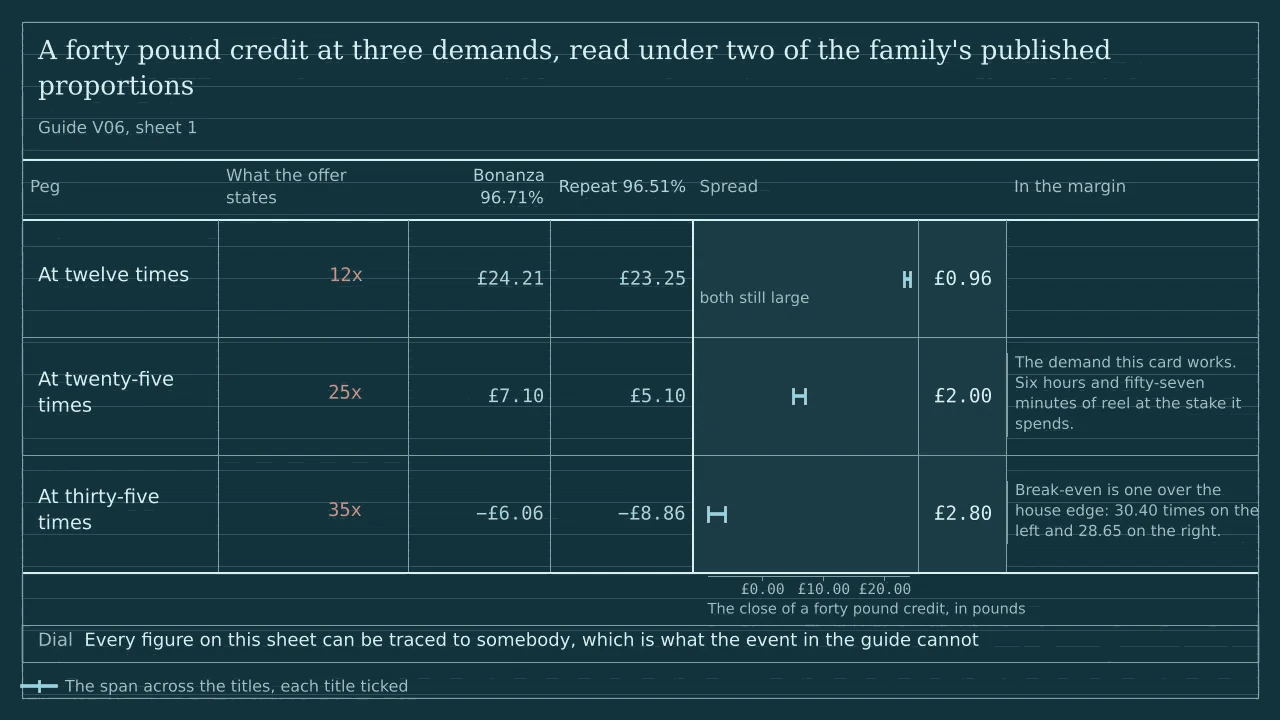
Every figure on that sheet can be traced to somebody. The two column heads belong to the studio, the demands down the side belong to whoever drafted a wording, the stake belongs to this publisher and says so, and the readings in the cells are arithmetic anybody can repeat. There is nothing on it whose author a reader would have to guess at, which is precisely what cannot be said of the event the page is named for.
Two columns, one of them empty by nature
The attributable column. A face of £40.00 at twenty-five times demands a thousand pounds of staking; priced at 0.10 a turn that is 10,000 turns; the floor forbids running them any faster, so six hours and fifty-seven minutes is the floor on the stretch; 3.29 points of the thousand is £32.90 expected to go; and £7.10 is expected to remain. Shift the staking to Big Bass Reel Repeat and the remainder comes down to £5.10, so the tile is worth £2.00.
The unattributable column. One event, arriving instantly, reliably and in full view, carrying its own occurrence and nothing else. No author, no ground, no rulebook named, no duration, and no published route that is known to lead to whoever produced it. It takes nothing from the figures in the first column and it decides whether the reader ever reaches them.
The honest total for this key, then, is £2.00, out of the column where every figure has a publisher, and the event this page is named for contributes nothing at all to it. That is not a disappointing result. It is the result: the loudest thing at a cashier turns out to be the one thing a reader can neither price nor pin on anybody, while the quiet figures on a tile wall are worth two pounds on this credit and can be checked by a stranger in a minute.
One practical consequence falls out of those two columns, and it is about where a reader puts their attention rather than about what they do at a till. An interruption is loud and costs nothing; a fifth of a percentage point is silent and costs two pounds on this face. Attention follows noise by default, and on this evidence the default is backwards. The figure worth reading is on a tile, printed by somebody who can be named, and it will still be there after the payment has gone through.
Which gives the sentence to carry away. Being told that something happened is not the same as being told anything about it, and a system can be scrupulously reliable about the first while saying nothing at all about the second. A reader who learns to ask who would have to be wrong has a question that works on every figure in this subject, and finds, at exactly one place in the cashier, that there is nobody to name.
Questions readers ask
Why does a declined card payment tell a reader so little
Because the event carries its own occurrence and nothing besides. The issuer, the scheme, the business taking the money or whoever processes for it could each have produced it, and nothing a reader sees distinguishes those.
Is there a way to find out which party refused
No published procedure exists and no party is under a duty to say. A reader choosing whom to approach is therefore guessing, and approaching the wrong one produces an answer that is true and useless.
Does a decline change anything about the machine
Not one figure. The proportion given back, the cap on what a cycle may hand over, the scatters a feature round needs and the floor under a turn are all exactly where they were, and the close has no term in it for an instrument.
What was the reader trying to reach when the payment failed
£7.10 of a £40.00 credit at twenty-five times, against a reel publishing 96.71 per cent, once a thousand pounds of staking has carried off an expected £32.90.
How long does that staking take
10,000 turns at a turn priced 0.10, and 2.5 seconds has to pass on a licensed build before the next cycle may open, so no hour carries more than 1,440 turns. Six hours and fifty-seven minutes is the least it can run.
What is the difference the tile makes on this credit
£2.00. Twenty-five times leaves £7.10 at 96.71 per cent and £5.10 at the 96.51 per cent published for Big Bass Reel Repeat, and both of those figures can be checked against their sources.
Might a refusal be a protection rather than a fault
It might, and the page sets out no route past one. The difficulty is that a protective refusal announces itself no more clearly than any other, so the event cannot be read as evidence in either direction.
Is a Great Britain licence held by anybody advertising an offer weighed here
By none of them. The duties leaving with that licence are the measure of the absence, and each can be read off the figures worked above.
Before you play
Read on
- Credit card casino
- One instrument is absent by rule from a licensed till, and its presence settles the licence question in one direction only.
- Mastercard casino
- A charge named at the last step of four, priced in turns of the reel rather than in pounds.
- Online casino UK
- Three parties set what a reader sees, and moving the venue’s whole column leaves the close exactly where it was.
- How this site is paid
- What the publisher is paid against what the reader keeps, and which of the two anybody publishes.