Bitcoin slots: which document the rail is in, and why the reel is in another one
A headline of this kind names a way of paying and a kind of machine in one breath, and the two belong to different paperwork. The list a game is handed when its session opens is short, and no payment method, no balance and no account is anywhere in it.
- Updated 13 November 2026
- Licence status shown for every offer
- Assumptions marked in the text
Offers of this kind, weighed against the same reel
These offers are paid placements, so this site is owed a fee whenever a reader opens an account through one of the buttons below.
-

Tweedbet
Welcome pack 470%
- Licence
- Not stated, no Great Britain licence
- Play-through
- Not published
- Min deposit
- £20
Bonus up to£14,000 Free spins470Read the offer18+ only. Terms apply.
Licence, terms and working
The site does not say where it is licensed or which company runs it.
The reel
- Build of the reel
- Big Bass Bonanza
- Return it publishes
- 96.71 per cent
- Stake it accepts on one turn
- 10p to £250.00
The offer
- Turns advertised
- 470 turns Turns valued at the cheapest turn this reel sells, no worth for one being stated anywhere in the offer
- Price of one turn
- 10p the smallest stake the reel accepts, this operator publishing no figure of its own
- Credit as a sum
- £14,000.00
- Credit waiting on a payment
- Stated in words Casino Welcome Pack 470% up to £14,000 + 470 FS. Crypto Welcome Bonus 110% up to 1,300 USDT + 110 FS. VIP Welcome Pack 770% up to £13,000
- Advertised, priced
- £14,047.00 140,470 turns of this reel
Hung on it
- Play-through
- Not published
- Credited towards it
- 100 per cent nobody has published a share, so the whole of a stake is credited, which is the kindest reading available
- Ceiling on winnings
- Not published
- Qualifying payment
- £20.00 200 turns of this reel at the price above, and it enters no weight
Not weighed, for want of the play-through multiple as a number.
Stated in words means the condition is set down in words that cost something and give nothing to subtract. Not published means the operator sets the figure down nowhere.
-

EliteSpin
£5,000 + 500 FS
- Licence
- Costa Rica, no Great Britain licence
- Play-through
- 40×
- Min deposit
- £20
Bonus up to£5,000 Free spins500Read the offer18+ only. Terms apply.
Licence, terms and working
Licence held in Costa Rica, by PrimeTier Limited.
The reel
- Build of the reel
- Big Bass Bonanza
- Return it publishes
- 96.71 per cent
- Stake it accepts on one turn
- 10p to £250.00
The offer
- Turns advertised
- 500 turns Turns valued at the cheapest turn this reel sells, no worth for one being stated anywhere in the offer
- Price of one turn
- 10p the smallest stake the reel accepts, this operator publishing no figure of its own
- Credit as a sum
- £5,000.00
- Credit waiting on a payment
- Stated in words Welcome bonus €/£5,000 + 500 FS. Elite lootboxes unlock surprise rewards up to €/£20,000 or 500 FS. Summer Festival by BGaming: win €80,000
- Advertised, priced
- £5,050.00 50,500 turns of this reel
Hung on it
- Play-through
- 40 times the bonus and the winnings from the spins
- Credited towards it
- 100 per cent nobody has published a share, so the whole of a stake is credited, which is the kindest reading available
- Ceiling on winnings
- Stated in words Five times the bonus
- Qualifying payment
- £20.00 200 turns of this reel at the price above, and it enters no weight
Priced at 10p a turn, the banner comes to £5,050.00, of which £5,048.36 survives the spins. At the reel's published return of 96.71 per cent, a play-through of 40 times asks for £201,934.20 of staking and costs £6,643.64, more than there is to pay it with, so the offer weighs £0.00.
Stated in words means the condition is set down in words that cost something and give nothing to subtract.
-

WinBeast
€5,000 + 500 FS
- Licence
- Curaçao, no Great Britain licence
- Min deposit
- €20
- Free spins
- 500
Bonus up to€5,000 Play-through40×Read the offer18+ only. Terms apply.
Licence, terms and working
Licence held in Curaçao, by a company the site does not name.
The reel
- Build of the reel
- Big Bass Bonanza
- Return it publishes
- 96.71 per cent
- Stake it accepts on one turn
- 10c to €250.00
The offer
- Turns advertised
- 500 turns Turns valued at the cheapest turn this reel sells, no worth for one being stated anywhere in the offer
- Price of one turn
- 10c the smallest stake the reel accepts, this operator publishing no figure of its own
- Credit as a sum
- €5,000.00
- Credit waiting on a payment
- Stated in words Welcome pack €5,000 + 500 FS + €650 free bet. Fortune wheel on €40+ deposits with code FORTUNE. 40% up to €300 Beast Boost Monday with code BOOST1 on €20 deposit
- Advertised, priced
- €5,050.00 50,500 turns of this reel
Hung on it
- Play-through
- 40 times the bonus and the winnings from the spins
- Credited towards it
- 100 per cent nobody has published a share, so the whole of a stake is credited, which is the kindest reading available
- Ceiling on winnings
- Stated in words €100 a batch of spins
- Qualifying payment
- €20.00 200 turns of this reel at the price above, and it enters no weight
Priced at 10c a turn, the banner comes to €5,050.00, of which €5,048.36 survives the spins. At the reel's published return of 96.71 per cent, a play-through of 40 times asks for €201,934.20 of staking and costs €6,643.64, more than there is to pay it with, so the offer weighs €0.00.
Stated in words means the condition is set down in words that cost something and give nothing to subtract.
-

Betportal
300% + 150 FS
- Licence
- Anjouan, Comoros, no Great Britain licence
- Play-through
- 35×
- Min deposit
- €20
- Stake cap
- €5.00
Bonus up to€1,000 Free spins150Read the offer18+ only. Terms apply.
Licence, terms and working
Licence held in Anjouan, Comoros, by BetPortal Gaming Ltd and Excite Ultra Media Ltd, numbered ALSI-202601040-FI2.
The reel
- Build of the reel
- Big Bass Bonanza
- Return it publishes
- 96.71 per cent
- Stake it accepts on one turn
- 10c to €250.00
The offer
- Turns advertised
- 150 turns Turns valued at the cheapest turn this reel sells, no worth for one being stated anywhere in the offer
- Price of one turn
- 10c the smallest stake the reel accepts, this operator publishing no figure of its own
- Credit as a sum
- €1,000.00
- Credit waiting on a payment
- Stated in words Welcome package 300% up to €1,000 + 150 free spins. 1st deposit 150% up to €500 + 100 FS. 2nd deposit 100% up to €300 + 50 FS
- Advertised, priced
- €1,015.00 10,150 turns of this reel
Hung on it
- Play-through
- 35 times the bonus
- Credited towards it
- 100 per cent nobody has published a share, so the whole of a stake is credited, which is the kindest reading available
- Ceiling on winnings
- Stated in words Five times the bonus
- Largest stake while it runs
- €5.00 under the largest stake the reel accepts, so part of the machine's own range is shut off while the credit runs
- Qualifying payment
- €20.00 200 turns of this reel at the price above, and it enters no weight
Priced at 10c a turn, the banner comes to €1,015.00, of which €1,014.51 survives the spins. At the reel's published return of 96.71 per cent, a play-through of 35 times asks for €35,507.73 of staking and costs €1,168.20, more than there is to pay it with, so the offer weighs €0.00.
Stated in words means the condition is set down in words that cost something and give nothing to subtract.
-

Night Luck
805% + 280 FS
- Licence
- Not stated, no Great Britain licence
- Play-through
- Not published
- Min deposit
- €20
Bonus up to€6,400 Free spins280Read the offer18+ only. Terms apply.
Licence, terms and working
The site does not say where it is licensed or which company runs it.
The reel
- Build of the reel
- Big Bass Bonanza
- Return it publishes
- 96.71 per cent
- Stake it accepts on one turn
- 10c to €250.00
The offer
- Turns advertised
- 280 turns Turns valued at the cheapest turn this reel sells, no worth for one being stated anywhere in the offer
- Price of one turn
- 10c the smallest stake the reel accepts, this operator publishing no figure of its own
- Credit as a sum
- €6,400.00
- Credit waiting on a payment
- Stated in words Casino welcome bonus 805% up to €6,400 + 280 FS. Crypto welcome bonus 140% up to 1,600 USDT + 140 FS. VIP welcome pack 800% up to €14,500
- Advertised, priced
- €6,428.00 64,280 turns of this reel
Hung on it
- Play-through
- Not published
- Credited towards it
- 100 per cent nobody has published a share, so the whole of a stake is credited, which is the kindest reading available
- Ceiling on winnings
- Not published
- Qualifying payment
- €20.00 200 turns of this reel at the price above, and it enters no weight
Not weighed, for want of the play-through multiple as a number.
Stated in words means the condition is set down in words that cost something and give nothing to subtract. Not published means the operator sets the figure down nowhere.
What a Great Britain licence would add to these offers
A licence from the Gambling Commission for Great Britain carries rules that an offer licensed elsewhere does not have to follow, and some figures in this ranking would not survive them. Social responsibility code provision 5.1.1 stops a British licensee applying a wagering requirement of more than ten times the bonus funds, and that limit has applied since 19 January 2026. A play-through above ten times in this list is therefore one a British licence would not allow.
Regulation 5(2) of the Gambling Act 2005 (Operating Licence Conditions) (Amendment) Regulations 2025, made on 25 February 2025, limits what a player can stake on one game cycle of an online slot to £5, or £2 for a player under 25. It is a condition of a British remote casino licence and not a property of the game, so a player at an operator licensed elsewhere does not have it behind them.
Remote technical standard 14D asks for at least two and a half seconds from the start of one slot game cycle to the start of the next, with the player pressing start each time. It is addressed to the game and not to the money, so no figure in this ranking measures it.
GAMSTOP is the free scheme that closes your accounts with online gambling companies licensed in Great Britain, and every one of them must join it. An operator licensed elsewhere is not required to, so a GAMSTOP registration cannot be counted on to reach these offers. If gambling is costing more than money, the National Gambling Helpline is free and answers on 0808 8020 133 at any hour.
Ranking last changed 8 November 2026. Operator terms change without notice, so open the offer page and read the terms there before you register.
At a glance
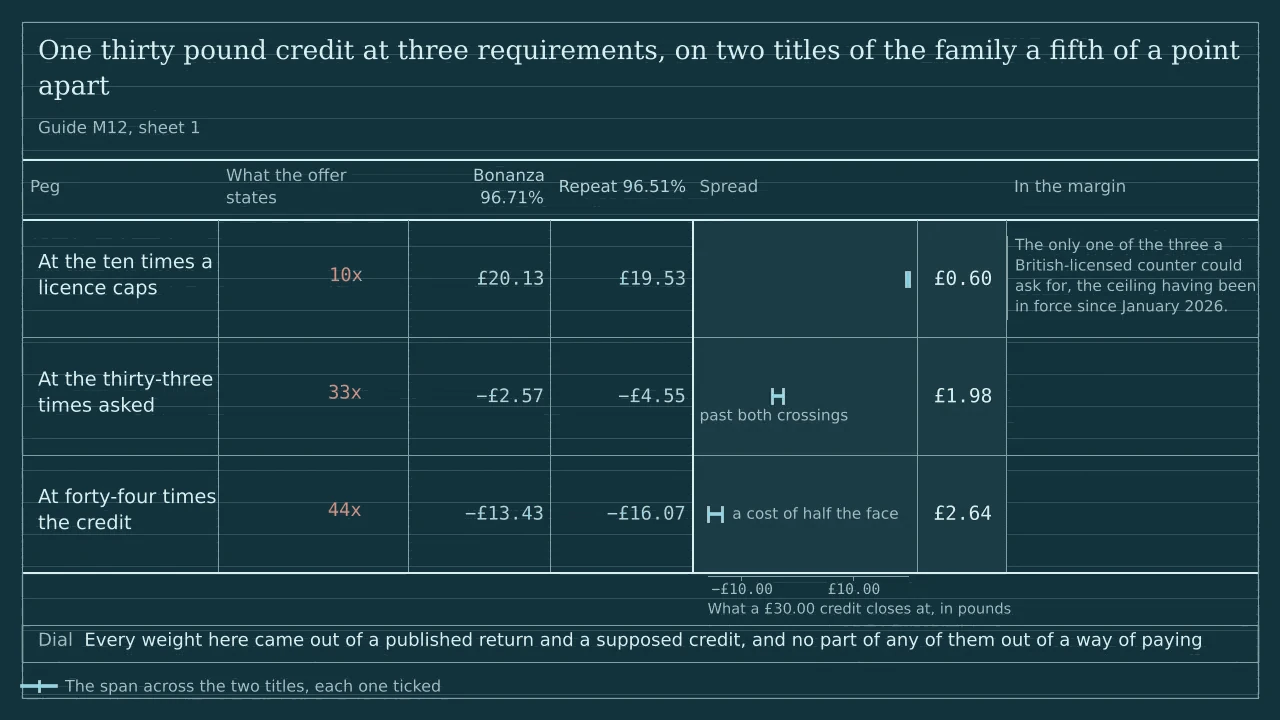
What the British rule book says about paying is addressed to the counter’s licence, and five of those rules name the maker’s own licence in their lists of exclusions. So the rail cannot reach the reel, and this page establishes that before it prices anything. A credit of £30.00 with £990.00 to be staked before any of it can leave closes at −£2.57 on Big Bass Bonanza and at −£4.55 on Big Bass Reel Repeat, a fifth of a point lower. The £1.98 between those two is what choosing a title is worth. What choosing a rail is worth, on anything the machine publishes, is nothing at all.
- What the machine states96.71 per centBig Bass Bonanza, from the maker’s own page and from the game’s own session reading, which agree. Being a proportion, it answers the question how much of the staking comes back, and no question at all about the route the staking took.
- What the offer states£30.00 at 33 timesThirty pounds of credit asked for nothing in advance, and a requirement set at thirty-three times its face. The face is written in pounds here because a page has to write it in something, and that choice is this page’s own rather than the machine’s.
- What the two make when multiplied−£2.57The close, below nothing because thirty-three times is past the multiple this reel can carry. Each turn of that staking costs ten pence, which is supposed here rather than read, and said again at each sentence that spends it.
On this page
- Two documents, and which of the two a rail turns up in
- Everything the reel is handed when a session opens, item by item
- Five rules about money, and the licence each one leaves out
- Thirty pounds of credit, worked on the reel’s own figures
- The same credit on a second title of the family
- The crossing point is a number, and a number has no unit to change
- What the rail does decide, and which document that sits in
- The side of the counter nothing can be sourced about
- A rule written about a rail in the middle, and what it tells a reader
- The rail and the reel, totalled
Two documents, and which of the two a rail turns up in
There are exactly two primary documents behind every machine figure on this domain. One is the page the maker publishes for a title, which carries a block of basic game information holding the return to player and nothing besides off the sheet, claim 76. The other is the reading the maker’s own game service returns when a session is opened against it, where the grid, the lines, the ladder of stakes, the paytable and the ceiling on a round come from claims 14 and 15. Between them they are the whole of what can be said about the reel with a source attached.
A way of paying appears in neither. That is not a gap this page is filling in with an assumption: the next entry lists what the second document contains, and the list is short enough to print. A rail is a fact about the counter, and the counter publishes its own paperwork, which is a third document this site does not read for figures at all and could not source for any particular cashier if it tried.
So the question in this key has a documentary answer rather than an argumentative one. The reader is not being asked to accept that a payment method cannot affect a published return. They are being shown that the two live in different files, that the file holding the machine’s figures has no field a payment could sit in, and that the British rules written about paying name the maker’s own licence among the licences they do not reach.
Everything the reel is handed when a session opens, item by item
The reading at the heart of this site was obtained in a way the sheet records so that anybody can repeat it, and what comes back is a configuration for that session claim 14. Its contents are listed on the sheet rather than summarised, which is what makes this entry possible. Nine things arrive in it claims 15, 29 and 64. A return to player. A count of lines and a count of rows. The strips the reels are built from. The paytable. What a count of scatters is worth in free turns. The selectable steps of stake. A ceiling on one round. The rate at which that ceiling is reached. And a count of configurations, which reads one for every title, is documented nowhere, and is therefore read into nothing here.
That is the list. There is no field for a payment method in it, none for a currency, none for a balance, none for an account and none for whatever a reader used to fund one. The absence is not an inference from silence either, because the response is what the game is given to run on: if a figure is not in there, the machine has not been told it. A reel that has not been told how the money arrived cannot behave differently according to how the money arrived.
One honest limit travels with that reading and the sheet states it plainly. The steps of stake it reports belong to the maker’s own free-play service, so they are the ladder is the game’s own and is no evidence that a counter anywhere sells from it claim 16. This page uses them as the machine’s published span and says so, which is the most they will support.
The reading has one further limit and it belongs in the open beside the others. The documents say the figure arrives per session from the maker’s server, and that the screen a player can open is drawn off that same reading, so what it reports is what was sent rather than a fixed advertised value claims 53, 15 and 71. That last step the sheet labels an inference from the protocol rather than a rendered screen anybody here has looked at, so this page goes no further than the documents do.
Five rules about money, and the licence each one leaves out
The second leg of the establishment is in the rule book, and it is sharper than the first because the rules say it themselves. Start with the maker. The maker stands on the Commission’s public register under account 56015, and the activity covering the supply of a slot to a casino is Gambling Software, entered as a remote activity and dated 30 January 2020 claims 1, 3 and 4. That is the licence the machine’s maker holds.
Now take the five British rules a reader paying for play would care about most, and read the scope line at the foot of each. A licensed counter is barred from accepting a credit card for gambling, and that condition’s own scope line omits gambling software licences LC 6.1.2, scope. The duty to establish who a customer is before they gamble leaves out gambling software licences LC 17.1.1, scope. Fair and transparent terms are required of every operating licence save the technical and the software ones LC 7.1.1, scope. The code provision governing every incentive, which is where a bonus and its terms live, carries the same exception SR 5.1.1, scope. And the ceiling of ten times on what may be asked of bonus funds carries it as well claim 93.
Five British rules about money, and the one licence named in the exclusions of all five is the licence the maker of this machine holds
So the rail and the reel are not merely different subjects. They are governed in documents that name each other’s absence. None of that makes the machine ungoverned: the duties that do bear on a build, the least interval before a cycle may restart, the ceiling a cycle’s stake may not pass, and the bar on a build changing its own odds in play, reach the game through the operating licence of whoever runs it claim 103, and a counter holding no such licence carries none of them. What the maker’s own licence settles is narrower than either: it authorises the supply of software and says nothing whatever about any casino running the result claim 6.
A smaller documentary detail sits beside that one, and it is the kind of thing that decides whether a reader trusts a page at all. The footer of the maker’s own game pages states its licensing position in full, naming the British regulator and its account number alongside a Gibraltar authority and a Gibraltar licence number claim 7. In that same footer the company writes its own name without the space the public register puts in it, so this domain uses the register’s spelling throughout and records that the two differ claims 8 and 125. Neither of those facts changes a figure, and both show what the rest of this entry shows: the paperwork about who is answerable is kept in different files from the paperwork about what the reel does.
Thirty pounds of credit, worked on the reel’s own figures
With the establishment done, the arithmetic below is the plain arithmetic this site performs everywhere, and that is the point: nothing in it needs a rail. Take an offer of the shape this part of the market publishes: £30.00 of credit with nothing wanted in advance, and a requirement set at thirty-three times the face of it. Thirty-three times £30.00 is £990.00 of turnover, which is 9,900 turns once a turn is costed at ten pence, supposed here and not read.
The expectation is E = B × (1 − W × (1 − RTP) ∕ g). W is the thirty-three times this offer asks, B the £30.00 it advertises, RTP the 96.71 per cent published for the title claims 20 and 21, and g a weighting of one, there being nothing in an offer of this shape to say a named slot counts short in the offer’s own terms. Worked out, the credit closes at minus £2.57: the staking asked is larger than the credit can carry across a reel keeping 3.29 points of every pound.
The same credit on a second title of the family
Hold that credit and its condition still, and move the one quantity a reader can actually change, which is the title. Big Bass Reel Repeat is published at 96.51 per cent, a fifth of a point under the original, with both primary sources agreeing on it, and its cheapest turn is ten pence like the original’s, so one supposed price of a turn is honest on both rows claim 74.
| The reel the credit crosses | Published return | Break-even play-through | The offer asks | What £30.00 is worth |
|---|---|---|---|---|
| Big Bass Bonanza | 96.71 per cent | 30.40 times | 33 times | −£2.57 |
| Big Bass Reel Repeat | 96.51 per cent | 28.65 times | 33 times | −£4.55 |
| What the title settles | 0.20 points of return | 1.75 times | no change | £1.98 |
Thirty-three passes over a fifth of a point of return, across £990.00 of turnover, add up to £1.98. Both closes are below nothing, so what the title bought a reader here was a smaller loss rather than a gain, and it bought it without any term of the offer changing by a word. That figure is the measure this page then holds the rail up against, because it is the one thing in the whole transaction a reader chooses that the published figures respond to.
The crossing point is a number, and a number has no unit to change
There is one figure in this arithmetic that decides whether a credit lives or dies rather than by how much, and it is worth isolating. Invert the share a reel keeps of each pound staked and out comes the multiple where the close reaches nothing. On the original that is 30.40 times, and on the second title here 28.65. Below it a credit survives, above it the credit is a cost, and the thirty-three times this offer asks is above both.
That figure is a reciprocal of a ratio, so it is a bare number. It is 30.40 whatever the credit is counted in, whatever the credit is worth, and whatever was handed across a counter to obtain it. The same is true of the two inputs behind it: a published return is a proportion and a requirement is a multiple, and neither of them has a currency in it to be converted. So the sign of the close on this page was settled by two unitless figures before any unit entered the question.
What a unit can touch is the size of the thing, and only the size. Thirty-three times past a break-even of 30.40 produces a loss of 8.57 pence in every pound of the credit on the original and 15.17 pence in every pound on the second title, and those two rates are the whole of what the reel contributed. Multiply them by whatever the credit is really worth and the sum changes; divide the two rates into each other and nothing changes at all.
What the rail does decide, and which document that sits in
A rail decides something real, and it is worth saying exactly what. In the published rules a way of paying appears as a condition of an advertisement: the advertising regulator sets out which conditions of a gambling promotion count as significant, and its list runs to eligibility restrictions, the payment and staking a reader has to do, the window for claiming and the kinds of bet that qualify CAP 8.17, guidance. A term admitting some ways of paying and excluding others is an eligibility restriction of exactly that class, and there is an enforcement record behind the point: a ruling of July 2024 went against an advertiser that had left an excluded way of paying among the small print, the condition being judged not prominent enough claim 66.
So the rail’s own term is a switch rather than a figure. It decides whether the offer applies to the reader at all, which multiplies the close by one or by nought and changes none of its parts. And that is where the arithmetic of this page does something a reader might not expect. At the thirty-three times asked, the close is minus £2.57, so a reader shut out by a payment-method term has been spared £2.57 rather than deprived of anything. At the ten times a licence would cap the requirement at, the same close is £20.13, and the same term would have cost them the whole of it.
Which means the worth of a rail’s condition is set by the requirement attached to the credit rather than by the rail. The counter writes the requirement, the reel decides where the requirement turns the close over, and the rail’s term only switches the result on or off. Three parties, three different documents, and the only figure in the chain that can be read off a published source belongs to the machine.
The side of the counter nothing can be sourced about
The asymmetry in a headline of this kind is the useful finding, and it is an asymmetry of evidence. On the machine’s side, every figure this page has spent was read off one of two primary documents and carries a numbered claim a reader can go and check: a return to the hundredth, a ceiling on a round, a ladder of stakes, a count of lines. On the counter’s side, the regulatory sheet behind this site records something blunter: for any brand anybody could name out there, no primary source gives the licence it holds, and no count of the holders of such a licence could be cited with a date claim 158.
It goes further than the licence. No primary source publishes a distribution of staking requirements, of ceilings on what a bonus may win, or of what one turn is valued at across that market, so a page may describe what a given rule book demands and may not put a number on how the market behaves claim 159. That is why every offer figure on this page is stated as this page’s own supposition of a shape rather than as a measurement of anything.
So the pairing in the headline is the most checkable half of a transaction advertised beside the least checkable half. A reader can verify the 96.71 per cent in two documents inside a minute. Nothing available to this publisher verifies a single figure about the counter that will be holding the money, and naming a rail does not improve that by one claim.
The regulator has published a warning of its own that bears on this exactly, and it is the strongest reason not to read a familiar reel as a sign of anything. It records having found games supplied by licensed makers appearing on websites with no licence here claim 131, so meeting a machine a reader recognises says nothing whatever about the counter it has been loaded into. That cuts both ways on this page and is worth stating in both directions: the reel’s figures are as published and as checkable on such a site as anywhere else, and the site itself is not vouched for by their presence.
A rule written about a rail in the middle, and what it tells a reader
One British rule does address a rail standing between a reader and a counter, and it is worth reading closely because of what it assumes. Paying for gambling by credit card is barred for a licensed counter, and the condition reaches a payment that comes to the licensee by that card by way of a money service business LC 6.1.2. That ban has been in effect since 14 April 2020 claim 22.
The drafting is the interesting part. It takes for granted that putting an intermediary in the middle does not change what the instrument is, and it closes that door by naming it. A rail, in other words, is treated by the rule book as a way of moving money rather than as a way of changing what the money is, which is exactly the conclusion the first half of this page reached about the machine from the other direction.
Two things follow for a reader. The first is that a rail cannot be expected to alter the character of anything on either side of it, the reel’s figures at one end or an instrument’s status at the other. The second is that the rule in question binds the counter’s licence and not the maker’s, so outside that licence nothing of the sort is promised, and this page prices no part of the transaction it cannot source.
The rail and the reel, totalled
Added up on the single credit held still throughout: the choice of title came to £1.98 on a £30.00 credit at the requirement asked, and £0.60 at the ten times a licence would cap the requirement at. The requirement itself was worth £22.70 between those two multiples, which makes the counter’s pen the largest instrument in the transaction by a wide margin. The rail moved the return by nothing, the ceiling on a round by nothing, the ladder of stakes by nothing and the crossing point by nothing, because not one of those is in the document a payment method appears in.
The instruction that follows is unglamorous and it is the same one this whole section keeps arriving at. Read the return the game reports for the session in front of you, read the ladder of stakes beside it, and read the requirement in the terms. Those three settled every figure above. The name of a payment rail in a headline settled which of the two halves of the transaction a reader can check, and it settled it in the direction of the half that publishes nothing.
Questions readers ask
Does paying in a crypto unit change a slot’s return to player?
Nothing published supports it. What a game is handed as its session opens holds a return, a count of lines and of rows, the reel strips, the paytable, the scatter mapping, the steps of stake and a ceiling on one round, and there is no field in it for a payment method, a currency or an account. A reel that was never told how the money arrived cannot answer to it.
Are Bitcoin slots a different kind of game from the ones at an ordinary cashier?
Not on anything the maker publishes. There is one page per title and one return printed on it, and the figures behind the arithmetic come from the session reading for that title. The published return for Big Bass Bonanza is 96.71 per cent and a round stops at 2,100 stakes whichever counter is running it, because those are the maker’s figures rather than the counter’s.
What is a £30 crypto bonus with thirty-three times wagering worth?
Below nothing, on either title weighed here. Thirty-three times £30.00 is £990.00 of turnover, which is 9,900 turns once a turn is costed at the ten pence supposed here, and a reel keeping 3.29 points of every pound staked takes more than the credit can carry. The close is minus £2.57 at 96.71 per cent and minus £4.55 at 96.51.
Why does the wagering multiple decide more than the payment rail does?
Because the multiple is one of the two figures the close is built from and the rail is in neither. At the ten times a British licence caps the requirement at, the same £30.00 credit closes at £20.13 rather than minus £2.57, so the multiple is worth £22.70 on this credit. Choosing between the two titles is worth £1.98 at thirty-three times and £0.60 at ten.
Is the maker of these games licensed in Great Britain?
It is, for one thing only. The maker is entered on the Commission’s public register at account 56015, where Gambling Software stands as a remote activity dated 30 January 2020. That authorises the supply of software and settles nothing about any casino running the games: not that the casino holds a licence here, and not what it may offer a British player.
Do the British rules about paying for gambling reach the company that makes the slot?
No, and five of them say so in their own scope lines. The credit-page ban, the duty to verify identity before play, the condition on fair and transparent terms, the code provision governing incentives and the ten-times ceiling on bonus staking all list gambling software licences among the licences they do not reach. Those duties attach to the counter, which is also where a payment rail belongs.
Does a payment rail in the middle change what the payment is?
The rule book assumes not, and closes the point by naming it: the bar on a licensed counter accepting a credit card for gambling reaches a payment that arrives by that card through a money service business as well. In effect since 14 April 2020, it binds the counter’s licence. So an intermediary is treated as a way of moving money rather than as a way of changing what the money is.
How much of a crypto casino’s own figures can this publisher check?
None of them for any particular counter. The regulatory sheet behind this site records that for any brand anybody could name out there no primary source gives the licence it holds, and that none publishes a distribution of staking requirements, of ceilings on bonus winnings or of what one turn is valued at out there. Every offer figure on this page is this page’s own supposition of a shape, and every machine figure carries a numbered claim.
What does the rate of the top prize have to do with a payment rail?
Nothing, which is the shortest demonstration on this page. The one rate of arrival the game states anywhere belongs to its biggest round, and it reads 1 in 3,880,481 turns. A rate expressed in turns carries no money in it, so there is nothing there for a way of paying to convert, and like every other figure the maker publishes it is stated against a title.
Can a player see which figure was sent for their own session?
The documents say the figure arrives per session from the maker’s server, and that the screen a player can open is drawn off that same reading, so what it reports is what was sent rather than a fixed advertised value. That last step the sheet labels an inference from the protocol rather than a rendered screen anybody here has looked at, so this page goes no further than the documents do.
Where does the crossing point between a surviving credit and a losing one sit?
At the reciprocal of the share the reel keeps, which works out at 30.40 times for Big Bass Bonanza and 28.65 for Big Bass Reel Repeat. It is a bare number rather than a sum, so it is the same figure whatever a credit is counted in and whatever was handed over to obtain it. The thirty-three times asked here is above both.
Before you play
Read on
- Big Bass slots
- One name over thirty-six pages, and the two figures the machine it is named after does not share with the family.
- Mobile slots
- The same question asked of a handset, with the same answer and a different set of published figures to prove it.
- Free slots no deposit
- A build that stakes nothing closes at nothing, which is what makes it evidence rather than an offer.
- Credit card casino
- An instrument absent by rule, and the one-directional test that absence gives a reader.