Casino welcome bonus: three parts, added up once and weighed against one reel
A package advertising £150.00 in three instalments carries three separate conditions, and the document it arrives in never adds them. Added here, they come to £3,600.00 of staking, which is twenty-four times the whole package and a figure no line of the terms prints.
- Updated 13 November 2026
- Licence status shown for every offer
- Assumptions marked in the text
Welcome packages released in instalments
These offers are paid placements, so this site is owed a fee whenever a reader opens an account through one of the buttons below.
-

Tweedbet
Welcome pack 470%
- Licence
- Not stated, no Great Britain licence
- Play-through
- Not published
- Min deposit
- £20
Bonus up to£14,000 Free spins470Read the offer18+ only. Terms apply.
Licence, terms and working
The site does not say where it is licensed or which company runs it.
The reel
- Build of the reel
- Big Bass Bonanza
- Return it publishes
- 96.71 per cent
- Stake it accepts on one turn
- 10p to £250.00
The offer
- Turns advertised
- 470 turns Turns valued at the cheapest turn this reel sells, no worth for one being stated anywhere in the offer
- Price of one turn
- 10p the smallest stake the reel accepts, this operator publishing no figure of its own
- Credit as a sum
- £14,000.00
- Credit waiting on a payment
- Stated in words Casino Welcome Pack 470% up to £14,000 + 470 FS. Crypto Welcome Bonus 110% up to 1,300 USDT + 110 FS. VIP Welcome Pack 770% up to £13,000
- Advertised, priced
- £14,047.00 140,470 turns of this reel
Hung on it
- Play-through
- Not published
- Credited towards it
- 100 per cent nobody has published a share, so the whole of a stake is credited, which is the kindest reading available
- Ceiling on winnings
- Not published
- Qualifying payment
- £20.00 200 turns of this reel at the price above, and it enters no weight
Not weighed, for want of the play-through multiple as a number.
Stated in words means the condition is set down in words that cost something and give nothing to subtract. Not published means the operator sets the figure down nowhere.
-

EliteSpin
£5,000 + 500 FS
- Licence
- Costa Rica, no Great Britain licence
- Play-through
- 40×
- Min deposit
- £20
Bonus up to£5,000 Free spins500Read the offer18+ only. Terms apply.
Licence, terms and working
Licence held in Costa Rica, by PrimeTier Limited.
The reel
- Build of the reel
- Big Bass Bonanza
- Return it publishes
- 96.71 per cent
- Stake it accepts on one turn
- 10p to £250.00
The offer
- Turns advertised
- 500 turns Turns valued at the cheapest turn this reel sells, no worth for one being stated anywhere in the offer
- Price of one turn
- 10p the smallest stake the reel accepts, this operator publishing no figure of its own
- Credit as a sum
- £5,000.00
- Credit waiting on a payment
- Stated in words Welcome bonus €/£5,000 + 500 FS. Elite lootboxes unlock surprise rewards up to €/£20,000 or 500 FS. Summer Festival by BGaming: win €80,000
- Advertised, priced
- £5,050.00 50,500 turns of this reel
Hung on it
- Play-through
- 40 times the bonus and the winnings from the spins
- Credited towards it
- 100 per cent nobody has published a share, so the whole of a stake is credited, which is the kindest reading available
- Ceiling on winnings
- Stated in words Five times the bonus
- Qualifying payment
- £20.00 200 turns of this reel at the price above, and it enters no weight
Priced at 10p a turn, the banner comes to £5,050.00, of which £5,048.36 survives the spins. At the reel's published return of 96.71 per cent, a play-through of 40 times asks for £201,934.20 of staking and costs £6,643.64, more than there is to pay it with, so the offer weighs £0.00.
Stated in words means the condition is set down in words that cost something and give nothing to subtract.
-

WinBeast
€5,000 + 500 FS
- Licence
- Curaçao, no Great Britain licence
- Min deposit
- €20
- Free spins
- 500
Bonus up to€5,000 Play-through40×Read the offer18+ only. Terms apply.
Licence, terms and working
Licence held in Curaçao, by a company the site does not name.
The reel
- Build of the reel
- Big Bass Bonanza
- Return it publishes
- 96.71 per cent
- Stake it accepts on one turn
- 10c to €250.00
The offer
- Turns advertised
- 500 turns Turns valued at the cheapest turn this reel sells, no worth for one being stated anywhere in the offer
- Price of one turn
- 10c the smallest stake the reel accepts, this operator publishing no figure of its own
- Credit as a sum
- €5,000.00
- Credit waiting on a payment
- Stated in words Welcome pack €5,000 + 500 FS + €650 free bet. Fortune wheel on €40+ deposits with code FORTUNE. 40% up to €300 Beast Boost Monday with code BOOST1 on €20 deposit
- Advertised, priced
- €5,050.00 50,500 turns of this reel
Hung on it
- Play-through
- 40 times the bonus and the winnings from the spins
- Credited towards it
- 100 per cent nobody has published a share, so the whole of a stake is credited, which is the kindest reading available
- Ceiling on winnings
- Stated in words €100 a batch of spins
- Qualifying payment
- €20.00 200 turns of this reel at the price above, and it enters no weight
Priced at 10c a turn, the banner comes to €5,050.00, of which €5,048.36 survives the spins. At the reel's published return of 96.71 per cent, a play-through of 40 times asks for €201,934.20 of staking and costs €6,643.64, more than there is to pay it with, so the offer weighs €0.00.
Stated in words means the condition is set down in words that cost something and give nothing to subtract.
-

Betportal
300% + 150 FS
- Licence
- Anjouan, Comoros, no Great Britain licence
- Play-through
- 35×
- Min deposit
- €20
- Stake cap
- €5.00
Bonus up to€1,000 Free spins150Read the offer18+ only. Terms apply.
Licence, terms and working
Licence held in Anjouan, Comoros, by BetPortal Gaming Ltd and Excite Ultra Media Ltd, numbered ALSI-202601040-FI2.
The reel
- Build of the reel
- Big Bass Bonanza
- Return it publishes
- 96.71 per cent
- Stake it accepts on one turn
- 10c to €250.00
The offer
- Turns advertised
- 150 turns Turns valued at the cheapest turn this reel sells, no worth for one being stated anywhere in the offer
- Price of one turn
- 10c the smallest stake the reel accepts, this operator publishing no figure of its own
- Credit as a sum
- €1,000.00
- Credit waiting on a payment
- Stated in words Welcome package 300% up to €1,000 + 150 free spins. 1st deposit 150% up to €500 + 100 FS. 2nd deposit 100% up to €300 + 50 FS
- Advertised, priced
- €1,015.00 10,150 turns of this reel
Hung on it
- Play-through
- 35 times the bonus
- Credited towards it
- 100 per cent nobody has published a share, so the whole of a stake is credited, which is the kindest reading available
- Ceiling on winnings
- Stated in words Five times the bonus
- Largest stake while it runs
- €5.00 under the largest stake the reel accepts, so part of the machine's own range is shut off while the credit runs
- Qualifying payment
- €20.00 200 turns of this reel at the price above, and it enters no weight
Priced at 10c a turn, the banner comes to €1,015.00, of which €1,014.51 survives the spins. At the reel's published return of 96.71 per cent, a play-through of 35 times asks for €35,507.73 of staking and costs €1,168.20, more than there is to pay it with, so the offer weighs €0.00.
Stated in words means the condition is set down in words that cost something and give nothing to subtract.
-

Night Luck
805% + 280 FS
- Licence
- Not stated, no Great Britain licence
- Play-through
- Not published
- Min deposit
- €20
Bonus up to€6,400 Free spins280Read the offer18+ only. Terms apply.
Licence, terms and working
The site does not say where it is licensed or which company runs it.
The reel
- Build of the reel
- Big Bass Bonanza
- Return it publishes
- 96.71 per cent
- Stake it accepts on one turn
- 10c to €250.00
The offer
- Turns advertised
- 280 turns Turns valued at the cheapest turn this reel sells, no worth for one being stated anywhere in the offer
- Price of one turn
- 10c the smallest stake the reel accepts, this operator publishing no figure of its own
- Credit as a sum
- €6,400.00
- Credit waiting on a payment
- Stated in words Casino welcome bonus 805% up to €6,400 + 280 FS. Crypto welcome bonus 140% up to 1,600 USDT + 140 FS. VIP welcome pack 800% up to €14,500
- Advertised, priced
- €6,428.00 64,280 turns of this reel
Hung on it
- Play-through
- Not published
- Credited towards it
- 100 per cent nobody has published a share, so the whole of a stake is credited, which is the kindest reading available
- Ceiling on winnings
- Not published
- Qualifying payment
- €20.00 200 turns of this reel at the price above, and it enters no weight
Not weighed, for want of the play-through multiple as a number.
Stated in words means the condition is set down in words that cost something and give nothing to subtract. Not published means the operator sets the figure down nowhere.
What a Great Britain licence would add to these offers
A licence from the Gambling Commission for Great Britain carries rules that an offer licensed elsewhere does not have to follow, and some figures in this ranking would not survive them. Social responsibility code provision 5.1.1 stops a British licensee applying a wagering requirement of more than ten times the bonus funds, and that limit has applied since 19 January 2026. A play-through above ten times in this list is therefore one a British licence would not allow.
Regulation 5(2) of the Gambling Act 2005 (Operating Licence Conditions) (Amendment) Regulations 2025, made on 25 February 2025, limits what a player can stake on one game cycle of an online slot to £5, or £2 for a player under 25. It is a condition of a British remote casino licence and not a property of the game, so a player at an operator licensed elsewhere does not have it behind them.
Remote technical standard 14D asks for at least two and a half seconds from the start of one slot game cycle to the start of the next, with the player pressing start each time. It is addressed to the game and not to the money, so no figure in this ranking measures it.
GAMSTOP is the free scheme that closes your accounts with online gambling companies licensed in Great Britain, and every one of them must join it. An operator licensed elsewhere is not required to, so a GAMSTOP registration cannot be counted on to reach these offers. If gambling is costing more than money, the National Gambling Helpline is free and answers on 0808 8020 133 at any hour.
Ranking last changed 8 November 2026. Operator terms change without notice, so open the offer page and read the terms there before you register.
At a glance
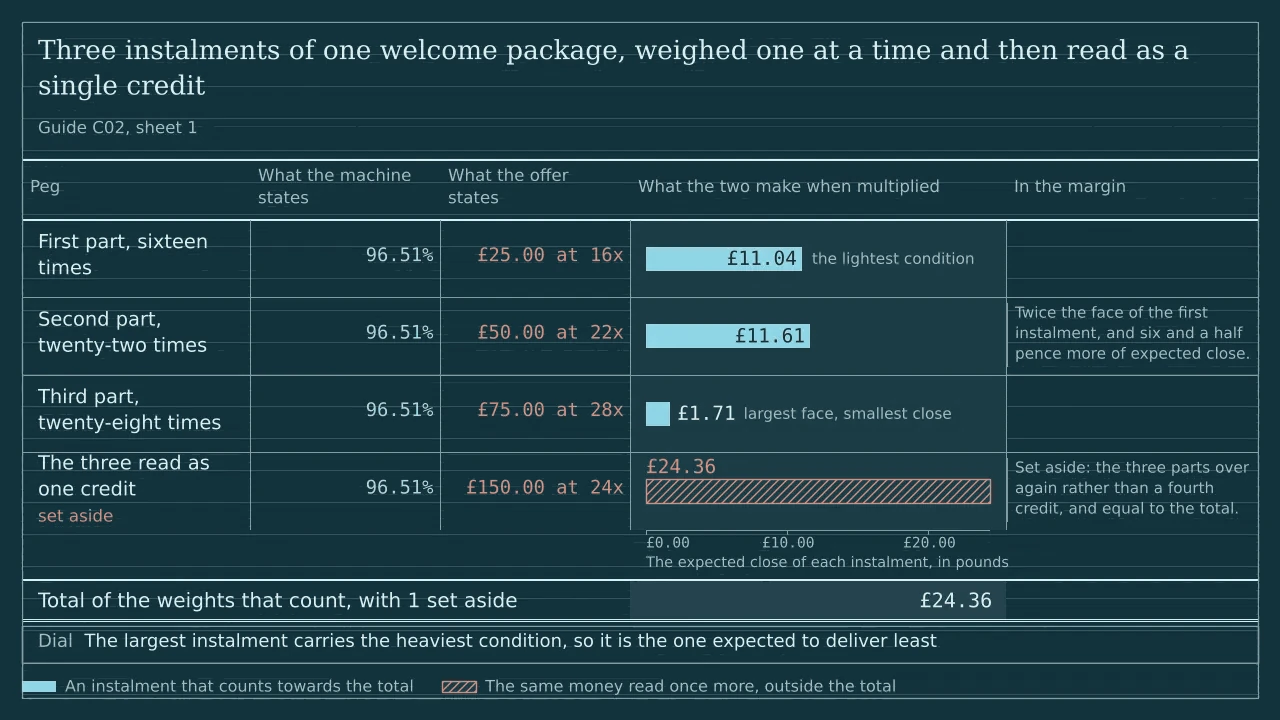
Put that obligation across Big Bass Bonanza 1000, a title the studio publishes at 96.51 per cent, and £24.36 of the £150.00 is expected to be left. This page performs the addition the package declines to perform, and then multiplies the answer by what the machine states about itself.
- What the machine states96.51 per centThe figure under the lone information item on the studio’s page for that title, matched by the regular-play figure the game sends at the start of a session. It is a property of the reel and survives every rewrite the package’s terms may go through.
- What the offer states£150.00 at three multiplesThree credits released against three payments, the first asking sixteen times its own value in staking, the second twenty-two and the third twenty-eight. A shape common where welcome terms run in instalments, written out here rather than quoted from anywhere.
- What the two make when multiplied£24.36The three instalments priced one by one at that return and then added, which is the same answer as pricing the package whole at the twenty-four times its three conditions amount to.
On this page
- Three credits, three conditions, and one headline over the lot
- Each instalment priced on its own against the reel
- Twenty-four times, a figure the terms never print
- The same package carried to a second title of the family
- What stopping after the first or second instalment is worth
- The payments standing beside the credits, counted separately
- What a licensed version of this package would have come to
- Four terms the package settles without printing a number
Three credits, three conditions, and one headline over the lot
A welcome package is not a single offer. It is a short series of offers bound together by a single advertised ceiling, and the ceiling is the only figure most readers ever see. The shape this page prices runs in three instalments: a first payment of £25.00 matched at 100 per cent, a second of £25.00 matched at 200 per cent, and a third of £25.00 matched at 300 per cent. Those three matches release a £25.00 credit, a £50.00 credit and a £75.00 credit, which a headline adds up to £150.00.
The three conditions attached to them are not equal and are not meant to be. The first credit asks sixteen times its own value in staking, the second twenty-two and the third twenty-eight. Each of those multiples is written in the clause belonging to its own instalment, each is accurate, and no sentence anywhere in such a document adds them together. There is no dishonesty in that. There is simply no reason for whoever drafted it to perform an addition that would make the package look like one number instead of three.
So the reader meets a document that is true in every clause and silent on the only quantity that decides the outcome. Multiply each credit by the multiple written beside it and the staking demanded is £400.00, then £1,100.00, then £2,100.00. Those three come to £3,600.00, and £3,600.00 against £150.00 of credit is twenty-four times the package. That figure is the subject of this page.
Before anything is multiplied, one thing has to be settled that the package has no view about, which is what a turn costs. A reader staking £2.00 a turn, which is the total the game’s own data carries as its default supposed here, named again wherever it is spent, discharges £3,600.00 of staking in 1,800 turns. At the shortest cycle a licensed build may run, 2.5 seconds, eighteen hundred turns is an hour and a quarter RTS 14D. Drop to the foot of the same published range, ten pence a turn, and the identical obligation is thirty-six thousand turns and twenty-five hours. Neither reader pays a different price for the exercise, which is the subject of entry three.
The machine chosen for this page is Big Bass Bonanza 1000, and the choice matters because one figure is not shared across the family. The studio prints 96.51 per cent on its own page for that title claim 74 of the game sheet. The game’s own data gives the same number for regular play. That is the reel the £3,600.00 has to cross, and everything this page computes about the package is computed against it.
One further quantity of the machine belongs in this opening, because a package of three credits is often sold on what the biggest outcome could be. The game’s own data caps a single round of that title at 20,000 times the stake claim 74, which at the £2.00 this page supposes is £40,000.00. The studio’s own announcement of the title, dated 24 April 2025, quotes wins of up to 20,000x and puts money symbol values at between 2x and 1,000x claim 78. Those figures say what the reel can do. They say nothing whatever about what a credit crossing it is expected to be worth, and the distance between those two kinds of statement is what this site was built to measure.
Each instalment priced on its own against the reel
Take the parts in the order they arrive. A reel printing 96.51 per cent is expected to hold back 3.49 per cent of whatever crosses it, which is the figure this entry applies three times over.
The first credit is £25.00 at sixteen times, so the reel has to see £400.00. 3.49 per cent of £400.00 is £13.96, and £25.00 less £13.96 leaves £11.04. The second credit is £50.00 at twenty-two times, so £1,100.00 crosses, the expected cost is £38.39, and £11.61 is left. The third credit is £75.00 at twenty-eight times, so £2,100.00 crosses, the expected cost is £73.29, and £1.71 is left. Add the three answers and the package closes at £24.36.
Read those three expected costs against the credits they belong to and the progression is steeper than the instalments look. £13.96 of expected cost against £25.00 of face is 55.84 pence for every pound advanced. £38.39 against £50.00 is 76.78 pence. £73.29 against £75.00 is 97.72 pence, which is to say that the third instalment is expected to cost very nearly its own face value before anything can be taken out of it. The cost per pound climbs because two things climb together: the credit gets bigger and the multiple attached to it gets heavier, and the product of the two is what crosses the reel.
Set those three side by side and the first finding of this page appears without anybody arguing for it. The largest credit of the three is expected to deliver the smallest sum, by a wide margin. Three quarters of the advertised face sits in instalments two and three, and those two together are expected to yield £13.32, while the smallest instalment on its own yields £11.04. A reader choosing a package on the size of the headline has chosen on the quantity that correlates least with the answer.
In one line, with the rate at which a slot counts towards a requirement standing as g:
E = B × (1 − W × (1 − RTP) ∕ g)
For the third instalment B is £75.00, W is twenty-eight, RTP is 96.51 per cent and g is one, this page taking the named slot to count in full. The line returns £1.71. Change nothing but W, dropping it to the sixteen times the first instalment asks, and the same £75.00 returns £33.12. The credit did not move. Only the condition attached to it did, and it took £31.41 of expectation with it.
£3,600.00of staking sits behind £150.00 of credit, which is 1,800 turns at the stake supposed here and an hour and a quarter at the briskest a licensed build may run
It is worth saying what has not been assumed in any of that. The return was read off the sheet. The three credits and the three multiples are the offer’s side of the page and are written out as a shape this part of the market commonly takes. The weighting was taken at its full face, which is what a named slot ordinarily counts at and what the terms decline to mention. The stake was supposed at £2.00 and changes none of the three answers, because each of them is a share of what crossed the reel, and what crossed the reel is money rather than a count of events.
Twenty-four times, a figure the terms never print
£3,600.00 of staking against £150.00 of credit is twenty-four times, exactly. That single number is the package stated whole, and it tells a reader more than the three clauses it was built out of, because it can be set beside anything. A credit somewhere else asking thirty times is a worse proposition than this package and a credit asking eighteen times is a better one, and no amount of reading the three clauses separately will tell anybody that.
Now notice the trap sitting next to it. Average the three multiples the way anybody would, adding sixteen, twenty-two and twenty-eight and dividing by three, and the answer is twenty-two times. That is the wrong figure, and it is wrong in the direction that flatters the package. The multiples do not carry equal weight, because the credits they are attached to are not equal: the heaviest condition sits on the largest credit, so it governs more of the money than either of the others.
Price the error. At twenty-two times the package would close at £34.83 on this reel. At the twenty-four times it actually asks it closes at £24.36. The plain average overstates the outcome by £10.47, which is more than two fifths of what the package is expected to be worth. A reader who performs the obvious arithmetic correctly and the right arithmetic not at all is out by that amount, and nothing in the document is in a position to correct them.
The general shape of this is simple enough to carry away. The multiple that governs a package is the total staking divided by the total credit, never the mean of the multiples, and the two agree only where every credit in the package is the same size. Where the later instalments are the larger ones and carry the heavier conditions, which is the usual arrangement, the governing multiple always sits above the plain average. Where a package front-loads its largest credit instead, it sits below.
Two sourced facts sit under that and are worth stating in the arithmetic rather than on their own. The first is that nothing in this trade requires a package to publish its own combined figure, because the terms duty bites on clarity, transparency and accessibility of the incentive’s terms rather than on arithmetic performed across them SR Code 5.1.1. The second is that the advertising regulator counts a wagering requirement among the terms an advertisement has to carry where a reader will see it. Both are satisfied by printing sixteen, twenty-two and twenty-eight in the right three places. Neither of them puts twenty-four anywhere a reader can find it.
The same package carried to a second title of the family
Everything so far has rested on one published figure, so the next question is what happens to the package if the staking goes across a different machine with the same name on the front of it. Big Bass Secrets of the Golden Lake carries 96.07 per cent on its own page at the studio claim 74, which is 0.44 points under the title this page has been working. The package has not changed by a word.
At 96.07 per cent the share held back out of staking is 3.93 per cent rather than 3.49, so £3,600.00 is expected to cost £141.48 rather than £125.64. The package closes at £8.52 instead of £24.36. Nearly two thirds of the expected outcome has gone and the only thing that moved was which tile the staking was done on.
| The title weighed | Published return | Break-even play-through | The offer asks | What £150.00 is worth |
|---|---|---|---|---|
| The title this page works | 96.51 per cent | 28.7 times | 24 times | £24.36 |
| A lower-returning title | 96.07 per cent | 25.4 times | 24 times | £8.52 |
| What the title decides | 0.44 points of return | 3.3 times | no change | £15.84 |
The middle column is where a package differs from a single credit, and the difference is not obvious until it is written down. Break-even, the multiple that leaves a credit expected to be worth nothing whatever, is one divided by the share the reel holds back: 28.7 times on the higher-returning title and 25.4 on the lower. The package asks twenty-four times in all, so it sits under both and survives on both. But the margin is 4.7 times on one reel and 1.4 on the other, which means the same package is comfortably inside the line on the first and barely inside it on the second. A fourth instalment of any size, or a weighting under full face anywhere in the document, would push the second over and leave the first standing.
Neither of those two returns is a version of one machine and neither is anybody’s selection. Each is the single figure standing on one title’s own page, and the builds behind those two pages are separate machines with separate paytables and separate ceilings on a round. The part of this site about the machine and its family carries the state of the evidence on that question at length. For a package, the practical consequence is narrow and exact: an instalment cleared on one tile and an instalment cleared on another are not the same instalment, and the terms will not have mentioned it.
What stopping after the first or second instalment is worth
A package in instalments has an exit after every part, and the exits are worth pricing because the governing multiple changes at each one. Stop after the first credit and the package is £25.00 at sixteen times, so the multiple that governs is sixteen and the expected close is £11.04. Take the first two and the credit is £75.00 against £1,500.00 of staking, which is twenty times, and the expected close is £22.65. Take all three and the credit is £150.00 against £3,600.00, which is twenty-four times, and the close is £24.36.
Written out as a sequence, the governing multiple climbs sixteen, twenty, twenty-four, four times of play-through at every step. The expected close climbs £11.04, £22.65, £24.36. The second instalment adds £50.00 of face and £11.61 of expected close. The third adds £75.00 of face and £1.71. That is the whole argument of this entry: the instalments are sold as one ascending offer and they are three offers of sharply falling value, with the fall concealed by the fact that the face value rises throughout.
Put the third instalment on its own terms and the point is sharper still. £75.00 of credit, £2,100.00 of staking, £73.29 of expected cost, £1.71 expected to remain. For every pound of face in that instalment a reader is expected to keep a little over two pence, and to put twenty-eight pounds across a reel to keep it. At the £2.00 a turn this page supposes, those £2,100.00 are 1,050 turns, which is forty-three minutes and three quarters at the shortest cycle a licensed build may run. Three quarters of an hour of unbroken play to hold on to one pound seventy-one of expectation is the fairest description of that instalment this page can give.
One ratio makes the shape of it plain. Of the eighteen hundred turns the whole package demands at the £2.00 supposed here, 1,050 belong to the third instalment alone. Seven twelfths of the entire exercise is therefore spent clearing the part expected to be worth £1.71, and five twelfths covers the two parts expected to be worth £22.65 between them. Nothing in a document arranged by instalment puts those two fractions anywhere near each other. There is a sourced reason a reader cannot simply take the good instalment and decline the rest in every case, and it is more interesting than it first looks.
Finish the qualifying activity inside the window rather than at the end of it and a licensee may not, for that reason, reduce what the incentive is worth SR Code 5.1.1. The limb is there to stop a reward shrinking on somebody for being quick. It says nothing about a package structured so that the later parts are the ones worth least, and that is the arrangement priced above. A rule against retrospective shrinkage is not a rule about how an offer may be laid out in the first place.
Outside a British licence the limb does not apply at all, along with everything else in that rulebook, so the honest statement about a staged package out here is that its shape belongs wholly to whoever drafted it. The arithmetic above holds wherever the terms hold. What it cannot tell anybody is whether the terms will still read the same way at the end of the window, and no published figure anywhere speaks to that.
The payments standing beside the credits, counted separately
Three payments of £25.00 release the three credits, so £75.00 that was already the reader’s sits in the account beside £150.00 that never was. Those two sums are different objects and this page keeps them apart throughout, because mixing them is the single commonest way a package gets mispriced. The credit is a conditional balance with £3,600.00 of staking tied to it. The payment is money the reader already owned before any of this began, and the arithmetic of the credit has no claim on it.
That separation is a rule of this publisher’s method rather than a reading of anybody else’s document: for a matched credit the reader’s payment is not part of the sum being weighed, and the two are shown in separate columns. Applied here it means the £24.36 above is the expected worth of the credit and not the expected worth of the exercise. A reader who put £75.00 in and holds a credit expected to be worth £24.36 still holds the £75.00, subject to whatever the terms say about it and subject to this page’s own supposition that the staking falls on the credit alone.
Set the two sums against each other and the asymmetry is plain. £3,600.00 has to cross the reel and £75.00 changed hands to set the arrangement going, so forty-eight pounds of staking is demanded for every pound the reader put in. Not one penny of the £75.00 carries a condition. Every penny of the £3,600.00 does, and that ratio is the shape of a welcome package stated in the only unit that makes the two halves comparable.
There is a blunter way of setting the two sums against each other. The expected cost of clearing the package is £125.64 on the reel weighed here, and the reader paid in £75.00. So the arithmetic of the conditions is expected to consume £50.64 more than the whole sum that changed hands to start the arrangement off. That figure is not a loss and this page does not call it one: it is the expected cost of an obligation attached to money nobody paid for, and it is quoted here because it is the one line that puts the payment and the condition in the same sentence at the same scale.
Two sourced facts bear on what can happen to each sum, and they point in opposite directions. Under a British licence a cashier may not put a ceiling on what a reader withdraws from money they paid in themselves. A ceiling over what a credit may grow into is a different object and that rule does not bar it, and nobody primary publishes a usual size for one. Both of those can therefore be true in one document at once, and a reader meeting an unrestricted withdrawal right beside a firm cap on bonus proceeds has found two rules about two different piles of money rather than a contradiction.
Where no British licence is in play, the first of the two is not imposed on anybody, so the protection over the reader’s own £75.00 is whatever the terms happen to grant. That is a loss a reader can state precisely rather than gesture at, and it is worth stating here because the sum involved is the only money in the whole arrangement that was ever unconditionally theirs.
What a licensed version of this package would have come to
The clearest way to say what a licence is worth is to apply it to the package already priced and print the difference. Each of the three credits would carry ten times its own value in staking and no more. £250.00, £500.00 and £750.00 is £1,500.00 in all, against the £3,600.00 the shape above asks. The governing multiple would be ten rather than twenty-four, and on the same reel at 96.51 per cent the package would be expected to close at £97.65 rather than £24.36.
£73.29 is therefore what that one ceiling is worth on this package, which is very nearly half of the £150.00 advertised. It is also, by coincidence worth noticing, the same figure as the expected cost of the third instalment on its own. In turns at the £2.00 supposed here, the licensed obligation is 750 turns against 1,800, which at the shortest licensed cycle is thirty-one minutes against seventy-five.
The identity duty in that list is the one item above that converts into no quantity of turns whatever, and that is worth saying rather than passing over. Under a British licence the person holding the account is established before the first credit becomes playable, so no part of the £3,600.00 priced above can be staked while the question is still open. Where the duty is not imposed, the moment at which it gets asked is whatever the terms make it, and a check that arrives after eighteen hundred turns rather than before the first one is a term with real consequences and no published cost. Every other figure on this page can be converted into turns of the reel.
That one cannot, and a page that pretended otherwise would be inventing the arithmetic this publisher spends its pages refusing to invent. One caution belongs beside that comparison, because overstating it would be as inaccurate as ignoring it. Bonus funds are what the ceiling just applied is drafted over. Whether it reaches a demand that the payment be staked too is published nowhere. This page has supposed throughout that the staking falls on the credit alone, which is the arrangement the arithmetic above describes. A package that asked for the payment to be staked too would be a different document and would want a different sum, and the published material does not settle how the ceiling would treat it.
The second caution is about what the comparison is not. Nothing above says a licensed package would be a good proposition. At ten times the credit on this reel a £150.00 package is still expected to shed £52.35 of its face before anything can be taken out, because £1,500.00 of staking across a machine holding 3.49 per cent is £52.35 whoever is licensing it. The licence changes the size of the obligation. It does not change the direction of the arithmetic, and no published figure in this trade does.
Four terms the package settles without printing a number
Everything above is arithmetic on figures somebody has published or this page has supposed out loud. Four terms in a package of this shape decide a great deal and carry no figure a reader can take away, and the honest close to a page like this one is to name them.
The first is the weighting, the rate at which staking on one game is credited against the requirement. At full face, which this page has taken throughout, £3,600.00 of staking satisfies £3,600.00 of requirement. Thirty pence in the pound is a rate the regulator’s published account of its wagering consultation records, and records from respondents rather than from itself; at that rate the same requirement would want £12,000.00 of staking. On this reel £12,000.00 is expected to cost £418.80, and the package would end at minus £268.80. A term that prints no number of its own is capable of moving the answer by nearly £300.00 on a £150.00 package.
The second is the window. The staking priced here is eighteen hundred turns, and at the shortest licensed cycle that comes to an hour and a quarter of play without a break, every single turn of it started by hand, since a licensed build takes a fresh commitment for each one and may offer no automatic sequence RTS 8A. A window of a day is therefore ample and a window of an hour is not, and the advertising regulator’s own list of conditions significant enough to need prominence puts a deadline for using an offer beside the wagering requirement itself. The figure is significant and is still not in the headline.
The third is the cap a cashier may place over the proceeds. No primary source publishes a usual one, so no figure may stand here for it, though how it meets the machine can be stated exactly: the game’s own data caps a round of this title at 20,000 times the stake, so at £2.00 that is £40,000.00, so any ceiling below that figure is a limit on the reel rather than a limit on the offer. The money symbols that drive the feature on the title the studio announced run between 2x and 1,000x, and a ceiling below the top of that range cuts into the paytable itself.
The fourth is the order of the three instalments, which carries no number because nobody thinks of it as a term at all. It is nonetheless the term that produced every finding on this page. Reverse the arrangement, so that £75.00 arrives at sixteen times and £25.00 at twenty-eight, and the staking falls from £3,600.00 to £3,000.00, the governing multiple falls from twenty-four times to twenty, and the package closes at £45.30 rather than £24.36. Identical credits, identical multiples, identical headline, and almost twice the expected outcome, decided entirely by which number was set against which.
So the figures to carry away from this page are these. A package advertising £150.00 in three instalments asks £3,600.00 of staking, which is twenty-four times the whole package and appears nowhere in its terms. Against Big Bass Bonanza 1000 at the 96.51 per cent the studio prints, that obligation is expected to cost £125.64 and to leave £24.36. Against a title of the same family at 96.07 per cent it leaves £8.52. The plain average of the three multiples would have said £34.83, and the ceiling of ten times inside a British licence would have said £97.65.
Questions readers ask
What is a casino welcome bonus worth once all three instalments are cleared?
On the package this page prices, £150.00 of credit released in three parts carries £3,600.00 of staking, and a reel printing 96.51 per cent is expected to hold back £125.64 of that, leaving £24.36. The three parts come to £11.04, £11.61 and £1.71 taken one at a time, which is the same answer.
How do you work out the real wagering on a package with several multiples?
Multiply each credit by the multiple written against it, add the results, and divide by the total credit. Here that is £400.00 plus £1,100.00 plus £2,100.00, which is £3,600.00, against £150.00 of credit, giving twenty-four times. Averaging the three multiples instead gives twenty-two, which is the wrong figure.
Why is averaging the multiples wrong?
Because the credits are not the same size, so the multiples do not carry equal weight. The heaviest condition here sits on the largest credit and governs more of the money than the others. The plain average would value the package at £34.83 and the governing multiple values it at £24.36, an overstatement of £10.47.
Is the second or third instalment of a welcome package worth taking?
This page gives no advice, only arithmetic. The second instalment adds £50.00 of face and £11.61 of expected close on the reel weighed here. The third adds £75.00 of face and £1.71, which is a little over two pence for every pound of face, and asks 1,050 turns at the £2.00 supposed here.
Does the slot a welcome bonus is cleared on change what it is worth?
It decides it. The same £3,600.00 of staking is expected to cost £125.64 against a title printing 96.51 per cent and £141.48 against one printing 96.07 per cent, so the package closes at £24.36 or at £8.52 depending on the tile. Both figures belong to the studio, a different one on each title’s page.
Would a British licence cap the wagering on a welcome package?
Since 19 January 2026 the ceiling inside a British licence is ten times the credit, applied part by part. The three here would then carry £250.00, £500.00 and £750.00, which is £1,500.00 rather than £3,600.00, and the package would be expected to close at £97.65. The difference that ceiling makes is £73.29.
Does the reader’s own deposit count towards what the bonus is worth?
No, and this page keeps the two apart. Three payments of £25.00 release the three credits, so £75.00 belongs to the reader and £150.00 is conditional. The £24.36 is the expected worth of the credit alone, worked on the supposition that the staking falls on the credit and not on the payment.
What term in a welcome package carries no figure but decides the most?
The rate at which staking on one game is credited against the requirement. At full face the obligation priced here is £3,600.00. Thirty pence in the pound, which the regulator records from respondents to its consultation and not from itself, would turn that into £12,000.00 of staking, and the package would end at minus £268.80.
Before you play
Read on
- Casino no deposit bonus
- A £15.00 credit at twenty times is £300.00 of turnover, and a reel at 96.71 per cent is expected to leave £5.13 of it standing.
- Bingo no deposit bonus
- The only published return within reach of a bingo credit belongs to a slot, and the pace that decides the rest has no publisher.
- 100% deposit bonus
- The simplest match there is, worked out far enough that every other percentage can be read against it.
- How a figure is weighed here
- Which figures are read off the machine, which off the offer, and which this publisher assumes.