Skrill/Neteller/Trustly casino: one question about a payout, answered four ways
How long does the money take. Ask it of a venue that lists Skrill, Neteller and Trustly and four parties answer, because each of the three rails documents a stretch of time inside its own system and the venue documents a stretch of time before any of them is reached.
- Updated 13 November 2026
- Licence status shown for every offer
- Assumptions marked in the text
Wallet offers, each weighed against a published return
These offers are paid placements, so this site is owed a fee whenever a reader opens an account through one of the buttons below.
-

Tweedbet
Welcome pack 470%
- Licence
- Not stated, no Great Britain licence
- Play-through
- Not published
- Min deposit
- £20
Bonus up to£14,000 Free spins470Read the offer18+ only. Terms apply.
Licence, terms and working
The site does not say where it is licensed or which company runs it.
The reel
- Build of the reel
- Big Bass Bonanza
- Return it publishes
- 96.71 per cent
- Stake it accepts on one turn
- 10p to £250.00
The offer
- Turns advertised
- 470 turns Turns valued at the cheapest turn this reel sells, no worth for one being stated anywhere in the offer
- Price of one turn
- 10p the smallest stake the reel accepts, this operator publishing no figure of its own
- Credit as a sum
- £14,000.00
- Credit waiting on a payment
- Stated in words Casino Welcome Pack 470% up to £14,000 + 470 FS. Crypto Welcome Bonus 110% up to 1,300 USDT + 110 FS. VIP Welcome Pack 770% up to £13,000
- Advertised, priced
- £14,047.00 140,470 turns of this reel
Hung on it
- Play-through
- Not published
- Credited towards it
- 100 per cent nobody has published a share, so the whole of a stake is credited, which is the kindest reading available
- Ceiling on winnings
- Not published
- Qualifying payment
- £20.00 200 turns of this reel at the price above, and it enters no weight
Not weighed, for want of the play-through multiple as a number.
Stated in words means the condition is set down in words that cost something and give nothing to subtract. Not published means the operator sets the figure down nowhere.
-

EliteSpin
£5,000 + 500 FS
- Licence
- Costa Rica, no Great Britain licence
- Play-through
- 40×
- Min deposit
- £20
Bonus up to£5,000 Free spins500Read the offer18+ only. Terms apply.
Licence, terms and working
Licence held in Costa Rica, by PrimeTier Limited.
The reel
- Build of the reel
- Big Bass Bonanza
- Return it publishes
- 96.71 per cent
- Stake it accepts on one turn
- 10p to £250.00
The offer
- Turns advertised
- 500 turns Turns valued at the cheapest turn this reel sells, no worth for one being stated anywhere in the offer
- Price of one turn
- 10p the smallest stake the reel accepts, this operator publishing no figure of its own
- Credit as a sum
- £5,000.00
- Credit waiting on a payment
- Stated in words Welcome bonus €/£5,000 + 500 FS. Elite lootboxes unlock surprise rewards up to €/£20,000 or 500 FS. Summer Festival by BGaming: win €80,000
- Advertised, priced
- £5,050.00 50,500 turns of this reel
Hung on it
- Play-through
- 40 times the bonus and the winnings from the spins
- Credited towards it
- 100 per cent nobody has published a share, so the whole of a stake is credited, which is the kindest reading available
- Ceiling on winnings
- Stated in words Five times the bonus
- Qualifying payment
- £20.00 200 turns of this reel at the price above, and it enters no weight
Priced at 10p a turn, the banner comes to £5,050.00, of which £5,048.36 survives the spins. At the reel's published return of 96.71 per cent, a play-through of 40 times asks for £201,934.20 of staking and costs £6,643.64, more than there is to pay it with, so the offer weighs £0.00.
Stated in words means the condition is set down in words that cost something and give nothing to subtract.
-

WinBeast
€5,000 + 500 FS
- Licence
- Curaçao, no Great Britain licence
- Min deposit
- €20
- Free spins
- 500
Bonus up to€5,000 Play-through40×Read the offer18+ only. Terms apply.
Licence, terms and working
Licence held in Curaçao, by a company the site does not name.
The reel
- Build of the reel
- Big Bass Bonanza
- Return it publishes
- 96.71 per cent
- Stake it accepts on one turn
- 10c to €250.00
The offer
- Turns advertised
- 500 turns Turns valued at the cheapest turn this reel sells, no worth for one being stated anywhere in the offer
- Price of one turn
- 10c the smallest stake the reel accepts, this operator publishing no figure of its own
- Credit as a sum
- €5,000.00
- Credit waiting on a payment
- Stated in words Welcome pack €5,000 + 500 FS + €650 free bet. Fortune wheel on €40+ deposits with code FORTUNE. 40% up to €300 Beast Boost Monday with code BOOST1 on €20 deposit
- Advertised, priced
- €5,050.00 50,500 turns of this reel
Hung on it
- Play-through
- 40 times the bonus and the winnings from the spins
- Credited towards it
- 100 per cent nobody has published a share, so the whole of a stake is credited, which is the kindest reading available
- Ceiling on winnings
- Stated in words €100 a batch of spins
- Qualifying payment
- €20.00 200 turns of this reel at the price above, and it enters no weight
Priced at 10c a turn, the banner comes to €5,050.00, of which €5,048.36 survives the spins. At the reel's published return of 96.71 per cent, a play-through of 40 times asks for €201,934.20 of staking and costs €6,643.64, more than there is to pay it with, so the offer weighs €0.00.
Stated in words means the condition is set down in words that cost something and give nothing to subtract.
-

Betportal
300% + 150 FS
- Licence
- Anjouan, Comoros, no Great Britain licence
- Play-through
- 35×
- Min deposit
- €20
- Stake cap
- €5.00
Bonus up to€1,000 Free spins150Read the offer18+ only. Terms apply.
Licence, terms and working
Licence held in Anjouan, Comoros, by BetPortal Gaming Ltd and Excite Ultra Media Ltd, numbered ALSI-202601040-FI2.
The reel
- Build of the reel
- Big Bass Bonanza
- Return it publishes
- 96.71 per cent
- Stake it accepts on one turn
- 10c to €250.00
The offer
- Turns advertised
- 150 turns Turns valued at the cheapest turn this reel sells, no worth for one being stated anywhere in the offer
- Price of one turn
- 10c the smallest stake the reel accepts, this operator publishing no figure of its own
- Credit as a sum
- €1,000.00
- Credit waiting on a payment
- Stated in words Welcome package 300% up to €1,000 + 150 free spins. 1st deposit 150% up to €500 + 100 FS. 2nd deposit 100% up to €300 + 50 FS
- Advertised, priced
- €1,015.00 10,150 turns of this reel
Hung on it
- Play-through
- 35 times the bonus
- Credited towards it
- 100 per cent nobody has published a share, so the whole of a stake is credited, which is the kindest reading available
- Ceiling on winnings
- Stated in words Five times the bonus
- Largest stake while it runs
- €5.00 under the largest stake the reel accepts, so part of the machine's own range is shut off while the credit runs
- Qualifying payment
- €20.00 200 turns of this reel at the price above, and it enters no weight
Priced at 10c a turn, the banner comes to €1,015.00, of which €1,014.51 survives the spins. At the reel's published return of 96.71 per cent, a play-through of 35 times asks for €35,507.73 of staking and costs €1,168.20, more than there is to pay it with, so the offer weighs €0.00.
Stated in words means the condition is set down in words that cost something and give nothing to subtract.
-

Night Luck
805% + 280 FS
- Licence
- Not stated, no Great Britain licence
- Play-through
- Not published
- Min deposit
- €20
Bonus up to€6,400 Free spins280Read the offer18+ only. Terms apply.
Licence, terms and working
The site does not say where it is licensed or which company runs it.
The reel
- Build of the reel
- Big Bass Bonanza
- Return it publishes
- 96.71 per cent
- Stake it accepts on one turn
- 10c to €250.00
The offer
- Turns advertised
- 280 turns Turns valued at the cheapest turn this reel sells, no worth for one being stated anywhere in the offer
- Price of one turn
- 10c the smallest stake the reel accepts, this operator publishing no figure of its own
- Credit as a sum
- €6,400.00
- Credit waiting on a payment
- Stated in words Casino welcome bonus 805% up to €6,400 + 280 FS. Crypto welcome bonus 140% up to 1,600 USDT + 140 FS. VIP welcome pack 800% up to €14,500
- Advertised, priced
- €6,428.00 64,280 turns of this reel
Hung on it
- Play-through
- Not published
- Credited towards it
- 100 per cent nobody has published a share, so the whole of a stake is credited, which is the kindest reading available
- Ceiling on winnings
- Not published
- Qualifying payment
- €20.00 200 turns of this reel at the price above, and it enters no weight
Not weighed, for want of the play-through multiple as a number.
Stated in words means the condition is set down in words that cost something and give nothing to subtract. Not published means the operator sets the figure down nowhere.
What a Great Britain licence would add to these offers
A licence from the Gambling Commission for Great Britain carries rules that an offer licensed elsewhere does not have to follow, and some figures in this ranking would not survive them. Social responsibility code provision 5.1.1 stops a British licensee applying a wagering requirement of more than ten times the bonus funds, and that limit has applied since 19 January 2026. A play-through above ten times in this list is therefore one a British licence would not allow.
Regulation 5(2) of the Gambling Act 2005 (Operating Licence Conditions) (Amendment) Regulations 2025, made on 25 February 2025, limits what a player can stake on one game cycle of an online slot to £5, or £2 for a player under 25. It is a condition of a British remote casino licence and not a property of the game, so a player at an operator licensed elsewhere does not have it behind them.
Remote technical standard 14D asks for at least two and a half seconds from the start of one slot game cycle to the start of the next, with the player pressing start each time. It is addressed to the game and not to the money, so no figure in this ranking measures it.
GAMSTOP is the free scheme that closes your accounts with online gambling companies licensed in Great Britain, and every one of them must join it. An operator licensed elsewhere is not required to, so a GAMSTOP registration cannot be counted on to reach these offers. If gambling is costing more than money, the National Gambling Helpline is free and answers on 0808 8020 133 at any hour.
Ranking last changed 8 November 2026. Operator terms change without notice, so open the offer page and read the terms there before you register.
At a glance
Four answers to one question, no two of them measuring the same stretch, and no publisher at all measuring the one a reader actually waits through. Only one interval in the whole sequence carries a figure from end to end, and it belongs to the reel: a credit of £30.00 asking twenty-two times must cross 6,600 turns, four hours and thirty-five minutes of reel at the quickest the licence permits, with £21.71 of it expected to have gone by the finish. What survives is £8.29, a figure none of the four publishers had any occasion to mention.
- What the machine states96.71 per centThe proportion Big Bass Bonanza gives back, stated by its maker and carried identically in the data a session is opened with. The quantity is indifferent to how money reaches the reel and to how it leaves, and that indifference is what lets this report use it as the one fixed point among four moving answers.
- What the offer states£30.00 at 22 timesA credit of the size that tends to sit beside a wallet deposit, with twenty-two times its face to be turned over before a payout can be requested at all, the named reel counting in full towards that turnover. Every one of those quantities comes out of the wording.
- What the two make when multiplied£8.29What is expected to be standing when the turnover has finished crossing a reel of that proportion, with a turn costing the 10p this report puts up and names again at each place it is spent. It is the sum all four published answers are answers about, and not one of them says how large it is.
On this page
- One question, and the four parties who answer it
- Three rails, and the three different stretches they time
- The venue’s answer, which is about a stretch of its own
- Why four published answers will not add into one
- The one stretch anybody publishes from end to end
- Twenty-two times on two titles, and £4.23
- When the wait runs past every published answer
- What the four answers are genuinely good for
- The quantities all four answers leave alone
- Adding up the one interval that has a price
One question, and the four parties who answer it
The question a reader asks about a payout has one word in it that does all the work: how long. It sounds like a question with a number for an answer, in the way that the price of a stamp is a question with a number for an answer. It is not, and the reason is not that anybody is hiding anything. It is that the question has been asked of a chain rather than of a party, and every party in the chain answers about its own link.
List Skrill, Neteller and Trustly at a till and the chain has four links a reader might care about. Each of the three rails sets out, in terms of its own, how long something takes once it is inside that rail. The venue sets out, in terms of its own, how long something takes before it has left the venue. So four documents, four answers, and every one of the four documents correct about what it is actually about. The trouble starts the moment a reader tries to use them together.
Here is the thing worth being honest about before anything else. This report prints no figure belonging to Skrill, to Neteller, to Trustly or to any venue, and the reason for that is the one this whole domain stands on. The only sheets behind these pages carry regulatory rule and the published figures of one named machine. Neither of them carries a rail’s own timing, so a figure for one would have to be supplied from memory or from somebody’s review, and a figure like that becomes worse the more pages repeat it. What can be set out is the shape of each answer, which is checkable by anybody against the terms they are already agreeing to, and what can be priced is the one interval in the chain that a primary source does publish from beginning to end.
That last interval is the point of the page, so it is worth naming early. It is not any part of the payout. It is the stretch before the payout exists, during which a turnover condition is being satisfied on a machine whose figures are published, and no other stretch in the sequence can be priced to the penny before it starts. Four parties document the stretches after it. Nobody documents it at all, except the machine, which documents it completely.
One more thing to put down at the start, because it belongs to the shape of this subject and not to any one part of it. A rail that will not carry a gambling payment at all, and a bank that will not, are both doing protective work, of the sort a self-exclusion register does. This report explains what follows from a refusal and sets out no way round one.
Three rails, and the three different stretches they time
Take the three in the order the shape of the thing suggests rather than the order a till lists them. Skrill and Neteller are stored-balance wallets. A reader holds a balance inside one of them, money arrives into that balance, and money leaves it towards a bank or a card at the reader’s own instruction, later, as a separate act. A rail of that shape has two clocks in it rather than one, and a statement about either is a true statement about the rail: how long until the balance moves, and how long until the money is out of the wallet altogether.
Trustly is not that shape. There is no balance to hold: the rail exists to carry an instruction between a bank and somebody who wants paying, which means a reader never has a stage to wait at inside it. A rail of that shape has one clock, and it runs between the instruction and the settlement at a bank. Whatever figure it publishes is a figure about that single stage, and comparing it with a wallet’s figure is comparing a stage with a stage-and-a-half.
So the three rails on a till are not three competing answers to one question. They are answers about three different stretches: the first stage of a wallet, the whole of a wallet, and the single stage of a bank rail. A reader setting them side by side and choosing the smallest number has chosen the rail with the narrowest definition rather than the one that gets money to their bank soonest, and no document anywhere told them the definitions differed.
The practical consequence is one a reader can act on without any figure at all. Whichever of the three is in front of them, the useful question is not how long but how long until what: until the money is in the wallet, or out of it, or in the account the reader actually spends from. Those are three events, and a figure attached to the first of them says nothing about the third. Ask the question in the form the rail answers and the terms become readable. Ask it in the form a reader cares about and no rail is answering it, because the last stage is a bank’s and not the rail’s.
None of this is a criticism of a rail. A payment network that promised a figure for the whole chain would be promising something about a party it does not control, which is exactly the kind of promise this publisher spends every page refusing to repeat. The three are answering precisely as far as their own reach extends, which is the honest thing to do and is also why the four answers cannot be stacked.
The venue’s answer, which is about a stretch of its own
The fourth answer is the one a reader meets first, usually in a table on a page about banking, and among the four it is the likeliest to be taken for an answer covering the whole chain. It is not. A venue is in a position to document the stretch between a reader asking and the venue releasing: a review of the request, whatever checks attach to it, and a handover into whichever rail was chosen. After the handover the venue has nothing left to time, because the money is in somebody else’s system.
Two features of that fourth answer are worth setting out, because together they explain why it reads so much more confidently than the other three. First, it is the only one of the four about a stretch the party publishing it actually controls from end to end. A venue decides how quickly it reviews a request. That makes the figure a commitment rather than a description, and a commitment can be written in a friendlier tone. Second, it is the only one of the four answers a venue can shorten by deciding to, which is why it is also the stretch any marketing about speed is really about.
What the fourth answer is not about is worth being equally plain. It is not about the rail. It is not about the bank at the end of the rail. And it is not, in any respect, about the reel. The machine has no part in a payout’s timing: its published figures describe what falls between the start of a game cycle and its end, and that end comes a long way before a withdrawal request exists.
There is one duty here that a British licence imposes and that bears on the fourth answer directly, and it is worth stating as a consequence rather than as a rule. A licensee is not allowed to let a customer take back a withdrawal they have already asked for RTS 14B. Read that against the sequence this page is describing and it is a rule about exactly the stretch the venue controls: the interval between asking and releasing is the interval in which an invitation to carry on could be put in front of somebody, and the duty closes that door. A venue without the licence is not bound by it, and the interval is the same length either way.
Why four published answers will not add into one
Suppose a reader does the sensible-looking thing and adds. Take the venue’s figure for its own stretch, add the rail’s figure for whichever stage the rail documents, and treat the total as the wait. The arithmetic is clean and the result is wrong, and it is worth being precise about the kind of wrong it is, because it is not a matter of the figures being slightly off.
The stretches overlap, and nobody publishes the overlap. A venue’s clock and a rail’s clock are not laid end to end like two fence panels; some of what one of them counts is counted again by the other, and how much is a fact about an arrangement between two companies that neither of them has any reason to describe. So a reader adding two published answers has produced an upper bound. The lower bound is whichever of the two is longer. The true wait lies somewhere between those two, and the width of that bracket is precisely the overlap nobody states.
Which gives the finding of this part, and it can be put without inventing a single number. Four published answers to one question do not narrow the answer to a point. They bracket it. The bracket’s width is unpublished, so the bracket cannot be narrowed by reading more carefully, and a reader who reads all four documents with complete attention ends up knowing the range and not the figure. That is a better position than knowing nothing, and it is a long way short of what the question sounded like it was asking for.
The same shape appears once more at the far end of the chain, and it is the part most often left out. A bank receives whatever the rail hands it, and a bank’s own processing is a fifth stretch, documented by a party nobody has asked. Four published answers, a fifth stretch with no answer in view, and an overlap of unknown width between each pair. A reader wanting one number for the whole thing is asking for a figure that no party in the chain is in a position to publish, and the honest report of that is not a complaint. It is the finding.
There is one unit in which the four answers can be set beside one another, and it is worth naming, because the rest of this domain counts in it. All four answers are stretches of time, and time becomes turns at a rate the machine publishes: 1,440 turns to the hour at the floor under a licensed cycle, which with a turn at 10p is £144.00 of turnover an hour and, at 3.29 points of edge, £4.74 of expected cost an hour. An hour anywhere in the chain is therefore an hour in which £4.74 is not expected to go, no turn being taken in it. That is the conversion, and the direction of it surprises most readers: the stretches those four documents describe are the free ones.
Compare the one stretch that does behave. The turnover on a credit has a beginning everybody agrees on, which is the first turn, and an end everybody agrees on, which is the turn at which the condition is satisfied. Nothing overlaps with anything. The figures that set its length are published by a maker and by a regulator, both of whom publish them for everyone rather than for a counterparty. That is the stretch part five prices, and the contrast with the four answers is the whole of this page’s argument.
The one stretch anybody publishes from end to end
The arithmetic this page needs is a single line, and the reason for printing it here rather than at the top is that none of the four answers appears anywhere in it: E = B × (1 − W × (1 − RTP) ∕ g). B is the face of the credit and W the turnover demanded of it, both out of the wording. RTP is the proportion the named machine gives back off the sheet, claim 20. And g is the rate at which that machine counts towards the turnover, which an offer of this description sets at full in the terms themselves. No timing of any kind is a term in the line, and no care taken over the four documents would put one there.
Twenty-two times a face of thirty pounds is £660.00 of turnover. What one turn costs is the player’s own decision. The game’s own data puts the cheapest whole cycle at 0.10 and the dearest at 250.00 read off the game’s own data, claim 25, the dear end being two and a half thousand times the cheap one, and the figure this report picks out of that span is a quarter of a pound supposed here, published by nobody. Which makes £660.00 of turnover 6,600 turns.
Now the clock, and this is the figure the page turns on. A game cycle on a licensed build cannot be restarted inside 2.5 seconds of its own beginning RTS 14D. That caps an hour at 1,440 turns, so 6,600 of them cannot be got through in less than four hours and thirty-five minutes, and that ceiling is a floor: a reader may take a week over it and cannot take less. It is the only hard figure anywhere in the sequence this page is about. Three rails and a venue publish four answers about stretches that come after it, and the stretch before it has a published minimum, in minutes, from a primary source, for everybody.
And it has a price. What 96.71 per cent does not hand back is 3.29 points, and 3.29 points of £660.00 is £21.71. So the four hours and thirty-five minutes is not a wait: it is a stretch during which a sum of money is expected to be moving in one direction, and the sum is twenty-one pounds and seventy-one pence of a thirty pound face. Thirty pounds less £21.71 leaves the £8.29 at the head of this page.
Set that against the four answers and the asymmetry is complete. Every stretch the four documents describe costs a reader nothing per hour, because no turn is being taken in any of them. The stretch nobody documents costs £21.71 and is over before the first of the four begins. A reader comparing rails on how quickly nothing happens has been looking at the cheap end of the chain.
Twenty-two times on two titles, and £4.23
The reciprocal of a house edge is break-even, so break-even follows the title in the way the edge does. At 96.71 per cent the edge is 3.29 points and the crossing stands at 30.4 times a credit. At 96.07 per cent, which is the figure for Big Bass Amazon Xtreme and for eight further titles of the family off the sheet, claim 74, the edge is 3.93 points and the crossing comes down to 25.4. Twenty-two times sits inside both, and so survives on either of them, and what separates the two survivals is the one sum of money here that anybody could have published in advance and nobody did.
Priced at a turn of 10p, which this report puts up throughout, a thirty pound credit closes on £8.29 against the first figure and £4.06 against the second. The gap is £4.23, which is more than half of the larger close and slightly more than the smaller close itself. Everything else is identical: the same face, the same twenty-two times, the same full weighting, the same 6,600 turns, the same four hours and thirty-five minutes, and the same four published answers about the payout afterwards.
| The title weighed | Published return | Break-even play-through | The offer asks | What £30.00 is worth |
|---|---|---|---|---|
| Big Bass Bonanza | 96.71 per cent | 30.4 times | 22 times | £8.29 |
| Big Bass Amazon Xtreme | 96.07 per cent | 25.4 times | 22 times | £4.06 |
| What the title decides | 0.64 points of return | 5.0 times | no change | £4.23 |
There is a second reading of that table which bears on the subject of this page more directly than the first. The expected cost of the turnover is £21.71 on the upper title and £25.94 on the lower, so the stretch is not the same stretch on both: the clock runs at one speed and the money leaves at two. A reader who wanted to compare two ways of getting paid has been handed, instead, two rates at which money departs during the stretch before anybody gets paid at all, and the difference between those two rates was never going to turn up in a table about banking.
Four hours and thirty-five minutes of reel stand before the first of four published answers begins, and those four hours and thirty-five minutes is the only stretch in the chain with a price on it
When the wait runs past every published answer
Four answers bracket a wait rather than fixing it, so the interesting case is the one where the wait runs out past the top of the bracket. At that point a reader no longer has a timing question at all. What they have is a procedure, and a British licence attaches figures to the procedure in the way nobody attaches figures to the chain.
The figures run like this. Acknowledging the thing may take three working days, and a single day only, where a venue keeps its doors open at all hours. Eight weeks, internal escalation and all, is the outside limit on the whole of it. The right to raise the thing survives six months at least from whatever is being complained of. And the letter closing the matter has to say how it may be carried on to a dispute body holding the regulator’s approval, nothing unapproved being open to a licensee. Hold the longest of those against the stretch part five priced: eight weeks runs to something like three hundred times the four hours and thirty-five minutes the reel needs for £660.00 of turnover.
The limit on all of that is published too, and in the regulator’s own words rather than in anybody’s characterisation of them. It is not an ombudsman. It does not resolve complaints about a gambling transaction, a withdrawal among them, and it has no sight of an account. So the route a reader is being pointed down ends at an approved dispute body, and a reader who has understood the four answers and the eight weeks and then writes to the regulator about a payout has written to the one party in the whole chain that has said in terms it cannot help with that.
Outside the licence the procedure belongs to whoever runs the venue, and hand-waving in either direction would be wrong here. Deny that any complaints route exists out there and the denial is inaccurate: the Curaçao rulebook publishes one, giving six months to bring a complaint and a timeline of four weeks extendable by four more, landing where the British outside limit lands. The difference is in who gets to write the terms a dispute body works to. In Great Britain the regulator approves them. The Curaçao policy instead leaves parameters with the operator, and one of those parameters is whether an outcome binds a player at all. That contrast comes out of two rulebooks and is not asserted here.
And then the conversion, which is the same one as everywhere else on this page. Through the three working days, the eight weeks and the six months, no turn is being taken, so the entire procedure costs a reader nothing an hour at the machine. It is the stretch before the payout existed that cost £21.71. A sequence running to eight weeks has exactly one priced stretch of four hours and thirty-five minutes in it, and it is over before the first of the four answers becomes relevant.
What the four answers are genuinely good for
A page that spent nine parts explaining that four documents cannot be added would be a page with a grievance rather than a finding. So here is the other side of it, which is that each of the four settles something real, and a reader who knows which question each one answers gets value out of all four answers.
The venue’s answer settles whether a request will sit in a queue. That is worth knowing, it is the stretch a venue controls, and it is the stretch where a reader has no visibility and no recourse except a complaint. The wallet’s first-stage answer settles when a balance will show the money, which matters to anybody who intends to leave it in the wallet and spend from there. The wallet’s second answer, where it gives one, settles the stretch out to a bank, which is the stretch a reader who wants cash actually cares about. And the bank rail’s single answer settles the only stretch it has, which is also, for that rail, the whole journey.
Put like that, the four answers are a map of a chain rather than four competing estimates, and the map is useful. What the map will not do is produce a total, because the distances between its towns are measured from different places and nobody has published the gaps. A reader using it as a map is well served. A reader using it as an odometer is not.
There is one more thing worth extracting from the four answers, and after the arithmetic it is the most useful thing here. Any one of the four answers is about a stretch in which no turn is taken. So all four answers, however long or short, cost a reader nothing per hour at the machine. That is not true of the stretch before them, which costs £21.71 at the figures here, and it is not true of the stretch after a payout either, if the money goes back in. A reader optimising the chain is optimising the only part of it that is free.
The quantities all four answers leave alone
Set out what remains exactly where it was no matter which of the four answers a reader is reading, because this is the list that decides where the money is. The proportion the machine gives back does not budge: 96.71 per cent for the original, 96.07 for the title weighed beside it. The feature round goes on needing three, four or five scatters to start, and goes on paying ten, fifteen or twenty turns when it does. A single game cycle can still hand back no more than 2,100 times the stake, which at the 10p supposed here is £210.00. The one hit rate the machine publishes about itself has not shifted from one turn in 3,880,481. And the floor under a cycle’s length is where it was, being the figure that made 6,600 turns into four hours and thirty-five minutes to begin with.
Dispersion sits in the same position, and the wording has to be exact. Nobody publishes a volatility for this family at all: the maker’s thirty-six game pages do not use the word, and no field of that name exists in the game’s own data either, which leaves no published quantity for a rail to have altered. Claim that one rail stretched a balance further than another and the figure being reasoned from would have been made up on the spot.
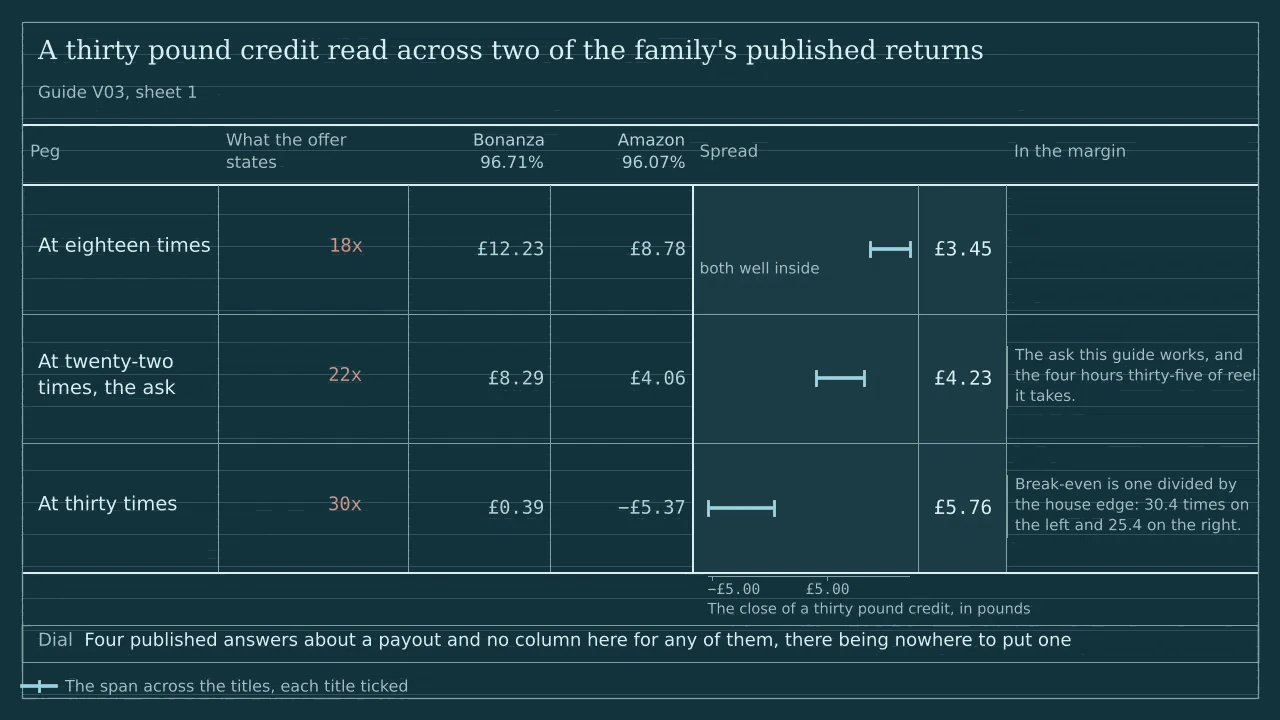
What the drawing shows about the subject of this page is the thing a banking table cannot. Down the side of it the demand made of the credit rises, and the two readings separate as it does: three pounds forty-five apart where the demand is lightest, £4.23 apart at the twenty-two times this report works, and five pounds seventy-six apart by thirty times, where one reading has gone under nought. Nowhere on the sheet is there a column for a rail, and nowhere could there be one. The four answers are about the stretch after the last of those readings has been settled.
Adding up the one interval that has a price
Begin with what cannot be added. Four published answers to one question about a payout, each correct about a different stretch, overlapping by amounts nobody states, with a bank’s own processing waiting at the end and no answer offered about it. The result of reading all four documents with care is a bracket rather than a figure, and the bracket cannot be narrowed from outside.
Then what can. Twenty-two times a thirty pound face is £660.00 of turnover. At the 10p a turn supposed throughout, that is 6,600 turns, and 6,600 turns run to four hours and thirty-five minutes at the quickest the licence permits. Take 3.29 points of £660.00 and £21.71 is what the stretch is expected to carry off, leaving £8.29. Change nothing but the title and the expected cost is £25.94 and the remainder £4.06, a difference of £4.23 on the same wording.
So the total this page hands to its section is £4.23, and the four answers contribute nothing to it, which is the honest result rather than a disappointing one. The quantity a reader was comparing rails on is a stretch of time in which no money moves at the machine. The quantity that decided how much money there was to move had been settled before any of the four documents became relevant, by a figure on a lobby tile that none of the four mentions.
A closing figure, for anybody who wants both halves of this page in a single line. The stretch with four published answers costs nothing an hour. The stretch with one published answer, and no mention anywhere in a table about banking, costs £21.71 and cannot be run in under four hours and thirty-five minutes. The reel publishes its half. The chain publishes the other half four times over and still cannot total it.
Questions readers ask
Why does a venue listing Skrill, Neteller and Trustly give more than one payout time
Because each party in the chain documents its own link. The three rails describe stretches inside their own systems and the venue describes the stretch before a rail is reached, so four answers arrive about four different things.
Can the four published answers be added together
Not into a figure. They overlap by amounts nobody publishes, so adding them gives an upper bound while the lower bound is whichever single answer is longest, and the width of that bracket is the unstated overlap.
Why does this page print no payout figure for Skrill, Neteller or Trustly
Because the sheets standing behind this domain carry regulatory rule and the published figures of one named machine, and neither carries a rail’s own timing. A figure supplied from anywhere else would be the one number here that nobody could check.
What is different about a bank rail such as Trustly
It holds no balance, so a reader has no stage to wait at inside it, and its answer covers a single stretch between an instruction and a settlement. A stored-balance wallet has two stretches, so comparing one figure with the other compares unlike things.
Which stretch in the chain does a venue actually control
The one between a reader asking and the venue releasing. That is why its answer reads as a commitment rather than a description, and why any marketing about speed is really about that stretch and not the rest.
How long does the turnover on a £30.00 credit at twenty-two times take
£660.00 of turnover becomes 6,600 turns where a turn costs the 10p this report puts up, and a game cycle on a licensed build cannot be restarted inside 2.5 seconds, which holds an hour to 1,440 turns. The stretch cannot run in under four hours and thirty-five minutes.
What does that stretch cost
£21.71 expected, being 3.29 points of £660.00 where the published proportion is 96.71 per cent, which leaves £8.29 of the face. On a title put at 96.07 per cent by its maker the expected cost is £25.94 and £4.06 remains.
Does the rail a payout travels on change anything about the machine
Nothing at all. The published proportion, the ceiling at 2,100 times a stake, the scatters that start the feature round and the floor under a game cycle read the same whichever rail a till lists, and the expected-close line has no term in it for a rail.
Is a rail that declines a gambling payment something to get round
It is doing protective work of the kind a self-exclusion register does, and no way past one is set out here. One entry on the Gamstop Online register shuts every account a reader holds with a Britain-licensed operator. The number for free help, at any hour, is 0808 8020 133.
Is a Great Britain licence held by any of the offers weighed in this report
Not one. Three duties about the clock leave with the licence: every game cycle set going by the player’s own act, no facility that brings a result forward, and a self-imposed money limit that falls the moment it is asked for and rises only after a day and a second deliberate act.
Before you play
Read on
- Fast withdrawal casinos
- A claim about speed set against the machine’s own clock, so the page can say what the claim is fast relative to.
- PayPal casino
- A destination rule arranges a payout the venue has released and alters no figure inside it, the whole of which the reel decided.
- Mobile casinos
- A handset moves the number of occasions and the taps to a term, and moves nothing whatever about the machine.
- Staying in control
- The machine’s own clock priced by the hour, with the helpline and the self-exclusion scheme printed whole.