10 free spins: the two figures that decide what they come to
Ten turns at 10p lay £1.00 over Big Bass Bonanza and a published 96.71 per cent hands £0.97 of it back. Attach a twenty-times requirement to the winnings and the award closes at £0.33. Now move one figure at a time.
- Updated 13 November 2026
- Licence status shown for every offer
- Assumptions marked in the text
Offers of this kind, weighed against the same reel
These offers are paid placements, so this site is owed a fee whenever a reader opens an account through one of the buttons below.
-

Tweedbet
Welcome pack 470%
- Licence
- Not stated, no Great Britain licence
- Play-through
- Not published
- Min deposit
- £20
Bonus up to£14,000 Free spins470Read the offer18+ only. Terms apply.
Licence, terms and working
The site does not say where it is licensed or which company runs it.
The reel
- Build of the reel
- Big Bass Bonanza
- Return it publishes
- 96.71 per cent
- Stake it accepts on one turn
- 10p to £250.00
The offer
- Turns advertised
- 470 turns Turns valued at the cheapest turn this reel sells, no worth for one being stated anywhere in the offer
- Price of one turn
- 10p the smallest stake the reel accepts, this operator publishing no figure of its own
- Credit as a sum
- £14,000.00
- Credit waiting on a payment
- Stated in words Casino Welcome Pack 470% up to £14,000 + 470 FS. Crypto Welcome Bonus 110% up to 1,300 USDT + 110 FS. VIP Welcome Pack 770% up to £13,000
- Advertised, priced
- £14,047.00 140,470 turns of this reel
Hung on it
- Play-through
- Not published
- Credited towards it
- 100 per cent nobody has published a share, so the whole of a stake is credited, which is the kindest reading available
- Ceiling on winnings
- Not published
- Qualifying payment
- £20.00 200 turns of this reel at the price above, and it enters no weight
Not weighed, for want of the play-through multiple as a number.
Stated in words means the condition is set down in words that cost something and give nothing to subtract. Not published means the operator sets the figure down nowhere.
-

EliteSpin
£5,000 + 500 FS
- Licence
- Costa Rica, no Great Britain licence
- Play-through
- 40×
- Min deposit
- £20
Bonus up to£5,000 Free spins500Read the offer18+ only. Terms apply.
Licence, terms and working
Licence held in Costa Rica, by PrimeTier Limited.
The reel
- Build of the reel
- Big Bass Bonanza
- Return it publishes
- 96.71 per cent
- Stake it accepts on one turn
- 10p to £250.00
The offer
- Turns advertised
- 500 turns Turns valued at the cheapest turn this reel sells, no worth for one being stated anywhere in the offer
- Price of one turn
- 10p the smallest stake the reel accepts, this operator publishing no figure of its own
- Credit as a sum
- £5,000.00
- Credit waiting on a payment
- Stated in words Welcome bonus €/£5,000 + 500 FS. Elite lootboxes unlock surprise rewards up to €/£20,000 or 500 FS. Summer Festival by BGaming: win €80,000
- Advertised, priced
- £5,050.00 50,500 turns of this reel
Hung on it
- Play-through
- 40 times the bonus and the winnings from the spins
- Credited towards it
- 100 per cent nobody has published a share, so the whole of a stake is credited, which is the kindest reading available
- Ceiling on winnings
- Stated in words Five times the bonus
- Qualifying payment
- £20.00 200 turns of this reel at the price above, and it enters no weight
Priced at 10p a turn, the banner comes to £5,050.00, of which £5,048.36 survives the spins. At the reel's published return of 96.71 per cent, a play-through of 40 times asks for £201,934.20 of staking and costs £6,643.64, more than there is to pay it with, so the offer weighs £0.00.
Stated in words means the condition is set down in words that cost something and give nothing to subtract.
-

WinBeast
€5,000 + 500 FS
- Licence
- Curaçao, no Great Britain licence
- Min deposit
- €20
- Free spins
- 500
Bonus up to€5,000 Play-through40×Read the offer18+ only. Terms apply.
Licence, terms and working
Licence held in Curaçao, by a company the site does not name.
The reel
- Build of the reel
- Big Bass Bonanza
- Return it publishes
- 96.71 per cent
- Stake it accepts on one turn
- 10c to €250.00
The offer
- Turns advertised
- 500 turns Turns valued at the cheapest turn this reel sells, no worth for one being stated anywhere in the offer
- Price of one turn
- 10c the smallest stake the reel accepts, this operator publishing no figure of its own
- Credit as a sum
- €5,000.00
- Credit waiting on a payment
- Stated in words Welcome pack €5,000 + 500 FS + €650 free bet. Fortune wheel on €40+ deposits with code FORTUNE. 40% up to €300 Beast Boost Monday with code BOOST1 on €20 deposit
- Advertised, priced
- €5,050.00 50,500 turns of this reel
Hung on it
- Play-through
- 40 times the bonus and the winnings from the spins
- Credited towards it
- 100 per cent nobody has published a share, so the whole of a stake is credited, which is the kindest reading available
- Ceiling on winnings
- Stated in words €100 a batch of spins
- Qualifying payment
- €20.00 200 turns of this reel at the price above, and it enters no weight
Priced at 10c a turn, the banner comes to €5,050.00, of which €5,048.36 survives the spins. At the reel's published return of 96.71 per cent, a play-through of 40 times asks for €201,934.20 of staking and costs €6,643.64, more than there is to pay it with, so the offer weighs €0.00.
Stated in words means the condition is set down in words that cost something and give nothing to subtract.
-

Betportal
300% + 150 FS
- Licence
- Anjouan, Comoros, no Great Britain licence
- Play-through
- 35×
- Min deposit
- €20
- Stake cap
- €5.00
Bonus up to€1,000 Free spins150Read the offer18+ only. Terms apply.
Licence, terms and working
Licence held in Anjouan, Comoros, by BetPortal Gaming Ltd and Excite Ultra Media Ltd, numbered ALSI-202601040-FI2.
The reel
- Build of the reel
- Big Bass Bonanza
- Return it publishes
- 96.71 per cent
- Stake it accepts on one turn
- 10c to €250.00
The offer
- Turns advertised
- 150 turns Turns valued at the cheapest turn this reel sells, no worth for one being stated anywhere in the offer
- Price of one turn
- 10c the smallest stake the reel accepts, this operator publishing no figure of its own
- Credit as a sum
- €1,000.00
- Credit waiting on a payment
- Stated in words Welcome package 300% up to €1,000 + 150 free spins. 1st deposit 150% up to €500 + 100 FS. 2nd deposit 100% up to €300 + 50 FS
- Advertised, priced
- €1,015.00 10,150 turns of this reel
Hung on it
- Play-through
- 35 times the bonus
- Credited towards it
- 100 per cent nobody has published a share, so the whole of a stake is credited, which is the kindest reading available
- Ceiling on winnings
- Stated in words Five times the bonus
- Largest stake while it runs
- €5.00 under the largest stake the reel accepts, so part of the machine's own range is shut off while the credit runs
- Qualifying payment
- €20.00 200 turns of this reel at the price above, and it enters no weight
Priced at 10c a turn, the banner comes to €1,015.00, of which €1,014.51 survives the spins. At the reel's published return of 96.71 per cent, a play-through of 35 times asks for €35,507.73 of staking and costs €1,168.20, more than there is to pay it with, so the offer weighs €0.00.
Stated in words means the condition is set down in words that cost something and give nothing to subtract.
-

Night Luck
805% + 280 FS
- Licence
- Not stated, no Great Britain licence
- Play-through
- Not published
- Min deposit
- €20
Bonus up to€6,400 Free spins280Read the offer18+ only. Terms apply.
Licence, terms and working
The site does not say where it is licensed or which company runs it.
The reel
- Build of the reel
- Big Bass Bonanza
- Return it publishes
- 96.71 per cent
- Stake it accepts on one turn
- 10c to €250.00
The offer
- Turns advertised
- 280 turns Turns valued at the cheapest turn this reel sells, no worth for one being stated anywhere in the offer
- Price of one turn
- 10c the smallest stake the reel accepts, this operator publishing no figure of its own
- Credit as a sum
- €6,400.00
- Credit waiting on a payment
- Stated in words Casino welcome bonus 805% up to €6,400 + 280 FS. Crypto welcome bonus 140% up to 1,600 USDT + 140 FS. VIP welcome pack 800% up to €14,500
- Advertised, priced
- €6,428.00 64,280 turns of this reel
Hung on it
- Play-through
- Not published
- Credited towards it
- 100 per cent nobody has published a share, so the whole of a stake is credited, which is the kindest reading available
- Ceiling on winnings
- Not published
- Qualifying payment
- €20.00 200 turns of this reel at the price above, and it enters no weight
Not weighed, for want of the play-through multiple as a number.
Stated in words means the condition is set down in words that cost something and give nothing to subtract. Not published means the operator sets the figure down nowhere.
What a Great Britain licence would add to these offers
A licence from the Gambling Commission for Great Britain carries rules that an offer licensed elsewhere does not have to follow, and some figures in this ranking would not survive them. Social responsibility code provision 5.1.1 stops a British licensee applying a wagering requirement of more than ten times the bonus funds, and that limit has applied since 19 January 2026. A play-through above ten times in this list is therefore one a British licence would not allow.
Regulation 5(2) of the Gambling Act 2005 (Operating Licence Conditions) (Amendment) Regulations 2025, made on 25 February 2025, limits what a player can stake on one game cycle of an online slot to £5, or £2 for a player under 25. It is a condition of a British remote casino licence and not a property of the game, so a player at an operator licensed elsewhere does not have it behind them.
Remote technical standard 14D asks for at least two and a half seconds from the start of one slot game cycle to the start of the next, with the player pressing start each time. It is addressed to the game and not to the money, so no figure in this ranking measures it.
GAMSTOP is the free scheme that closes your accounts with online gambling companies licensed in Great Britain, and every one of them must join it. An operator licensed elsewhere is not required to, so a GAMSTOP registration cannot be counted on to reach these offers. If gambling is costing more than money, the National Gambling Helpline is free and answers on 0808 8020 133 at any hour.
Ranking last changed 8 November 2026. Operator terms change without notice, so open the offer page and read the terms there before you register.
At a glance
Raise the price of a turn to the 2.00 the default coin value makes, and the close becomes £6.61, twenty times the size and the same kind of number. Put the price back and raise the requirement to forty times instead, and the close becomes −£0.31, much the same size and no longer the same kind. Two figures the headline never prints, and they do not do the same job.
- What the machine states96.71 per centThe sheet puts this title at that figure and two primary sources state it alike, at claims 20 and 21. It is the only term in the expression that belongs to the machine, and on this page it is held still while the other two are moved.
- What the offer states10 turns at 20 timesTen turns handed over, and the winnings to be staked twenty times before any of the money may leave. The count is in the headline. The multiple is in the terms, and of the two it is the one that decides whether the answer is positive.
- What the two make when multiplied£0.33What ten turns are worth once the requirement has been paid for, at 10p a turn, a price this report chose and names wherever it is used. Change the price and this figure moves in proportion; change the multiple and it changes character.
On this page
- Two numbers the headline does not print
- What ten turns stake, and what a requirement leaves
- Moving the price, and watching only the size move
- Moving the multiple, and watching the sign go
- Where three reels of the family cross over
- Why no price a reader can set reaches the sign
- The one other term that does reach the sign
- Both figures are regulated, and the sign more tightly
- What the award is worth once both have been read
Two numbers the headline does not print
A count of turns is a quantity of nothing. Ten of them might be worth a pound or fifty, might leave a reader ahead or behind, and the headline that names them supplies not one of the figures that settle it. Two do. One is the price of a single turn, which an offer sometimes fixes and more often leaves to whatever the reel is set at when the turns land. The other is the multiple the terms attach to the winnings, which has to be staked through before any of it may be drawn out.
This report has priced eight other awards of the same family and the same two figures have done all the work on every one of them. What has not been said plainly until now is that the two work in different dimensions, and that treating them as interchangeable quietly spoils the answer. A price is a scale. A multiple is a verdict. Double the first and the answer doubles. Double the second and the answer may stop being an answer about profit at all.
The distinction matters because the two are advertised in opposite directions. An offer that wants to look generous raises the count and says nothing about the price, because a hundred turns reads better than ten whatever each one costs. An offer that wants to look generous also lowers the headline multiple and says nothing about what the multiple is applied to. A reader given a count and a multiple and no price has been handed the sign of the result without its size. A reader given a count and a price and no multiple has been handed the size without the sign.
What follows takes one award of ten turns and moves each of the two figures in turn, holding everything else where it was, so that the shape of each movement can be seen on its own. The arithmetic is the same arithmetic the rest of the section uses. Only the question is new.
What ten turns stake, and what a requirement leaves
Start with the award standing still. Ten turns at 10p put £1.00 across the reel. A published 96.71 per cent returns £0.9671 of every pound laid over it claims 20 and 21, so the expected winnings before anything further happens are £0.97. The price of ten pence is this report’s own supposition and is the floor of the stake range the game’s data gives, a range whose head is 250.00 and which is spread over ten lines claim 25.
Then the requirement arrives. Read the expression outwards from the middle: W is the twenty times the terms ask, RTP is whatever published figure the reel takes the staking at, g is what the offer counts a round of that reel as worth a whole round, where the terms say nothing, and B is the £0.97 that ten turns return before any of it is staked again. Written out that is E = B × (1 − W × (1 − RTP) ∕ g), and at twenty times it closes at £0.33.
Thirty-three pence out of a pound of exposure the reader never had to find. It is a positive figure and it stays positive, and the reason is worth naming before the rest of the page pulls it apart. The multiple at which the expression comes to nothing is one divided by the house’s own margin, so on this reel it is 1 divided by 0.0329, which is 30.4 times. Twenty is under it. Forty is over it.
| The title the ten turns run on | Published return | Break-even play-through | What £1.00 of stake is worth |
|---|---|---|---|
| Big Bass Bonanza | 96.71 per cent | 30.4 times | £0.33 |
| Big Bass: Keeping it Reel | 96.07 per cent | 25.4 times | £0.21 |
| What the choice of reel comes to | 0.64 of a point | 5.0 times fewer | £0.12 |
Twelve pence between two reels on a pound of exposure, which is better than a third of the larger of the two answers. The second title is worth a second look for a reason unconnected with the money: Big Bass: Keeping it Reel publishes 10,000 times the stake as the reach of one round, against the original’s 2,100 claims 27 and 74. So the reel that pays back less on average reaches very much further on one round. Return and reach are separate published figures that move independently, and a count of turns tells a reader neither.
Moving the price, and watching only the size move
Hold the count at ten, hold the requirement at twenty times, hold the reel at 96.71 per cent, and move nothing but what one turn costs. Three prices are worth taking, and every one of them is a figure somebody else set. Ten pence is the floor of the published range. Two pounds is what the default coin value makes across the ten lines claim 25. Five pounds is where a British licence stops a single round of a slot SI 2025 No. 215, reg 5(2). What sits between the first two of those is deliberately left alone: the data gives the two ends of the range, a count of twenty-eight selectable coin values and the default, and it names none of the steps between them, so a rung part way up the ladder would be this report’s invention rather than the machine’s figure.
At ten pence the award closes at £0.33. At two pounds it closes at £6.61. At five pounds it closes at £16.54. Set those beside the prices that produced them and the pattern is not a pattern so much as an identity: the prices stand as one to twenty to fifty, and so do the closes, to the penny the rounding allows.
Multiply the price of a turn by any number you like and the close is multiplied by the same number, which is why a count of turns with no price beside it names no quantity at all
Nothing surprising has happened. The price enters the arithmetic once, in the stake, and the stake multiplies through everything after it. What is worth noticing is what did not happen. Across a fifty-fold change in the price of a turn, the award stayed profitable in expectation and stayed profitable by exactly the same proportion of what was laid over the reel. Thirty-three pence on a pound. Sixteen pounds and fifty-four pence on fifty. The reader at the top of that ladder is risking fifty times as much of somebody else’s money and keeping fifty times as much of the expected value, and the two cancel out of any judgement about whether the offer is worth taking.
Which is the first half of the finding, and it is a release rather than a restriction. A reader who does not know the price of a turn still knows whether the award is worth having. They simply do not know what it is worth.
Moving the multiple, and watching the sign go
Now put the price back at ten pence and leave it there, and move the other figure instead. Ten times, twenty times, thirty times, forty times: four multiples of the kind these terms attach, none of them unusual, all of them applied to the same £0.97 the ten turns are expected to produce.
At ten times the award closes at £0.65. At twenty times it closes at £0.33. At thirty times it closes at £0.01. At forty times it closes at minus £0.31. The first three differ in size. The fourth differs in what it is.
£0.65The whole distance from £0.65 to minus £0.31 is ninety-six pence, which is less than what ten turns stake, and somewhere inside that distance the offer stops being worth taking
The crossing is at 30.4 times, which is where the staking a requirement demands destroys precisely as much as the winnings were worth. That figure is not an opinion. It is one divided by the margin between a published return and a hundred per cent, and on this reel the margin is 3.29 points. A requirement under 30.4 times leaves a positive figure however small. A requirement over it leaves a negative one however large the award looked.
Notice the thirty-times row. One penny. An award of ten turns cleared at thirty times on this reel is worth a single penny in expectation, which is a tenth of what one turn of it costs, and a reader who took it would have staked £29.01 of their own winnings to arrive there. The arithmetic does not say that nobody should take it. It says that the headline count, the published return and the multiple together produced a figure smaller than the smallest coin the machine accepts, and that none of the three figures looked like trouble on its own.
Where three reels of the family cross over
The crossing moves with the reel, because it is built out of the published return and nothing else. Take three titles of the family with three different figures and the same award runs three different courses through the four multiples.
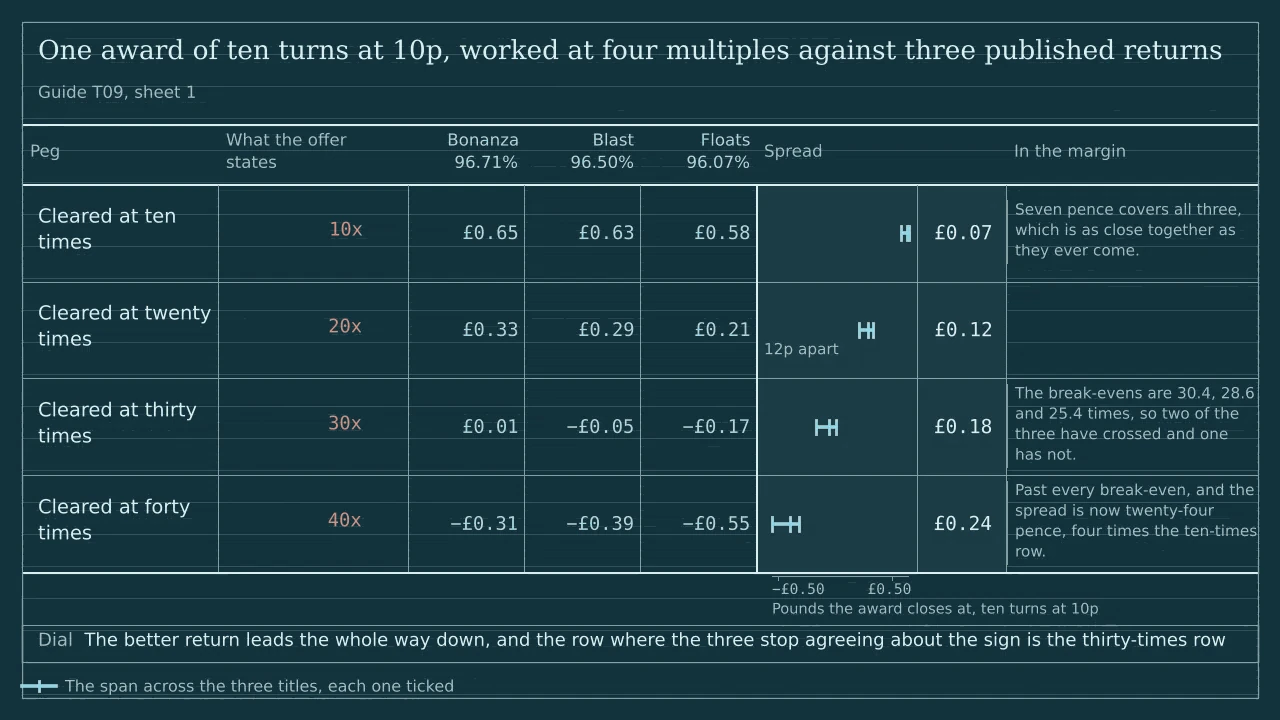
Two things fall out of the picture, and only one of them was expected. The expected one is that the better return stays ahead down the whole ladder. The unexpected one is the width of the span strip. At ten times the three titles lie 7p apart. At twenty times they lie 12p apart. At thirty times, 18p. At forty times, 24p. The choice of reel is worth more the heavier the requirement, and it is worth more in a straight line, because a multiple applies the difference between two returns as many times over as it asks the winnings to be staked.
The other thing in the picture is the row where the signs stop agreeing. At thirty times the original is a penny to the good and the other two are already under water, by 5p and by 17p. Three titles of the same family, the same count of turns, the same price, the same requirement, and two of the three have crossed over while the third has not. The break-evens are 30.4 times, 28.6 times and 25.4 times, which is the whole of the explanation.
No price appears anywhere in that reasoning, and no second ladder is drawn at a second price, for a reason worth stating rather than leaving to be noticed. Draw the same sheet at two pounds a turn instead of ten pence and every weight on it is twenty times larger and the picture is identical in shape, with the same row changing sign in the same place. A drawing whose only content is a scale factor is a drawing of nothing.
Why no price a reader can set reaches the sign
It is worth doing properly, because the result is stronger than an observation about four prices. Write out what the credit actually is. B is the count of turns times the price of a turn times the published return, since that is what the turns are expected to produce. Put that into the house expression and the price stands outside the bracket, multiplying everything in it, and appears nowhere inside.
A price is a positive number. Multiplying by a positive number changes how big a quantity is and never whether it is above or below nought. So the sign of the answer is decided entirely by what is in the bracket, and what is in the bracket is the multiple, the published return and the weighting. The price is not among them.
The price of a turn multiplies the whole expression and sits nowhere inside it, so it can make an award worth fifty times more and cannot make a bad award a good one
Three neighbouring pages in this section lean on that half of the picture. The flagship priced a count with no price attached and found that a range was the honest answer. The page on fifty turns with the requirement deleted found the deletion worth the award multiplied by the requirement and again by the house’s margin. The page on twenty turns worked the dead band at the foot of a balance and found it one stake wide at every rung. Not one of those three would survive a page that let a price decide a sign, and all three stand unharmed under a page that keeps the two apart.
There is a practical form of it for a reader standing in front of an offer. If the only thing in doubt is the price of a turn, the question of whether to take the award is already settled and only the size of the answer is open. If the multiple is in doubt, nothing is settled at all.
The one other term that does reach the sign
One term inside the bracket has been sitting quietly at one all the way down this page, and it deserves its own paragraph because it reaches the sign exactly as the multiple does. That term is g, what an offer counts a round of a given reel as worth against the requirement. Where the terms are silent this report takes it as a whole round, which is the assumption every figure above rests on and the assumption most likely to be wrong in a reader’s disfavour.
The arithmetic is simple and unkind. Counting a round at half a round does not halve anything; it doubles the requirement, because the winnings have to cross the reel twice as often to satisfy the same multiple. In the expression the weighting divides the multiple, so a twenty-times requirement counted at half is a forty-times requirement wearing a smaller number. On this reel that is the difference between £0.33 and minus £0.31, which is to say the difference between an offer worth taking and one that is not.
Solve for the weighting at which a given multiple crosses over and the answer is the multiple times the margin. A ten-times requirement on this reel turns negative at a weighting of 0.329, a twenty-times one at 0.658, and a thirty-times one at 0.987, which is to say that a thirty-times requirement on this reel is under water at any weighting at all short of the whole round arithmetic on claims 20 and 21.
Two honest limits on that. The first is that this report has no published figure for what any offer counts this reel at, and none of the grounds it works from supplies one, so the whole of the paragraph above is a statement about the expression rather than about any offer in the world. The second is that it is not recorded anywhere in the material behind this site whether a ceiling placed on a play-through is a ceiling on the multiple as written or on the multiple as weighted, and the two are not the same quantity. Where a figure cannot be sourced this site says so rather than supplying one.
Both figures are regulated, and the sign more tightly
Both of the two figures this page has been separating are the subject of British rules, and the rules treat them very differently, which is a useful check on whether the distinction is a real one or an invention of this page.
The price is capped. A licensed round of an online slot is held to £5, with a lower ceiling of £2 over a player under twenty-five SI 2025 No. 215, reg 5(2). That is a ceiling on the size of everything downstream of it and it leaves every sign on this page exactly where it stands: the fifty-pound ladder of entry three simply stops at its fourth rung, and the award is as worth taking at the top of what remains as it was at the bottom.
The multiple is capped too, and the cap is the interesting one. A British licensee may ask no more than ten times a bonus before the money can be withdrawn, under SR Code 5.1.1, in force from the nineteenth of January 2026. Set that beside the break-evens on the drawing above. Across the thirty-five slots the slowest crosses over at 25.3 times and the original at 30.4, and the one row of the thirty-six that is not a slot crosses lower than either, at 22.2 arithmetic on claims 75d and 75e. Ten times is a long way under every one of them.
No requirement a British licensee may write passes ten times a bonus, and the slowest break-even anywhere in this family is 22.2 times, so inside the licence no award of this shape can be made negative by its own requirement
That is a stronger protection than it sounds, and it is placed on the axis that decides the sign rather than on the one that decides the size. A reader inside the licence may be offered an award worth very little. They cannot, on this family of reels, be offered one worth less than nothing on account of the multiple alone. A cap of five pounds on the price could never have achieved that, because no price can reach a sign.
What the award is worth once both have been read
Ten turns at ten pence on Big Bass Bonanza under a twenty-times requirement are worth £0.33 in expectation, and that single figure needed three numbers to produce, only one of which the offer’s headline carried. The published return did the least work of the three. The price fixed how big the answer was. The multiple fixed what sort of answer it was.
The count itself did almost nothing. Ten turns is a unit of exposure and not a unit of money, and until a price is written beside it the figure names no quantity. Ten turns is also very little time: a licensed round may not be sold at under 2.5 seconds to the round RTS 14D, so the whole award is twenty-five seconds of play at its quickest, against a requirement that may ask thirty pounds of staking to clear.
So the test a reader can apply to an award of this shape has two steps and they are not interchangeable. First read the multiple against the reel’s break-even, because that settles whether the thing is worth taking and no price will overturn it. Second read the price against the count, because that settles what taking it is worth. Doing the second first produces a confident figure attached to the wrong verdict, which is the most expensive mistake available on a page of this kind.
And the figure that has not appeared in either step is the one the headline shouts. Ten, fifty, a hundred: the count scales with the price and does nothing else, so an offer that doubles its count and halves its price has handed over an identical award. The two figures that matter are both somewhere further down the terms.
Questions readers ask
What are ten free turns actually worth
£0.33 at 10p a turn on Big Bass Bonanza under a twenty-times requirement. The ten turns lay £1.00 over the reel, a published 96.71 per cent returns £0.97 of it, and the requirement takes the rest. Big Bass: Keeping it Reel publishes 96.07 per cent, and there the same award leaves £0.21.
Does the price of a turn change whether the offer is worth taking
No. It changes only by how much. The price multiplies the whole expression and appears nowhere inside the bracket that carries the sign, so raising it from 10p to 2.00 makes the same award worth twenty times more and cannot turn a bad one good.
Which figure decides whether the answer goes under nought
The multiple the terms attach to the winnings, read against the reel’s break-even. On this title the break-even is 30.4 times, so twenty times leaves £0.33, thirty times leaves £0.01 and forty times leaves minus £0.31, all at the same price.
How is the break-even multiple worked out
One divided by the margin between the published return and a hundred per cent. On 96.71 per cent the margin is 3.29 points, which gives 30.4 times. On 96.50 per cent it gives 28.6 and on 96.07 per cent 25.4, so a worse reel crosses over sooner.
Is the count of turns worth anything on its own
Not by itself. The count sets exposure rather than money, so ten turns names a quantity only once a price stands beside it. An offer that doubles its count and halves its price has changed nothing whatever about what it is handing over.
What a game weighting does to these figures
It divides the multiple, so counting a round at half a round turns a twenty-times requirement into a forty-times one. On this reel that is the difference between £0.33 and minus £0.31. No published figure says what any offer counts this reel at, and this page assumes a whole round throughout.
Does a British licence stop a requirement going past break-even
On this family of reels, yes. Ten times is the most a licensee may ask of a bonus, and the slowest break-even in the family is 22.2 times, which belongs to the one row that is not a slot; the slots themselves run from 25.3 upwards. Nothing of the sort constrains an offer written outside that licence.
Why does the better paying reel not reach as far
Because a published return and a published ceiling are separate figures. Big Bass Bonanza publishes 96.71 per cent and one round reaching 2,100 times the stake; Big Bass: Keeping it Reel publishes 96.07 per cent and 10,000 times. A count of turns tells a reader neither one.
Before you play
Read on
- Free spins no deposit
- A count with no price attached can be answered only with a range, and the four places a price could come from answer at different times.
- 5 free spins no deposit
- At five turns every ingredient of the expectation except a fortieth of a penny has no published rate behind it.
- 30 free spins no deposit required keep what you win
- Removing a requirement leaves a ceiling, and the ceiling that never bites is the reel’s published reach carried out at the price of a turn.
- Terms of use
- What this publisher may be relied on for and what it may not, with the gap named rather than disclaimed.