Figures read 20 October 2026 Card V11, weigh-in 1
Best gambling sites, where nearly every published figure reads the same at the next venue
To sort anything you need a key, and a key has to carry a unit, to have somebody standing behind it, and to take different values across the things being sorted. Go looking for one that will sort places of play and the search ends in an awkward place: the quantities with publishers behind them are published because a duty put them there, and a duty reads the same at every licensee by construction. What is left over is unpublished. So a credit of £45.00 asked for 24 times can be priced exactly against the one key that does move, which turns out to be the machine’s own and never the venue’s: it leaves £9.47 where the tile reads Big Bass Bonanza and its published 96.71 per cent, and £7.42 where it reads Big Bass Splash 1000 at 96.52, and the whole distance between those two published figures is £2.05.
What the machine states 96.71 per cent The proportion the studio prints for the original, and the only candidate key on this card that carries a figure and still moves. It moves by title, though, and every venue running that title inherits it unaltered. What the offer states £45.00 at 24 times A mid-sized credit with a multiple comfortably under the break-even, which is the shape an offer takes where a venue is competing on its own prospectus rather than on its terms. What the two make when multiplied £9.47 The residue after the staking, worked at the 10p a turn this card spends, which is an assumption and rests on the bottom of the reel’s published range rather than on an advertisement.
Offers at this end of the market, weighed against the same reel
The destinations below are paid placements. Registering through one of them earns this publisher a fee, and the scale is not told which destination is which: a figure on the card would read identically either way.
-
01The Weigh-In
Betportal
Three deposits, 35x
What the reel states96.71 per centBig Bass BonanzaWhat the offer advertises€15.00150 turns at 10cWhat the two make€0.00No turns of this reelThe reel
Build of the reelBig Bass BonanzaReturn it publishes96.71 per centStake it accepts on one turn10c to €250.00The offer
Turns advertised150 turnsTurns valued at the cheapest turn this reel sells, no worth for one being stated anywhere in the offerPrice of one turn10cthe smallest stake the reel accepts, this operator publishing no figure of its ownCredit as a sumunpublishedCredit waiting on a paymentstated300% over three deposits, up to €1,000Advertised, priced€15.00150 turns of this reelHung on it
Play-through35 timesthe bonusCredited towards it100 per centnobody has published a share, so the whole of a stake is credited, which is the kindest reading availableCeiling on winningsstatedFive times the bonusLargest stake while it runs€5.00under the largest stake the reel accepts, so part of the machine's own range is shut off while the credit runsQualifying payment€20.00200 turns of this reel at the price above, and it enters no weightThe dial, read at every return this reel is published at Return Breaks even at Staking asked Costs Weight In turns 96.71 per centpriced out 30.4 times 5,077 turns −16.70 €0.00 No turns No Great Britain licence
Licence held in Anjouan, Comoros, by BetPortal Gaming Ltd and Excite Ultra Media Ltd, numbered ALSI-202601040-FI2.
Open the offer at Betportal, opens in a window of its own -
02The Weigh-In
WinBeast
Five deposits and a free bet
What the reel states96.71 per centBig Bass BonanzaWhat the offer advertises€50.00500 turns at 10cWhat the two make€0.00No turns of this reelThe reel
Build of the reelBig Bass BonanzaReturn it publishes96.71 per centStake it accepts on one turn10c to €250.00The offer
Turns advertised500 turnsTurns valued at the cheapest turn this reel sells, no worth for one being stated anywhere in the offerPrice of one turn10cthe smallest stake the reel accepts, this operator publishing no figure of its ownCredit as a sumunpublishedCredit waiting on a paymentstatedFive matched deposits of 50% to 100%, each up to €1,000, with a €650 free betAdvertised, priced€50.00500 turns of this reelHung on it
Play-through40 timesthe bonus and the winnings from the spinsCredited towards it100 per centnobody has published a share, so the whole of a stake is credited, which is the kindest reading availableCeiling on winningsstated€100 a batch of spinsQualifying payment€20.00200 turns of this reel at the price above, and it enters no weightThe dial, read at every return this reel is published at Return Breaks even at Staking asked Costs Weight In turns 96.71 per centpriced out 30.4 times 19,342 turns −63.64 €0.00 No turns No Great Britain licence
Licence held in Curaçao, by a company the site does not name.
Open the offer at WinBeast, opens in a window of its own -
03The Weigh-In
EliteSpin
Five deposits, 40x
What the reel states96.71 per centBig Bass BonanzaWhat the offer advertises£50.00500 turns at 10pWhat the two make£0.00No turns of this reelThe reel
Build of the reelBig Bass BonanzaReturn it publishes96.71 per centStake it accepts on one turn10p to £250.00The offer
Turns advertised500 turnsTurns valued at the cheapest turn this reel sells, no worth for one being stated anywhere in the offerPrice of one turn10pthe smallest stake the reel accepts, this operator publishing no figure of its ownCredit as a sumunpublishedCredit waiting on a paymentstatedFive matched deposits of 50% to 100%, each up to £1,000Advertised, priced£50.00500 turns of this reelHung on it
Play-through40 timesthe bonus and the winnings from the spinsCredited towards it100 per centnobody has published a share, so the whole of a stake is credited, which is the kindest reading availableCeiling on winningsstatedFive times the bonusQualifying payment£20.00200 turns of this reel at the price above, and it enters no weightThe dial, read at every return this reel is published at Return Breaks even at Staking asked Costs Weight In turns 96.71 per centpriced out 30.4 times 19,342 turns −63.64 £0.00 No turns No Great Britain licence
Licence held in Costa Rica, by PrimeTier Limited.
Open the offer at EliteSpin, opens in a window of its own -
04The Weigh-In
Crown Jewelz
200% on the first
What the reel statesNO RETURN RECORDEDBig Bass BonanzaWhat the offer advertises£15.00150 turns at 10pWhat the two makeNOT WEIGHEDNot weighed, for want of the play-through multiple as a number.The reel
Build of the reelBig Bass BonanzaReturn it publishes96.71 per centStake it accepts on one turn10p to £250.00The offer
Turns advertised150 turnsTurns valued at the cheapest turn this reel sells, no worth for one being stated anywhere in the offerPrice of one turn10pthe smallest stake the reel accepts, this operator publishing no figure of its ownCredit as a sumunpublishedCredit waiting on a paymentstated200% up to £1,000 with 50 cash spins, then 150% twice with 50 cash spins eachAdvertised, priced£15.00150 turns of this reelHung on it
Play-throughunpublishedCredited towards it100 per centnobody has published a share, so the whole of a stake is credited, which is the kindest reading availableCeiling on winningsunpublishedQualifying payment£20.00200 turns of this reel at the price above, and it enters no weightNo Great Britain licence
Licence held in Curaçao, number not verified, by a company the site does not name.
Open the offer at Crown Jewelz, opens in a window of its own
Of everything in a row, the weight alone was worked out here; the rest was copied. It comes off E = B × (1 − W × (1 − RTP) ∕ g), in which W is the play-through, g the portion of a stake this reel is credited with towards it, RTP the figure the machine publishes about itself, and B the credit still standing when the condition arrives. A batch of turns gives part of itself up before that moment, each turn having staked its own value and taken the machine's return on it, while credit handed over as a sum gives up nothing yet, nothing having been staked with it. Beyond the break-even multiple the condition costs more than it has to work on, and the dial rests at nothing rather than swinging below the pin: a condition cannot take out more than arrived.
No return is kept in this software. Each one is copied off one named machine, build by build, which is why a row may carry several and why the break-even multiple is different from row to row. That multiple is the credited portion of a stake divided by the machine's house edge, so crediting the whole stake on a build published at 96 per cent puts break-even at twenty-five times, and nothing asked for above twenty-five times survives being cleared. A creel holding several settings is read at all of them and the distance between the ends is printed, because the build an operator chose to run is published nowhere a reader can get at.
Turns are not money until a turn has a price. An operator stating what one of its own turns is worth supplies it, and the row credits the operator with having said so. Otherwise the cheapest turn this reel sells supplies it, which is a figure off the machine and not an estimate, no cheaper turn being on sale, and again the row names its source. Everything below that line moves when the price moves. On a row advertising turns and no credit, halve the price and the weight halves while the count of turns the weight buys does not budge, which is as plainly as it can be shown that a count of turns and a quantity of money are different things.
A qualifying payment belongs to the reader. The card prices it in turns, that being the useful thing to know, and no weight is allowed near it. Where a figure has no business existing, one of three words stands instead. Stated marks a condition set down in words, costing something, offering nothing to subtract. Unpublished marks a condition set down nowhere whatever. Unpriced marks a count of turns that is published plainly enough while nothing anywhere says what one of them is worth. None of the three conceals an estimate, and no operator is credited on this card with a figure it never gave.
Two columns of this card are pinned by rules that a Great Britain licence writes and a licence from elsewhere does not. The play-through column: Social Responsibility Code 5.1.1 bars a licence holder from asking more than ten times the bonus funds, so any multiple above ten times on this card is one a British licence would never have let through. The stake column: regulation 5(2) of the Gambling Act 2005 (Operating Licence Conditions) (Amendment) Regulations 2025, made on 25 February 2025, caps the total an individual may stake on any one game cycle at £5, and at £2 for anybody under 25. That cap is attached to a remote casino operating licence and not to the machine, which means a reader who steps outside the licence meets the reel's own stake range with nothing on top of it. Remote technical standard 14D requires a minimum of two and a half seconds from the time a game is started until the next game cycle can be commenced. That one is addressed to the machine rather than to the money, and no column here reports it. Gamstop Online reaches exactly as far as the British licence reaches, that being the condition the scheme was built on, so an offer licensed outside it stands outside the scheme by construction and a registration made with the scheme does not reach as far as this offer. The National Gambling Helpline answers on 0808 8020 133, 24 hours a day, every day of the year.
Conditions quoted in a row are quoted in the wording of the operator that published them, and each row carries the date it was checked. The earliest date on this card is 27 October 2026. A reader is bound by an operator's own terms in full, never by a line of this card.
1
Four things a quantity needs before it will sort anything
Sorting is a mechanical business and its requirements are short. A key needs a unit, because two readings in different units cannot be put in order. It needs somebody standing behind each reading, because an order built on recollection is an order of recollections. It needs to take different values across the things being sorted, since a quantity identical everywhere puts everything in one position. And it needs a method, by which is meant a procedure a reader could actually carry out to get the reading for a particular case, rather than a quantity that exists somewhere in principle.
Those four requirements are not a high bar and plenty of quantities clear them. The price of a stamp clears them. A train fare clears them. What makes a place of play awkward is not that its figures are hidden, which would be a complaint about secrecy, but that the figures standing in plain sight turn out to fail the third requirement, and the ones that would pass the third fail the second. Those two failures are not independent of each other, and the connection between them is this card’s finding.
It is worth naming what this report cannot do before going further, because the limit shapes everything after it. The two sheets under this domain hold rule on one side and one named reel’s own figures on the other. Neither of them carries a table of venues with quantities beside them, and nothing here names an operator or traces a term to one. So no ordering is produced on this page, neither a short one nor a long one, and what is produced instead is an audit a reader can repeat: candidate by candidate, with the unit, whoever publishes it, the method for reading it, and whether the reading changes as a reader moves from one venue to another.
One more distinction will save confusion later. A key that sorts into two classes is not an ordering, it is a test. Whether a Great Britain licence stands behind a venue is a test of exactly that kind: it is published, it is checkable in a public register, and it varies. What it will not do is arrange anything inside either class, and a reader choosing between two licensed venues has been handed a result that is true of both of them in the same words.
2
The candidates that carry a figure, and who put it there
Here is the audit, run over every quantity this report could find a published source for. The unit column is what the reading is counted in, the publisher column names who states it, the method column is what a reader would do to obtain it, and the last column decides whether the quantity will sort anything at all.
| The candidate quantity | Unit | Who states it | How a reader reads it | Moves from venue to venue |
|---|---|---|---|---|
| A Great Britain licence behind the venue | held or not | the public register | look the account up | yes, into two classes |
| The published return of the title played | per cent | the studio, and the game itself | open the game sheet | no |
| The floor under one game cycle | seconds | the technical standard | read the standard | no |
| The ceiling on one game cycle | pounds | a statutory instrument of 2025 | read the instrument | no |
| The intervals written round a complaint | hours and weeks | the regulator’s guidance | read the guidance | no |
| The limit machinery a reader can set | hours and days | the technical standard | read the standard | no |
| The proportion actually running on the machine | per cent | nobody reachable | no method exists | it would |
| The spread of terms across this part of the market | a multiple | nobody reachable | no method exists | it would |
Two further duties round out the audit without changing its result, and both are worth having for their own sake. Identity has to be established before a reader gambles at all, name and address and date of birth at the least, and the duty does not stop at a reader’s own money, since a bonus counts and so do the versions that cost nothing to open the identity condition in the licence. So the checks a reader meets at the door are the same checks at every licensee, which is a protection rather than a distinguishing feature. And where a complaint runs past the venue, the body it goes on to has to be one the regulator has approved, so even the exit from an argument is drawn from a list nobody is free to lengthen. Add those two to the table and the audit holds ten candidates and returns the same answer.
Six of the eight candidates carry a figure from a source a reader can open, and every one of those six comes back no in the last column. The licence is the exception in one direction and sorts into two classes rather than into an order. Two candidates would sort properly if anybody measured them, and nobody does. That is the audit entire, and what follows is an account of why it lands there rather than somewhere else.
Take the figures one at a time and the pattern is hard to miss. The 2.5 seconds a licensed cycle may not come in under is 2.5 seconds at every licensee alike the slots entry in RTS 14. A ceiling of £5.00 on one cycle’s staking, dropping to £2.00 before a reader’s twenty-fifth birthday, is the identical pair of figures at every licensee the 2025 stake limit instrument. The intervals a venue has to keep round a complaint are the regulator’s intervals rather than the venue’s. None of this is a secret and none of it will sort anything.
The machinery a reader can reach to put a limit on themselves makes the point as well as anything in the table. It is specified down to the durations it must offer, a day among them, then a week, then a month the financial limits entry in RTS 12. A raise waits a day at the least and then wants a fresh act from the reader before it takes hold, where a reduction lands immediately, and a reader with activity on the account is prompted to look at the whole of it twice a year. The default on offer has to be a limit set, and declining one takes an act of its own. Every figure in that paragraph is the standard’s, so a reader comparing two licensed venues on the limits they offer is comparing one document with itself.
One row of that audit is worth being blunt about, since it is the row this whole domain stands on. Offers of the sort weighed in this report are advertised by operators carrying no Great Britain licence, which puts them outside every figure in the middle of the table at once: the floor under a cycle, the ceiling on a cycle, the complaint intervals and the limit machinery. Those four duties come as a set and they go as a set. Notice what that does to a sort: it does not spread the offshore side out along a scale, it moves the whole class off the scale together, so a reader is no better placed to order within it than before. The one lever that survives the move is a reader’s own, Gamstop Online, where a signing up once pulls down every account standing in a reader’s own name at an operator Britain licenses, and which reaches exactly as far as that licence reaches and no further.
3
Why a published quantity is a uniform quantity here
The pattern in the audit is not a coincidence and it is worth stating as a rule, because once stated it predicts where the next candidate will land. Ask why any of those six quantities has a published figure attached to it at all. In every case the answer is the same: somebody imposed it. A figure about a venue exists in public because a duty put it there, and a duty that applied to one venue and not the next would not be a duty. So the act that makes a quantity readable is the same act that makes it uniform.
That gives a short test for any candidate a reader meets afterwards. If a quantity about a venue is published by somebody other than the venue, ask who made them publish it, and the answer will usually be a rule that binds the whole class. If a quantity varies between venues, ask who checks it, and the answer will usually be nobody, because the venue is the only party with the reading and no duty compels it to produce one. Publication and variation are pulling in opposite directions, and the pull is structural rather than accidental.
The machine sits on the other side of that line, which is why this site holds it still and lets the offers move. A published return is not a duty imposed on a venue: it is a figure a studio prints about a product, and the studio prints twelve distinct figures across the thirty-six pages it has published for this family off the sheet’s family table. It varies, it has a publisher, it carries a unit and a reader can look it up in a minute. It passes all four requirements from the first part of this card, which none of the venue-side candidates manages. And the thing it sorts is titles.
One candidate does clear every requirement except the last one that matters, and it is worth putting on the record. The public register does publish figures that differ from one account to the next, and the method for reading them is to look the account up. Against the one account the sheet behind this page carries: a licence with five activities on it, all of them remote and all current, and nought trading names, nought domain names and nought premises. That account belongs to the studio, which supplies software rather than selling play, so this publisher holds no such reading for any place of play and names none. And figures of that kind count paperwork rather than money: a count of domain names on a register moves no part of the close worked out below, which is why a quantity can pass three of the four requirements and still be no use to a reader asking how far a credit goes.
There is a tempting move here that this report declines to make. It would be easy to say that a venue is therefore worth nothing to a reader, and that is not what the audit shows. The licence test is worth a great deal and it is the only candidate in the table that genuinely divides the field. What the audit shows is narrower and more useful: inside either class, the quantities a reader can read are shared, so the reading cannot be used to put one venue ahead of another. That is a statement about sorting and not about worth.
4
The one key that would sort them, and its publisher
There is a quantity that would do the job properly if it were available. It is said throughout this trade that a game of this kind can be deployed at more than one return, and that whoever runs it picks. If that were so and the pick were readable, a reader would have exactly the key the audit is short of: a per cent, varying from venue to venue, deciding money directly, with a method for obtaining it.
The game sheet went looking for the source and came back with an absence rather than a figure. The studio publishes one proportion per title across all thirty-six of its own pages and says nowhere that anything varies or that anybody chooses; sessions opened against its own demonstration server returned the same figure under seven different jurisdiction values; and the only sources that assert otherwise are affiliate reviews, which disagree with each other about how many figures there are and about what they are, one of them disagreeing with itself inside a single page the sheet’s own section on the question. So neither assertion nor denial is available to this report, and none of the circulating figures is printed here, because a figure needing a caveat in every sentence is not a sort key.
The second half of the absence matters more for sorting than the first. Nothing in this network’s sourced regulatory material requires a licensee to publish a proportion at all: the requirement about a reader’s chances of winning is satisfied by a description of how the game works, or by a house edge, or by the likelihood of winning events, any one of which will do the game-description entry in RTS 3. And there is no duty anywhere on that sheet to disclose which deployment is running. So even if the practice were exactly as described, no reading would be owed to anybody, which means no method exists, which means the fourth requirement fails even where the first three might not.
There is one piece of evidence that would settle it and this site may not use it. The strongest available reading would be a game’s own information screen as served by a named venue, and citing one names an operator, which the sheet behind these pages forbids outright. That is a real cost and it is recorded here rather than worked around. What follows from it is simple enough: the key that would sort venues is unread, unowed and, for this publisher, unreadable.
5
The second input nobody has measured either
Suppose a reader gave up on the machine and tried to sort venues on their terms instead, which is the obvious retreat. A multiple is a quantity, it carries a unit of a sort, and it certainly varies: that much is visible to anybody who reads two sets of terms. The trouble is the second requirement rather than the third. A reading taken by a reader from the terms in front of them is a reading of one case, and sorting wants the field.
What would be needed is a measured distribution across this part of the market, and the regulatory sheet behind these pages records plainly that no such distribution is published: not for the multiples asked, not for the ceilings put on what a credit may turn into, not for the sums a turn is counted at. The sheet lists that absence rather than filling it from a secondary source, which is why this card prints no typical multiple and no range of them.
So the offer side fails for a different reason from the machine side, and the two failures are worth keeping separate. On the machine side the reading exists for a title and is identical at every venue running it. On the offer side the reading varies between venues and nobody has collected it. A sort needs both halves of the same thing: a quantity that moves and a measurement of where it has moved to. Neither candidate supplies both.
It is worth noticing that the offer side is not short of a price, only of a distribution. One extra time asked of this credit costs £1.48 where the original’s proportion applies, £45.00 multiplied by an edge of 3.29 points being what it is, and £1.57 under the 96.52 per cent the other title publishes. So a reader holding two sets of terms can price the gap between them to the penny. What they cannot do is place either set against the field, because the field has never been counted, and an ordering wants the field rather than a pair.
Consider what collecting the field would actually cost a reader, since that is what the method requirement is really asking. Each reading means opening an account, agreeing a set of terms and taking the figure down, and the reading goes stale the moment those terms move. A reader who did that for a dozen venues would hold a dozen readings of a quantity nobody audits, taken at a dozen different moments, which is a table rather than a measurement. Set against that the cost of reading the one key that does work: a game sheet, one line, before any money has gone anywhere.
And the two absences compound rather than cancelling. Imagine a reader who somehow obtained every venue’s terms and ordered the field on the multiple asked. The order would still be wrong by an unknown amount, because what a multiple costs depends on the proportion the machine gives back, and that is the quantity the previous part established nobody owes anybody. A sort on one unknown input is unreliable. A sort on two is not a sort, and the arithmetic in the next part is the only part of this question that produces a figure at all.
6
The sort that does move money, worked at both figures
Here is the quantity that survives every one of the four requirements, priced. Take this card’s own credit of £45.00 and the 24 times it that has to go across the reel before any of it is the reader’s. The rest is the house expectation: E = B × (1 − W × (1 − RTP) ∕ g). B is the £45.00 face, W the 24 times, g a weighting of one where terms are silent about counting a slot lower, and RTP whichever published proportion the title on the tile carries.
Where the tile reads Big Bass Bonanza, 96.71 per cent is what the studio prints, an edge of 3.29 points follows, and the 24 times takes 0.7896 of the credit away, leaving £9.47 expected to survive. Where it reads Big Bass Splash 1000 the published figure is 96.52 per cent, an edge of 3.48 points, and the same requirement takes 0.8352 of the credit, leaving £7.42. The same offer, the same requirement, the same assumed turn price, and £2.05 of difference decided by which tile a reader opened.
| The title weighed | Published return | Break-even play-through | The offer asks | What £45.00 is worth |
|---|---|---|---|---|
| The reel this card is built on | 96.71 per cent | 30.40 times | 24 times | £9.47 |
| The title with the family’s largest ceiling | 96.52 per cent | 28.74 times | 24 times | £7.42 |
| What the title is worth | 0.19 points of return | 1.66 times | no change | £2.05 |
Why that second title, out of the thirty-five slots the studio lists. Because the two are as close as the family gets to a controlled comparison from the venue’s side and as far apart as it gets from the machine’s. Put them side by side in a lobby and nothing a venue publishes tells them apart: both are the same series, both carry the same name across the top, both arrive through the same cashier under the same terms. Open the game sheet and they differ in the proportion, in the ceiling, where one holds the family’s largest at twenty-five thousand times a stake against the original’s 2,100 times the stake, and in the date their pages went up, better than five years apart.
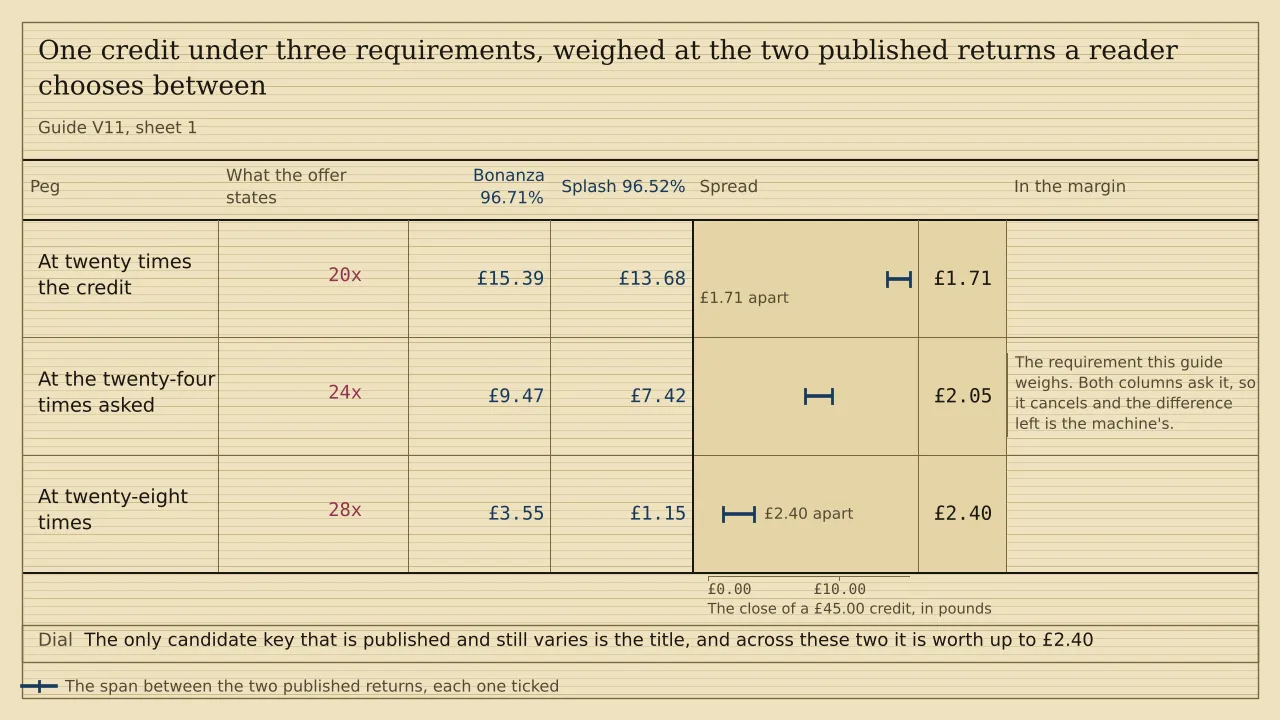
£1,080.00 of staking asked of a £45.00 credit, with £2.05 of the close decided by a quantity the venue does not publish and does not choose
The key that survives has a resolution worth knowing, and it is coarser than the family is large. Twelve distinct figures stand across the thirty-six pages the studio publishes, so an ordering on this key has twelve positions in it rather than thirty-six, and several titles share each one. The gap between two adjacent positions can be as little as a hundredth of a point, which on this card’s staking is 10.8 pence. So the one key that works is exact, published and checkable, and it is also blunt: it will tell a reader which band a title sits in and it will not separate titles inside a band at all.
Which is the sentence the whole card has been working towards. The one key that sorts, carries a unit, has a publisher and takes different values is a property of the machine. The venue did not set it, cannot alter it, and hands it to the reader exactly as the studio printed it. So the sort a reader can actually perform is a sort over tiles, it is worth £2.05 on this credit between those two published figures, and the venue’s contribution to it is nil.
7
What an ordering is worth when its key cannot be read
There is a wrong answer here that sounds rigorous, and it is worth refusing explicitly. The wrong answer is that since nobody publishes the key, getting the order right is worth nothing. That does not follow. An unmeasured quantity is not a quantity of nought, and treating the two as one thing swaps a finding for a guess with a confident tone.
What can be said has a shape worth setting out. If the practice described in the fourth part exists, then the key varies, and the amount at stake in getting the order right would be the spread of that variation run through the same arithmetic as above. On a credit of £45.00 at 24 times, every point of difference in the proportion is worth £10.80, which is the staking divided by a hundred and is exact whatever the proportion turns out to be. So the cost of ordering venues wrongly is a point count nobody publishes multiplied by a figure anybody can compute, and that is the most honest statement available: one factor known to the penny, the other unmeasured.
Set that beside the figure the audit does produce and the proportions become instructive. The published spread across two titles of one family is 0.19 points, worth £2.05 here. A reader who moved venue in the hope of a better deployment is chasing a quantity whose size they cannot know, while a reader who read the figure on the tile in front of them has collected a difference that is printed, checkable and available before any money is committed. The second reader is working with arithmetic. The first is working with a rumour that three sources tell three ways.
One consequence worth drawing out, because it runs against the grain of how this question is usually asked. The audit does not say that places of play are all the same. It says that the respects in which they differ are the respects nobody has measured, and the respects anybody has measured are the respects in which they do not differ. A reader who wants a venue chosen for them is asking for an ordering on the first set. A reader who wants their money to go further is asking about the second set, and about the machine, where the figures are and where this card has been able to produce one.
8
Adding up the one quantity that varies and is published
Start with the money. A face of £45.00, a requirement of 24 times it, the original’s 96.71 per cent doing the work and a slot counted in full: £9.47 is the expected residue. The staking comes to £1,080.00, which at the 10p a turn put up throughout is 10,800 cycles of the reel. Under the 96.52 per cent Big Bass Splash 1000 publishes, the same face and the same requirement leave £7.42, with the break-even multiple moving from 30.40 times to 28.74, so the distance between the two tiles is £2.05.
The audit next, as a result rather than as a list. Of eight candidate keys, six carry a published figure and not one of the six takes a different value from one venue to the next; one is a test rather than an order and divides the field in two; and two would sort the field properly if anybody had measured them, which nobody reachable from this domain has. The reason the six are uniform is the reason they are published: a duty put the figure there, and a duty that varied by venue would not be one.
And the price of the unknown, stated as arithmetic rather than as an opinion. Every point of difference in the proportion a machine gives back is worth £10.80 on this card’s staking, exactly, whatever the proportion is. What no sanctioned source supplies is the count of points, so the product cannot be completed from the venue’s side. From the machine’s side it can: 0.19 points between two titles the studio publishes, and £2.05 of a £45.00 credit.
One last way of putting the result, for a reader who came to this page wanting a name and a position. The audit produces no name, because the quantity a name would have been chosen on has no reading, and it produces a figure, because the quantity that decides the money is printed on a game sheet. Those are the same sentence seen from either end, and the second is the one worth acting on: £2.05 of a £45.00 credit, settled before a deposit, by reading one line about a machine rather than by weighing one place of play against another.
So the useful answer to the question this page is keyed to is not a list and not a ranking. It is that the quantity deciding how far a credit goes is printed on a game sheet, is the same at every venue running that title, and is read before anybody deposits anything. The sort worth performing is over the machine, which is what this publisher sorts, and the ordering of venues that readers want is held up by two inputs that no source reachable here has ever measured.
Questions
- What does a quantity need before it will sort venues
- Four things. A unit, so two readings can be compared; a publisher, so neither reading is recollection; different values across the venues, since a quantity identical everywhere puts everything level; and a method a reader could actually carry out to get the reading for one case.
- Which candidate quantities carry a published figure
- Six of the eight audited here. The floor under one game cycle, the ceiling on one cycle, the intervals written round a complaint, the limit machinery a reader can set, the published return of the title played, and whether a Great Britain licence stands behind the venue at all.
- Why do none of those six put one venue ahead of another
- Because a figure about a venue is in public mainly because somebody imposed it, and an imposition that applied to one venue and not the next would not be a duty. The act making a quantity readable is the act making it uniform, so publication and variation pull apart.
- Is a Great Britain licence not a way of telling venues apart
- It is, and it is the strongest result in the audit, but it sorts into two classes rather than into an order. Inside either class it says nothing, and a reader choosing between two licensed venues has been handed a result that applies to both equally.
- What about the proportion a machine is said to be deployed at
- That would be the key, and no primary source reachable here supports it. The studio prints one figure per title across thirty-six pages, says nowhere that anything varies, and the sources asserting otherwise disagree with each other. This report neither asserts the practice nor denies it.
- Does anybody have to say which deployment is running
- No duty on the regulatory sheet behind these pages requires it, and none requires a proportion to be published at all: a description of how the game works, a house edge or the likelihood of winning events each satisfy the requirement on their own. So no reading is owed to anybody.
- Could venues be sorted on the terms they write instead
- Not from here. A multiple varies between venues, which is the right property, but no measured spread across this part of the market is published anywhere the sheets reach, so a reader has one reading from the terms in front of them and nothing to place it against.
- What is the one quantity that does move money
- The published return of the title played. On a £45.00 credit asked for 24 times the close comes to £9.47 where the original’s figure of 96.71 per cent applies and £7.42 where Big Bass Splash 1000’s 96.52 per cent does, so £2.05 is settled by the tile rather than by the venue.
- What is one point of difference in that proportion worth here
- £10.80, being the £1,080.00 of staking divided by a hundred, and the figure holds whatever the proportion turns out to be. It is the part of the product that can be computed exactly, and the count of points is the part nobody reachable from this domain publishes.
- Does this report rank venues anywhere
- No. It audits candidate keys and prices the one that survives the audit, which is a property of the machine. No operator is named on this site, no term is traced to one, and the arithmetic above would read the same on the day any set of terms changed.
- What does the absence of a Great Britain licence do to this audit
- It moves a whole class off the scale at once rather than spreading it out along one. Offers of this sort are advertised from outside that licence, so the floor under a cycle, the ceiling on a cycle, the complaint intervals and the limit machinery leave together, and a reader is no better placed to order inside the class than before.