Online slots UK: what a licence obliges a reel to be, priced against one credit
A British licence writes rules about the reel itself, not only about the cashier in front of it: a ceiling of £5.00 on what one cycle may take, a floor under how quickly the next cycle may start, a duty to put the chances within reach before anybody commits, and a flat bar on a game adjusting its own odds.
- Updated 13 November 2026
- Licence status shown for every offer
- Assumptions marked in the text
Credits of this size, weighed against a reel that publishes its own return
These offers are paid placements, so this site is owed a fee whenever a reader opens an account through one of the buttons below.
-

Tweedbet
Welcome pack 470%
- Licence
- Not stated, no Great Britain licence
- Play-through
- Not published
- Min deposit
- £20
Bonus up to£14,000 Free spins470Read the offer18+ only. Terms apply.
Licence, terms and working
The site does not say where it is licensed or which company runs it.
The reel
- Build of the reel
- Big Bass Bonanza
- Return it publishes
- 96.71 per cent
- Stake it accepts on one turn
- 10p to £250.00
The offer
- Turns advertised
- 470 turns Turns valued at the cheapest turn this reel sells, no worth for one being stated anywhere in the offer
- Price of one turn
- 10p the smallest stake the reel accepts, this operator publishing no figure of its own
- Credit as a sum
- £14,000.00
- Credit waiting on a payment
- Stated in words Casino Welcome Pack 470% up to £14,000 + 470 FS. Crypto Welcome Bonus 110% up to 1,300 USDT + 110 FS. VIP Welcome Pack 770% up to £13,000
- Advertised, priced
- £14,047.00 140,470 turns of this reel
Hung on it
- Play-through
- Not published
- Credited towards it
- 100 per cent nobody has published a share, so the whole of a stake is credited, which is the kindest reading available
- Ceiling on winnings
- Not published
- Qualifying payment
- £20.00 200 turns of this reel at the price above, and it enters no weight
Not weighed, for want of the play-through multiple as a number.
Stated in words means the condition is set down in words that cost something and give nothing to subtract. Not published means the operator sets the figure down nowhere.
-

EliteSpin
£5,000 + 500 FS
- Licence
- Costa Rica, no Great Britain licence
- Play-through
- 40×
- Min deposit
- £20
Bonus up to£5,000 Free spins500Read the offer18+ only. Terms apply.
Licence, terms and working
Licence held in Costa Rica, by PrimeTier Limited.
The reel
- Build of the reel
- Big Bass Bonanza
- Return it publishes
- 96.71 per cent
- Stake it accepts on one turn
- 10p to £250.00
The offer
- Turns advertised
- 500 turns Turns valued at the cheapest turn this reel sells, no worth for one being stated anywhere in the offer
- Price of one turn
- 10p the smallest stake the reel accepts, this operator publishing no figure of its own
- Credit as a sum
- £5,000.00
- Credit waiting on a payment
- Stated in words Welcome bonus €/£5,000 + 500 FS. Elite lootboxes unlock surprise rewards up to €/£20,000 or 500 FS. Summer Festival by BGaming: win €80,000
- Advertised, priced
- £5,050.00 50,500 turns of this reel
Hung on it
- Play-through
- 40 times the bonus and the winnings from the spins
- Credited towards it
- 100 per cent nobody has published a share, so the whole of a stake is credited, which is the kindest reading available
- Ceiling on winnings
- Stated in words Five times the bonus
- Qualifying payment
- £20.00 200 turns of this reel at the price above, and it enters no weight
Priced at 10p a turn, the banner comes to £5,050.00, of which £5,048.36 survives the spins. At the reel's published return of 96.71 per cent, a play-through of 40 times asks for £201,934.20 of staking and costs £6,643.64, more than there is to pay it with, so the offer weighs £0.00.
Stated in words means the condition is set down in words that cost something and give nothing to subtract.
-

WinBeast
€5,000 + 500 FS
- Licence
- Curaçao, no Great Britain licence
- Min deposit
- €20
- Free spins
- 500
Bonus up to€5,000 Play-through40×Read the offer18+ only. Terms apply.
Licence, terms and working
Licence held in Curaçao, by a company the site does not name.
The reel
- Build of the reel
- Big Bass Bonanza
- Return it publishes
- 96.71 per cent
- Stake it accepts on one turn
- 10c to €250.00
The offer
- Turns advertised
- 500 turns Turns valued at the cheapest turn this reel sells, no worth for one being stated anywhere in the offer
- Price of one turn
- 10c the smallest stake the reel accepts, this operator publishing no figure of its own
- Credit as a sum
- €5,000.00
- Credit waiting on a payment
- Stated in words Welcome pack €5,000 + 500 FS + €650 free bet. Fortune wheel on €40+ deposits with code FORTUNE. 40% up to €300 Beast Boost Monday with code BOOST1 on €20 deposit
- Advertised, priced
- €5,050.00 50,500 turns of this reel
Hung on it
- Play-through
- 40 times the bonus and the winnings from the spins
- Credited towards it
- 100 per cent nobody has published a share, so the whole of a stake is credited, which is the kindest reading available
- Ceiling on winnings
- Stated in words €100 a batch of spins
- Qualifying payment
- €20.00 200 turns of this reel at the price above, and it enters no weight
Priced at 10c a turn, the banner comes to €5,050.00, of which €5,048.36 survives the spins. At the reel's published return of 96.71 per cent, a play-through of 40 times asks for €201,934.20 of staking and costs €6,643.64, more than there is to pay it with, so the offer weighs €0.00.
Stated in words means the condition is set down in words that cost something and give nothing to subtract.
-

Betportal
300% + 150 FS
- Licence
- Anjouan, Comoros, no Great Britain licence
- Play-through
- 35×
- Min deposit
- €20
- Stake cap
- €5.00
Bonus up to€1,000 Free spins150Read the offer18+ only. Terms apply.
Licence, terms and working
Licence held in Anjouan, Comoros, by BetPortal Gaming Ltd and Excite Ultra Media Ltd, numbered ALSI-202601040-FI2.
The reel
- Build of the reel
- Big Bass Bonanza
- Return it publishes
- 96.71 per cent
- Stake it accepts on one turn
- 10c to €250.00
The offer
- Turns advertised
- 150 turns Turns valued at the cheapest turn this reel sells, no worth for one being stated anywhere in the offer
- Price of one turn
- 10c the smallest stake the reel accepts, this operator publishing no figure of its own
- Credit as a sum
- €1,000.00
- Credit waiting on a payment
- Stated in words Welcome package 300% up to €1,000 + 150 free spins. 1st deposit 150% up to €500 + 100 FS. 2nd deposit 100% up to €300 + 50 FS
- Advertised, priced
- €1,015.00 10,150 turns of this reel
Hung on it
- Play-through
- 35 times the bonus
- Credited towards it
- 100 per cent nobody has published a share, so the whole of a stake is credited, which is the kindest reading available
- Ceiling on winnings
- Stated in words Five times the bonus
- Largest stake while it runs
- €5.00 under the largest stake the reel accepts, so part of the machine's own range is shut off while the credit runs
- Qualifying payment
- €20.00 200 turns of this reel at the price above, and it enters no weight
Priced at 10c a turn, the banner comes to €1,015.00, of which €1,014.51 survives the spins. At the reel's published return of 96.71 per cent, a play-through of 35 times asks for €35,507.73 of staking and costs €1,168.20, more than there is to pay it with, so the offer weighs €0.00.
Stated in words means the condition is set down in words that cost something and give nothing to subtract.
-

Night Luck
805% + 280 FS
- Licence
- Not stated, no Great Britain licence
- Play-through
- Not published
- Min deposit
- €20
Bonus up to€6,400 Free spins280Read the offer18+ only. Terms apply.
Licence, terms and working
The site does not say where it is licensed or which company runs it.
The reel
- Build of the reel
- Big Bass Bonanza
- Return it publishes
- 96.71 per cent
- Stake it accepts on one turn
- 10c to €250.00
The offer
- Turns advertised
- 280 turns Turns valued at the cheapest turn this reel sells, no worth for one being stated anywhere in the offer
- Price of one turn
- 10c the smallest stake the reel accepts, this operator publishing no figure of its own
- Credit as a sum
- €6,400.00
- Credit waiting on a payment
- Stated in words Casino welcome bonus 805% up to €6,400 + 280 FS. Crypto welcome bonus 140% up to 1,600 USDT + 140 FS. VIP welcome pack 800% up to €14,500
- Advertised, priced
- €6,428.00 64,280 turns of this reel
Hung on it
- Play-through
- Not published
- Credited towards it
- 100 per cent nobody has published a share, so the whole of a stake is credited, which is the kindest reading available
- Ceiling on winnings
- Not published
- Qualifying payment
- €20.00 200 turns of this reel at the price above, and it enters no weight
Not weighed, for want of the play-through multiple as a number.
Stated in words means the condition is set down in words that cost something and give nothing to subtract. Not published means the operator sets the figure down nowhere.
What a Great Britain licence would add to these offers
A licence from the Gambling Commission for Great Britain carries rules that an offer licensed elsewhere does not have to follow, and some figures in this ranking would not survive them. Social responsibility code provision 5.1.1 stops a British licensee applying a wagering requirement of more than ten times the bonus funds, and that limit has applied since 19 January 2026. A play-through above ten times in this list is therefore one a British licence would not allow.
Regulation 5(2) of the Gambling Act 2005 (Operating Licence Conditions) (Amendment) Regulations 2025, made on 25 February 2025, limits what a player can stake on one game cycle of an online slot to £5, or £2 for a player under 25. It is a condition of a British remote casino licence and not a property of the game, so a player at an operator licensed elsewhere does not have it behind them.
Remote technical standard 14D asks for at least two and a half seconds from the start of one slot game cycle to the start of the next, with the player pressing start each time. It is addressed to the game and not to the money, so no figure in this ranking measures it.
GAMSTOP is the free scheme that closes your accounts with online gambling companies licensed in Great Britain, and every one of them must join it. An operator licensed elsewhere is not required to, so a GAMSTOP registration cannot be counted on to reach these offers. If gambling is costing more than money, the National Gambling Helpline is free and answers on 0808 8020 133 at any hour.
Ranking last changed 8 November 2026. Operator terms change without notice, so open the offer page and read the terms there before you register.
At a glance
This page prices that class of duty rather than listing it, using a credit of £15.00 asked for forty times against a reel whose maker prints 96.71 per cent for it. The credit closes at −£4.74, the staking behind it runs to £600.00, and the duties decide how many turns and how many hours that staking takes.
- What the machine states96.71 per centBig Bass Bonanza, taken from the one item of basic game information the studio prints and confirmed by the figure the game itself receives at the start of a session. A second title is worked beside it further down, at 96.52 per cent.
- What the offer states£15.00 at 40 timesA credit of a size handed over at this end of the market before any payment, with forty times asked of it before a withdrawal opens. Neither figure comes from a rule: both are what such terms say, and the second is above anything a British licence permits.
- What the two make when multiplied−£4.74The expectation once £600.00 of required staking has crossed a reel returning 96.71 per cent. Every duty priced on this page acts on one of the three quantities that produce it: the stake, the pace or the return.
On this page
- The duties that attach to the reel rather than to the cashier
- A ceiling on one cycle, priced in what a round can hand back
- A floor under one turn, priced in hours of staking
- What has to be reachable before anybody commits
- The bar on a reel adjusting its own odds, and what it is worth
- What one credit closes at on two published returns
- The class of duty, totalled against a single credit
- Which duties bind the reel and which bind the cashier
- Four things a licence does not promise anybody
- One credit, read back in turns, in hours and in expectation
The duties that attach to the reel rather than to the cashier
Most writing about British regulation of this trade describes duties that fall on the business: who may hold an account, what has to be checked, how an incentive may be worded. A separate body of rules falls on the machine, and it is the one that decides what a reader’s turn actually consists of. Four of those rules are priced on this page, and every one of them acts on a quantity that appears in the arithmetic rather than on a quantity that appears in a contract.
The subject throughout is a reel this publisher can name, because the sheet behind this site covers it: Big Bass Bonanza, whose studio prints 96.71 per cent for it, with 10 paylines over 5 reels and 3 rows the studio’s figure and the game’s own data. The offer weighed against it is a credit of £15.00 carrying a requirement of forty times a shape this part of the market publishes. Where a turn price is needed, two appear: £5.00, which is the most a licensed cycle may take, and ten pence, the foot of the reel’s own published range chosen here, so that the same requirement can be priced at both ends.
The four duties, in the order the page prices them. A cycle of an online slot stops at £5.00 of stake, or at £2.00 before a player’s twenty-fifth birthday. A cycle may not be followed by the next one in under two and a half seconds, and nothing may be offered that shortens the wait or runs cycles automatically. The chances of winning must be reachable before a player commits, together with the rules of the game and a description of the prizes. And the odds themselves may not be adapted: no compensation, no near-miss substitution, no altering the rules of a game while it is running.
None of the four duties is about a bonus. All four bind the machine, which is why a reader who takes an offer offshore keeps the offer’s wording and loses every one of them at once.
A ceiling on one cycle, priced in what a round can hand back
On a licensed build this reel takes £5.00 a cycle at most, and £2.00 until an account holder turns twenty-five. The limits came by statutory instrument in February 2025 under SI 2025 No. 215, with the regulator’s guidance dating the first to 9 April that year and the second to 21 May. They reach reel-based games played online and nothing else in a casino, so blackjack and roulette sit outside them.
What a ceiling on the stake really caps is the win, because the biggest thing this reel can do is published as a multiple of one stake. The most one round of it returns in one round comes to 2,100 stakes, a figure the game’s own data holds and not from the studio’s page the maximum round win it reports, so the ceiling converts directly: at £5.00 the largest sum one round can return is £10,500, and at £2.00 it is £4,200. The reel’s own stake range runs up to 250.00 a spin, which would put the same multiple at £525,000, and that figure is the clearest measure of what the instrument did. It did not change the game. It changed what the game is permitted to be worth in one round.
The same ceiling works on the other end of the page too. A credit of £15.00 is three cycles at the ceiling and a hundred and fifty at the reel’s own floor of ten pence, and the requirement of forty times behind it is 120 turns against 6,000. One rule, two experiences of the identical offer, and nothing in the offer’s wording says which of them a reader is buying.
Two cautions on the figures above. The maximum of 2,100 times the stake comes from the data the game itself carries and not from the studio’s own page, which states no maximum for this title at all, and attributing it to the page would be wrong. And the reel’s own range of stakes, 0.10 to 250.00, is the game’s and not a British one: the top of it is unreachable on a licensed build, by exactly the instrument quoted above.
A floor under one turn, priced in hours of staking
An hour on a licensed build holds 1,440 cycles and not one more. The floor is two and a half seconds from the moment a cycle of a slot begins to the earliest the following one may, and a cycle has not ended while money staked or won is still unsettled or the start control is still away RTS 14D. Two rules keep that floor honest: a result may not be sped up, which takes turbo, quick spin and slam stop off a licensed reel RTS 14E, and a run of cycles may not be set going on a player’s behalf RTS 8A.
Turn that into the unit this page uses. The requirement attached to a £15.00 credit at forty times is £600.00 of staking: at the ten pence supposed here that is 6,000 turns and therefore at least 4 hours and 10 minutes of uninterrupted play. At the £5.00 ceiling the same £600.00 is 120 turns and 5 minutes. The duty has not changed the amount staked by a penny; it has set the range of time that amount can be staked in, and the ratio between the two ends is fifty to one.
The same arithmetic sets a limit on something this site is careful never to promise. The only rate the reel publishes is for its largest round, once in every 3,880,481 turns the one hit rate the game’s data carries. At the 1,440 cycles an hour the pace floor allows, that many turns is 2,694.8 hours of play without a break, or 112.3 days. The figure is not a prediction and the reel is never due: it simply says what the published rate means once the pace rule is applied to it, and a published rate without a pace rule beside it has no unit of time at all.
A reader meeting those two paragraphs for the first time usually notices the same thing: the duty that looks like a restriction on the machine is also the only reason a count of turns can be converted into a length of time. A figure of 6,000 turns means nothing until somebody fixes how fast a turn may go, and outside the licence nobody has.
What has to be reachable before anybody commits
Four readings a player is entitled to before anything goes in, and what each is worth on this page. The first is the rule book of the game, all of it, in language meant to be understood and reachable without committing to anything RTS 3A. On this reel that is what tells a reader money symbols are collected by a wild and only inside the feature, which is the fact that most changes what a round looks like.
The second is a running account of where a player stands while a round is open RTS 3B. The third is the prize side: what can be won, or the method that settles it RTS 3D. On this reel the ceiling for one round is published at 2,100 times the stake, so at the £5.00 a licensed cycle allows, that duty is worth knowing £10,500 is where the range ends.
The fourth reading is the chances, and it is written loosely enough to matter. A reader has to be able to reach something that would let them judge how likely a win is, and the rule lets a licensee choose which something: the workings of the game, the edge the house keeps, the return as a percentage, or the frequency of winning events RTS 3C. Any single one of those will do, so a licensed lobby that never prints a percentage has complied all the same, and that is the point most often got wrong about this rule.
So the 96.71 per cent at the head of this page is not there because a rule compelled anybody to print it. It is there because the studio chose to publish one figure per title on its own pages, and because the game itself reports a return in the data it receives when a session opens. Had the studio not published, this page would have a duty to point at and no figure to weigh, and every arithmetic on this site would stop. That is the honest relationship between the rule and the number: the rule guarantees a reader something about the chances, and the particular something that makes arithmetic possible is a commercial decision by a games studio.
It is worth pricing the difference between the two. With the figure published, a reader can work out that a £15.00 credit at forty times closes at −£4.74 on this reel and know the sum is wrong by nothing at all. With only a house edge published they could reach the same place by subtraction. With only a description of how the game works, the most honest thing anybody could say about the credit is that it is worth less than £15.00 by an unstated amount, and the whole method of this site would be unavailable.
The bar on a reel adjusting its own odds, and what it is worth
Every figure on this page assumes the same 3.29 points come off the first pound staked and off the six hundredth. That assumption is a rule on a licensed build: results have to be acceptably random, a game that leans back against a run of outcomes is barred, and what comes out has to follow the odds the mathematics describes. The numbers behind it are taken in sequence, and none may be thrown away for arriving at an awkward moment RTS 7A and 7B. Nothing in the rules, the payouts or the odds moves while a round is open, and a clause claiming the right to rewrite rules at will is named in the guidance as one that would not pass RTS 7D.
Three more design rules sit beside it, and each takes something off the table that would otherwise flatter the machine. A result that lost may not be made to look like one that nearly won, and a game imitating a real device has to imitate its real odds too RTS 7C. Whatever happens has to be displayed plainly and held there long enough for a player to take it in RTS 7E. And where a round hands back no more than it took, nothing may sound or flash as though it had paid RTS 14F: on a reel whose money symbols are gathered only inside the feature, that last one decides how a great many rounds look.
What is it worth? Everything above and below it on this page. The figure 96.71 per cent describes the whole distribution of a reel, and it only describes anything at all if nobody is permitted to tune the distribution while a reader is inside it. The arithmetic that turns £600.00 of staking into an expected cost of £19.74 assumes the same rate applies to the first pound and to the six hundredth. Without the bar on adaptation that assumption would be a hope, and the correct expected cost of the requirement would be unknown rather than wrong.
It is also the rule that licenses the plainest sentence on this site, which is that nothing about a reel’s recent behaviour bears on its next round. On a licensed build that is a rule. Everywhere else it is an assumption about a machine nobody is obliged to describe, and no run of turns on this reel, however long, makes the turn after it any likelier.
What one credit closes at on two published returns
Now the close, because a class of duty cannot be priced until the thing it acts on has a figure. A credit of £15.00 carrying forty times puts £600.00 of staking across the reel. The reel keeps 3.29 points of everything staked, which is what the published figure of 96.71 per cent leaves, so the expected cost of the requirement is £19.74 against a credit of £15.00, and the credit closes at −£4.74. The house sets it out as E = B × (1 − W × (1 − RTP) ∕ g), with B the credit, W the requirement, RTP the published figure and g the weighting a slot counts at, which is one wherever the terms count a slot in full from what such terms state.
Worked a second time at the figure of another title in the family, the same credit behaves differently, and the table below holds the two side by side. The studio prints 96.52 per cent for Big Bass Splash 1000, whose maximum in one round is 25,000 times the stake, the largest multiple anywhere in the family the family table on the game sheet. The title with the lower return is again the one with the larger ceiling, which is the trade a reader is making without being shown it.
| The reel weighed | Published return | Break-even play-through | The offer asks | What £15.00 is worth |
|---|---|---|---|---|
| Big Bass Bonanza, the reel above | 96.71 per cent | 30.40 times | 40 times | −£4.74 |
| Big Bass Splash 1000 | 96.52 per cent | 28.74 times | 40 times | −£5.88 |
| What 0.19 points of return decide | 0.19 points of return | 1.66 times | no change | £1.14 |
The middle column is where the duties and the arithmetic meet. Break-even is the reciprocal of the share a reel keeps, so it moves with the published return and with nothing else: 30.40 times on the first reel and 28.74 on the second. A requirement of forty times stands above both, which is why both closes are below nothing, and the distance between the two closes is £1.14 on a credit whose wording never changed.
£600.00of staking asked of a £15.00 credit, which is 6,000 turns at ten pence or 120 at the £5.00 ceiling a licensed cycle carries
The class of duty, totalled against a single credit
Each duty priced above acts on one quantity, so each can be given a figure on the same credit. The requirement of forty times is the first: against the ten times a licensed incentive may ask of bonus funds, dated 19 January 2026, the same £15.00 would close at £10.07 rather than −£4.74, so the gap between the two requirements is £14.81 on this credit alone SR Code 5.1.1. The pace floor is the second: it fixes 6,000 turns at a minimum of 4 hours and 10 minutes, so a reader who imagined an evening is short by roughly half of one. The stake ceiling is the third, deciding whether those 6,000 turns are 120 instead, and capping what a single round can hand back at £10,500 rather than £525,000. The information duty is the fourth, and it is what put the 96.71 per cent on this page at all.
Totalled as a class, against this one credit, the arithmetic says something simple. The duty that moves the money is the one about the requirement, worth £14.81. The duties that move the experience are the pace floor and the stake ceiling, worth several hours and a factor of fifty in the turn count. The duty that makes the rest computable is the information one, and its value cannot be written as a sum of money because without it there is no sum to write.
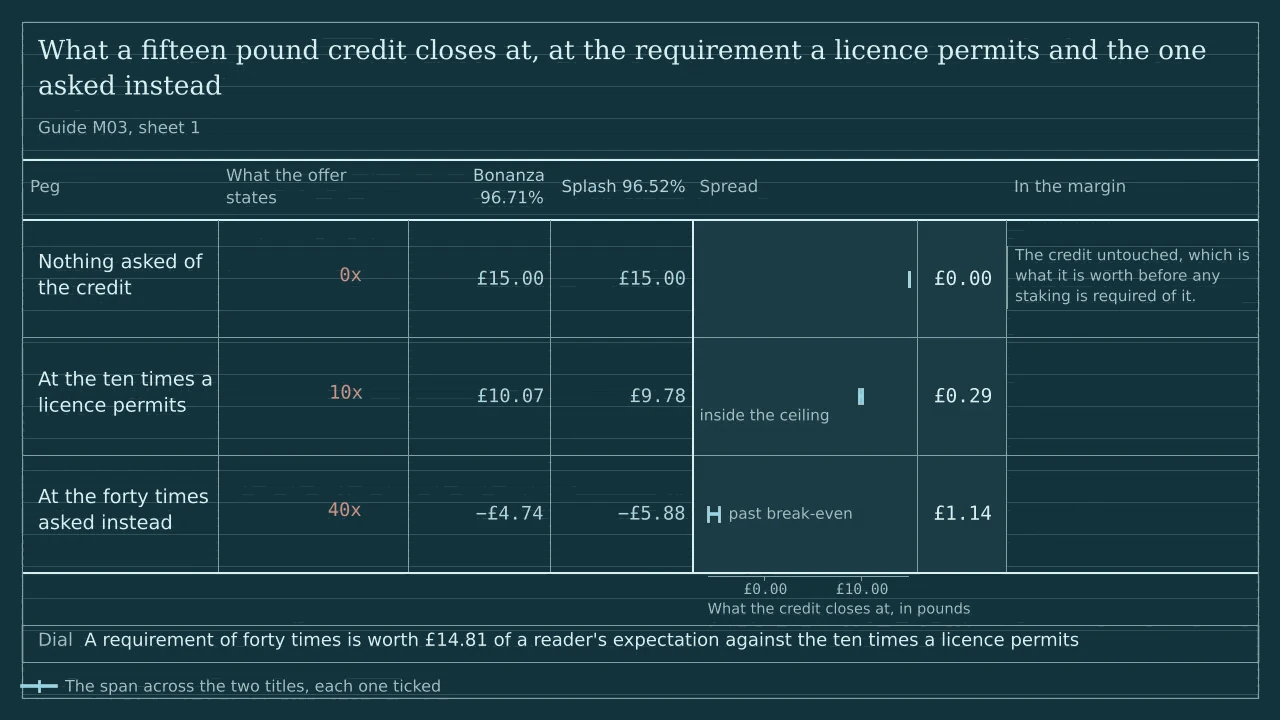
A note on what the drawing is not. It does not price a duty by subtracting one cashier’s terms from another’s, because no term on it is traced to anybody: the forty times is what packages of that sort ask, and the ten times is a regulated ceiling rather than an observed average. The difference between the two pegs in the middle is the difference between what a rule permits and what an offer outside that rule asks, which is a comparison this publisher can make honestly and the only one worth making.
Which duties bind the reel and which bind the cashier
The separation is worth drawing carefully, because the two halves travel differently when a reader goes looking for an offer. The duties on the reel are carried by the build of the game: the stake ceiling, the pace floor, the bar on features that speed a result up, the bar on automatic runs of cycles, the information duties and the bar on adaptive behaviour. They describe what the machine is permitted to do, and a game supplier builds them in or does not.
The duties on the cashier are carried by the account: the ceiling on what an incentive may require, the duty to state an incentive’s terms clearly and fairly and keep them within reach, the ban on mixing products inside one incentive, and the whole apparatus of self-exclusion, whose reach the licence fixes and the site does not, so it covers operators Britain licenses and stops there. Those describe what the business may ask of a reader and what it must tell them first.
A page that mixes the two halves will mislead a reader in a specific direction: it will imply that a familiar reel brings its rules with it. It does not. Games built under a supplier’s licence turn up in lobbies holding none, which the regulator put on record in a warning notice of January 2025. A penalty of £4.75m followed in July 2026, against a supplier whose own titles had reached six websites with no licence here. The build a reader meets in an unlicensed lobby may carry the pace floor or may not, and nothing published tells them which, which is why this page prices the duties rather than assuming any of them travel.
One figure makes the point better than the argument does. The studio behind the reel on this page is itself entered on the public register the Commission keeps, at account 56015, holding Gambling Software as a remote activity from 30 January 2020. What that authorises is the supply of software, and it settles nothing whatever about any casino running it: not whether a British player may be offered the game there, and not which build is loaded.
Four things a licence does not promise anybody
First, it does not make a reel a good bet. Every duty on this page operates on a reel whose published figure is 96.71 per cent, and the arithmetic throughout runs against the player by exactly the margin the studio prints. A licensed slot is a slot with rules around it, and the rules do not touch the direction of the expectation.
Second, it does not oblige anybody to publish a return as a percentage, as the four alternatives in the information duty make plain. The figure this page is built on exists because a studio published it, not because a regulator required it, and a page that says otherwise has read the rule the common way round.
Third, it does not supply a figure for dispersion. No volatility rating is published for this reel, nor for any other title the family runs to: the studio’s pages do not use the word, the game’s own data offers no field it could be entered in, and the three secondary sources that state a figure disagree with each other, one of them contradicting itself inside a single page. What a licensed build must do is display results clearly and keep the probabilities theoretical. Neither duty produces a dispersion figure, so this page derives what it needs from the paytable, from 2,100 times the stake as the most one round returns, and from the 3,880,481 turns a top round is published to need.
Fourth, it does not promise that a reader’s own sitting will resemble any figure on this page. An expectation describes the average of a long run, and the only honest use of it is comparative: it tells a reader that a credit of £15.00 at forty times is worth £14.81 less than the same credit at the ceiling a licence allows, and that the same credit is worth £1.14 less on one reel of this family than on another. Those are differences between one offer and another, which is the choice a reader is really making.
One credit, read back in turns, in hours and in expectation
In turns: £15.00 is 150 of them at the reel’s own floor of ten pence, or three at the £5.00 ceiling a licensed cycle carries, and the requirement behind it is 6,000 turns or 120. In hours: no fewer than 4 hours and 10 minutes at the smaller stake, or 5 minutes at the larger, with every cycle in both committed to separately and nothing permitted to speed the result up. In expectation: −£4.74 at a studio figure of 96.71 per cent, −£5.88 on one published at 96.52, and £10.07 had the requirement been held to the ceiling a British licence imposes.
Read in that order, the duties stop looking like a list and start looking like a set of dials on one machine. One of them fixes how much a turn may cost. One fixes how often a turn may happen. One fixes what has to be knowable before any of it starts, and one fixes that the odds behind it hold still while it runs. Move any of the four and every figure on this page moves with it.
The last thing to say is the thing the arithmetic says plainest. A requirement of forty times is above the break-even of both reels weighed here, so both closes are below nothing, and no duty inside the British licence would have made the offer good. What the duties would have done is cap the requirement at ten times, which turns −£4.74 into £10.07, and that single number is the most useful comparison on this page for anybody weighing a credit from a cashier that holds no British licence.
Questions readers ask
What is the maximum stake on online slots in the UK?
£5.00 a cycle, and £2.00 while a player is under twenty-five, from regulations made in February 2025. The regulator’s own guidance puts the larger limit in force from 9 April 2025, the smaller six weeks later. The limits are for reel-based games played online, so other casino games keep none of them.
How fast can a licensed online slot spin?
An hour holds 1,440 cycles at most: 2.5 seconds is what a licensed slot puts under one cycle, counted to the earliest the next may be started. A result may not be sped up, and a run of cycles may not be set going on a player’s behalf.
Does a UK licence require a slot to publish its RTP?
No. The rule offers a licensee four ways to tell a player about their chances and a percentage is only one of them: the workings of the game, the edge the house keeps, the return as a percentage, or the frequency of winning events. The figure this page uses is published because a studio chose to publish it.
Can an online slot change its odds while somebody is playing it?
Not on a licensed build. A game that leans back against a run of results is barred, outcomes have to follow the odds the mathematics describes, and nothing in a game’s rules, payouts or odds may move while a round is open. The guidance names the failing clause: one claiming the right to change rules whenever the operator pleases.
What is the biggest win a British stake ceiling allows on Big Bass Bonanza?
The maximum for one round is published at 2,100 times the stake, in the game’s own data and not on the studio’s page. At the £5.00 ceiling that is £10,500, and at the £2.00 ceiling £4,200. At the top of the reel’s own stake range, which no licensed cycle reaches, the same multiple would be £525,000.
What does a £15 credit at forty times actually cost in staking?
£600.00 of turnover, which at ten pence a turn is 6,000 turns and at the £5.00 ceiling is 120. Where the published figure is 96.71 per cent the expected cost of that turnover is £19.74 against a credit of £15.00, so the credit closes at £4.74 below nothing.
How long would 6,000 turns take on a licensed slot?
At least 4 hours and 10 minutes, since an hour of a licensed build holds 1,440 cycles and no more, nothing may speed a result up, and a run of cycles may not be set going on a player’s behalf. That is a floor rather than an estimate: it is what the rule permits at its quickest.
Is a slot with a UK licence safer than the same slot without one?
The duties priced on this page apply to a licensed build and to no other, so a reader outside the licence keeps the reel and loses the stake ceiling, the pace floor, the information duties and the bar on adaptive behaviour. None of those duties changes the direction of the arithmetic, which runs against the player by the margin the studio publishes.
Before you play
Read on
- 20 free spins no deposit Big Bass Bonanza
- The site’s own worked example: twenty turns priced from the turn price to a close of 29 pence below nothing.
- 150 free spins no deposit Book of Dead
- A count is not portable: one advertised number, two published returns, and a tenfold difference in what it is worth.
- Top 20 slots UK
- What could order twenty reels, and the finding that the quantity a reader most wants ordered is published by nobody.
- How a figure is weighed here
- Which figures are read off the machine, which off the offer, and which this publisher assumes.