Figures read 20 October 2026 Card L01, weigh-in 1
High roller online casinos, weighed against a reel that scales exactly
Raise the stake and almost everything a reader cares about moves with it in exact proportion, and the one figure that does not move is the one the offer was advertised on. A credit of £1,000.00 carrying a play-through of thirty-five times closes at minus £151.50 against Big Bass Bonanza at the 96.71 per cent the studio prints for it, and that figure is identical at 10p a turn and at £250.00 a turn. What a larger stake buys is a shorter clock. This card takes the reel’s published figures first, the terms of a large balance second, and multiplies in that order.
What the machine states 96.71 per cent The single item the maker publishes in its information block for the original title, which on this card does nothing but divide: it fixes 3.29 points as the toll on each pound of turnover, whatever size the pound arrives in. What the offer states £1,000.00 at 35 times A four-figure credit with thirty-five times the credit of play-through written against it, set down as the shape a large balance is commonly advertised in and traced to no account anywhere. What the two make when multiplied −£151.50 The close, and the only quantity on this card a bigger turn price leaves precisely where it stands. Section three below is the inventory of what a bigger turn price does move.
Offers built for a large balance, weighed against the same reel
The destinations below are paid placements. Registering through one of them earns this publisher a fee, and the scale is not told which destination is which: a figure on the card would read identically either way.
-
01The Weigh-In
Betportal
Three deposits, 35x
What the reel states96.71 per centBig Bass BonanzaWhat the offer advertises€15.00150 turns at 10cWhat the two make€0.00No turns of this reelThe reel
Build of the reelBig Bass BonanzaReturn it publishes96.71 per centStake it accepts on one turn10c to €250.00The offer
Turns advertised150 turnsTurns valued at the cheapest turn this reel sells, no worth for one being stated anywhere in the offerPrice of one turn10cthe smallest stake the reel accepts, this operator publishing no figure of its ownCredit as a sumunpublishedCredit waiting on a paymentstated300% over three deposits, up to €1,000Advertised, priced€15.00150 turns of this reelHung on it
Play-through35 timesthe bonusCredited towards it100 per centnobody has published a share, so the whole of a stake is credited, which is the kindest reading availableCeiling on winningsstatedFive times the bonusLargest stake while it runs€5.00under the largest stake the reel accepts, so part of the machine's own range is shut off while the credit runsQualifying payment€20.00200 turns of this reel at the price above, and it enters no weightThe dial, read at every return this reel is published at Return Breaks even at Staking asked Costs Weight In turns 96.71 per centpriced out 30.4 times 5,077 turns −16.70 €0.00 No turns No Great Britain licence
Licence held in Anjouan, Comoros, by BetPortal Gaming Ltd and Excite Ultra Media Ltd, numbered ALSI-202601040-FI2.
Open the offer at Betportal, opens in a window of its own -
02The Weigh-In
WinBeast
Five deposits and a free bet
What the reel states96.71 per centBig Bass BonanzaWhat the offer advertises€50.00500 turns at 10cWhat the two make€0.00No turns of this reelThe reel
Build of the reelBig Bass BonanzaReturn it publishes96.71 per centStake it accepts on one turn10c to €250.00The offer
Turns advertised500 turnsTurns valued at the cheapest turn this reel sells, no worth for one being stated anywhere in the offerPrice of one turn10cthe smallest stake the reel accepts, this operator publishing no figure of its ownCredit as a sumunpublishedCredit waiting on a paymentstatedFive matched deposits of 50% to 100%, each up to €1,000, with a €650 free betAdvertised, priced€50.00500 turns of this reelHung on it
Play-through40 timesthe bonus and the winnings from the spinsCredited towards it100 per centnobody has published a share, so the whole of a stake is credited, which is the kindest reading availableCeiling on winningsstated€100 a batch of spinsQualifying payment€20.00200 turns of this reel at the price above, and it enters no weightThe dial, read at every return this reel is published at Return Breaks even at Staking asked Costs Weight In turns 96.71 per centpriced out 30.4 times 19,342 turns −63.64 €0.00 No turns No Great Britain licence
Licence held in Curaçao, by a company the site does not name.
Open the offer at WinBeast, opens in a window of its own -
03The Weigh-In
EliteSpin
Five deposits, 40x
What the reel states96.71 per centBig Bass BonanzaWhat the offer advertises£50.00500 turns at 10pWhat the two make£0.00No turns of this reelThe reel
Build of the reelBig Bass BonanzaReturn it publishes96.71 per centStake it accepts on one turn10p to £250.00The offer
Turns advertised500 turnsTurns valued at the cheapest turn this reel sells, no worth for one being stated anywhere in the offerPrice of one turn10pthe smallest stake the reel accepts, this operator publishing no figure of its ownCredit as a sumunpublishedCredit waiting on a paymentstatedFive matched deposits of 50% to 100%, each up to £1,000Advertised, priced£50.00500 turns of this reelHung on it
Play-through40 timesthe bonus and the winnings from the spinsCredited towards it100 per centnobody has published a share, so the whole of a stake is credited, which is the kindest reading availableCeiling on winningsstatedFive times the bonusQualifying payment£20.00200 turns of this reel at the price above, and it enters no weightThe dial, read at every return this reel is published at Return Breaks even at Staking asked Costs Weight In turns 96.71 per centpriced out 30.4 times 19,342 turns −63.64 £0.00 No turns No Great Britain licence
Licence held in Costa Rica, by PrimeTier Limited.
Open the offer at EliteSpin, opens in a window of its own -
04The Weigh-In
Crown Jewelz
200% on the first
What the reel statesNO RETURN RECORDEDBig Bass BonanzaWhat the offer advertises£15.00150 turns at 10pWhat the two makeNOT WEIGHEDNot weighed, for want of the play-through multiple as a number.The reel
Build of the reelBig Bass BonanzaReturn it publishes96.71 per centStake it accepts on one turn10p to £250.00The offer
Turns advertised150 turnsTurns valued at the cheapest turn this reel sells, no worth for one being stated anywhere in the offerPrice of one turn10pthe smallest stake the reel accepts, this operator publishing no figure of its ownCredit as a sumunpublishedCredit waiting on a paymentstated200% up to £1,000 with 50 cash spins, then 150% twice with 50 cash spins eachAdvertised, priced£15.00150 turns of this reelHung on it
Play-throughunpublishedCredited towards it100 per centnobody has published a share, so the whole of a stake is credited, which is the kindest reading availableCeiling on winningsunpublishedQualifying payment£20.00200 turns of this reel at the price above, and it enters no weightNo Great Britain licence
Licence held in Curaçao, number not verified, by a company the site does not name.
Open the offer at Crown Jewelz, opens in a window of its own
Of everything in a row, the weight alone was worked out here; the rest was copied. It comes off E = B × (1 − W × (1 − RTP) ∕ g), in which W is the play-through, g the portion of a stake this reel is credited with towards it, RTP the figure the machine publishes about itself, and B the credit still standing when the condition arrives. A batch of turns gives part of itself up before that moment, each turn having staked its own value and taken the machine's return on it, while credit handed over as a sum gives up nothing yet, nothing having been staked with it. Beyond the break-even multiple the condition costs more than it has to work on, and the dial rests at nothing rather than swinging below the pin: a condition cannot take out more than arrived.
No return is kept in this software. Each one is copied off one named machine, build by build, which is why a row may carry several and why the break-even multiple is different from row to row. That multiple is the credited portion of a stake divided by the machine's house edge, so crediting the whole stake on a build published at 96 per cent puts break-even at twenty-five times, and nothing asked for above twenty-five times survives being cleared. A creel holding several settings is read at all of them and the distance between the ends is printed, because the build an operator chose to run is published nowhere a reader can get at.
Turns are not money until a turn has a price. An operator stating what one of its own turns is worth supplies it, and the row credits the operator with having said so. Otherwise the cheapest turn this reel sells supplies it, which is a figure off the machine and not an estimate, no cheaper turn being on sale, and again the row names its source. Everything below that line moves when the price moves. On a row advertising turns and no credit, halve the price and the weight halves while the count of turns the weight buys does not budge, which is as plainly as it can be shown that a count of turns and a quantity of money are different things.
A qualifying payment belongs to the reader. The card prices it in turns, that being the useful thing to know, and no weight is allowed near it. Where a figure has no business existing, one of three words stands instead. Stated marks a condition set down in words, costing something, offering nothing to subtract. Unpublished marks a condition set down nowhere whatever. Unpriced marks a count of turns that is published plainly enough while nothing anywhere says what one of them is worth. None of the three conceals an estimate, and no operator is credited on this card with a figure it never gave.
Two columns of this card are pinned by rules that a Great Britain licence writes and a licence from elsewhere does not. The play-through column: Social Responsibility Code 5.1.1 bars a licence holder from asking more than ten times the bonus funds, so any multiple above ten times on this card is one a British licence would never have let through. The stake column: regulation 5(2) of the Gambling Act 2005 (Operating Licence Conditions) (Amendment) Regulations 2025, made on 25 February 2025, caps the total an individual may stake on any one game cycle at £5, and at £2 for anybody under 25. That cap is attached to a remote casino operating licence and not to the machine, which means a reader who steps outside the licence meets the reel's own stake range with nothing on top of it. Remote technical standard 14D requires a minimum of two and a half seconds from the time a game is started until the next game cycle can be commenced. That one is addressed to the machine rather than to the money, and no column here reports it. Gamstop Online reaches exactly as far as the British licence reaches, that being the condition the scheme was built on, so an offer licensed outside it stands outside the scheme by construction and a registration made with the scheme does not reach as far as this offer. The National Gambling Helpline answers on 0808 8020 133, 24 hours a day, every day of the year.
Conditions quoted in a row are quoted in the wording of the operator that published them, and each row carries the date it was checked. The earliest date on this card is 27 October 2026. A reader is bound by an operator's own terms in full, never by a line of this card.
1
A thousand pounds of credit, and the toll on its turnover
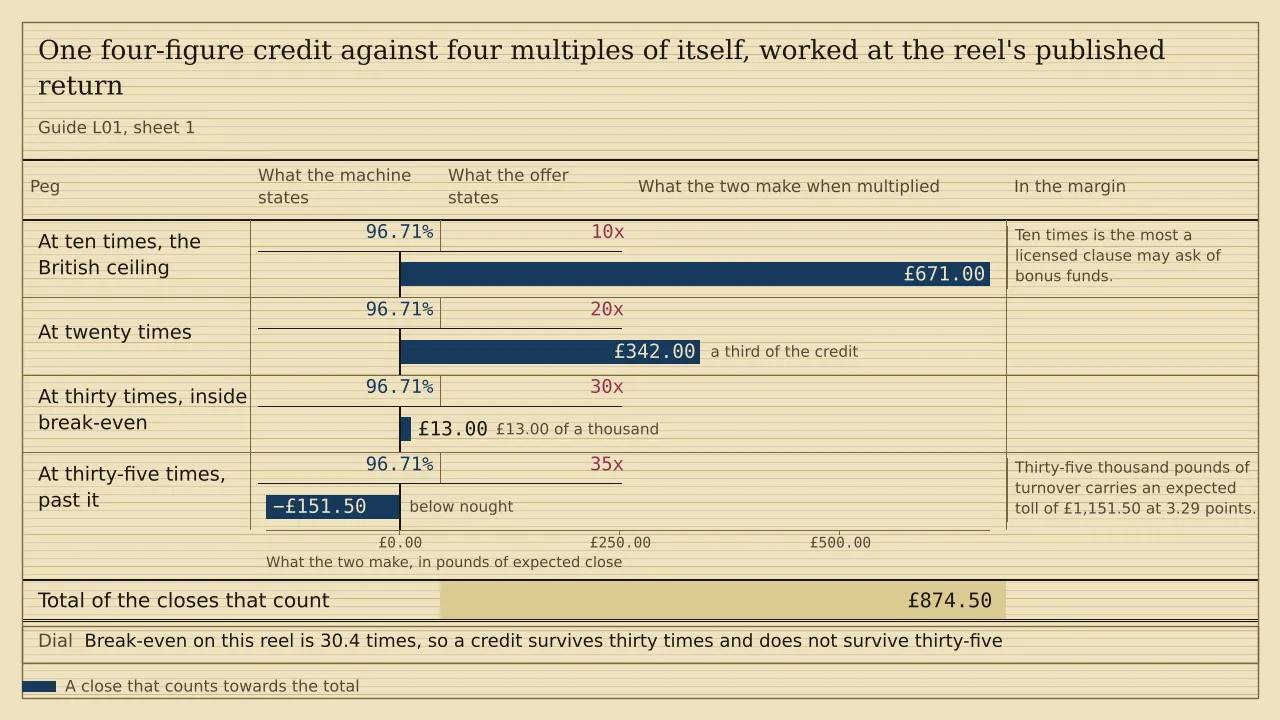
Thirty-five times a thousand pounds is thirty-five thousand pounds of turnover, and turnover is the quantity a reel charges for. The charge is the complement of the published return the studio’s own information item: at 96.71 per cent the reel keeps back 3.29 points of whatever passes through it, which puts a toll of £1,151.50 on £35,000.00 of turnover. The credit is a thousand. The toll is eleven hundred and fifty-one pounds fifty. The close is the difference, and the difference is minus £151.50.
Written as one line, with the weighting an offer gives a named slot towards its own requirement standing as g:
E = B × (1 − W × (1 − RTP) ∕ g)
B stands for the advertised credit and W for the multiple of it that must be staked; RTP is whichever published return the title in hand carries, and g is the weighting, one wherever a named slot counts in full a term of the offer, not of the game. The useful property of the line is the sign. Put W past the reciprocal of the house edge and the answer crosses below nought, and an answer below nought is the arithmetic reporting that a clause has eaten its own inducement.
That reciprocal is where a four-figure balance gets interesting, because it is not a round number and it is not a constant on this site. Three point two nine points of edge inverts to 30.4, so a thousand pounds survives its own clause at thirty times and does not at thirty-five. The gap between those two multiples is five, which sounds like nothing and is worth £164.50 of close on this credit: £13.00 standing at thirty times against minus £151.50 at thirty-five. Nothing about the size of the credit produced that. A hundred pounds at the same two multiples closes at £1.30 and minus £15.15, which is the same arithmetic with a decimal point moved, and that is the whole of what size does here.
| The title weighed | Published return | Break-even play-through | The offer asks | What £1,000.00 is worth |
|---|---|---|---|---|
| The original | 96.71 per cent | 30.4 times | 35 times | minus £151.50 |
| A title at the family’s lower figure | 96.07 per cent | 25.4 times | 35 times | minus £375.50 |
| What the name on the tile is worth | 0.64 points of return | 5.0 times | no change | £224.00 |
Two hundred and twenty-four pounds separates the two rows above, and the offer is word for word the same in both. A reader who carries a thousand-pound credit to one of the nine titles whose published figure is 96.07 per cent has paid £224.00 for a choice nobody asked them to make and nobody priced for them. Section seven comes back to how that choice is presented.
2
The range is the machine’s and the ceiling on a turn is not
One turn on the original can be bought anywhere between 0.10 and 250.00, and that pair of figures comes out of the session data rather than off any page a reader could browse the coin steps the game hands its own client, each coin value multiplied by the ten paylines the title rules. The cheapest turn the machine sells and the dearest stand two and a half thousand steps apart, which is a wider spread than any clause has ever imposed on anything. None of it is printed where a reader would look: the maker’s information block holds the return and stops there, so going to the studio to find out what a turn costs settles one figure out of two.
Read the top of that range against what a licensed British cycle may take and it stops being available. A game cycle on a licensed site is held to £5 of stake, and to £2 again where the account belongs to somebody aged eighteen to twenty-four the 2025 amendment regulations, so fifty steps of the machine’s own range sit above anything a licensed cashier could offer and the arithmetic of a very large turn simply never arises there. Outside that licence nothing holds the cycle at all, and the machine’s own ceiling is then the only one standing. The table below is therefore two sums about the same reel, one of which can be had in Great Britain and one of which cannot.
| Which end of the range | Price of one turn | Turns a £1,000 credit buys | Expected cost of an hour | Most one turn may hand over | What £1,000.00 closes at |
|---|---|---|---|---|---|
| The head of the machine’s own range | £250.00 | 4 turns | £11,844.00 | £525,000.00 | minus £151.50 |
| The most a licensed cycle may take | £5.00 | 200 turns | £236.88 | £10,500.00 | minus £151.50 |
| What the licensed ceiling moves | £245.00 | minus 196 turns | £11,607.12 | £514,500.00 | no change |
One column of that closing row reads no change, and that column settles whether the offer is worth taking at all: the credit closes at minus £151.50 at both ends of the published range, since a proportion survives multiplication. Everything that did move is in the other four, and the second of them is the one nobody expects. A ceiling on what a turn may cost takes no money away from a reader at all: it hands them 196 extra turns out of the same thousand pounds, and 196 turns is thirty-nine times as much play as four turns are. The cost of an hour and the sum one turn may hand back both rise with the turn price, and both belong to sections five and six.
Nobody holding a Great Britain licence could have written the clause this card has just priced. A play-through attached to bonus funds there cannot ask more than ten times. That ceiling dates from 19 January 2026, and ten times closes at £671.00 instead of £151.50 below nothing, which puts £822.50 of difference into one clause and makes that the price of the licence in money rather than in adjectives. Two further duties bear directly on the sums in this section. A licensed game cycle takes £5 at most, and £2 at most from an eighteen to twenty-four-year-old, so the £250.00 at the head of the machine’s published range is unreachable on a licensed site and the third column above is an offshore column only. And a licensed build has to leave 2.5 seconds between the opening of one cycle and the earliest opening of the next, which fixes the fastest possible spend at 1,440 turns an hour and makes the hourly figures in section five ceilings rather than guesses. A thirty-five-times clause is already outside the first duty, and whatever falls outside the first falls outside the other two, since one licence imposes the three of them and nothing else imposes any. Gamstop Online is bound to that same licence and stops where the licence stops: registering closes down whatever accounts Britain’s own licensees are holding for that reader, and the scheme’s terms say plainly that it cannot reach a gambling service whose operator never joined it.
3
Nine published quantities, sorted by what the stake does to them
A reel is a scale-free machine. Nothing in its published figures knows how much a turn cost, which means every quantity it states either multiplies by the turn price, divides by it, or refuses to notice it, and a reader who sorts the nine quantities on the game sheet into those three heaps has most of what a large balance needs to know.
Four multiply. The expected toll on one turn is 3.29 points of the turn price, so it runs from a third of a penny at 10p to £8.22 at £250.00. The expected toll on an hour is the same figure taken 1,440 times. The turnover an hour commits is the turn price taken 1,440 times, from £144.00 at the foot of the range to £360,000.00 at its head. And the maximum the round may hand over is 2,100 times the stake the win limit in the game’s own data, which is £210.00 at the foot and £525,000.00 at the head.
Two divide. A fixed sum of money buys the sum divided by the turn price, so a thousand pounds is ten thousand turns at the cheapest and four at the dearest. Time follows count, because the count is what the clock is applied to, and the hour a thousand pounds lasts at the foot of the range is six and a half seconds at its head.
Three refuse to move at all, and these are the three the trade quotes. The published return is 96.71 per cent at every price of turn. The break-even multiple is 30.4 times at every price of turn, because it is built out of the return and nothing else. And the ceiling is timed at once in 3,880,481 turns at every price of turn. The data the game sends its client carries that rate, and carries no other frequency of any kind whatever. A reader at £250.00 a turn is playing the identical machine a reader at 10p is playing, on the identical odds, and is reaching the end of it two and a half thousand times faster.
That inventory is the reason this card can state a close of minus £151.50 without ever naming a turn price. The close belongs to the credit and the clause, both of which are sums of money, and the toll is a proportion. Proportions survive multiplication. It is also the reason the two most common pieces of advice given to a reader with a large balance point in opposite directions: raise the stake and the sum at stake per turn goes up with it, while the fraction of the balance the conditions will take is exactly where it was.
One quantity sits awkwardly in the sorting and is worth naming rather than filing. The feature round opens on a scatter count of three, four or five, and the turns it awards against those counts are ten, fifteen and twenty the trigger map the page and the data agree on. Those are counts of turns rather than sums of money, so they neither multiply nor divide. What the round is then worth does multiply, because the turns inside it run at the price of the turn that triggered them.
4
Solving for the turn price at which a written clause starts to bind
Here is the finding this card exists to reach, and it is the one thing on it that is not published by anybody. Clauses written against a large balance are quoted in money: a ceiling on what may be withdrawn, a largest permitted stake while a credit is in play, a cap on what a single round may be worth. The reel’s own capacity is quoted as a multiple. A multiple against a sum of money has a crossing point, and the crossing point is a turn price, and nothing in either document tells a reader what it is.
Take a ceiling of £500.00 on what may leave the account. The reel can reach £500.00 in one round only where 2,100 times the turn price is at least £500.00, which is a turn price of £0.2381. Below that the ceiling is inert: at 10p a turn the most the round may produce is £210.00, so a £500.00 ceiling has nothing to do and could be set at £5,000.00 without changing one penny of what a reader may keep. Above it the ceiling is the binding figure rather than the reel: at £5.00 a turn the round may reach £10,500.00 and the ceiling removes £10,000.00 of that. The same sentence in the same terms is decoration at one turn price and the whole of the deal at another, and the deciding figure is a quarter of a pound.
The arithmetic generalises in one step. Divide the money the clause names by 2,100 and the answer is the turn price at which the clause starts to matter this card’s own working, from the win limit and nothing else. A £1,000.00 ceiling crosses at £0.4762 a turn. A £10,000.00 ceiling crosses at £4.7619, which is just inside the most a licensed cycle may take, so on a licensed site a five-figure ceiling is almost exactly the point at which the reel and the paperwork meet. A £100,000.00 ceiling crosses at £47.62 a turn, which exists only where no licensed ceiling on the cycle is standing.
A largest-permitted-stake clause works the other way round and is cruder. A clause holding a turn to £5.00 while a credit is live is fifty steps above the cheapest turn the machine sells and fifty steps below the dearest, so it cannot bind a reader playing at the foot of the range and cuts the turn price by a factor of fifty for a reader who came for the head of it. The close does not notice either way, because the close is a proportion, but the clock does: £35,000.00 of required turnover is 140 turns at £250.00 and 7,000 turns at £5.00, and 7,000 turns at the pace ceiling a licence imposes is four hours fifty-two minutes against six minutes at the other price.
So the honest answer to what a large balance is for is a question back: which clause in the terms names a sum of money, and what does that sum divided by 2,100 come to? A reader who works that one division before committing knows which sentences in the terms can reach them and which cannot, and that is not a judgement about anybody. It is the win limit in the game’s own data divided by a figure printed in the offer.
5
What an hour costs at each end of the published range
An hour is the unit a reader actually spends, and the reel fixes how many turns can be got into one. A licensed build is held to 2.5 seconds between the opening of one cycle and the first moment the next may open the pace standard written for slots, the reader has to let go of the start control and press it afresh for each cycle, and automatic play is barred outright, so an hour cannot be spent on more than 1,440 turns and no arrangement of buttons gets past that. That number is a ceiling rather than a measurement: nobody here has played anything, and a reader who pauses between turns reaches fewer.
Multiply the ceiling by the toll and the cost of an hour is 47.376 times the turn price. At the foot of the machine’s published range it is £4.74 an hour. At £2.00 a turn it is £94.75. At the most a licensed cycle may take it is £236.88. At the head of the machine’s own range it is £11,844.00, on turnover of £360,000.00, which is the figure that makes the phrase about a larger stake buying a shorter clock concrete rather than rhetorical.
£11,844.00 of expected cost in one hour at the head of the published range, against £236.88 at the most a licensed cycle may take, with the same reel and the same 96.71 per cent behind both
Two things follow that are worth more than the figures. The first is that the fifty-fold gap between those two hourly costs is produced entirely by the turn price, which is the one quantity in this whole arithmetic that nobody but the reader chooses. The second is that an hourly cost is the only form in which the toll becomes legible. Three point two nine points sounds small, and £11,844.00 an hour does not, and they are the same statement about the same machine.
The thirty-five-times clause has an hourly reading too. £35,000.00 of turnover at £250.00 a turn is 140 turns, which is five minutes fifty seconds at the quickest, and the expected toll on it is £1,151.50. A reader who has met a four-figure credit and a large turn price together has therefore met a six-minute arrangement with an expected cost of eleven hundred pounds, and the headline on it was a thousand pounds free. At £5.00 a turn the same clause is 7,000 turns and a little under five hours, and the expected toll is the identical £1,151.50, because turnover is turnover and the reel charges for turnover.
6
The ceiling moves and the wait for it does not
The game states one hit rate and it belongs to the largest outcome alone: the win limit is timed at once in 3,880,481 turns the win-limit rate the session data carries. That is the figure a reader with a large balance is implicitly buying, because the whole case for a large turn price is that the ceiling is a bigger sum of money at the top of the range than at the bottom, and it is. At 10p the ceiling is £210.00. At £250.00 it is £525,000.00.
What does not change is the queue. Taken at 1,440 turns an hour, that rate works out at 2,694.8 hours, and 2,694.8 unbroken hours are 112.3 days, and the answer is the same at both ends of the range, since the rate sits in the reel rather than in the stake and the clock has only the rate to act on. A reader at the head of the range is not closer to the ceiling than a reader at the foot. They are buying the same wait at two and a half thousand times the price per hour, and getting two and a half thousand times the prize if the wait ends.
Set that against the credit this card is weighing and the proportions come out plainly. Thirty-five thousand pounds of turnover at £250.00 a turn is 140 turns. One hundred and forty turns out of 3,880,481 is a shade over one part in twenty-seven thousand, so roughly 27,718 readers would have to clear the identical clause at the identical turn price for one of them to see the win limit land while doing it. The expected toll across those readers is £1,151.50 each. That is not a prediction about anybody and it is not a reason to do anything: it is two published figures divided by one another, and the division is the only honest way to say how far the ceiling is from the arithmetic of an offer.
The game sheet carries one further figure worth putting beside the ceiling, and one silence worth naming. The figure is the money symbol, which the studio describes as reaching 2,000 times the stake inside the feature round, a hundred stakes short of everything the round may produce at once. The silence is the base-game hit rate, which neither the studio nor the game’s own data states anywhere, so this card gives none and no figure on it depends on one. A reader who has met a frequency quoted for the feature round has met a reviewer’s characterisation, and the pair of them in circulation are not within half as much again of one another, which is the sort of disagreement a quantity with no publisher attracts.
7
Choosing a name on a lobby tile is choosing a toll
The studio’s own site lists thirty-six game pages with Bass in the title, and across them it prints ten different returns, with two more appearing only in the data the games hand a browser. Six of the pages carry the original’s 96.71 per cent. Nine titles are published at 96.07 per cent, which is 0.64 points lower, and that is the spread the closing row in section one was built on. The lowest published figure for a slot in the family is 96.04 per cent on the maker’s page, while the same title’s own data answers 96.06, so the two primary sources are two hundredths of a point apart on exactly the title where a reader would care most.
For a reader spending ten pounds the spread is loose change. For a reader clearing £35,000.00 of required turnover it is the largest single figure in the whole calculation: 0.64 points of 35,000 is £224.00, which is more than the close itself is worth at any multiple inside break-even. The difference between taking a large credit to the original and taking it to a title published 0.64 points lower is therefore bigger than the difference between a good clause and a slightly better one, and the offer says nothing about it because the offer is written about the account rather than about the game.
This is also where the arithmetic has to stop short, and the stopping point is worth stating in the open. The published return is the one figure the studio prints for every title; it does not print a maximum win, a payline count, a stake range, a hit rate or a release date on any of the thirty-six, which is why every other figure on this card had to be read out of what the game hands its own client. The trade meanwhile repeats that this studio ships its titles at a choice of returns and lets whoever installs them pick. The game sheet went looking and found exactly one figure printed per title across all thirty-six pages, no statement anywhere that anything varies, and the same figure returned from seven different jurisdiction values asked of the studio’s own server. The only sources are affiliate reviews, they disagree with one another about how many figures exist and about what the figures are, and one of them lists five while its own prose says three. So this card neither asserts the claim nor denies it, prints none of the candidate figures, and works every sum above at the figure the studio actually publishes. A reader weighing a four-figure credit is entitled to know that the one quantity the whole calculation turns on is published once per title and corroborated only by the title’s own data.
What a reader can do with that is narrow and real. The published return is readable inside a licensed game before anything is committed, because a licensed build owes a reader something about the chances of winning before any commitment is made, and a published return is one of four alternative disclosures that discharges the duty. Outside that licence nobody is obliged to publish such a figure at all, and nothing on the regulatory sheet requires a site to say which of anything it is running. Where the number cannot be read, the £224.00 in section one cannot be worked out, and a reader is choosing a toll blind.
8
What the size actually buys, once the proportions are out of the way
Collect the figures. A thousand pounds at thirty-five times closes at minus £151.50 on the original and at minus £375.50 on a title 0.64 points lower. Ten times, which is the most a licensed clause may ask, closes at £671.00, so the clause alone is worth £822.50. The expected toll on the required turnover is £1,151.50 at every turn price the machine sells. The ceiling is 2,100 times whatever the turn cost and the queue for it runs to 2,694.8 hours at the fastest a licence lets a build go. The crossing point of any money clause is that clause divided by 2,100.
Put them together and the answer to what a large turn price buys is: the same outcome, sooner, in bigger units. It does not buy a better return, a shorter queue to the ceiling, a lower proportionate toll or a softer clause. It buys compression. Two and a half thousand steps of compression are available on this reel, from £4.74 of expected cost an hour to £11,844.00, and the licensed ceiling on a cycle cuts the available compression to fifty steps and hands back 196 turns out of a thousand pounds while doing it.
One figure in that list is settled by the reader and by nobody else, namely what a single turn is to cost, and it is the one figure an offer never prints. The advertised credit, the multiple, the ceiling on a withdrawal and the largest permitted stake are all quoted by whoever wrote the terms, and all four of those figures are sums of money meaning different things at different turn prices. The reel’s own figures are quoted by the studio and its session data, and they mean the same thing at every turn price. Where those two kinds of figure meet is the only place this card has anything to say, and what it has to say is one division: divide the money the terms name by 2,100 and the clause has either reached you or it has not.
None of that is a statement about any particular place of play, and none of it is a recommendation. Offers written for a large balance are licensed somewhere other than Great Britain, which is why a thirty-five-times clause can be written at all, and the duties that would have held the clause to ten times, held the cycle to £5, held the cycle open for 2.5 seconds and put the account into a national register of self-exclusions are duties of a licence those offers do not hold. The reel is the same reel. Everything written around it is not.
Questions
- Does a bigger stake improve anything about the game itself
- No. The published return holds at 96.71 per cent, the break-even multiple holds at 30.4 times, and the win limit is still timed at once in 3,880,481 turns. A bigger stake changes the size of each outcome and how fast the reader arrives at it, which is why an hour costs £4.74 at 10p a turn and £11,844.00 at £250.00.
- What is the largest stake this reel will take on one turn
- The session data offers a single turn at anything from 0.10 up to 250.00, each coin value taken against the title’s ten paylines. Set that beside the British ceiling on a game cycle, which is £5, with £2 standing instead where the account holder is aged eighteen to twenty-four: the head of the machine’s range belongs to sites holding no Great Britain licence.
- How much play-through can an offer legitimately ask of a large credit
- Inside the British licence a play-through attached to bonus funds became limited to ten times on 19 January 2026, and ten times against a £1,000.00 credit leaves £671.00 standing. Thirty-five times leaves minus £151.50, since break-even on this reel is 30.4 times and thirty-five has gone past it.
- At what stake does a maximum withdrawal clause actually start to matter
- Divide the sum the clause names by 2,100, which is the most the round may hand over per stake. A £500.00 ceiling crosses at £0.2381 a turn, a £1,000.00 ceiling at £0.4762 and a £10,000.00 ceiling at £4.7619. Below the crossing point the reel cannot reach the ceiling and the clause does nothing.
- Is it cheaper to clear a wagering requirement at a high stake or a low one
- Neither, in expectation. Thirty-five thousand pounds of turnover carries a toll of £1,151.50 whether it arrives as 140 turns at £250.00 or 7,000 turns at £5.00, the toll being 3.29 points of turnover and nothing besides. What differs is the clock: six minutes against nearly five hours at the pace ceiling a licence imposes.
- Which title of the family should a large credit be spent on
- This card names no venue and recommends nothing, but the figure is worth having: 0.64 points separates the original’s 96.71 per cent from the nine titles published at 96.07, and on £35,000.00 of turnover that is £224.00. Six of the studio’s thirty-six game pages carry the higher figure.
- How long would it take to reach the maximum win on this reel
- Taken at 1,440 turns an hour, the ceiling a licensed build’s pace carries, the rate works out at 2,694.8 hours, or 112.3 days of unbroken play. That queue is identical at every price of turn, since the rate sits in the reel and the stake settles only what the outcome is worth in money.
- Does the studio really offer this game at several different returns
- Nobody has published a figure that says so. One return is printed on each of the maker’s thirty-six Bass game pages, nothing there says the figure varies, and seven different jurisdiction values asked of the maker’s own server all answered with the same number. The claim rests on affiliate reviews that disagree, so every sum here is worked at the published figure.
- What does the offshore side of this market cost a reader in protections
- Duty by duty: no ten-times ceiling on a play-through, no £5 or £2 cap on a game cycle, nothing holding a turn open for 2.5 seconds, no ban on automatic play, nothing stopping a build from making a show of a win that did not beat its own stake, and no place in the national register of self-exclusions. Every one of those is a duty of a licence rather than a property of the reel.