Best Bitcoin casino: how long a balance lasts, and the two spreads nobody prints
A balance of £144.00 put across Big Bass Bonanza is expected to generate £4,376.90 of turnover before it is gone, because the balance divided by the house edge is the whole of that sum and the stake cancels out of it. At the floor under a turn that is 30.4 hours of continuous play.
- Updated 13 November 2026
- Licence status shown for every offer
- Assumptions marked in the text
Places of play taking a moving unit, weighed against one named reel
These offers are paid placements, so this site is owed a fee whenever a reader opens an account through one of the buttons below.
-

Tweedbet
Welcome pack 470%
- Licence
- Not stated, no Great Britain licence
- Play-through
- Not published
- Min deposit
- £20
Bonus up to£14,000 Free spins470Read the offer18+ only. Terms apply.
Licence, terms and working
The site does not say where it is licensed or which company runs it.
The reel
- Build of the reel
- Big Bass Bonanza
- Return it publishes
- 96.71 per cent
- Stake it accepts on one turn
- 10p to £250.00
The offer
- Turns advertised
- 470 turns Turns valued at the cheapest turn this reel sells, no worth for one being stated anywhere in the offer
- Price of one turn
- 10p the smallest stake the reel accepts, this operator publishing no figure of its own
- Credit as a sum
- £14,000.00
- Credit waiting on a payment
- Stated in words Casino Welcome Pack 470% up to £14,000 + 470 FS. Crypto Welcome Bonus 110% up to 1,300 USDT + 110 FS. VIP Welcome Pack 770% up to £13,000
- Advertised, priced
- £14,047.00 140,470 turns of this reel
Hung on it
- Play-through
- Not published
- Credited towards it
- 100 per cent nobody has published a share, so the whole of a stake is credited, which is the kindest reading available
- Ceiling on winnings
- Not published
- Qualifying payment
- £20.00 200 turns of this reel at the price above, and it enters no weight
Not weighed, for want of the play-through multiple as a number.
Stated in words means the condition is set down in words that cost something and give nothing to subtract. Not published means the operator sets the figure down nowhere.
-

EliteSpin
£5,000 + 500 FS
- Licence
- Costa Rica, no Great Britain licence
- Play-through
- 40×
- Min deposit
- £20
Bonus up to£5,000 Free spins500Read the offer18+ only. Terms apply.
Licence, terms and working
Licence held in Costa Rica, by PrimeTier Limited.
The reel
- Build of the reel
- Big Bass Bonanza
- Return it publishes
- 96.71 per cent
- Stake it accepts on one turn
- 10p to £250.00
The offer
- Turns advertised
- 500 turns Turns valued at the cheapest turn this reel sells, no worth for one being stated anywhere in the offer
- Price of one turn
- 10p the smallest stake the reel accepts, this operator publishing no figure of its own
- Credit as a sum
- £5,000.00
- Credit waiting on a payment
- Stated in words Welcome bonus €/£5,000 + 500 FS. Elite lootboxes unlock surprise rewards up to €/£20,000 or 500 FS. Summer Festival by BGaming: win €80,000
- Advertised, priced
- £5,050.00 50,500 turns of this reel
Hung on it
- Play-through
- 40 times the bonus and the winnings from the spins
- Credited towards it
- 100 per cent nobody has published a share, so the whole of a stake is credited, which is the kindest reading available
- Ceiling on winnings
- Stated in words Five times the bonus
- Qualifying payment
- £20.00 200 turns of this reel at the price above, and it enters no weight
Priced at 10p a turn, the banner comes to £5,050.00, of which £5,048.36 survives the spins. At the reel's published return of 96.71 per cent, a play-through of 40 times asks for £201,934.20 of staking and costs £6,643.64, more than there is to pay it with, so the offer weighs £0.00.
Stated in words means the condition is set down in words that cost something and give nothing to subtract.
-

WinBeast
€5,000 + 500 FS
- Licence
- Curaçao, no Great Britain licence
- Min deposit
- €20
- Free spins
- 500
Bonus up to€5,000 Play-through40×Read the offer18+ only. Terms apply.
Licence, terms and working
Licence held in Curaçao, by a company the site does not name.
The reel
- Build of the reel
- Big Bass Bonanza
- Return it publishes
- 96.71 per cent
- Stake it accepts on one turn
- 10c to €250.00
The offer
- Turns advertised
- 500 turns Turns valued at the cheapest turn this reel sells, no worth for one being stated anywhere in the offer
- Price of one turn
- 10c the smallest stake the reel accepts, this operator publishing no figure of its own
- Credit as a sum
- €5,000.00
- Credit waiting on a payment
- Stated in words Welcome pack €5,000 + 500 FS + €650 free bet. Fortune wheel on €40+ deposits with code FORTUNE. 40% up to €300 Beast Boost Monday with code BOOST1 on €20 deposit
- Advertised, priced
- €5,050.00 50,500 turns of this reel
Hung on it
- Play-through
- 40 times the bonus and the winnings from the spins
- Credited towards it
- 100 per cent nobody has published a share, so the whole of a stake is credited, which is the kindest reading available
- Ceiling on winnings
- Stated in words €100 a batch of spins
- Qualifying payment
- €20.00 200 turns of this reel at the price above, and it enters no weight
Priced at 10c a turn, the banner comes to €5,050.00, of which €5,048.36 survives the spins. At the reel's published return of 96.71 per cent, a play-through of 40 times asks for €201,934.20 of staking and costs €6,643.64, more than there is to pay it with, so the offer weighs €0.00.
Stated in words means the condition is set down in words that cost something and give nothing to subtract.
-

Betportal
300% + 150 FS
- Licence
- Anjouan, Comoros, no Great Britain licence
- Play-through
- 35×
- Min deposit
- €20
- Stake cap
- €5.00
Bonus up to€1,000 Free spins150Read the offer18+ only. Terms apply.
Licence, terms and working
Licence held in Anjouan, Comoros, by BetPortal Gaming Ltd and Excite Ultra Media Ltd, numbered ALSI-202601040-FI2.
The reel
- Build of the reel
- Big Bass Bonanza
- Return it publishes
- 96.71 per cent
- Stake it accepts on one turn
- 10c to €250.00
The offer
- Turns advertised
- 150 turns Turns valued at the cheapest turn this reel sells, no worth for one being stated anywhere in the offer
- Price of one turn
- 10c the smallest stake the reel accepts, this operator publishing no figure of its own
- Credit as a sum
- €1,000.00
- Credit waiting on a payment
- Stated in words Welcome package 300% up to €1,000 + 150 free spins. 1st deposit 150% up to €500 + 100 FS. 2nd deposit 100% up to €300 + 50 FS
- Advertised, priced
- €1,015.00 10,150 turns of this reel
Hung on it
- Play-through
- 35 times the bonus
- Credited towards it
- 100 per cent nobody has published a share, so the whole of a stake is credited, which is the kindest reading available
- Ceiling on winnings
- Stated in words Five times the bonus
- Largest stake while it runs
- €5.00 under the largest stake the reel accepts, so part of the machine's own range is shut off while the credit runs
- Qualifying payment
- €20.00 200 turns of this reel at the price above, and it enters no weight
Priced at 10c a turn, the banner comes to €1,015.00, of which €1,014.51 survives the spins. At the reel's published return of 96.71 per cent, a play-through of 35 times asks for €35,507.73 of staking and costs €1,168.20, more than there is to pay it with, so the offer weighs €0.00.
Stated in words means the condition is set down in words that cost something and give nothing to subtract.
-

Night Luck
805% + 280 FS
- Licence
- Not stated, no Great Britain licence
- Play-through
- Not published
- Min deposit
- €20
Bonus up to€6,400 Free spins280Read the offer18+ only. Terms apply.
Licence, terms and working
The site does not say where it is licensed or which company runs it.
The reel
- Build of the reel
- Big Bass Bonanza
- Return it publishes
- 96.71 per cent
- Stake it accepts on one turn
- 10c to €250.00
The offer
- Turns advertised
- 280 turns Turns valued at the cheapest turn this reel sells, no worth for one being stated anywhere in the offer
- Price of one turn
- 10c the smallest stake the reel accepts, this operator publishing no figure of its own
- Credit as a sum
- €6,400.00
- Credit waiting on a payment
- Stated in words Casino welcome bonus 805% up to €6,400 + 280 FS. Crypto welcome bonus 140% up to 1,600 USDT + 140 FS. VIP welcome pack 800% up to €14,500
- Advertised, priced
- €6,428.00 64,280 turns of this reel
Hung on it
- Play-through
- Not published
- Credited towards it
- 100 per cent nobody has published a share, so the whole of a stake is credited, which is the kindest reading available
- Ceiling on winnings
- Not published
- Qualifying payment
- €20.00 200 turns of this reel at the price above, and it enters no weight
Not weighed, for want of the play-through multiple as a number.
Stated in words means the condition is set down in words that cost something and give nothing to subtract. Not published means the operator sets the figure down nowhere.
What a Great Britain licence would add to these offers
A licence from the Gambling Commission for Great Britain carries rules that an offer licensed elsewhere does not have to follow, and some figures in this ranking would not survive them. Social responsibility code provision 5.1.1 stops a British licensee applying a wagering requirement of more than ten times the bonus funds, and that limit has applied since 19 January 2026. A play-through above ten times in this list is therefore one a British licence would not allow.
Regulation 5(2) of the Gambling Act 2005 (Operating Licence Conditions) (Amendment) Regulations 2025, made on 25 February 2025, limits what a player can stake on one game cycle of an online slot to £5, or £2 for a player under 25. It is a condition of a British remote casino licence and not a property of the game, so a player at an operator licensed elsewhere does not have it behind them.
Remote technical standard 14D asks for at least two and a half seconds from the start of one slot game cycle to the start of the next, with the player pressing start each time. It is addressed to the game and not to the money, so no figure in this ranking measures it.
GAMSTOP is the free scheme that closes your accounts with online gambling companies licensed in Great Britain, and every one of them must join it. An operator licensed elsewhere is not required to, so a GAMSTOP registration cannot be counted on to reach these offers. If gambling is costing more than money, the National Gambling Helpline is free and answers on 0808 8020 133 at any hour.
Ranking last changed 8 November 2026. Operator terms change without notice, so open the offer page and read the terms there before you register.
At a glance
Those are the centre of the distribution and the only part of it anybody publishes: the width around it needs a figure for the machine’s dispersion, which nobody states, and a figure for the unit’s, which this site has no source for.
- What the machine states96.71 per centThe original’s published return, which leaves an edge of 3.29 points. It is the only quantity in the horizon below that comes from anywhere at all, and inverting it is what turns a balance into a span of play.
- What the offer states£144.00 heldA balance of the size one hour at the cheapest step puts across the reel, which this page supposes so that the two quantities can be compared directly. Any other balance scales every figure below it in proportion.
- What the two make when multiplied£4,376.90The turnover that balance is expected to generate before it is exhausted, which is the balance divided by an edge of 3.29 points. The figure is a mean rather than a forecast, and this page is about what stands either side of it.
On this page
- The horizon, and why the stake falls out of it
- How a quantity of turnover becomes a quantity of time
- A centre everybody can compute, and two widths nobody prints
- The machine’s spread, and the figure that has no publisher
- The unit’s spread, and the source this page has not got
- Two reels, two horizons, one balance
- Why the two spreads will not add into one answer
- What this page declines to rank, and what it hands over instead
The horizon, and why the stake falls out of it
Begin with the one quantity on this subject that can be computed from published figures alone. At 96.71 per cent the reel takes 3.29 points of all that is staked on it the maker’s figure for the original, so a balance crossing it sheds that proportion of every pound of turnover, and the turnover it is expected to produce before it is exhausted is the balance divided by that proportion. For £144.00 the answer is £4,376.90.
Notice what is not in that sentence. There is no stake in it. Divide a balance by an edge and the result is a quantity of turnover, and the size of the individual turns making up the turnover never enters: a thousand turns at a tenth of a pound and a hundred at a pound produce the same figure. The stake decides how fast the turnover accumulates and has nothing to say about how much of it there will be.
That is worth dwelling on because it turns the usual advice inside out. A reader lowering their stake has not made the balance last longer in turnover; they have made it last longer in turns and in minutes, which is a different quantity, and probably the one they meant. The sum of money crossing the reel before the balance is gone was fixed the moment the balance and the reel were chosen.
Scale the balance and the horizon scales exactly with it, since the division is linear in the balance and in nothing else. Fifty pounds across the same reel is expected to produce £1,519.76 of turnover; five hundred is expected to produce £15,197.57. Neither figure moves if the stake changes, and both move in strict proportion if the balance does, which is the whole of the behaviour of a mean.
One more consequence falls straight out of the arithmetic, and it is the kind of coincidence that turns out not to be one. The break-even play-through on this reel is 30.4 times the credit, being the same edge inverted, and a balance the size of one hour’s worth of turnover lasts 30.4 hours. The two figures are the same number because they are the same division performed on two different things, and the shared figure is the clearest single statement of what an edge of 3.29 points means.
How a quantity of turnover becomes a quantity of time
Turnover is the wrong unit for a reader, who thinks in evenings rather than in sums crossing a counter, so the horizon needs dividing by a rate. The rate is an hour’s worth of play, and an hour’s worth of play is itself fixed by a duty: no more than 1,440 cycles will fit inside one where a floor holds them open RTS 14D, off the rule sheet. Spend the least step on the price list through all of them the house stake, said again where it is spent and the hour costs £4.74 in expectation, which is the divisor this part needs.
Divide the horizon by the hour and the balance of £144.00 comes to 30.4 hours of continuous play. At a balance of £50.00 it is 10.5 hours; at £500.00 it is 105.5. Those are means and they are reported here as means, which is a distinction part four is entirely about.
Exactness about what the horizon is not matters here, because the phrase invites a misreading. It is not a promise that a balance survives that long, nor a claim that it survives at all, nor a statement about any particular evening. It is the point at which the expected losses add up to the balance, computed on a figure the maker publishes, and the arithmetic has nothing to say about which side of it a given run falls.
Two further quantities travel with the horizon and are worth naming, because they move with the balance in the same proportion: the turns it is expected to buy, which at the cheapest step is the turnover divided by that step, and the minutes those turns occupy wherever a floor holds the clock. Both scale linearly, and both stop being computable in the same place the hours do.
Put the three together for the balance this page prices and they read across: £4,376.90 of expected turnover, 43,769 turns of it at the cheapest step, and 30.4 hours wherever a floor holds the cycle open. One division produces all three, and the last of them is the only one that needs a duty to exist.
The floor is what makes any of that a time at all. Remove it and the turnover figure survives untouched, because it never depended on the clock, while the hours figure stops existing: the same £4,376.90 could cross the reel in half the time or a quarter of it, and no published figure says which. So of the two ways of stating a horizon, one is a property of the machine and the reader’s balance, and the other needs a duty that only a licence imposes.
That matters more here than on a page about pounds, for a reason the next three parts develop. A balance held in a moving unit is exposed to the unit for as long as it is held, so the length of the horizon in hours is not a convenience of presentation. It is the span over which the second of the two costs on this page has to act.
A centre everybody can compute, and two widths nobody prints
Now the superlative in this page’s key, which asks for an ordering and deserves a precise answer rather than a refusal. Order places of play by how long a balance lasts at one of them and the quantity being ordered is a distribution, not a number. A distribution needs two things before anything can be ranked on it: where it is centred and how wide it is. The centre is part one, and anybody with the published return can compute it in one division.
The width is the problem, and it is the problem twice over. Half of it belongs to the machine: how far an individual run departs from the mean, which follows from the paytable and from the way the outcomes are spread through it. The other half belongs to the unit a balance is denominated in, which moves on its own account over the span the first half plays out in. Neither half is published anywhere this page may cite, and the two have different causes, so neither can stand in for the other.
That is a different answer from the one a reader usually gets, and the difference is worth being plain about. The objection is not that the figures are hard to find. It is that an ordering on survival would need three inputs, of which exactly one is published, and the other two come from different sources with no reason to be related. A single ranking implies they can be combined into one score. They cannot, and part seven shows why in arithmetic rather than in assertion.
A reader might ask why this page prices a horizon at all, if the width around it is the thing that decides any actual case. The answer is that the centre is the only part anybody can check. Hand over a derivation of the width and a reader has to trust the derivation; hand over the centre and they can perform the division themselves in a line, against a figure printed on the maker’s own page.
So what this page can honestly do is hand over the centre and name the two widths, which is what the parts below do in order. No mark out of anything appears on this domain, no rating of this publisher’s invention, and no ordering of places of play by a quantity assembled out of two figures nobody states.
The machine’s spread, and the figure that has no publisher
The word everybody reaches for here is volatility, and the first thing to say about it is that this machine has none. Not a low one or a high one: the maker publishes no such figure on any of its thirty-six pages for this family, and the response the game sends a client has no field one could sit in recorded as unpublished, not as unknown. Any description of this reel’s variance that a reader meets anywhere belongs to whoever wrote it, and the three reviews the game sheet examined characterise it in three incompatible ways, and one of them manages to disagree with itself between its own table and its own prose.
What is published instead, and what the width would have to be derived from, is a short list: the paytable, a single turn’s ceiling of 2,100 stakes, and the rate at which a turn of that size arrives, which the data gives as 1 in 3,880,481 both figures off the game’s own data. A reel whose largest outcome is that rare, and that large, has most of its return arriving in pieces a session does not contain, which is a statement about shape rather than a figure for it.
Put the two published figures together and the shape they describe is a long tail. A turn capable of returning 2,100 stakes, arriving about once in four million, accounts for part of the published return on its own, and whatever part that is has been subtracted from what the ordinary turns give back. A reader will meet the ordinary turns and will almost certainly never meet the other kind.
Deriving a width from those three is real work and it belongs to the section of this site built on how long a balance lasts, not to this page. What this page takes from it is the one thing it needs: the machine’s half of the width is derivable from published quantities but is not itself published, so an ordering using it would be an ordering on somebody’s derivation rather than on anybody’s figure.
It is worth saying what follows for the horizon in part one, because a mean and a shape interact. The 30.4 hours is where the distribution sits, and on a reel with most of its return in rare pieces the typical run finishes earlier than the mean while a small number of runs go far past it. That is not a hedge. It is the arithmetic of a long tail, and it means the figure most readers want, which is the usual case rather than the average one, is further from 30.4 hours than they would expect.
The unit’s spread, and the source this page has not got
The second width is the one this page’s key is really about, and the position on it is simple to state and unsatisfying to read. Neither of the two sheets behind this site publishes anything about the price history of any unit of account. One carries regulatory fact and the other carries fact about the machine, and a figure for how far a unit moves in thirty hours is in neither of them.
So no figure for it appears here. What can be said without one is structural and is worth having. The unit’s movement acts on whatever balance is held, for as long as it is held, which on the arithmetic above is 30.4 hours for a balance of £144.00 at the cheapest step and proportionally longer for a larger one. A reader who plays more slowly is exposed to the machine for the same turnover and to the unit for longer, which is the one place the two widths are connected at all, and they are connected through the clock rather than through anything either of them does.
There is a second structural point, and it cuts against the usual way of writing about this. The unit’s movement is symmetric in a sense the machine’s is not. A reel returning less than the whole of what crosses it produces an expected cost in one direction only, which is why every figure on this domain is a cost. A unit that moves can move either way, so the second width widens the distribution without shifting its centre, while the first both widens it and shifts it. Those are different operations and a single ordering would have to collapse them.
What this page will not do is fill the gap with an estimate. An estimate dropped in here would carry no claim number while sitting beside figures that do, which is the one thing this site cannot afford to print.
Two reels, two horizons, one balance
Before leaving the centre, it is worth showing how far it moves on published figures alone, because that movement is the part of this subject a reader can actually act on. The same balance has a different horizon on every reel of the family, since the horizon is the balance divided by the edge and the family publishes a dozen distinct returns. The table takes the original and a reel published at 96.07 per cent, which nine of the family carry.
| The title weighed | Published return | Break-even play-through | Turnover before it is gone | Hours at the floor |
|---|---|---|---|---|
| The original | 96.71 per cent | 30.4 times | £4,376.90 | 30.4 hours |
| A reel of the same family | 96.07 per cent | 25.4 times | £3,664.12 | 25.4 hours |
| What the reel is worth | 0.64 points of return | 5.0 times | £712.78 | 5.0 hours |
Two columns of that table carry the same figures, and the repetition is the finding rather than a slip. Break-even and the horizon in hours are both the edge inverted, so a reel’s break-even multiple read in times is its balance’s life read in hours, on a balance the size of one hour’s worth of turnover. Five times the credit of difference in the first is five hours of difference in the second.
Five hours out of thirty is a sixth of the horizon, available from a published figure and requiring nothing from either of the two widths. Set that beside the ordering part three declined to make, and the comparison is the practical one: the quantity nobody can rank moves the answer by an unknown amount, and the quantity anybody can read off a maker’s page moves it by a sixth.
£4,376.90of turnover and 30.4 hours is where the distribution sits, and both of the widths around it come from sources this page has named and cannot quote
Why the two spreads will not add into one answer
Here is the arithmetic behind part three’s refusal, and it takes three lines. The machine’s cost is a proportion of turnover: £4,376.90 of it accounts for the whole £144.00, by construction. The unit’s effect is a proportion of the balance held, and the balance falls as the turnover accumulates, from £144.00 at the start towards nothing at the horizon. The two therefore act on quantities that are not only different but moving in opposite directions through the same span.
A single ordering of places of play by survival would need those combined into one number, and combining them needs a figure for how a balance declines through the span, which is the shape of the distribution rather than its mean. That is the first width. It would also need a figure for the unit’s movement, which is the second. A score assembled without them would be the author’s assumptions wearing the clothes of the machine’s figures, and this domain exists to tell those two apart.
Here is the contrast in one pair of sentences. Two readers who put the same balance across the same reel at the same step have the same expected turnover and the same expected hours, whatever either of them is holding their balance in. What they do not have is the same distribution of outcomes, and the difference between their distributions comes from a quantity neither the maker nor this site publishes.
There is a cleaner way to see the same point. Two readers at the same place of play, one holding a balance in a unit that moves and one in a unit that does not, meet identical published returns, an identical ceiling, an identical price list and an identical horizon in turnover. Everything orderable about the place of play is the same for both of them. What differs is a property of the money, not of the venue, which is why an ordering of venues cannot carry it.
That is the answer to the key, stated as plainly as it can be. The ordering a reader wants is an ordering of outcomes rather than of places, the centre of those outcomes is published-derivable and identical wherever the reel runs, and the two widths belong to a machine nobody has measured publicly and to a market this site does not cover.
What this page declines to rank, and what it hands over instead
What a reader takes away from here is three published-derivable figures and two named gaps. The figures are the horizon in turnover, the horizon in hours wherever a floor holds the clock, and the distance between two reels of one family. The gaps are the machine’s dispersion, which has no publisher, and the unit’s, which has no source on either sheet this site is built from.
The drawing sets three balances against the same reel so that the proportionality is visible: the horizon scales with the balance exactly, because the division that produces it is linear in the balance and in nothing else.
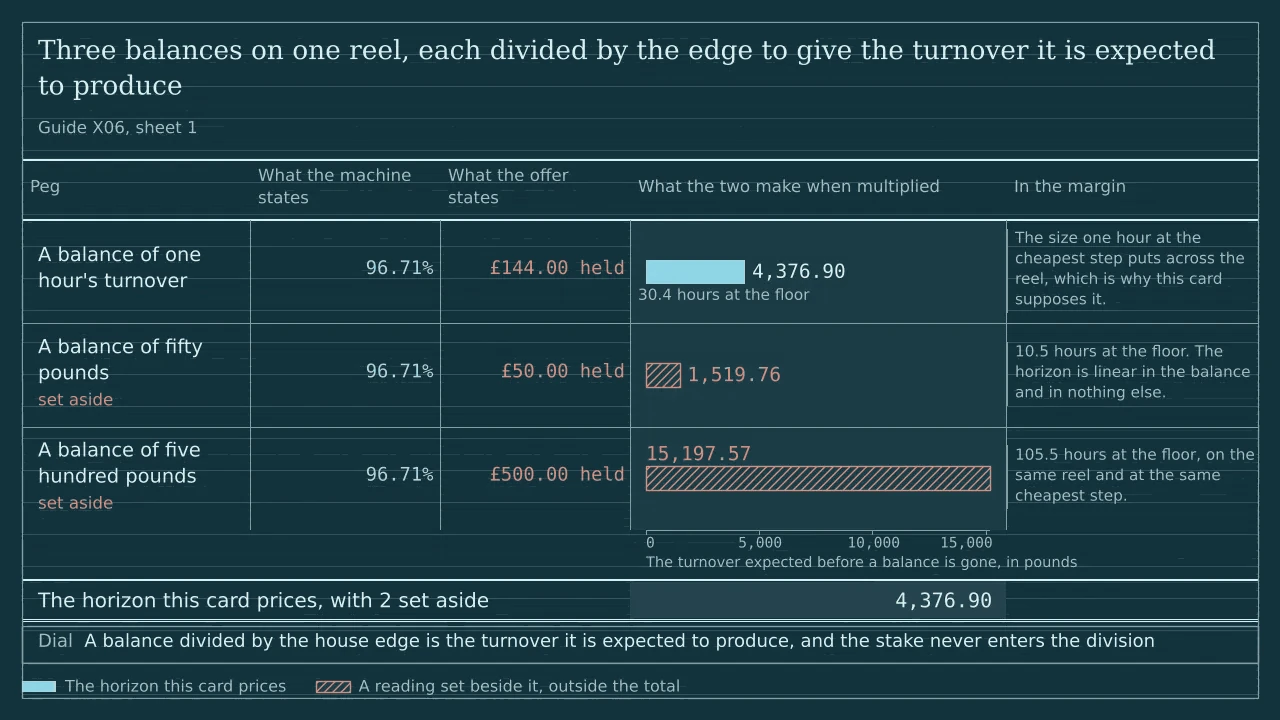
So the practical use of this page is the centre and the proportionality: a horizon any reader can compute for any balance in one division, and a set of named gaps where the rest of the answer would be. That is less than an ordering, and it is the part that can be checked.
Two cautions close the page and both are house rules rather than opinions. Nothing here says a reel is ever owed anything: each turn is settled by itself, the published figure is an average over a count of turns no session contains, and a run of outcomes bears on nothing that follows it. And nothing here says which way a unit will move, because a page with no source for that has nothing to say about it in either direction.
Which leaves the honest version of the question a reader arrived with. Not which place of play is best, which cannot be computed, but how long a given balance is expected to last on a given reel, which can be computed exactly and comes to 30.4 hours for £144.00 on this one. Everything beyond that is a width, and the widths are where this subject keeps its uncertainty rather than where it hides it.
Questions readers ask
How long is a balance expected to last on this reel?
A balance divided by the house edge gives the turnover it is expected to generate before it is gone, so £144.00 at an edge of 3.29 points comes to £4,376.90. Where a licensed floor holds an hour to 1,440 turns and the stake is 0.10, that is 30.4 hours of continuous play. Both figures are means rather than forecasts.
Does playing at a smaller stake make a balance last longer?
In turns and in hours, yes; in turnover, no. The turnover a balance is expected to produce before it is exhausted is the balance divided by the edge, and no stake appears in that division. A smaller stake spreads the same turnover over more turns and more time, which is usually what a reader means and is not the same claim.
What is this reel’s volatility?
There is no such published figure, not for this reel and not for any other title the maker lists. Its pages carry none and the response the game sends a client has no field one could sit in, so every characterisation a reader meets belongs to whoever wrote it. Three reviews the game sheet read describe the variance in three incompatible ways, and one of them disagrees with its own table.
Why will this page not rank places of play on survival?
Because survival is a distribution rather than a number, and ranking one needs its centre and its width. The centre is published-derivable and identical wherever the reel runs. The width has two halves, one belonging to a machine nobody has published a dispersion for and one to the movement of a unit this site has no source for, and they have different causes.
Does a moving unit change the expected horizon?
Not its centre. The horizon in turnover is the balance over the edge and neither term involves a unit, so the figure is the same count in whatever the balance is denominated in. What a moving unit does is widen the distribution around that centre without shifting it, because it can move either way, while the machine’s edge shifts the centre in one direction only.
How much does the choice of reel move the horizon?
By a sixth, between the two ends of this comparison. A balance of £144.00 is expected to produce £4,376.90 of turnover on the original, which publishes 96.71 per cent, and £3,664.12 on a reel of the family at 96.07, which is 30.4 hours against 25.4 at the floor. The difference of £712.78 and five hours comes entirely from published figures.
Why do break-even and the horizon show the same number?
Because each is the house edge inverted. One divided by the edge, read in times the credit, is the break-even multiple; the same division read in hours is how long a balance the size of an hour’s worth of turnover lasts. On this reel the figure is 30.4 in both senses at once, and on a reel of the family published at 96.07 it is 25.4 in both.
What should a reader do with the two gaps?
Treat them as the places where the uncertainty lives rather than as missing decoration. The centre of the distribution is exact and can be worked out for any balance in one division. Anyone holding a figure for either width from a source that publishes one can carry it to the centre this page supplies, which is the division of labour a page without that source can honestly offer.
Before you play
Read on
- A unit that moves under the price list
- The reel’s stake steps are the same numbers whichever unit a session opens in, so the rail changes what a fixed count of steps is worth and nothing else.
- Where a public record stops
- A register settles whether the duties reaching a reel apply at all, and settles nothing about which of twenty-eight steps anybody takes.
- The check behind a stake ceiling
- The ceiling is written per individual, so the identity duty is what puts an account on one side of it, and the two ceilings are £142.13 an hour apart.
- How long a balance lasts on it
- The quantity that decides a session is the one quantity of the six that nobody publishes, so the section derives it from the paytable and the ceiling.