USDT casino: what a unit’s steadiness would be worth, if anybody published it
A unit offered as holding still against the money a British reader thinks in is making a claim about a price, and a claim about a price is exactly the kind of thing this domain goes looking for a publisher of. Neither sheet behind this page has one.
- Updated 13 November 2026
- Licence status shown for every offer
- Assumptions marked in the text
Cashiers whose authorisation comes from somewhere other than Great Britain, set against one named reel
These offers are paid placements, so this site is owed a fee whenever a reader opens an account through one of the buttons below.
-

Tweedbet
Welcome pack 470%
- Licence
- Not stated, no Great Britain licence
- Play-through
- Not published
- Min deposit
- £20
Bonus up to£14,000 Free spins470Read the offer18+ only. Terms apply.
Licence, terms and working
The site does not say where it is licensed or which company runs it.
The reel
- Build of the reel
- Big Bass Bonanza
- Return it publishes
- 96.71 per cent
- Stake it accepts on one turn
- 10p to £250.00
The offer
- Turns advertised
- 470 turns Turns valued at the cheapest turn this reel sells, no worth for one being stated anywhere in the offer
- Price of one turn
- 10p the smallest stake the reel accepts, this operator publishing no figure of its own
- Credit as a sum
- £14,000.00
- Credit waiting on a payment
- Stated in words Casino Welcome Pack 470% up to £14,000 + 470 FS. Crypto Welcome Bonus 110% up to 1,300 USDT + 110 FS. VIP Welcome Pack 770% up to £13,000
- Advertised, priced
- £14,047.00 140,470 turns of this reel
Hung on it
- Play-through
- Not published
- Credited towards it
- 100 per cent nobody has published a share, so the whole of a stake is credited, which is the kindest reading available
- Ceiling on winnings
- Not published
- Qualifying payment
- £20.00 200 turns of this reel at the price above, and it enters no weight
Not weighed, for want of the play-through multiple as a number.
Stated in words means the condition is set down in words that cost something and give nothing to subtract. Not published means the operator sets the figure down nowhere.
-

EliteSpin
£5,000 + 500 FS
- Licence
- Costa Rica, no Great Britain licence
- Play-through
- 40×
- Min deposit
- £20
Bonus up to£5,000 Free spins500Read the offer18+ only. Terms apply.
Licence, terms and working
Licence held in Costa Rica, by PrimeTier Limited.
The reel
- Build of the reel
- Big Bass Bonanza
- Return it publishes
- 96.71 per cent
- Stake it accepts on one turn
- 10p to £250.00
The offer
- Turns advertised
- 500 turns Turns valued at the cheapest turn this reel sells, no worth for one being stated anywhere in the offer
- Price of one turn
- 10p the smallest stake the reel accepts, this operator publishing no figure of its own
- Credit as a sum
- £5,000.00
- Credit waiting on a payment
- Stated in words Welcome bonus €/£5,000 + 500 FS. Elite lootboxes unlock surprise rewards up to €/£20,000 or 500 FS. Summer Festival by BGaming: win €80,000
- Advertised, priced
- £5,050.00 50,500 turns of this reel
Hung on it
- Play-through
- 40 times the bonus and the winnings from the spins
- Credited towards it
- 100 per cent nobody has published a share, so the whole of a stake is credited, which is the kindest reading available
- Ceiling on winnings
- Stated in words Five times the bonus
- Qualifying payment
- £20.00 200 turns of this reel at the price above, and it enters no weight
Priced at 10p a turn, the banner comes to £5,050.00, of which £5,048.36 survives the spins. At the reel's published return of 96.71 per cent, a play-through of 40 times asks for £201,934.20 of staking and costs £6,643.64, more than there is to pay it with, so the offer weighs £0.00.
Stated in words means the condition is set down in words that cost something and give nothing to subtract.
-

WinBeast
€5,000 + 500 FS
- Licence
- Curaçao, no Great Britain licence
- Min deposit
- €20
- Free spins
- 500
Bonus up to€5,000 Play-through40×Read the offer18+ only. Terms apply.
Licence, terms and working
Licence held in Curaçao, by a company the site does not name.
The reel
- Build of the reel
- Big Bass Bonanza
- Return it publishes
- 96.71 per cent
- Stake it accepts on one turn
- 10c to €250.00
The offer
- Turns advertised
- 500 turns Turns valued at the cheapest turn this reel sells, no worth for one being stated anywhere in the offer
- Price of one turn
- 10c the smallest stake the reel accepts, this operator publishing no figure of its own
- Credit as a sum
- €5,000.00
- Credit waiting on a payment
- Stated in words Welcome pack €5,000 + 500 FS + €650 free bet. Fortune wheel on €40+ deposits with code FORTUNE. 40% up to €300 Beast Boost Monday with code BOOST1 on €20 deposit
- Advertised, priced
- €5,050.00 50,500 turns of this reel
Hung on it
- Play-through
- 40 times the bonus and the winnings from the spins
- Credited towards it
- 100 per cent nobody has published a share, so the whole of a stake is credited, which is the kindest reading available
- Ceiling on winnings
- Stated in words €100 a batch of spins
- Qualifying payment
- €20.00 200 turns of this reel at the price above, and it enters no weight
Priced at 10c a turn, the banner comes to €5,050.00, of which €5,048.36 survives the spins. At the reel's published return of 96.71 per cent, a play-through of 40 times asks for €201,934.20 of staking and costs €6,643.64, more than there is to pay it with, so the offer weighs €0.00.
Stated in words means the condition is set down in words that cost something and give nothing to subtract.
-

Betportal
300% + 150 FS
- Licence
- Anjouan, Comoros, no Great Britain licence
- Play-through
- 35×
- Min deposit
- €20
- Stake cap
- €5.00
Bonus up to€1,000 Free spins150Read the offer18+ only. Terms apply.
Licence, terms and working
Licence held in Anjouan, Comoros, by BetPortal Gaming Ltd and Excite Ultra Media Ltd, numbered ALSI-202601040-FI2.
The reel
- Build of the reel
- Big Bass Bonanza
- Return it publishes
- 96.71 per cent
- Stake it accepts on one turn
- 10c to €250.00
The offer
- Turns advertised
- 150 turns Turns valued at the cheapest turn this reel sells, no worth for one being stated anywhere in the offer
- Price of one turn
- 10c the smallest stake the reel accepts, this operator publishing no figure of its own
- Credit as a sum
- €1,000.00
- Credit waiting on a payment
- Stated in words Welcome package 300% up to €1,000 + 150 free spins. 1st deposit 150% up to €500 + 100 FS. 2nd deposit 100% up to €300 + 50 FS
- Advertised, priced
- €1,015.00 10,150 turns of this reel
Hung on it
- Play-through
- 35 times the bonus
- Credited towards it
- 100 per cent nobody has published a share, so the whole of a stake is credited, which is the kindest reading available
- Ceiling on winnings
- Stated in words Five times the bonus
- Largest stake while it runs
- €5.00 under the largest stake the reel accepts, so part of the machine's own range is shut off while the credit runs
- Qualifying payment
- €20.00 200 turns of this reel at the price above, and it enters no weight
Priced at 10c a turn, the banner comes to €1,015.00, of which €1,014.51 survives the spins. At the reel's published return of 96.71 per cent, a play-through of 35 times asks for €35,507.73 of staking and costs €1,168.20, more than there is to pay it with, so the offer weighs €0.00.
Stated in words means the condition is set down in words that cost something and give nothing to subtract.
-

Night Luck
805% + 280 FS
- Licence
- Not stated, no Great Britain licence
- Play-through
- Not published
- Min deposit
- €20
Bonus up to€6,400 Free spins280Read the offer18+ only. Terms apply.
Licence, terms and working
The site does not say where it is licensed or which company runs it.
The reel
- Build of the reel
- Big Bass Bonanza
- Return it publishes
- 96.71 per cent
- Stake it accepts on one turn
- 10c to €250.00
The offer
- Turns advertised
- 280 turns Turns valued at the cheapest turn this reel sells, no worth for one being stated anywhere in the offer
- Price of one turn
- 10c the smallest stake the reel accepts, this operator publishing no figure of its own
- Credit as a sum
- €6,400.00
- Credit waiting on a payment
- Stated in words Casino welcome bonus 805% up to €6,400 + 280 FS. Crypto welcome bonus 140% up to 1,600 USDT + 140 FS. VIP welcome pack 800% up to €14,500
- Advertised, priced
- €6,428.00 64,280 turns of this reel
Hung on it
- Play-through
- Not published
- Credited towards it
- 100 per cent nobody has published a share, so the whole of a stake is credited, which is the kindest reading available
- Ceiling on winnings
- Not published
- Qualifying payment
- €20.00 200 turns of this reel at the price above, and it enters no weight
Not weighed, for want of the play-through multiple as a number.
Stated in words means the condition is set down in words that cost something and give nothing to subtract. Not published means the operator sets the figure down nowhere.
What a Great Britain licence would add to these offers
A licence from the Gambling Commission for Great Britain carries rules that an offer licensed elsewhere does not have to follow, and some figures in this ranking would not survive them. Social responsibility code provision 5.1.1 stops a British licensee applying a wagering requirement of more than ten times the bonus funds, and that limit has applied since 19 January 2026. A play-through above ten times in this list is therefore one a British licence would not allow.
Regulation 5(2) of the Gambling Act 2005 (Operating Licence Conditions) (Amendment) Regulations 2025, made on 25 February 2025, limits what a player can stake on one game cycle of an online slot to £5, or £2 for a player under 25. It is a condition of a British remote casino licence and not a property of the game, so a player at an operator licensed elsewhere does not have it behind them.
Remote technical standard 14D asks for at least two and a half seconds from the start of one slot game cycle to the start of the next, with the player pressing start each time. It is addressed to the game and not to the money, so no figure in this ranking measures it.
GAMSTOP is the free scheme that closes your accounts with online gambling companies licensed in Great Britain, and every one of them must join it. An operator licensed elsewhere is not required to, so a GAMSTOP registration cannot be counted on to reach these offers. If gambling is costing more than money, the National Gambling Helpline is free and answers on 0808 8020 133 at any hour.
Ranking last changed 8 November 2026. Operator terms change without notice, so open the offer page and read the terms there before you register.
At a glance
So the claim cannot be priced, and what can be priced instead is the size at which it would start to matter. Across a holding of £200.00, the distance between the highest figure the studio prints for this family and the figure nine of its titles share is 0.64 points of return and £1.28 of one pass across the reel. A unit slipping by less than that has cost a reader less than the name on the lobby tile did.
- What the machine states0.64 pointsTwo published returns subtracted: the 96.71 per cent the studio gives the original against the 96.07 carried by nine of its titles. It is on this page as a yardstick rather than as a cost, because a reader with no way of sizing a slip in a unit can at least size it against something the maker prints.
- What the offer states£200.00 heldA holding of this publisher’s own choosing, and this page names it as a supposition wherever it is spent. Nothing about it is advertised anywhere and nothing turns on its size: the arithmetic is linear in it, so a reader holding more or less multiplies the columns below.
- What the two make when multiplied£1.28The published spread applied to the supposed holding, so it is both the money a reader gives up by being on the lower-returning reel and the size of slip in a unit that would take the same sum. Two quite different risks, and this is where they cross.
On this page
- A claim about a price, put through this domain’s own method
- What the claim rests on, as far as these two sheets reach
- Two thresholds, both of them figures somebody published
- One pass of a holding, and a certainty that is not an average
- A slip, converted into turns of the reel
- Three holdings read at two of the family’s figures
- Which of the two costs more, and where the answer turns over
- What stays unpriced here, and why the gap will not be filled
A claim about a price, put through this domain’s own method
The method on this domain has three steps and they are the same whatever is being weighed. Take a figure the machine states about itself. Take a figure the offer states about itself. See what the two come to at the point of meeting. Run the proposition in front of us through that method and it falls over at the first step, because a unit offered as standing still is not stating a figure about a machine at all. It is stating a figure about itself, and the figure is one.
No complaint is intended by that. It is the one interesting thing about this subject, and it decides the whole shape of the page. A published return describes a machine and can be looked up on the maker’s own page. A play-through describes an offer and can be read in terms before anything is committed. A unit’s steadiness describes neither, and the only document that could settle it would be a record of prices this publisher has no sanctioned source for. So this page does not say whether the unit holds still, does not say it fails, and prices the question instead of the answer: how large would a slip have to be before it mattered against the figures the reel does publish?
Three things make that a real question rather than a dodge. The reel’s figures are fixed, published and checkable, so they make a yardstick. A slip in a unit is a certain loss on whatever is held in it, where the reel’s edge is an average taken over turns nobody counts. And the two bear on the same money at the same time, which means a reader is carrying both and can only usefully carry one of them in their head. Putting the second in the units of the first is the only comparison available, and it needs no figure for the unit whatever.
What the claim rests on, as far as these two sheets reach
Two sheets stand behind every figure on this domain and it is worth saying exactly what each of them covers, because the answer the heading asks for lies in the shape of that coverage rather than in any single claim. One sheet is about a studio, its thirty-six game pages and the data its own server hands a client when a session opens. It carries returns, grids, lines, ceilings, stake steps, a paytable and one hit rate. It carries no price for anything, in any unit, on any date.
The other sheet is about a regulator and the documents a regulator publishes: conditions on a licence, technical standards, statutory instruments, an enforcement record, the terms of a self-exclusion scheme. It carries a great deal about what a licensee must do with money it holds, including a duty to tell a customer in its own terms whether a holding would survive the business going under, and a rating system with four named levels for saying how far it would. What it does not carry, anywhere, is a statement that any unit of account holds a particular value against any other.
So the answer is that within the sources this page may use, the claim rests on nothing: not on a regulator’s document, not on the maker’s pages, not on the data the game is sent. That is a narrow finding and it is worth stating narrowly. It does not mean no record of prices exists in the world. It means this publisher has no sanctioned reading of one, cannot date one, and will not convert a figure it cannot cite into money on a page where every other figure carries a numbered claim behind it.
There is one sourced point about holdings that does bear on this, and it is worth having beside the rest. Inside the British licence the question of whether money held on a reader’s behalf would survive the business failing is not left to inference: a licensee has to set out the position in its terms, rate how far the protection goes against a published scale, hand the statement to the customer in writing, and secure an acknowledgement before any of it is staked condition 4.2.1. A licensee using the lowest of those ratings has to repeat the warning twice a year and say what the holding is worth. None of that tells a reader what a unit is worth. All of it is the kind of duty that produces a document, and a document is what the question in this heading wants and has not got.
Two thresholds, both of them figures somebody published
If the size of a slip cannot be looked up, the next best thing is a scale to read it against, and the family supplies two marks on that scale. The first is the distance between its own published returns. The studio gives the original 96.71 per cent and gives 96.07 to nine of its other titles, which puts 0.64 points between them claim 75c. The second is the house edge of the original itself, which is 3.29 points, being whatever a hundred less that figure comes to.
Those two marks answer two different questions. A slip of 0.64 points costs a holding what moving between the top of the family and its most-shared lower figure costs it, which is to say that it costs what a reader’s choice of lobby tile already costs them. A slip of 3.29 points costs a holding exactly what putting the whole holding across the original once is expected to cost. Below the first mark the unit is the smallest thing a reader is carrying. Above the second it is larger than a complete pass of their money across the reel.
| The title weighed | Published return | Break-even play-through | One pass of the holding costs | A slip of equal cost |
|---|---|---|---|---|
| The original | 96.71 per cent | 30.4 times | £6.58 | 3.29 points |
| The family’s shared lower figure | 96.07 per cent | 25.4 times | £7.86 | 3.93 points |
| The original, less the lower figure | 0.64 points of return | 5.0 times | −£1.28 | −0.64 points |
The closing row is negative in both of the last two columns because the better reel stands on the first line, and reordering to tidy that away would have thrown out what the row is for. The reel with more to give back costs less to cross, and it needs a smaller slip in a unit to match that cost. The two figures in the row are the same fact twice: 0.64 points of return and £1.28 on a holding of £200.00 are one quantity expressed in the units of the reel and in the units of the money.
The lower row is Big Bass Keeping it Reel, and it was chosen rather than the lowest figure in the family for a reason the sheet itself supplies. The lowest published slot figure is the 96.04 per cent on one title, and on that very title two hundredths separate what the maker prints from what the game reports claim 119. The 96.07 used here is carried by nine titles and both primary sources agree on all nine, which makes it the firmer of the two marks for a page whose whole subject is what rests on a source.
One pass of a holding, and a certainty that is not an average
A pass is worth defining before it is priced. Putting a holding across the reel once means staking the whole of it, in turns of whatever size, with nothing being staked twice. On £200.00 at the published return of the original the expectation is that £6.58 stays behind, and the rest comes back in a distribution this page is not in a position to describe. The 3.29 points doing that work comes from taking that return away from a hundred, so it is as sourced as the return is.
Now set the two risks side by side on the same holding, at the same moment, in the same currency. A slip of 3.29 points takes £6.58 from the holding with certainty, once, before anything is staked. A pass across the reel is expected to take £6.58, over many turns, with a spread round it. The arithmetic says those are equal. This page’s reading is that they are not, and the reason is the shape of each outcome rather than its size.
The asymmetry runs one way and it is worth being precise about which. A reader who stakes a holding and meets the average has lost the £6.58. A reader who stakes it and does better than the average has lost less, and one who does worse has lost more, and both of those are real possibilities whose sizes the published quantities here do not settle. A slip has none of that: it is taken from the whole holding, it does not depend on how the turns fall, and it is already a loss at the moment it happens. The expected sums match and the distributions do not, which is why a page that stopped at the matching figure would have told half the story.
One further thing the comparison needs is a floor under the reel’s clock, and that is where the licence comes in. A licensed build holds a cycle open 2.5 seconds before another may begin RTS 14D, so 1,440 turns is as many as an hour will take. A holding of £200.00 spent at the cheapest step the game sells supposed, at the published floor is 2,000 turns, so one pass of it occupies at least one hour and twenty-three minutes. The slip is instantaneous. The pass has a duration the rules put a floor under, and that difference is the only thing on this page the regulator supplies.
A slip of 3.29 points on a holding takes with certainty what a complete pass of that holding across the original is expected to take over 2,000 turns
A slip, converted into turns of the reel
Money is the awkward unit for this comparison, because a slip is quoted as a proportion and a reel is priced per turn. Turns are the unit that takes both. At the cheapest step the game’s own data states claim 25, which is the step this page supposes throughout and is naming again here, a slip of 0.64 points on the supposed £200.00 is £1.28 and buys 12 whole turns. A slip of 3.29 points is £6.58 and buys 65. Neither count is rounded: the reel sells no fraction of a turn, so each division has been taken down.
Twelve turns is 30 seconds at the quickest a licensed cycle allows, and 65 turns is two minutes and forty-two seconds of it. Those are small intervals and printing them small is the point. The whole published spread of this family’s slot returns, applied to a holding of two hundred pounds, is half a minute of play. A slip the size of the original’s own house edge is under three minutes of it. Anybody carrying a figure for the unit in their head can divide it by the same step and get their own count.
| The mark on the scale | On the supposed holding | Whole turns at the cheapest step |
|---|---|---|
| The family’s published spread, 0.64 points | £1.28 | 12 |
| The original’s house edge, 3.29 points | £6.58 | 65 |
What the conversion buys a reader is a sense of scale that does not need the missing figure. A slip cannot be looked up here, but a count of turns can be looked at, and a reader who knows what twelve turns feels like knows what the family’s entire spread of published returns is worth on two hundred pounds. The point of putting it that way round is that the smaller of the two quantities is the one every review in this trade writes about, and the larger is the one none of them can source.
Three holdings read at two of the family’s figures
Everything above has been worked on one holding, and the drawing takes the same arithmetic to two others so that the linearity is visible rather than asserted. A column is ruled for each of the two published returns in part three, a peg is given to each of three holdings, and what stands in the cells is the expected cost of one pass. The page closes on the span between the ends and not on a total, because two readings of one holding are two accounts of the same money and a sum of them would be a quantity of nothing at all.
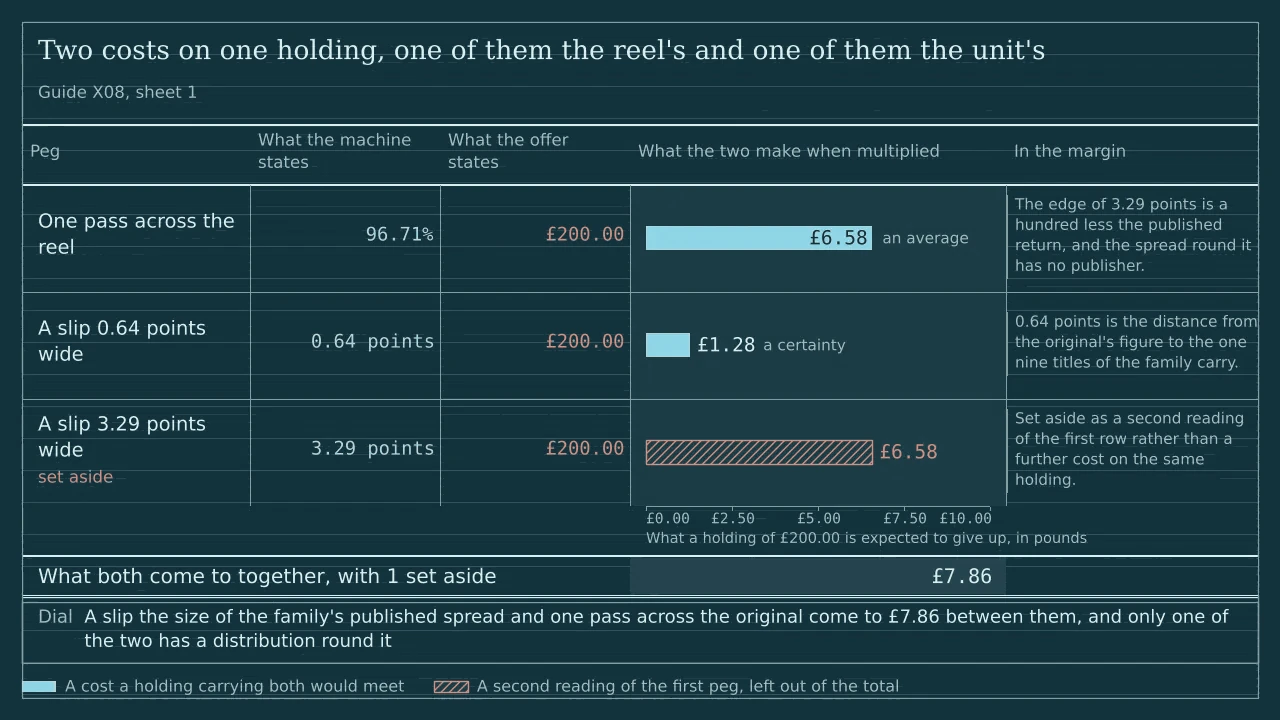
Read the spans and the proportion never moves, which is what linear means here. The £0.32 at fifty pounds, the £1.28 at two hundred and the £3.20 at five hundred are all the same 0.64 points, and so is the slip that would match them. A reader holding ten times as much has ten times as much riding on both the unit and the lobby tile, in the same ratio, and nothing in the comparison between them changes.
That is the useful half of the result and there is an awkward half. Because the two scale together, no size of holding makes the unit question answerable: a reader who holds a great deal is not better placed to judge a slip than a reader who holds little, merely more exposed to one. The only thing that would settle it is the figure neither sheet carries, and no amount of arithmetic on the holdings produces it.
Which of the two costs more, and where the answer turns over
Set the question properly and it has a clean answer with a published threshold in it. A reader is carrying two costs. One is the reel’s, and it is the house edge applied to everything staked, which for the original is 3.29 points of each pass. The other is the unit’s, and it is whatever slip occurs applied once to the holding. The second overtakes the first when the slip passes the edge, and that is the threshold: 3.29 points on the original, 3.93 points on the family’s shared lower figure, 3.96 points on the lowest of its slots.
Three consequences come out of that and all three run against what a reader would guess. The first is that the threshold is higher on a worse reel. A reel giving back less costs more to cross, so it takes a larger slip to overtake it, which means the unit matters least exactly where the machine matters most. The second is that the threshold is indifferent to the size of the holding, the two sides of the comparison scaling together as part six showed. The third is that the threshold applies to one pass. Stake a holding twice and the reel’s side doubles while the unit’s side stays where it was.
That third point deserves its own sentence, because it is where a reader is most likely to go wrong in the other direction. A holding that crosses the reel ten times has met the edge ten times, and ten passes of £200.00 at 3.29 points come to £65.80 of expected cost against a single slip of the same proportion costing £6.58. So for anybody doing more than a pass or two, the reel is much the larger of the two, and the way round for the threshold to matter is a holding that barely plays at all.
None of which is advice about what to hold or where. It is a statement about which of two quantities is larger under which conditions, worked at figures the maker publishes and at a holding this page supposed. A reader who wants the comparison done at their own holding and their own count of passes has everything needed above: the published return, the edge it leaves, the supposed stake named each time it is spent, and the arithmetic in the open.
What stays unpriced here, and why the gap will not be filled
Four quantities a reader would want are absent and the page is better for naming them than for quietly working round them. The first is the obvious one: how far the unit actually moves, if at all. No sanctioned source behind this domain publishes a price history of anything, and a figure taken from somewhere else would read exactly like a figure read off a sheet. The second is how often. A frequency needs a series, and the absence of the first absence makes the second one unanswerable.
The third is the spread round a pass across the reel, which part four leaned on without quantifying. The studio prints no measure of dispersion on any page it has for this family, and nothing in what the game returns to a browser makes room for one. What is published is the far tail: the maximum win at 2,100 times the stake, and 1 in 3,880,481 turns as the published frequency of one that large claims 27 and 29. Those two describe the rarest outcome the reel has and say nothing whatever about the middle of the distribution, which is where a reader’s pass will actually land.
The fourth is the one a reader would most reasonably expect an affiliate page to supply, which is a figure for how much of this trade uses one arrangement rather than another. The rule sheet is explicit that nothing primary it could reach supplies a distribution of that kind, and explicit again that no count exists of how many cashiers hold any given authorisation the sheet’s unverified entries. So this page describes what an arrangement would cost and never how common one is, and the difference between those two sentences is the difference between arithmetic and guesswork.
What is left standing is three figures and a threshold. On a holding of £200.00, the distance between the highest return the maker prints for this family and the figure nine of its titles carry is £1.28, which is 12 whole turns at the step supposed here. A slip equal to the original’s own edge of 3.29 points is £6.58, or 65 turns, and is the point at which the unit overtakes a single pass across the reel. And both of those thresholds are published figures about a machine, which is the only reason this page has anything to say about a unit nobody here can price.
Questions readers ask
Does a unit that holds its value make a slot cheaper to play?
Not by a penny. The cost of playing is the published return applied to whatever is staked, and 96.71 per cent on the original leaves an edge of 3.29 points in expectation whatever the money is called. A steady unit removes one cost that sits beside the reel rather than inside it, and this page’s arithmetic is about where the two cross.
How large would a slip in the unit have to be to matter?
There are two marks worth knowing. A slip of 0.64 points costs a holding what moving from the family’s highest published return to the figure nine of its titles share costs it, which on a supposed £200.00 is £1.28. A slip of 3.29 points costs what one complete pass of that holding across the original is expected to cost, which is £6.58. Those are published figures about a machine, not estimates of a unit.
Why does this page give no figure for the unit at all?
Because no sheet this page may open holds one. One covers a studio, its game pages and the data the game is sent, and holds returns, grids, ceilings and stake steps but no price for anything. The other covers a regulator’s documents. A price taken from anywhere else would sit on the page looking identical to a figure with a numbered claim behind it, and nothing would mark it out from the figures that do.
Is the risk from a unit larger or smaller than the risk from the reel?
It depends entirely on how much play happens. One pass of a holding across the original is expected to take an edge of 3.29 points out of it, so a slip under that size is the smaller of the two. Ten passes cost ten times as much while a single slip does not, so for anybody staking repeatedly the reel is much the larger quantity. The threshold also rises on a worse-returning reel, which runs against the grain of the usual advice.
What is a slip worth in turns of Big Bass Bonanza?
On the £200.00 this page supposes, and at the cheapest step the game’s data states, 0.64 points is £1.28 and buys 12 whole turns, while 3.29 points is £6.58 and buys 65. At the licensed floor under a cycle those are 30 seconds and two minutes forty-two seconds of play. Both counts are floored, a part of a turn being nothing the reel sells.
Does the size of a holding change the comparison?
No, and that is worth knowing because it is the one thing a reader can control. The reel’s expected cost and the cost of a slip both scale with the holding in the same proportion, so the ratio between them is fixed: £0.32 against £0.32 at fifty pounds, £1.28 against £1.28 at two hundred, £3.20 against £3.20 at five hundred. A larger holding means more riding on both and no change in which is bigger.
What happens to money a cashier is holding if the business fails?
Where a British licence applies, a licensee must set the position out in its terms, rate how far the protection goes against a four-level published scale, hand the statement over in writing and secure an acknowledgement before any of it is staked, repeating the warning twice a year where the lowest rating applies. That is a duty on the holder of the licence, so it is one of the duties that stops applying where no such licence stands behind the cashier.
Which published figures about the slot cannot move with a unit?
A published return of 96.71, a win limit of 2,100 times the stake, a frequency of 1 in 3,880,481 for a turn that large, the scatter counts that open the feature round and the ten extra turns a fourth wild adds. A proportion and a count are not sums of money, so no price can act on them. What a price acts on is the money put behind them.
Before you play
Read on
- Ethereum casino
- A fee taken once a movement converts at the reel’s least stake, so £1.50 is 15 whole turns and 30.4 times their expected cost.
- Best Bitcoin casino
- A balance of £144.00 is expected to produce £4,376.90 of turnover before it is gone, and the widths round that figure have no publisher.
- Crypto casino
- Two currencies returned the same stake steps, so not one figure the reel publishes is a sum of money at all.
- Terms of use
- What this publisher states, what a reader may act on, and how old the oldest figure here is allowed to get.