Google Pay casino payments: the line that decides whether it counts
Two documents describe one payment and they do not overlap. The rail’s own terms explain how a token stands in for a card and where the authorising happens, and they say nothing whatever about gambling. The cashier’s terms explain what it will take and what it will send back.
- Updated 13 November 2026
- Licence status shown for every offer
- Assumptions marked in the text
Offers of this kind, weighed against the same reel
These offers are paid placements, so this site is owed a fee whenever a reader opens an account through one of the buttons below.
-

Tweedbet
Welcome pack 470%
- Licence
- Not stated, no Great Britain licence
- Play-through
- Not published
- Min deposit
- £20
Bonus up to£14,000 Free spins470Read the offer18+ only. Terms apply.
Licence, terms and working
The site does not say where it is licensed or which company runs it.
The reel
- Build of the reel
- Big Bass Bonanza
- Return it publishes
- 96.71 per cent
- Stake it accepts on one turn
- 10p to £250.00
The offer
- Turns advertised
- 470 turns Turns valued at the cheapest turn this reel sells, no worth for one being stated anywhere in the offer
- Price of one turn
- 10p the smallest stake the reel accepts, this operator publishing no figure of its own
- Credit as a sum
- £14,000.00
- Credit waiting on a payment
- Stated in words Casino Welcome Pack 470% up to £14,000 + 470 FS. Crypto Welcome Bonus 110% up to 1,300 USDT + 110 FS. VIP Welcome Pack 770% up to £13,000
- Advertised, priced
- £14,047.00 140,470 turns of this reel
Hung on it
- Play-through
- Not published
- Credited towards it
- 100 per cent nobody has published a share, so the whole of a stake is credited, which is the kindest reading available
- Ceiling on winnings
- Not published
- Qualifying payment
- £20.00 200 turns of this reel at the price above, and it enters no weight
Not weighed, for want of the play-through multiple as a number.
Stated in words means the condition is set down in words that cost something and give nothing to subtract. Not published means the operator sets the figure down nowhere.
-

EliteSpin
£5,000 + 500 FS
- Licence
- Costa Rica, no Great Britain licence
- Play-through
- 40×
- Min deposit
- £20
Bonus up to£5,000 Free spins500Read the offer18+ only. Terms apply.
Licence, terms and working
Licence held in Costa Rica, by PrimeTier Limited.
The reel
- Build of the reel
- Big Bass Bonanza
- Return it publishes
- 96.71 per cent
- Stake it accepts on one turn
- 10p to £250.00
The offer
- Turns advertised
- 500 turns Turns valued at the cheapest turn this reel sells, no worth for one being stated anywhere in the offer
- Price of one turn
- 10p the smallest stake the reel accepts, this operator publishing no figure of its own
- Credit as a sum
- £5,000.00
- Credit waiting on a payment
- Stated in words Welcome bonus €/£5,000 + 500 FS. Elite lootboxes unlock surprise rewards up to €/£20,000 or 500 FS. Summer Festival by BGaming: win €80,000
- Advertised, priced
- £5,050.00 50,500 turns of this reel
Hung on it
- Play-through
- 40 times the bonus and the winnings from the spins
- Credited towards it
- 100 per cent nobody has published a share, so the whole of a stake is credited, which is the kindest reading available
- Ceiling on winnings
- Stated in words Five times the bonus
- Qualifying payment
- £20.00 200 turns of this reel at the price above, and it enters no weight
Priced at 10p a turn, the banner comes to £5,050.00, of which £5,048.36 survives the spins. At the reel's published return of 96.71 per cent, a play-through of 40 times asks for £201,934.20 of staking and costs £6,643.64, more than there is to pay it with, so the offer weighs £0.00.
Stated in words means the condition is set down in words that cost something and give nothing to subtract.
-

WinBeast
€5,000 + 500 FS
- Licence
- Curaçao, no Great Britain licence
- Min deposit
- €20
- Free spins
- 500
Bonus up to€5,000 Play-through40×Read the offer18+ only. Terms apply.
Licence, terms and working
Licence held in Curaçao, by a company the site does not name.
The reel
- Build of the reel
- Big Bass Bonanza
- Return it publishes
- 96.71 per cent
- Stake it accepts on one turn
- 10c to €250.00
The offer
- Turns advertised
- 500 turns Turns valued at the cheapest turn this reel sells, no worth for one being stated anywhere in the offer
- Price of one turn
- 10c the smallest stake the reel accepts, this operator publishing no figure of its own
- Credit as a sum
- €5,000.00
- Credit waiting on a payment
- Stated in words Welcome pack €5,000 + 500 FS + €650 free bet. Fortune wheel on €40+ deposits with code FORTUNE. 40% up to €300 Beast Boost Monday with code BOOST1 on €20 deposit
- Advertised, priced
- €5,050.00 50,500 turns of this reel
Hung on it
- Play-through
- 40 times the bonus and the winnings from the spins
- Credited towards it
- 100 per cent nobody has published a share, so the whole of a stake is credited, which is the kindest reading available
- Ceiling on winnings
- Stated in words €100 a batch of spins
- Qualifying payment
- €20.00 200 turns of this reel at the price above, and it enters no weight
Priced at 10c a turn, the banner comes to €5,050.00, of which €5,048.36 survives the spins. At the reel's published return of 96.71 per cent, a play-through of 40 times asks for €201,934.20 of staking and costs €6,643.64, more than there is to pay it with, so the offer weighs €0.00.
Stated in words means the condition is set down in words that cost something and give nothing to subtract.
-

Betportal
300% + 150 FS
- Licence
- Anjouan, Comoros, no Great Britain licence
- Play-through
- 35×
- Min deposit
- €20
- Stake cap
- €5.00
Bonus up to€1,000 Free spins150Read the offer18+ only. Terms apply.
Licence, terms and working
Licence held in Anjouan, Comoros, by BetPortal Gaming Ltd and Excite Ultra Media Ltd, numbered ALSI-202601040-FI2.
The reel
- Build of the reel
- Big Bass Bonanza
- Return it publishes
- 96.71 per cent
- Stake it accepts on one turn
- 10c to €250.00
The offer
- Turns advertised
- 150 turns Turns valued at the cheapest turn this reel sells, no worth for one being stated anywhere in the offer
- Price of one turn
- 10c the smallest stake the reel accepts, this operator publishing no figure of its own
- Credit as a sum
- €1,000.00
- Credit waiting on a payment
- Stated in words Welcome package 300% up to €1,000 + 150 free spins. 1st deposit 150% up to €500 + 100 FS. 2nd deposit 100% up to €300 + 50 FS
- Advertised, priced
- €1,015.00 10,150 turns of this reel
Hung on it
- Play-through
- 35 times the bonus
- Credited towards it
- 100 per cent nobody has published a share, so the whole of a stake is credited, which is the kindest reading available
- Ceiling on winnings
- Stated in words Five times the bonus
- Largest stake while it runs
- €5.00 under the largest stake the reel accepts, so part of the machine's own range is shut off while the credit runs
- Qualifying payment
- €20.00 200 turns of this reel at the price above, and it enters no weight
Priced at 10c a turn, the banner comes to €1,015.00, of which €1,014.51 survives the spins. At the reel's published return of 96.71 per cent, a play-through of 35 times asks for €35,507.73 of staking and costs €1,168.20, more than there is to pay it with, so the offer weighs €0.00.
Stated in words means the condition is set down in words that cost something and give nothing to subtract.
-

Night Luck
805% + 280 FS
- Licence
- Not stated, no Great Britain licence
- Play-through
- Not published
- Min deposit
- €20
Bonus up to€6,400 Free spins280Read the offer18+ only. Terms apply.
Licence, terms and working
The site does not say where it is licensed or which company runs it.
The reel
- Build of the reel
- Big Bass Bonanza
- Return it publishes
- 96.71 per cent
- Stake it accepts on one turn
- 10c to €250.00
The offer
- Turns advertised
- 280 turns Turns valued at the cheapest turn this reel sells, no worth for one being stated anywhere in the offer
- Price of one turn
- 10c the smallest stake the reel accepts, this operator publishing no figure of its own
- Credit as a sum
- €6,400.00
- Credit waiting on a payment
- Stated in words Casino welcome bonus 805% up to €6,400 + 280 FS. Crypto welcome bonus 140% up to 1,600 USDT + 140 FS. VIP welcome pack 800% up to €14,500
- Advertised, priced
- €6,428.00 64,280 turns of this reel
Hung on it
- Play-through
- Not published
- Credited towards it
- 100 per cent nobody has published a share, so the whole of a stake is credited, which is the kindest reading available
- Ceiling on winnings
- Not published
- Qualifying payment
- €20.00 200 turns of this reel at the price above, and it enters no weight
Not weighed, for want of the play-through multiple as a number.
Stated in words means the condition is set down in words that cost something and give nothing to subtract. Not published means the operator sets the figure down nowhere.
What a Great Britain licence would add to these offers
A licence from the Gambling Commission for Great Britain carries rules that an offer licensed elsewhere does not have to follow, and some figures in this ranking would not survive them. Social responsibility code provision 5.1.1 stops a British licensee applying a wagering requirement of more than ten times the bonus funds, and that limit has applied since 19 January 2026. A play-through above ten times in this list is therefore one a British licence would not allow.
Regulation 5(2) of the Gambling Act 2005 (Operating Licence Conditions) (Amendment) Regulations 2025, made on 25 February 2025, limits what a player can stake on one game cycle of an online slot to £5, or £2 for a player under 25. It is a condition of a British remote casino licence and not a property of the game, so a player at an operator licensed elsewhere does not have it behind them.
Remote technical standard 14D asks for at least two and a half seconds from the start of one slot game cycle to the start of the next, with the player pressing start each time. It is addressed to the game and not to the money, so no figure in this ranking measures it.
GAMSTOP is the free scheme that closes your accounts with online gambling companies licensed in Great Britain, and every one of them must join it. An operator licensed elsewhere is not required to, so a GAMSTOP registration cannot be counted on to reach these offers. If gambling is costing more than money, the National Gambling Helpline is free and answers on 0808 8020 133 at any hour.
Ranking last changed 8 November 2026. Operator terms change without notice, so open the offer page and read the terms there before you register.
At a glance
Neither mentions the line that actually decides what the payment is worth, which lives in a third document and reads as a list of methods that do not qualify. A hundred turns at this reel’s cheapest stake are worth £6.30 once a tenfold condition has been satisfied, and a payment landing on the wrong side of that line is worth none of it.
- What the machine states£0.10 a turnThe least this reel takes for one turn, off its own stake ladder. Its job on this page is to give an advertised count a price, since a count of turns stays a count until some figure outside the advertisement prices one turn, and no document in this transaction carries one.
- What the offer states100 turns at 10 timesA count of turns with a tenfold condition on what they produce. Ten times is taken because a British licence would allow no more, so it is the gentlest version of the clause this market is likely to show. The count and the condition are supposed, and said to be supposed wherever spent.
- What the two make when multiplied£6.30What survives the condition, worked from expected winnings rather than from face value. It is also exactly what an excluded payment method costs a reader, since an offer that does not apply is worth nought and the whole of this figure is the gap between the two outcomes.
On this page
- What the rail’s own document settles, and where it stops
- A cashier keeps three lists and they are not one list
- The line that decides whether a payment counts
- What landing on the wrong list costs, counted out
- A hundred turns weighed at two published returns
- The silences, set out in a list of their own
- Which of the documents a British licence reaches
- When the rail will not carry it at all
What the rail’s own document settles, and where it stops
Start with what the rail actually claims, because it is narrower and more precise than the impression a reader carries away. A device-token rail holds a stand-in number rather than the number printed on the card, hands the stand-in to the receiving business, and has the holder approve each instruction on a device that checks them. Underneath it is still the card or the account that funds it, with that instrument’s own rules intact. Every one of those statements is about plumbing, and all of them are true.
Now notice the subject they share. Each is a statement about how an instruction travels, and none is a statement about what the instruction buys. The rail is indifferent to what is on the other end of it: the same document covers a railway ticket, a coffee and a payment to a cashier running a reel, which is exactly why it can say nothing useful about the third.
That indifference is a virtue in a payment system and a hole in a reader’s information. It means the rail’s document cannot tell anybody whether a payment made through it will qualify for what is advertised beside it, whether money can come back the same way, or what happens if the receiving business decides the method is not one it wants to reward. Those are the questions a reader has, and the document a reader is most likely to have read is the one that cannot answer any of them.
So what this page finds first is a boundary and not a figure. The rail describes a mechanism, the cashier describes a relationship, and a reader assembling one picture out of two documents is doing work neither party has done. The rest of this page prices what that work is worth when it is not done.
A cashier keeps three lists and they are not one list
On the other side of the counter there are three lists, and a reader who has seen one will usually assume they have seen all three. The first names what the cashier will take money through. The second names what it will send money back through, and it is shorter, because sending is a different operation with different costs and different risks attached. The third names which methods qualify for whatever is being advertised, and it is shorter again.
None of the three is deducible from the others. A method on the first list and off the third is a method that will take a reader’s money and leave the headline unearned. A method on the first and off the second is the subject of another page in this section. And the ordering between them is not stable either, because each list answers to a different pressure: what is easy to accept, what is expensive to send, and what a marketing department wants to subsidise.
The arithmetic this page performs lives entirely in the gap between the first list and the third. A payment that arrives perfectly well, through a rail that worked exactly as its own document describes, can still miss the thing it was made for, and nothing in either document a reader has read would have told them so.
The line that decides whether a payment counts
The line itself is usually one clause long and reads as housekeeping: a short list of methods that do not qualify, set among the full terms. It is not hidden and nobody needs to allege that it is. It is simply small, placed where small things go, and load-bearing in a way its size does not advertise.
Britain’s advertising regulator has already met this exact shape and said what it thinks of it. The rules require a promotion to put its significant conditions where they will be seen, and eligibility restrictions are named among the things that count as significant. A ruling of 31 July 2024 went against an operator whose excluded method was buried among the full terms, the regulator calling that condition insufficiently prominent. The ruling does not reach a cashier licensed elsewhere, and quoting it as though it did would be worthless. What it establishes is that the omission is a known failure with a known remedy inside the British system, and that the cure is among the things a reader surrenders out here.
Fold that into the arithmetic rather than leaving it as a grievance. A condition is significant when its omission would change what a reader does, and this one changes the whole value of the transaction: the same payment, the same rail, the same reel, and either the advertised count applies to it or it does not. Either the count applies to the payment or it does not, with no middle outcome anywhere. That is what makes it the sharpest line in the three documents and the least prominent of the lot.
The reader’s position is worth stating exactly. They have read a rail’s document, which is about plumbing. They may have read a cashier’s payment page, which is about what is accepted. The clause that decides the outcome is in neither, and it is written in a document whose own purpose is to describe something else.
What landing on the wrong list costs, counted out
Take the headline as a hundred turns at the cheapest stake this reel sells, which is the figure assumed wherever these pages need a stake. A hundred turns are not ten pounds. At ten pence a turn they are ten pounds of face and £9.67 of expected winnings on a title whose return is published at 96.71 per cent, and the gap between those two figures is the house edge doing its work before any condition has been reached. The sum a condition bites on, when what is advertised is a count of turns, is the second figure and never the first.
Now apply the tenfold condition. Ten times £9.67 has to go across the reels, and each crossing is expected to leave something behind, so worked on a title the maker publishes at 96.51 per cent what survives is £6.30. That is the offer, honestly measured: not a hundred turns, not ten pounds, but six pounds thirty, which this reel prices at 63 turns at its own cheapest stake.
63 turnsof the reel, or £6.30, is what an advertised hundred turns is worth after a tenfold condition, and the whole of it turns on one line in a document about something else
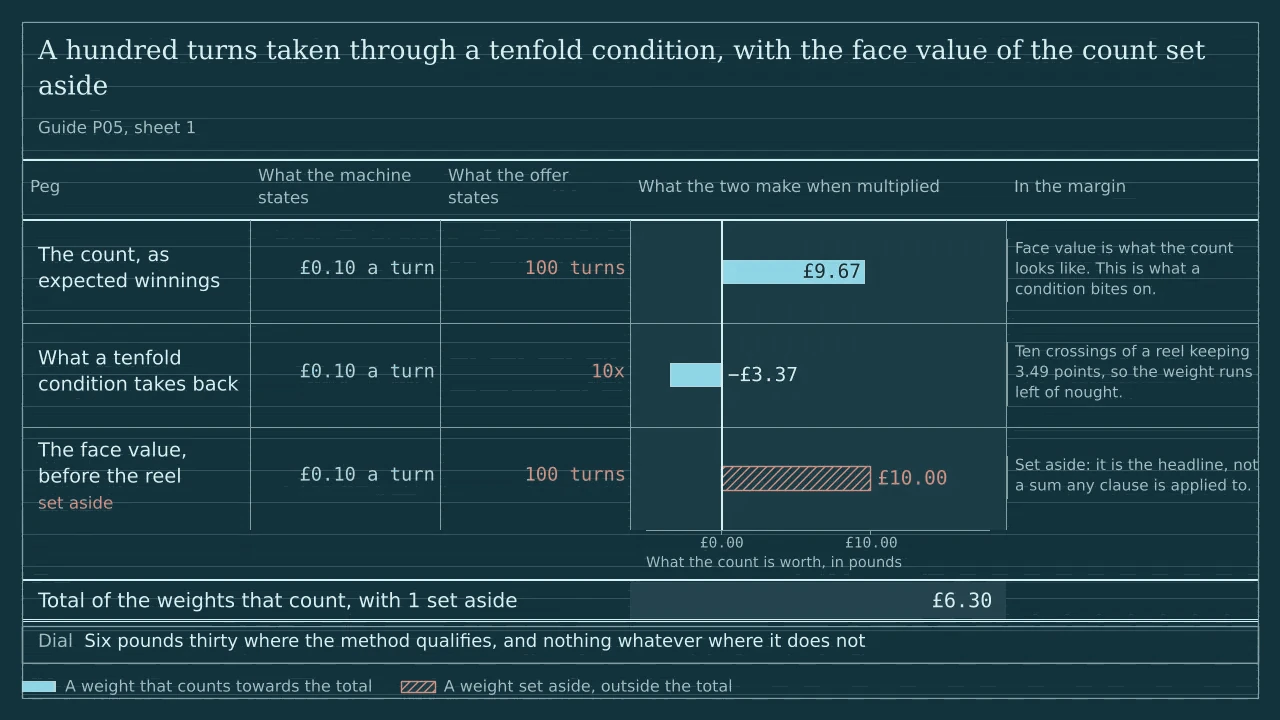
And here is the whole of the finding. A payment made through a method the third list excludes earns none of that. Not a reduced version, not the turns without the condition: the offer does not apply, so the arithmetic above describes something that did not happen. The line in the small print is therefore worth £6.30 of this reel’s turns, which is more than the stake, more than most charges in this section and more than the difference between any two titles of the family at this size.
A hundred turns weighed at two published returns
The condition has to be worked somewhere, and where it is worked changes what it leaves. The maker publishes ten different returns across this family’s game pages, so the same count, the same tenfold clause and the same stake produce different money depending on which title a reader opens to discharge the staking. Nothing about the payment has changed between the two rows below.
The subtraction is E = B × (1 − W × (1 − RTP) ∕ g). Reading the letters in the order the arithmetic needs them: B is what the condition bites on, which is the £9.67 of expected winnings rather than the ten pounds of face; W counts the crossings the clause demands of that sum, ten in this instance; RTP is the published figure of whichever title the staking happens on; and g is the share of a stake a document will credit, held at 100 per cent here which is where such clauses usually put it, and never anything the reel contributes.
| The title weighed | Published return | Break-even play-through | The offer asks | What £9.67 is worth |
|---|---|---|---|---|
| Big Bass Reel Repeat | 96.51 per cent | 28.7 times | 10 times | £6.30 |
| Big Bass Xmas Extreme | 96.07 per cent | 25.4 times | 10 times | £5.87 |
| What the title is worth | 0.44 points of return | 3.3 times | no change | £0.43 |
Forty-three pence separates the two titles, which this reel prices at four turns and a third. Hold that against the £6.30 the excluded-method line is worth and the ordering on this page is plain: the clause in the small print weighs about fifteen times what the choice of title weighs. Invert the house’s share and the break-even play-through appears: 28.7 times for one row, 25.4 for the other, and a tenfold condition sits comfortably inside either of them, which is why these two stand so close together.
Both rows travel along the one axis the maker publishes about itself, which is the title. The claim repeated everywhere in this trade, that one title is run at several returns picked by somebody who is not the player, is not what these rows show. The sheet standing behind this domain went looking for a primary source for it and came back empty, so this page neither takes it up nor throws it out, and measures the published axis instead.
The silences, set out in a list of their own
It is worth writing down what neither document says, because a silence is easy to read as a reassurance. The rail does not say whether a payment through it qualifies for an offer. It does not say whether money returns along the same route. It does not say what the receiving business will ask for later or when. And it does not say what the underlying card or account will do if its own issuer takes a view about gambling payments.
The cashier’s payment page is quieter still on the things that matter here. It routinely gives a smallest payment and rarely gives a smallest payout. It gives a list of what is accepted and rarely marks which entries are also on the list that qualifies. And the clock on a payout, which another page in this section prices against the machine’s own, is published by almost nobody.
Four silences, and the useful thing is that each converts. A qualification clause nobody points at is worth £6.30 on the figures here. A payout route left unstated is worth whatever a second instrument’s floor turns out to be. A clock left unstated is worth whatever the wait comes to on the machine’s own rate. The habit this domain is built on is to take each unstated thing, find the published figure it would have to be measured against, and print the product rather than complaining about the silence.
There is a shape of silence worth separating from the others, because it looks like the same thing and is not. A document that omits a figure leaves a reader guessing. A document that states a figure which another document then overrides leaves a reader wrong, which is worse, since a wrong figure gets acted on and a missing one gets asked about. The three lists above produce the second kind whenever an accepted method turns out not to qualify, and that is why the clause is worth more than its length suggests.
One silence does not convert, and this page will not pretend otherwise. Nothing published anywhere establishes how often a payment is made through a method that turns out not to qualify. That would need a figure from inside a business, and no primary source carries one, so the page states the consequence for one reader and stops there. A number invented for that would undo the value of every number above it.
Which of the documents a British licence reaches
Three documents, and a licence that would have reached exactly one of them. Taking them in the order a reader meets them makes the shape clear.
The rail’s document it does not reach at all. Device tokenisation is a payments arrangement, the business running it is not a gambling business, and nothing in the sourced regulatory record says what such a document must contain. It reads the same whether the money is going to a licensed counter or an unlicensed one.
The cashier’s payment page it reaches in one respect only, and that respect is prominence rather than content. A licensed business owes terms that are fair and transparent and has to keep the contract terms reachable without hunting. No duty tells it which methods to accept or which to pay out through. So even inside the licence the three lists remain three lists; what changes is whether the reader is likely to have found the third.
The incentive’s own terms are where the licence bites hardest, and it bites on both sides at once. It caps the wagering requirement at ten times, which is the figure this page has been working with, and it requires the incentive’s terms to be clear and reachable for anybody the offer is made to. Away from the licence neither holds, so the condition can be any multiple at all and the clause excluding a method can sit wherever it fits. The reader’s exposure is the product of the two: a larger multiple applied to the same count, decided by a line that is harder to find.
What the licence never touches is the reel. 96.51 per cent and 96.07 per cent belong to the titles, the family’s original cannot hand over above 2,100 times one stake in a single round, and the cheapest turn is ten pence wherever the machine is run. Those figures are why this page can price a document it has not read, and why the pricing survives the document being rewritten.
When the rail will not carry it at all
There is a fourth document, belonging to whoever issued the card or holds the account underneath the rail. That party may decline to carry a gambling payment, and meeting such a refusal is meeting a protection at work rather than a fault in the plumbing. It is of a piece with the national register: one decision, taken calmly, and fashioned to stand up later when calm is in short supply. The consequence appears below and no route past it does, and that silence is chosen.
Converted, the consequence is short. A payment that is refused buys nought turns, so there is no count to price, no condition to apply and no list to land on the wrong side of. Every figure in the seven entries above assumes a payment that went through.
A register exists and it is called Gamstop, or Gamstop Online when set out in full. Registering with it shuts a door, and what decides how many doors it shuts is where the counter is licensed rather than anything about the payment: every company Britain licenses is behind that door, and the counters this page is about are not, which the register states about itself in its own terms. That is the one gap on this page which no arithmetic closes, and saying so plainly is better than converting it badly.
The conversion that does run in a reader’s favour is the same one this page has used throughout, turned round. Any sum a reader decides not to commit has a length of play beside it at the cheapest stake the reel sells: ten pounds not paid in is a hundred turns not taken, and the £6.30 that a qualification clause can quietly remove is sixty-three. Figures of that size are worth knowing before a payment rather than after it. Where this page ends the helpline number stands in full, free to call and never shut.
Questions readers ask
Does the rail’s own document say anything about gambling
No, and that is the point rather than an oversight. It describes how a stand-in number replaces a card number, where the approving happens and what funds the payment underneath. The same document covers a coffee and a railway ticket. It cannot tell a reader whether a payment qualifies for an advertised offer, because qualification is not a property of the plumbing.
What are the three lists a cashier keeps
What it will take money through, what it will send money back through, and which methods qualify for whatever is advertised alongside. The second is shorter than the first and the third is shorter again. None is deducible from the others, and a reader who has seen only the first has seen the one that decides least.
What is a hundred turns at this reel actually worth
Ten pounds of face value and £9.67 of expected winnings at ten pence a turn, on a title whose return is published at 96.71 per cent. A condition bites on the second figure, not the first, which is what the arithmetic appendix behind this domain requires. After a tenfold condition worked on a title at 96.51 per cent, £6.30 is left.
What does an excluded payment method cost
The whole of the offer, which on these figures is £6.30, or 63 turns at the cheapest stake the reel sells. There is no partial outcome: either the advertised count applies to the payment or it does not. That single clause is worth about fifteen times what choosing one title of the family over another is worth at this size.
Why is the condition taken at ten times
Because a British licence would permit no more, so it is the most generous version of the clause a licensed site could lawfully ask and every figure drawn from it is the kindest reading available. Away from that licence nothing caps the multiple, so a real clause may be larger and the sums above correspondingly smaller.
How much does the choice of title matter here
Forty-three pence, the distance between £6.30 on a title at 96.51 per cent and £5.87 on one at 96.07, which comes to a little over four turns. Turn the house’s share upside down and the break-even play-through appears, 28.7 times against 25.4, and a tenfold condition sits well inside either, which keeps the rows close at this multiple.
Which document would a Great Britain licence have reached
Chiefly the incentive’s own terms, where it caps the wagering requirement at ten times and requires the terms to be clear and reachable by anybody the offer is made to. It touches the cashier’s payment page only on prominence, and the rail’s document not at all, that business not being a gambling business.
What happens when the card behind the rail refuses the payment
Nought turns, and nothing on this page left to price. A refusal like that is put up for the reason a registration with Gamstop Online is put up, and this domain sets out no way round either. The helpline number is printed in full where this page ends, free to call at any hour.
Before you play
Read on
- Apple Pay casino
- A tap authorises in a second and the money returns in days, which is 103,680 turns of the machine’s own clock.
- MuchBetter casino
- A wallet’s own floor answers before a cashier’s does, so the figure a reader meets is the higher of two and appears in neither advertisement.
- Deposit 5 get 200 free spins
- A generous-looking ratio of payment to turns and a mean-looking one can describe the same offer.
- How a figure is weighed here
- Which figures are read off the machine, which off the offer, and which this publisher supposes.