Top 20 slots UK: the two published figures that could order twenty machines
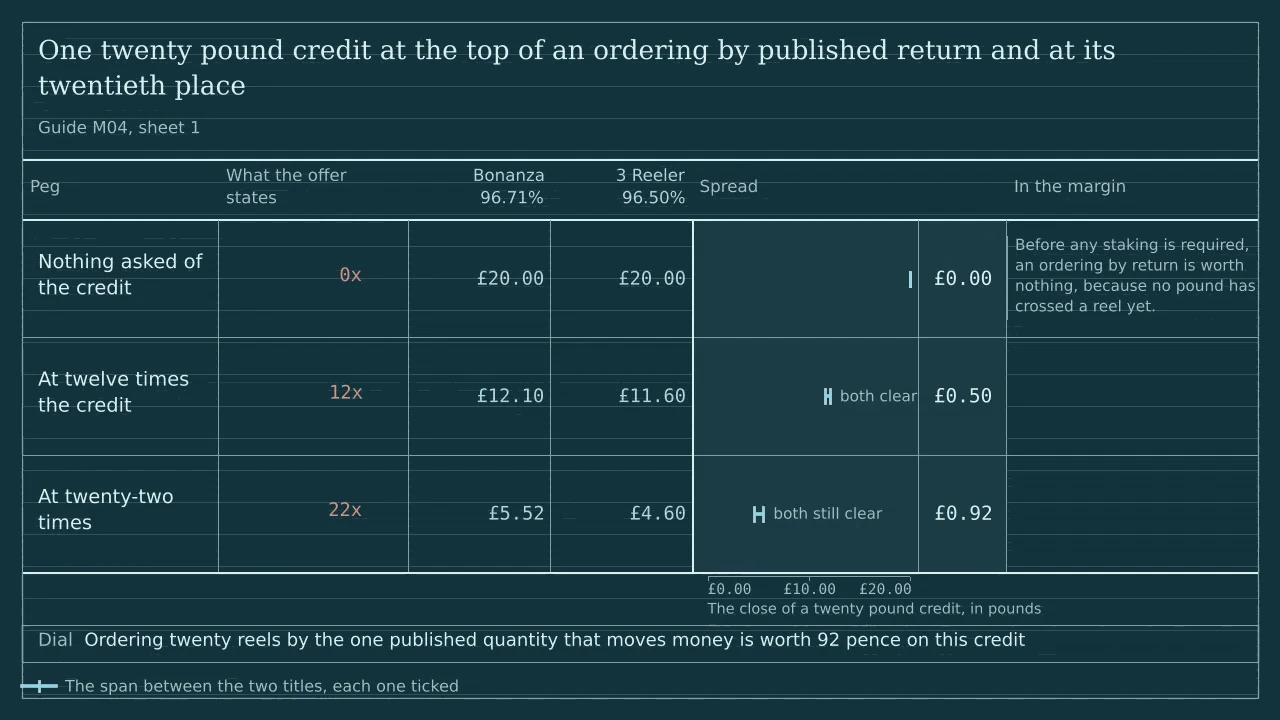
Ordering machines needs a quantity to order them by, and only two of the quantities this family publishes will do it. Sorted by published return, the distance from the head of a top twenty to its twentieth place is 0.21 points, which on a credit of £20.00 asked for twenty-two times comes to £0.92.
- Updated 13 November 2026
- Licence status shown for every offer
- Assumptions marked in the text
Credits of this size, weighed against reels that publish their own returns
These offers are paid placements, so this site is owed a fee whenever a reader opens an account through one of the buttons below.
-

Tweedbet
Welcome pack 470%
- Licence
- Not stated, no Great Britain licence
- Play-through
- Not published
- Min deposit
- £20
Bonus up to£14,000 Free spins470Read the offer18+ only. Terms apply.
Licence, terms and working
The site does not say where it is licensed or which company runs it.
The reel
- Build of the reel
- Big Bass Bonanza
- Return it publishes
- 96.71 per cent
- Stake it accepts on one turn
- 10p to £250.00
The offer
- Turns advertised
- 470 turns Turns valued at the cheapest turn this reel sells, no worth for one being stated anywhere in the offer
- Price of one turn
- 10p the smallest stake the reel accepts, this operator publishing no figure of its own
- Credit as a sum
- £14,000.00
- Credit waiting on a payment
- Stated in words Casino Welcome Pack 470% up to £14,000 + 470 FS. Crypto Welcome Bonus 110% up to 1,300 USDT + 110 FS. VIP Welcome Pack 770% up to £13,000
- Advertised, priced
- £14,047.00 140,470 turns of this reel
Hung on it
- Play-through
- Not published
- Credited towards it
- 100 per cent nobody has published a share, so the whole of a stake is credited, which is the kindest reading available
- Ceiling on winnings
- Not published
- Qualifying payment
- £20.00 200 turns of this reel at the price above, and it enters no weight
Not weighed, for want of the play-through multiple as a number.
Stated in words means the condition is set down in words that cost something and give nothing to subtract. Not published means the operator sets the figure down nowhere.
-

EliteSpin
£5,000 + 500 FS
- Licence
- Costa Rica, no Great Britain licence
- Play-through
- 40×
- Min deposit
- £20
Bonus up to£5,000 Free spins500Read the offer18+ only. Terms apply.
Licence, terms and working
Licence held in Costa Rica, by PrimeTier Limited.
The reel
- Build of the reel
- Big Bass Bonanza
- Return it publishes
- 96.71 per cent
- Stake it accepts on one turn
- 10p to £250.00
The offer
- Turns advertised
- 500 turns Turns valued at the cheapest turn this reel sells, no worth for one being stated anywhere in the offer
- Price of one turn
- 10p the smallest stake the reel accepts, this operator publishing no figure of its own
- Credit as a sum
- £5,000.00
- Credit waiting on a payment
- Stated in words Welcome bonus €/£5,000 + 500 FS. Elite lootboxes unlock surprise rewards up to €/£20,000 or 500 FS. Summer Festival by BGaming: win €80,000
- Advertised, priced
- £5,050.00 50,500 turns of this reel
Hung on it
- Play-through
- 40 times the bonus and the winnings from the spins
- Credited towards it
- 100 per cent nobody has published a share, so the whole of a stake is credited, which is the kindest reading available
- Ceiling on winnings
- Stated in words Five times the bonus
- Qualifying payment
- £20.00 200 turns of this reel at the price above, and it enters no weight
Priced at 10p a turn, the banner comes to £5,050.00, of which £5,048.36 survives the spins. At the reel's published return of 96.71 per cent, a play-through of 40 times asks for £201,934.20 of staking and costs £6,643.64, more than there is to pay it with, so the offer weighs £0.00.
Stated in words means the condition is set down in words that cost something and give nothing to subtract.
-
WinBeast
€5,000 + 500 FS
- Licence
- Curaçao, no Great Britain licence
- Min deposit
- €20
- Free spins
- 500
Bonus up to€5,000 Play-through40×Read the offer18+ only. Terms apply.
Licence, terms and working
Licence held in Curaçao, by a company the site does not name.
The reel
- Build of the reel
- Big Bass Bonanza
- Return it publishes
- 96.71 per cent
- Stake it accepts on one turn
- 10c to €250.00
The offer
- Turns advertised
- 500 turns Turns valued at the cheapest turn this reel sells, no worth for one being stated anywhere in the offer
- Price of one turn
- 10c the smallest stake the reel accepts, this operator publishing no figure of its own
- Credit as a sum
- €5,000.00
- Credit waiting on a payment
- Stated in words Welcome pack €5,000 + 500 FS + €650 free bet. Fortune wheel on €40+ deposits with code FORTUNE. 40% up to €300 Beast Boost Monday with code BOOST1 on €20 deposit
- Advertised, priced
- €5,050.00 50,500 turns of this reel
Hung on it
- Play-through
- 40 times the bonus and the winnings from the spins
- Credited towards it
- 100 per cent nobody has published a share, so the whole of a stake is credited, which is the kindest reading available
- Ceiling on winnings
- Stated in words €100 a batch of spins
- Qualifying payment
- €20.00 200 turns of this reel at the price above, and it enters no weight
Priced at 10c a turn, the banner comes to €5,050.00, of which €5,048.36 survives the spins. At the reel's published return of 96.71 per cent, a play-through of 40 times asks for €201,934.20 of staking and costs €6,643.64, more than there is to pay it with, so the offer weighs €0.00.
Stated in words means the condition is set down in words that cost something and give nothing to subtract.
-

Betportal
300% + 150 FS
- Licence
- Anjouan, Comoros, no Great Britain licence
- Play-through
- 35×
- Min deposit
- €20
- Stake cap
- €5.00
Bonus up to€1,000 Free spins150Read the offer18+ only. Terms apply.
Licence, terms and working
Licence held in Anjouan, Comoros, by BetPortal Gaming Ltd and Excite Ultra Media Ltd, numbered ALSI-202601040-FI2.
The reel
- Build of the reel
- Big Bass Bonanza
- Return it publishes
- 96.71 per cent
- Stake it accepts on one turn
- 10c to €250.00
The offer
- Turns advertised
- 150 turns Turns valued at the cheapest turn this reel sells, no worth for one being stated anywhere in the offer
- Price of one turn
- 10c the smallest stake the reel accepts, this operator publishing no figure of its own
- Credit as a sum
- €1,000.00
- Credit waiting on a payment
- Stated in words Welcome package 300% up to €1,000 + 150 free spins. 1st deposit 150% up to €500 + 100 FS. 2nd deposit 100% up to €300 + 50 FS
- Advertised, priced
- €1,015.00 10,150 turns of this reel
Hung on it
- Play-through
- 35 times the bonus
- Credited towards it
- 100 per cent nobody has published a share, so the whole of a stake is credited, which is the kindest reading available
- Ceiling on winnings
- Stated in words Five times the bonus
- Largest stake while it runs
- €5.00 under the largest stake the reel accepts, so part of the machine's own range is shut off while the credit runs
- Qualifying payment
- €20.00 200 turns of this reel at the price above, and it enters no weight
Priced at 10c a turn, the banner comes to €1,015.00, of which €1,014.51 survives the spins. At the reel's published return of 96.71 per cent, a play-through of 35 times asks for €35,507.73 of staking and costs €1,168.20, more than there is to pay it with, so the offer weighs €0.00.
Stated in words means the condition is set down in words that cost something and give nothing to subtract.
-

Night Luck
805% + 280 FS
- Licence
- Not stated, no Great Britain licence
- Play-through
- Not published
- Min deposit
- €20
Bonus up to€6,400 Free spins280Read the offer18+ only. Terms apply.
Licence, terms and working
The site does not say where it is licensed or which company runs it.
The reel
- Build of the reel
- Big Bass Bonanza
- Return it publishes
- 96.71 per cent
- Stake it accepts on one turn
- 10c to €250.00
The offer
- Turns advertised
- 280 turns Turns valued at the cheapest turn this reel sells, no worth for one being stated anywhere in the offer
- Price of one turn
- 10c the smallest stake the reel accepts, this operator publishing no figure of its own
- Credit as a sum
- €6,400.00
- Credit waiting on a payment
- Stated in words Casino welcome bonus 805% up to €6,400 + 280 FS. Crypto welcome bonus 140% up to 1,600 USDT + 140 FS. VIP welcome pack 800% up to €14,500
- Advertised, priced
- €6,428.00 64,280 turns of this reel
Hung on it
- Play-through
- Not published
- Credited towards it
- 100 per cent nobody has published a share, so the whole of a stake is credited, which is the kindest reading available
- Ceiling on winnings
- Not published
- Qualifying payment
- €20.00 200 turns of this reel at the price above, and it enters no weight
Not weighed, for want of the play-through multiple as a number.
Stated in words means the condition is set down in words that cost something and give nothing to subtract. Not published means the operator sets the figure down nowhere.
What a Great Britain licence would add to these offers
A licence from the Gambling Commission for Great Britain carries rules that an offer licensed elsewhere does not have to follow, and some figures in this ranking would not survive them. Social responsibility code provision 5.1.1 stops a British licensee applying a wagering requirement of more than ten times the bonus funds, and that limit has applied since 19 January 2026. A play-through above ten times in this list is therefore one a British licence would not allow.
Regulation 5(2) of the Gambling Act 2005 (Operating Licence Conditions) (Amendment) Regulations 2025, made on 25 February 2025, limits what a player can stake on one game cycle of an online slot to £5, or £2 for a player under 25. It is a condition of a British remote casino licence and not a property of the game, so a player at an operator licensed elsewhere does not have it behind them.
Remote technical standard 14D asks for at least two and a half seconds from the start of one slot game cycle to the start of the next, with the player pressing start each time. It is addressed to the game and not to the money, so no figure in this ranking measures it.
GAMSTOP is the free scheme that closes your accounts with online gambling companies licensed in Great Britain, and every one of them must join it. An operator licensed elsewhere is not required to, so a GAMSTOP registration cannot be counted on to reach these offers. If gambling is costing more than money, the National Gambling Helpline is free and answers on 0808 8020 133 at any hour.
Ranking last changed 8 November 2026. Operator terms change without notice, so open the offer page and read the terms there before you register.
At a glance
Sorted by the biggest round a reel can pay, the distance is nearly tenfold and worth nothing whatever in expectation. And the quantity most readers would actually sort by is published for no title in the family, which is this page’s finding and not a complaint.
- What the machine states96.71 per centThe figure at the head of any ordering by return in this family, shared by six of the studio’s pages. Twenty-second to twenty-fourth place share a figure too, which is what makes the cut at twenty an invention rather than a measurement.
- What the offer states£20.00 at 22 timesA credit of a size this part of the market gives away, with twenty-two times asked of it before withdrawal. It is held still throughout so that only the machine underneath it moves, which is what an ordering is supposed to be about.
- What the two make when multiplied£5.52What the credit leaves at the head of the ordering. At the twentieth place it leaves £4.60, so the whole of a reader’s sorting is worth 92 pence here, at ten pence a turn, supposed by this page wherever it is spent.
On this page
- The quantities a list of twenty could be built from
- Sorted by published return, and where the twentieth place lands
- What that sorting is worth once a credit crosses it
- Sorted by the biggest round, which moves no money at all
- Two sortings built from published figures, disagreeing
- Stake range, grid and lines, and what each is worth
- The quantity a reader would sort by, which nobody publishes
- What any list of twenty has to leave out, and why
- The cut at twenty, and what the tie-break is worth
- The two sortings a reader can perform without anybody’s help
The quantities a list of twenty could be built from
A list of twenty machines is a sorting, and a sorting needs a quantity that exists for every machine in it. One sheet stands behind every machine figure on this site and it covers one family: the thirty-six Bass pages the studio’s own site lists, read on a single day, with the figure the studio prints beside each and the figure the game itself reports beside that. Thirty-five of the thirty-six are slot machines. So the question this page can actually answer is narrow and worth answering: given those thirty-five, which published quantities would sort them, and what is each sorting worth to somebody holding a credit?
Six quantities exist per title. The return the studio prints. The biggest sum one round can pay, as a multiple of the stake. The grid, as reels by rows. The count of paylines. The range of stakes the reel will sell. And the date on which the studio published its own page for the title, which is not a release date and is not called one. Of those six, the first two are the only ones a reader could reasonably care about, and only the first moves money.
One quantity does not exist per title at all, and it is the one most readers believe they are sorting by: how widely the outcomes spread. No figure for it is published for any title here. That absence is not a gap in this page’s research, it is the finding, and part seven prices what it costs a reader.
No ranked list of titles appears below. The sheet carries no claim that would support one, and a list invented to fill the shape of the search phrase would be exactly the thing this publisher exists not to print. What appears instead is the arithmetic of sorting: how many titles sit at each published figure, where a cut at twenty would fall, and what the whole exercise comes to in money on one credit.
Sorted by published return, and where the twentieth place lands
Take the thirty-five slots and sort them by the figure the studio prints. The figures are not spread evenly, and the shape of the bunching is the whole of this part. Six pages carry 96.71 per cent. Two carry 96.70. One carries 96.53, one 96.52, and three carry 96.51. That is thirteen titles before the next figure is reached, and the next figure is 96.50, which eleven titles share counted off the family table.
Eleven titles at one figure, arriving at the fourteenth place, means places fourteen through twenty-four are occupied by machines a reader cannot tell apart on this quantity, because the quantity is identical. A top twenty therefore cuts straight through the middle of that block. Whichever seven of those eleven titles make the list and whichever four miss it, the published figure deciding between them is the same published figure, and nothing in the sheet settles the order inside a tie.
The reader’s position is better than that makes it sound, because the part of the sorting above the tie is real. The distance from the head of the list to the block at 96.50 is 0.21 points of return, and 0.21 points is a quantity of money as soon as a credit has to cross it. What it is worth is part three. What it is worth below the block matters as well, and this page does not go there: the nine titles at 96.07 and the one at 96.04 sit a long way down, and what the whole family’s spread amounts to belongs to Pragmatic slots rather than here.
Two cautions before the money. The figures above are the studio’s own, taken from the single item of basic game information each of its pages carries, and for thirty-three of the thirty-five slots the session data of the game itself reports the identical number. The two exceptions are not swept up into the count: each differs by 0.02 points and each is recorded as a disagreement rather than resolved. And a figure shared by eleven titles is shared, not averaged: this page never produces a single number to stand for a group of machines, because no such number is published.
What that sorting is worth once a credit crosses it
Hold one offer completely still and let only the machine move. The offer is a credit of £20.00 with twenty-two times asked of it a shape this end of the market publishes, staked at ten pence a turn this page’s own figure, named again wherever it is spent, with a slot counting in full towards the requirement.
Twenty-two times £20.00 is £440.00 of staking. What a reel takes out of staking is the complement of its published return, so at the head of the sorting it takes 3.29 points of every pound and at the twentieth place 3.50 points. On £440.00 those come to £14.48 and £15.40, and the credit closes at £5.52 and £4.60 respectively. The house writes the same arithmetic as E = B × (1 − W × (1 − RTP) ∕ g), where g is the weight a slot is credited at, RTP the figure off the sheet, W the multiple in the terms and B the credit itself.
| Where the title sits | Published return | Break-even play-through | The offer asks | What £20.00 is worth |
|---|---|---|---|---|
| At the head of the sorting | 96.71 per cent | 30.40 times | 22 times | £5.52 |
| In the block at the twentieth place | 96.50 per cent | 28.57 times | 22 times | £4.60 |
| What the whole sorting is worth | 0.21 points of return | 1.83 times | no change | £0.92 |
Ninety-two pence. That is what sorting twenty machines by the only published quantity that moves money comes to, on this credit, at this multiple, and it is worth saying out loud because the figure is smaller than most readers expect and larger than nothing. It grows with the credit and with the multiple: the same two titles on the same terms at forty times rather than twenty-two would stand £1.68 apart, with both closes below nothing. It shrinks to nothing as the multiple does, and at no requirement at all the sorting is worth precisely zero, because no pound has crossed either reel.
£440.00of staking asked of a £20.00 credit, which is 4,400 turns, and a licensed build cannot put them through in under three hours and three minutes
Sorted by the biggest round, which moves no money at all
The second quantity published for every slot in the family is the largest sum one round can pay, given as a multiple of the stake, which the game itself reports when a session opens and which the studio’s page never prints the game’s own maximum round win. Across the family it runs from 2,100 times the stake up to 25,000. Priced at the ten pence this page spends throughout, that is £210.00 at the bottom and £2,500.00 at the top, and sorting by it produces a list that looks far more dramatic than sorting by return.
It is worth nothing. Not nearly nothing: nothing. The published return already contains the ceiling, because a return is what comes back across every outcome the machine can produce, the largest one included. Two titles that publish the same return hand back the same expected sum whatever their ceilings are, and the family proves it on its own figures. Of the eleven titles sharing 96.50 per cent, one is stopped at 2,100 times the stake where another runs to 20,000, nearly tenfold, and the £20.00 credit at twenty-two times closes at £4.60 on both.
What a ceiling does change is the shape of the thing, and this page will not pretend to measure that, because the figures that would measure it are not published. A bigger ceiling with the same return means the same money arriving in a different pattern, more of it concentrated in rarer rounds. How much rarer is exactly what nobody states: the only rate this family publishes is for the maximum round of the original, at one in 3,880,481 turns, with no equivalent published for any other title.
So a sorting by ceiling is honest, checkable, built entirely from published figures, and useless for the purpose a reader has in mind. That combination is worth noticing whenever a list of twenty appears anywhere: a sorting can be perfectly sourced and still answer a question nobody asked.
Two sortings built from published figures, disagreeing
Put the two sortings beside each other and they do not merely differ, they nearly invert. The title with the largest ceiling in the family, at 25,000 times the stake, publishes 96.52 per cent, which puts it tenth or eleventh by return depending on how the ties above it are resolved. The original, which shares the highest published return with five other pages, stops at 2,100 times the stake and so sits in the bottom four of the family by ceiling: only three other titles are capped that low the four at that cap, off the sheet.
Both sortings are correct. Both come out of the same table, and a reader could rebuild either from the studio’s own pages and the game’s own data in an afternoon. They cannot both be a top twenty, and nothing published decides between them, because the choice is about what a reader wants rather than about what a machine states.
That is the sharpest reason this page prints no list. A list has to choose a quantity and then hide the choice behind a number, and on this family the two defensible choices produce different machines at the top. The honest form of the thing is the one above: name the quantity, sort by it, and say what the sorting is worth in money. The reader keeps the choice, which was theirs anyway.
A third sorting exists and is worth dismissing explicitly, because it is the one a search result will usually be built from: popularity. No figure for it is published by the studio or carried in the game’s data, this publisher has none, and a count of how often a title is played is not a property of the machine. Rather, it belongs to the lobbies the machine sits in, which is a different subject and a different page.
Stake range, grid and lines, and what each is worth
Three further published quantities could sort the family, and each is worth setting out because each is worth something different from nothing but less than a reader expects.
The stake range comes first, since it decides the turn price and therefore how many turns a credit becomes. Thirty-one of the thirty-five slots will sell a turn anywhere between 0.10 and 250.00 a spin the ranges in the game’s own data. The exceptions are three titles whose twelve lines put the floor at 0.12 and the ceiling at 240.00, and two whose twenty lines put the floor at 0.20 and the ceiling at the same 240.00. Sorted by the floor, the family therefore has three steps and no more. What the difference is worth: a credit of £20.00 is 200 turns at the common floor, 166 turns at 0.12 and 100 at 0.20, so the sorting changes how long a reader plays and not what the playing is expected to cost, since the expected cost is a share of the staking and the staking is £20.00 either way.
The grid and the line count come next and are worth less still. Most of the family runs five reels, three rows and ten paylines. Three titles run five by four across twelve. Two run 6 reels with as many as 7 and 9 rows and a line field of 20, which on that kind of build describes a maximum rather than a fixed shape. And one title reports a 3 by 3 grid while its line field still reads 10, a pair of figures this publisher prints as it found them rather than reconciling, because both are the game’s own. None of those shapes is a quantity of money. A reader sorting by them is sorting by what a machine looks like, which is a real preference and simply not the one the sorting above measures.
The sixth quantity is the date the studio published each page, which exists for all thirty-six and is not a release date and is not called one by anybody. Sorted by it the family lines up neatly from December 2020 to October 2026, and what that sorting is worth, and what it cannot tell a reader, is the business of New online slots.
The quantity a reader would sort by, which nobody publishes
Ask a reader what they want from a list of twenty and the answer is rarely the return. It is some version of how the money arrives: whether a balance of £20.00 grinds down slowly with small frequent returns or disappears in twenty minutes with one chance of something large. That is dispersion, and nobody publishes a figure for it anywhere in this family. Search the thirty-six pages for the word and it is not there. Open the configuration a game is handed as a session begins and no field exists that one could be entered in. The announcements say nothing of it either.
Three secondary sources state one for the original and no two of them agree: the high side of medium in the first, low in the second, and in the third a specification table and a paragraph a few lines apart that do not agree with each other. A characterisation belongs to whoever made it, so none of those figures appears on this page as a property of the machine, and the disagreement among them is more useful to a reader than any one of them would have been.
What that absence costs is measurable in one direction at least. A sorting by return is worth 92 pence on the credit above. A sorting by dispersion would be worth whatever the difference in survival time between two balances is, which is a quantity this publisher can describe but not price per title, because the inputs are not published per title. So the honest total for a reader hunting a list of twenty is this: one sorting worth 92 pence, one worth nothing, three worth a change in the turn count, and the one they came for not available at any price.
What is published instead, and what this page uses wherever variance matters, is the paytable, the ceiling as a multiple of one stake, and for the original the rate at which that ceiling arrives, 1 in 3,880,481 turns. Those are facts about how the machine behaves and they are the machine’s own. They are not a volatility rating, and nothing on this site will dress them up as one.
What any list of twenty has to leave out, and why
One title in the family publishes the lowest figure of all, 95.50 per cent, and it cannot go in a list of slots. It is not a slot: its page carries no internal game symbol of the kind every other title has, and no slot configuration could be read for it at all, so it has no grid, no line count, no stake range and no ceiling on this sheet the gaps marked on the family table. A sorting that included it would be sorting two different kinds of machine on a figure that does not mean the same thing in both.
That is not a technicality. It is the commonest way a list of twenty goes wrong: the list is built from whatever carries the right name, and the name is not a quantity. Leaving one title out costs this page the lowest figure in the family, which would have made the spread look 0.54 points wider than it honestly is for machines of one kind.
Two further exclusions are worth printing. The studio’s own announcements name a bingo product and two titles built for named operators, none of which has an English game page of its own, so this page cannot read a figure for any of them and does not count them. And a title published after the day this sheet was built would not be here at all, which is true of every list anybody prints and is the reason a figure carries the date it was read.
So the population being sorted is thirty-five slot machines with a published return each, and a reader who meets a list of twenty elsewhere is entitled to ask which population it came from and what it left out. The answer decides more than the ordering does.
The cut at twenty, and what the tie-break is worth
Return to the block of eleven titles at 96.50 per cent, which begins at the fourteenth place and runs to the twenty-fourth. A list of twenty takes seven of them and leaves four out. The arithmetic of what that costs a reader is short: both the twentieth title and the twenty-first publish 96.50, so the distance between them is 0.00 points of return, the break-even multiple is 28.57 times for each of them, and the £20.00 credit at twenty-two times closes at £4.60 on either. The cut is worth nothing to the penny.
Anybody printing a list of twenty from these figures has therefore made a decision worth nothing and presented it as a result. The decision might be alphabetical, or by date of the page, or by the ceiling, or by nothing at all, and nothing published says which. For a reader who came for the list itself, that is the most useful sentence here.
It also puts the 92 pence of part three in its proper place. The whole sorting is worth 92 pence on a £20.00 credit at twenty-two times, and almost all of that 92 pence is earned above the thirteenth place, where the figures still move. Inside the block, which is a third of the family, sorting is a typographical act. A reader who takes the top of a published list because it is the top has paid attention to the part of the sorting that means something only if the list’s own cut happened to fall where the figures stopped moving.
None of this says a reader should not choose by return. It says the choice is worth what it is worth: real at the top of the family, nothing in the middle of it, and always available without anybody’s list, because the studio publishes the figure on every one of its own pages.
The two sortings a reader can perform without anybody’s help
The first takes a minute. Open the studio’s page for a title and read the one item of basic game information it carries, which is the return. Do it for whichever titles are actually in front of you, and sort those. A reader does not need thirty-five machines sorted, they need the four or five a lobby is offering, and the figure that sorts them is printed by the maker on its own page for each.
The second takes a little longer and settles the shape rather than the money. The game itself reports its ceiling as a multiple of the stake and its stake range when a session opens, and both are readable from the game’s own information, which on a licensed build has to be reachable before anybody commits. Sort by the ceiling if what is wanted is the chance of something large, and understand from part four that the sorting costs nothing and gains nothing in expectation.
Then stop, because the third sorting is not available. Nobody publishes a dispersion figure for any title in this family, the sources that offer one disagree with each other, and this publisher will not invent one. A reader whose question is really about how long £20.00 survives is better served by the arithmetic this site performs than by any ordinal. £440.00 of staking, at a turn price of ten pence, is 4,400 turns and at least three hours and three minutes on a licensed build, and that staking is expected to cost £14.48 at the head of the family and £15.40 in the block of eleven.
That is the whole of what a top twenty can honestly be here: one sorting worth 92 pence, one worth nothing, a handful that change the turn count, and a plain statement that the figure a reader wants ordered has no publisher. The last of those is the finding, and it is worth more than the list would have been.
Questions readers ask
Can a top 20 slots list be built from published figures?
Partly. Two quantities are published for every slot in this family, the return and the biggest round as a multiple of the stake, and either will sort them. A cut at twenty falls inside a block of eleven titles sharing 96.50 per cent, so the last places are decided by a tie-break nothing published settles.
What is a sorting by RTP actually worth in money?
On a credit of £20.00 with twenty-two times asked of it, the distance from the head of the family at 96.71 per cent to the block at 96.50 is 0.21 points, which comes to 92 pence. At forty times rather than twenty-two the same gap is £1.68, and with nothing asked of the credit the sorting is worth nothing.
Does a bigger maximum win mean a better slot?
Not in expectation. The published return already contains the largest round, so two titles publishing the same return hand back the same expected sum whatever their ceilings. Of the eleven titles at 96.50 per cent, one stops at 2,100 times the stake where another runs to 20,000, and a £20.00 credit at twenty-two times closes at £4.60 on both.
Which title in the Big Bass family publishes the highest RTP?
Six of the studio’s pages carry the family’s highest figure, 96.71 per cent, so no single title holds it. This page prints no ranked list of titles because the sheet behind it supports none, and the figure is on the studio’s own page for each title anyway.
How many different RTPs does this family of slots publish?
Enough that a sorting is possible and not enough to fill twenty places: six pages at 96.71 per cent, two at 96.70, one each at 96.53 and 96.52, three at 96.51, then eleven at 96.50. What the full spread across the family amounts to is the business of Pragmatic slots.
Why can nobody rank these slots by volatility?
Because nobody publishes one. The thirty-six pages do not carry the word, nothing in a session’s own data makes room for it, and the three secondary sources that offer a figure for the original disagree three ways, one of them with itself.
Is the lowest RTP in the family really 95.50 per cent?
It is the lowest figure the studio publishes, but it belongs to a title that is not a slot machine and carries no slot configuration at all, so it cannot stand in a sorting of slots. The lowest figure for a machine of the same kind as the rest is 96.04 per cent.
What does a £20 credit at twenty-two times actually cost to clear?
£440.00 of staking. At a turn price of ten pence that is 4,400 turns and at least three hours and three minutes on a licensed build. That staking is expected to cost £14.48 at 96.71 per cent and £15.40 at 96.50, leaving £5.52 and £4.60 of the credit.
Before you play
Read on
- Pragmatic slots
- A maker’s name settles who built a machine and nothing else: twelve distinct returns stand across the family.
- New online slots
- Everything needed to price a machine is published on its first day, and the observed rate never arrives at all.
- Big Bass slots
- Title by title, every published figure that differs from the original’s, with the difference priced.
- How a figure is weighed here
- Which figures are read off the machine, which off the offer, and which this publisher assumes.