New online slots: everything a reel publishes on day one, and the one thing it never will
A machine arrives complete.
- Updated 13 November 2026
- Licence status shown for every offer
- Assumptions marked in the text
Credits of this size, weighed against reels published this year and six years ago
These offers are paid placements, so this site is owed a fee whenever a reader opens an account through one of the buttons below.
-

Tweedbet
Welcome pack 470%
- Licence
- Not stated, no Great Britain licence
- Play-through
- Not published
- Min deposit
- £20
Bonus up to£14,000 Free spins470Read the offer18+ only. Terms apply.
Licence, terms and working
The site does not say where it is licensed or which company runs it.
The reel
- Build of the reel
- Big Bass Bonanza
- Return it publishes
- 96.71 per cent
- Stake it accepts on one turn
- 10p to £250.00
The offer
- Turns advertised
- 470 turns Turns valued at the cheapest turn this reel sells, no worth for one being stated anywhere in the offer
- Price of one turn
- 10p the smallest stake the reel accepts, this operator publishing no figure of its own
- Credit as a sum
- £14,000.00
- Credit waiting on a payment
- Stated in words Casino Welcome Pack 470% up to £14,000 + 470 FS. Crypto Welcome Bonus 110% up to 1,300 USDT + 110 FS. VIP Welcome Pack 770% up to £13,000
- Advertised, priced
- £14,047.00 140,470 turns of this reel
Hung on it
- Play-through
- Not published
- Credited towards it
- 100 per cent nobody has published a share, so the whole of a stake is credited, which is the kindest reading available
- Ceiling on winnings
- Not published
- Qualifying payment
- £20.00 200 turns of this reel at the price above, and it enters no weight
Not weighed, for want of the play-through multiple as a number.
Stated in words means the condition is set down in words that cost something and give nothing to subtract. Not published means the operator sets the figure down nowhere.
-

EliteSpin
£5,000 + 500 FS
- Licence
- Costa Rica, no Great Britain licence
- Play-through
- 40×
- Min deposit
- £20
Bonus up to£5,000 Free spins500Read the offer18+ only. Terms apply.
Licence, terms and working
Licence held in Costa Rica, by PrimeTier Limited.
The reel
- Build of the reel
- Big Bass Bonanza
- Return it publishes
- 96.71 per cent
- Stake it accepts on one turn
- 10p to £250.00
The offer
- Turns advertised
- 500 turns Turns valued at the cheapest turn this reel sells, no worth for one being stated anywhere in the offer
- Price of one turn
- 10p the smallest stake the reel accepts, this operator publishing no figure of its own
- Credit as a sum
- £5,000.00
- Credit waiting on a payment
- Stated in words Welcome bonus €/£5,000 + 500 FS. Elite lootboxes unlock surprise rewards up to €/£20,000 or 500 FS. Summer Festival by BGaming: win €80,000
- Advertised, priced
- £5,050.00 50,500 turns of this reel
Hung on it
- Play-through
- 40 times the bonus and the winnings from the spins
- Credited towards it
- 100 per cent nobody has published a share, so the whole of a stake is credited, which is the kindest reading available
- Ceiling on winnings
- Stated in words Five times the bonus
- Qualifying payment
- £20.00 200 turns of this reel at the price above, and it enters no weight
Priced at 10p a turn, the banner comes to £5,050.00, of which £5,048.36 survives the spins. At the reel's published return of 96.71 per cent, a play-through of 40 times asks for £201,934.20 of staking and costs £6,643.64, more than there is to pay it with, so the offer weighs £0.00.
Stated in words means the condition is set down in words that cost something and give nothing to subtract.
-

WinBeast
€5,000 + 500 FS
- Licence
- Curaçao, no Great Britain licence
- Min deposit
- €20
- Free spins
- 500
Bonus up to€5,000 Play-through40×Read the offer18+ only. Terms apply.
Licence, terms and working
Licence held in Curaçao, by a company the site does not name.
The reel
- Build of the reel
- Big Bass Bonanza
- Return it publishes
- 96.71 per cent
- Stake it accepts on one turn
- 10c to €250.00
The offer
- Turns advertised
- 500 turns Turns valued at the cheapest turn this reel sells, no worth for one being stated anywhere in the offer
- Price of one turn
- 10c the smallest stake the reel accepts, this operator publishing no figure of its own
- Credit as a sum
- €5,000.00
- Credit waiting on a payment
- Stated in words Welcome pack €5,000 + 500 FS + €650 free bet. Fortune wheel on €40+ deposits with code FORTUNE. 40% up to €300 Beast Boost Monday with code BOOST1 on €20 deposit
- Advertised, priced
- €5,050.00 50,500 turns of this reel
Hung on it
- Play-through
- 40 times the bonus and the winnings from the spins
- Credited towards it
- 100 per cent nobody has published a share, so the whole of a stake is credited, which is the kindest reading available
- Ceiling on winnings
- Stated in words €100 a batch of spins
- Qualifying payment
- €20.00 200 turns of this reel at the price above, and it enters no weight
Priced at 10c a turn, the banner comes to €5,050.00, of which €5,048.36 survives the spins. At the reel's published return of 96.71 per cent, a play-through of 40 times asks for €201,934.20 of staking and costs €6,643.64, more than there is to pay it with, so the offer weighs €0.00.
Stated in words means the condition is set down in words that cost something and give nothing to subtract.
-

Betportal
300% + 150 FS
- Licence
- Anjouan, Comoros, no Great Britain licence
- Play-through
- 35×
- Min deposit
- €20
- Stake cap
- €5.00
Bonus up to€1,000 Free spins150Read the offer18+ only. Terms apply.
Licence, terms and working
Licence held in Anjouan, Comoros, by BetPortal Gaming Ltd and Excite Ultra Media Ltd, numbered ALSI-202601040-FI2.
The reel
- Build of the reel
- Big Bass Bonanza
- Return it publishes
- 96.71 per cent
- Stake it accepts on one turn
- 10c to €250.00
The offer
- Turns advertised
- 150 turns Turns valued at the cheapest turn this reel sells, no worth for one being stated anywhere in the offer
- Price of one turn
- 10c the smallest stake the reel accepts, this operator publishing no figure of its own
- Credit as a sum
- €1,000.00
- Credit waiting on a payment
- Stated in words Welcome package 300% up to €1,000 + 150 free spins. 1st deposit 150% up to €500 + 100 FS. 2nd deposit 100% up to €300 + 50 FS
- Advertised, priced
- €1,015.00 10,150 turns of this reel
Hung on it
- Play-through
- 35 times the bonus
- Credited towards it
- 100 per cent nobody has published a share, so the whole of a stake is credited, which is the kindest reading available
- Ceiling on winnings
- Stated in words Five times the bonus
- Largest stake while it runs
- €5.00 under the largest stake the reel accepts, so part of the machine's own range is shut off while the credit runs
- Qualifying payment
- €20.00 200 turns of this reel at the price above, and it enters no weight
Priced at 10c a turn, the banner comes to €1,015.00, of which €1,014.51 survives the spins. At the reel's published return of 96.71 per cent, a play-through of 35 times asks for €35,507.73 of staking and costs €1,168.20, more than there is to pay it with, so the offer weighs €0.00.
Stated in words means the condition is set down in words that cost something and give nothing to subtract.
-

Night Luck
805% + 280 FS
- Licence
- Not stated, no Great Britain licence
- Play-through
- Not published
- Min deposit
- €20
Bonus up to€6,400 Free spins280Read the offer18+ only. Terms apply.
Licence, terms and working
The site does not say where it is licensed or which company runs it.
The reel
- Build of the reel
- Big Bass Bonanza
- Return it publishes
- 96.71 per cent
- Stake it accepts on one turn
- 10c to €250.00
The offer
- Turns advertised
- 280 turns Turns valued at the cheapest turn this reel sells, no worth for one being stated anywhere in the offer
- Price of one turn
- 10c the smallest stake the reel accepts, this operator publishing no figure of its own
- Credit as a sum
- €6,400.00
- Credit waiting on a payment
- Stated in words Casino welcome bonus 805% up to €6,400 + 280 FS. Crypto welcome bonus 140% up to 1,600 USDT + 140 FS. VIP welcome pack 800% up to €14,500
- Advertised, priced
- €6,428.00 64,280 turns of this reel
Hung on it
- Play-through
- Not published
- Credited towards it
- 100 per cent nobody has published a share, so the whole of a stake is credited, which is the kindest reading available
- Ceiling on winnings
- Not published
- Qualifying payment
- €20.00 200 turns of this reel at the price above, and it enters no weight
Not weighed, for want of the play-through multiple as a number.
Stated in words means the condition is set down in words that cost something and give nothing to subtract. Not published means the operator sets the figure down nowhere.
What a Great Britain licence would add to these offers
A licence from the Gambling Commission for Great Britain carries rules that an offer licensed elsewhere does not have to follow, and some figures in this ranking would not survive them. Social responsibility code provision 5.1.1 stops a British licensee applying a wagering requirement of more than ten times the bonus funds, and that limit has applied since 19 January 2026. A play-through above ten times in this list is therefore one a British licence would not allow.
Regulation 5(2) of the Gambling Act 2005 (Operating Licence Conditions) (Amendment) Regulations 2025, made on 25 February 2025, limits what a player can stake on one game cycle of an online slot to £5, or £2 for a player under 25. It is a condition of a British remote casino licence and not a property of the game, so a player at an operator licensed elsewhere does not have it behind them.
Remote technical standard 14D asks for at least two and a half seconds from the start of one slot game cycle to the start of the next, with the player pressing start each time. It is addressed to the game and not to the money, so no figure in this ranking measures it.
GAMSTOP is the free scheme that closes your accounts with online gambling companies licensed in Great Britain, and every one of them must join it. An operator licensed elsewhere is not required to, so a GAMSTOP registration cannot be counted on to reach these offers. If gambling is costing more than money, the National Gambling Helpline is free and answers on 0808 8020 133 at any hour.
Ranking last changed 8 November 2026. Operator terms change without notice, so open the offer page and read the terms there before you register.
At a glance
Its return, its biggest round, its grid, its lines and the range of stakes it will sell are all in hand from the first session anybody opens, so a credit of £30.00 asked for twenty times can be priced on a reel that nobody has played: on the most recently published page of this family it closes at £9.00, against £10.26 on the oldest page of the same family. What does not arrive on day one, and does not arrive in year five either, is an observed rate. And the maker does not publish the day itself: two of its own sources date the original twelve days apart.
- What the machine states96.50 per centThe figure on the most recently published of this maker’s thirty-six pages, which was a fortnight old when the sheet behind this site was built. It was there from the first session, and nothing about it improves as the machine ages.
- What the offer states£30.00 at 20 timesA credit a new reel is often attached to, with twenty times asked before withdrawal. Nothing in the terms of such an offer is newer or older than anything else: a requirement is a requirement on a reel of any age.
- What the two make when multiplied£9.00The expected close on the newest reel, at ten pence a turn, supposed here and said again wherever it is spent. The same credit on the family’s first title closes at £10.26, so age runs the wrong way for a reader.
On this page
- Everything a reel publishes about itself on day one
- The one quantity that never arrives, however long anybody waits
- The newest page and the first one, priced on one credit
- Two dates for one machine, twelve days apart
- What a date can be used for and what it cannot
- What six years actually changed about these reels
- What waiting for evidence would cost a reader
- What a review can add on day one, and what it invents
- The newest reel in this family, read off the sheet
- What being new is worth, totalled on one credit
Everything a reel publishes about itself on day one
The useful thing about a brand-new machine is how little about it is actually unknown. Open a session on one and the server hands the game a block of figures before a single turn is taken: the return to player, the largest round the machine can pay stated as a multiple of one stake, the number of reels and rows, the line count, the selectable stake steps and the paytable the configuration a game is sent. The page the maker keeps for a title carries the return as well, in a basic game information block that holds that figure and nothing else beside it.
None of those figures improves with age, and none of them is provisional. A return of 96.50 per cent on a page published this month means exactly what the same figure means on a page published in 2020: the share of everything staked that the machine’s own mathematics returns over its whole distribution of outcomes. A reader who waits six months before trusting it is waiting for nothing to happen to it.
So a new reel can be weighed on the day it appears, which is what this page does. A credit of £30.00, a requirement of twenty times a figure of the order such terms carry, a turn priced at the ten pence supposed throughout named again at every sentence that spends it, and a published figure that was inside the machine before anybody had played it.
What genuinely does not exist on day one is the subject of part two, and the precise form of it matters more than the vague one: not a rating, not a reputation and not a consensus, none of which were ever quantities. What does not exist is an observed rate, and the reason it does not is arithmetic rather than impatience.
The one quantity that never arrives, however long anybody waits
The regulator’s own wording for what a published return is describes an average theoretical return to player percentage, and the word theoretical is the whole of the matter. The figure is worked out of the machine’s own mathematics across every outcome it can produce, including the outcomes a player will almost certainly never see. An observed rate, by contrast, is whatever happened to a particular run of turns, and it only approaches the published figure once the rare outcomes have had their turn.
Put a number on that, because this family makes it possible. The original publishes one hit rate and only one: its biggest round arrives once in 3,880,481 turns, the one rate this family publishes anywhere the top-round rate the data carries. A licensed build may not run more than 1,440 cycles in an hour, so a single visit from that outcome is 2,694 hours and 47 minutes of unbroken play, which is a little over a hundred and twelve days without sleeping. Any observed rate gathered over anything shorter is missing the largest single component of the figure it is trying to measure.
This is why no page on this site reports what a machine has been doing lately, and why a new reel is not at a disadvantage against an old one. Six years of other people’s play has not produced an observed rate for the original either: nobody publishes one, the maker does not, and the figure everybody quotes for it is the theoretical one that was in the machine on the first day.
The honest summary is short. On day one a reader has the published return, the published ceiling and the published frequency of that ceiling. On day two thousand they have exactly the same three figures. Nothing accumulates, which means nothing is gained by waiting and nothing is risked by not waiting, in the specific sense that the arithmetic a reader can perform is identical either way.
The newest page and the first one, priced on one credit
Take the most recently published page of this maker’s thirty-six, and the first of them, and run one offer across both. The newer page carries 96.50 per cent and a ceiling of 20,000 times the stake. The first page carries 96.71 per cent and a ceiling of 2,100 stakes in one round both figures off the family table. Twenty times a £30.00 credit is £600.00 of staking either way, and what each reel takes out of that staking is the complement of its own published figure: £21.00 on the newer one and £19.74 on the older.
The credits therefore close at £9.00 and £10.26, and the house writes the step as E = B × (1 − W × (1 − RTP) ∕ g), where W is the requirement in the terms, B the credit, g the weight a slot counts at and RTP whichever published figure the reader has landed on.
| Which page the reel has | Published return | Break-even play-through | The offer asks | What £30.00 is worth |
|---|---|---|---|---|
| The newest page of the thirty-six | 96.50 per cent | 28.57 times | 20 times | £9.00 |
| The first page of the thirty-six | 96.71 per cent | 30.40 times | 20 times | £10.26 |
| What six years of pages amount to | −0.21 points of return | −1.83 times | no change | −£1.26 |
The closing row carries a minus sign and it is not a misprint. On this family, the newest reel is worth £1.26 less of the same credit than the one published six years before it, because its published figure is 0.21 points lower and nothing else in the offer changed. Newness is not an improvement in the quantity that decides the money, and on these two pages it runs the other way.
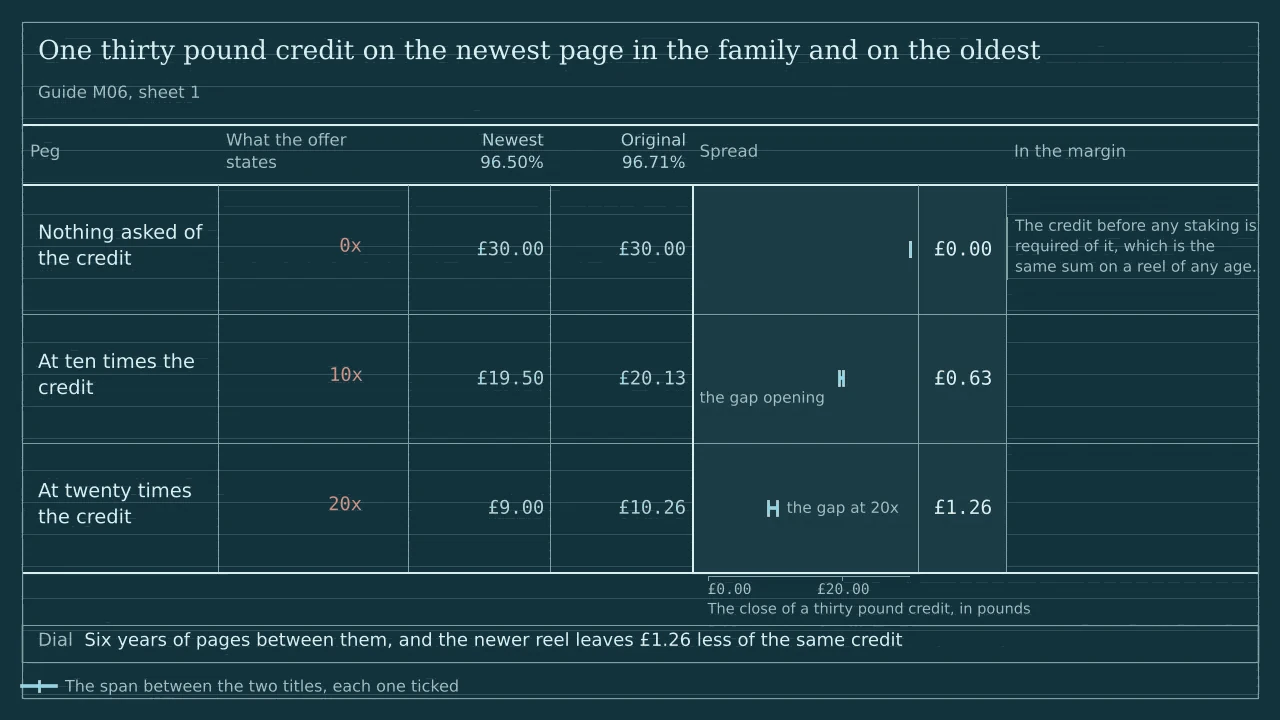
£600.00of staking asked of a £30.00 credit, which is 6,000 turns, and £21.00 of expected cost on the newer reel against £19.74 on the older
Two dates for one machine, twelve days apart
Here is the oddity this page was built around. For the family’s first title, the maker gives two different dates in two of its own places. Its announcement of the game is dated 14 December 2020. The structured data embedded in its own page for that game gives a publication date of 2 December 2020. Twelve days apart, both the maker’s own, and neither of them labelled a release date by anybody the disagreement as the sheet records it.
The maker’s game page states no release date at all, neither for this title nor for any other of the thirty-six. What exists is the date an announcement was published and the date a web page was published, which are facts about documents rather than about a machine going live anywhere. This publisher therefore prints neither as the release date, and says which of the two it is using whenever it uses one.
Twelve days is worth something concrete, which is the only way this page knows how to treat a discrepancy. At the pace ceiling a licensed build carries, 1,440 cycles an hour, twelve days of continuous play is 414,720 turns, and with a turn at the supposed ten pence that is £41,472.00 of staking. The gap between a maker’s two accounts of its own machine is therefore wider, in turns, than most readers will play in a lifetime. The point is not that somebody made a clerical error. It is that the date a machine arrived is not a published quantity, while the figures that decide what it pays are.
That inversion is worth holding on to. The thing a search for a new machine is sorting by, its newness, is the one thing the maker does not state. The things nobody searches by, the return and the ceiling, are stated precisely and from the first day.
What a date can be used for and what it cannot
The sheet behind this site carries a page publication date for all thirty-six titles, running from 2 December 2020 to 5 October 2026, and it labels the column for what it is. Sorted by that date the family lines up in a clean order, and the order is good for exactly one thing: telling a reader which pages the maker put up most recently. It is evidence about publishing, not about availability.
Three uses of such a date are legitimate and worth naming. It identifies the most recently published title in a family, which is what a reader hunting a new machine is usually after. It settles which of two titles the maker documented first, which matters when one title’s description borrows wording from another’s. And it dates the reading itself: every figure on this site carries the day it was read, because a published figure can change and a reader is entitled to know how fresh the arithmetic is.
Three uses are not legitimate. It is not a release date, and nothing on this site calls it one. It is not evidence about how long a machine has been available in any particular lobby, which is a fact about that lobby. And it is not a proxy for quality in either direction: the newest page in this family publishes 96.50 per cent and the oldest publishes 96.71, so a reader sorting by date and hoping to sort by return would have sorted it backwards.
The general rule this page follows: use a date to find a machine, never to price one. The pricing is done by the quantities the machine states about itself, and those are the same quantities whatever the date beside them says.
What six years actually changed about these reels
Set the family’s first pages against its most recent ones and four things have moved, none of them the thing a reader would hope for.
The ceilings have risen enormously. The first title pays at most 2,100 stakes in one round and three others of the family share that cap, while the most recent pages reach 20,000 and 25,000 times the ceilings in the game’s own data. Where a turn costs ten pence that is a move from £210.00 to £2,500.00 as the largest single round. The published returns have not risen with them: the newest page is 0.21 points below the oldest, and the family’s whole band of figures has not improved in six years of titles.
Purchasable features have appeared. The two oldest titles report a single flat return and no bonus round that can be bought, while thirty-three of the thirty-five slots now carry a separate published return for each bet mode, the bonus-buy options among them. And the shapes have multiplied: five reels by three rows in the early titles, and since then five by four, six reels with as many as seven and nine rows, and one title on a three by three grid.
So newness in this family means a bigger ceiling, more ways to bet and a slightly lower published return. A reader who prefers the chance of something large is being offered exactly that, and paying 0.21 points for it on the two pages this page weighs, which comes to £1.26 on the credit above. That is a trade a reader can make deliberately. What they cannot do is make it accidentally by sorting on a date.
What waiting for evidence would cost a reader
Suppose a reader distrusts a figure published by the party that built the machine and wants to see it demonstrated before committing. Price that. To put ten thousand turns through a new reel at the ten pence supposed throughout is £1,000.00 of staking, whose expected cost at 96.50 per cent is £35.00. Ten thousand turns is also six hours and fifty-six minutes at the pace ceiling a licensed build carries, and at the end of it the reader has an observed rate drawn from a sample that cannot contain the machine’s largest outcome, which arrives once in nearly four million turns on the only title that publishes such a rate.
The cost of that exercise is set by the turn price and by nothing else, which is worth seeing in figures. The same ten thousand turns, taken at the £5.00 a licensed cycle will accept, is £50,000.00 of staking, expected to cost £1,750.00 at the newest page’s published figure, and at the £2.00 a player under twenty-five is held to it is £20,000.00 of staking and £700.00 of expected cost. The sample is identical in every case: the same count of turns, the same machine, the same inability to contain an outcome arriving once in nearly four million. Only the bill changes, and it changes fiftyfold across the reel’s own published range of stakes.
Thirty-five pounds and seven hours, then, to learn less than the maker’s own page says for nothing. That is the arithmetic of waiting for proof, and it is why this site spends its effort on published figures rather than on observation: the observation is expensive, slow, and worse than the document it would be checking.
There is a second kind of waiting, which is waiting for other people’s reports, and it costs nothing but is worth about as much. Part eight is about what those reports can honestly contain. The short version is that the figures in them are the same published figures, and the judgements in them are not quantities at all.
None of this is an argument for playing a new machine. The expectation on the credit above is positive only because the requirement is modest: at forty times rather than twenty, the same £30.00 closes below nothing on both reels in the table, and no amount of newness or age moves that. It is an argument about where a reader’s attention is worth spending, which is on the published figure and the requirement rather than on the age of either.
What a review can add on day one, and what it invents
A description written on the day a machine appears can usefully carry three things: the published figures, correctly attributed; the mechanics, which the maker describes in prose on its own page; and the arithmetic somebody has performed on those, which is what this page is. All three are available immediately and none of them improves with time.
What such a description cannot carry is a measured dispersion, and this is where most of them go wrong. No volatility is published anywhere in this family: the maker’s pages never use the word, nothing in the data a game receives makes room for one, and the maker’s announcements state none. The three reviewers who do state one for the original give three different answers, and one of the three contradicts itself inside a single page, calling the machine high in a table and something milder a few lines later in its own prose.
A figure invented on day one does not become sound by being repeated for six years, which is the quiet risk of a new machine: the first description of it sets the vocabulary everybody else borrows. The sheet behind this site records where sources disagree precisely so that a disagreement survives repetition, and the three-way split above is the clearest example it holds.
So a reader meeting a new reel should treat a description as a route to the published figures and not as a substitute for them. The useful question to ask of any account of a new machine is which of its numbers came from the maker and which came from the writer. On this page the answer is printed throughout: the returns, the ceilings, the grids, the rates and the trigger come off the sheet, and the credit, the requirement and the ten pence a turn are this page’s own suppositions.
The newest reel in this family, read off the sheet
For completeness, here is everything this publisher holds about the most recently published page of the thirty-six, which was fourteen days old when the sheet was built. Its published return is 96.50 per cent, a figure eleven titles of the family share. Its ceiling in a single round is 20,000 stakes, which at ten pence is £2,000.00 and at the £5.00 a licensed cycle permits would be £100,000. It runs five reels by three rows across ten paylines and sells a turn from 0.10 to 250.00, every figure of it taken off the family table the sheet’s own column for each.
That is the whole of it, and it is enough to price any offer attached to it. What this publisher does not hold: a release date, because none is published; a volatility, for the reason in part eight; a base-game hit rate, which no page in the family publishes; and any statement about which lobbies carry it, because the sheet names no operator and this page will not either.
Notice what is missing from that list of absences: nothing a reader needs in order to do the arithmetic. The return and the stake range between them fix what a credit becomes, and the ceiling fixes what one round could return. A machine fourteen days old is as weighable as one six years old, which is the finding this page exists to establish.
One caution on the count. The thirty-six are the titles with an English game page of the maker’s own, read on one day. The maker’s announcements name further Bass products without such pages, including one that is not a slot machine at all, so this page says the maker’s site lists thirty-six Bass pages rather than that the series has thirty-six titles.
What being new is worth, totalled on one credit
Totalled on the credit this page has carried throughout, being new is worth minus £1.26. The newest page in the family publishes 0.21 points less than the first one, the requirement is identical, the staking is the same £600.00 and the turn count the same 6,000, so the gap between them is entirely the figure the maker printed before either machine was ever played.
Being new buys something else, and the page has priced that too: a ceiling of 20,000 times the stake rather than 2,100, which at ten pence is £2,000.00 against £210.00 in a single round. That is a real difference in what the machine can do and it costs 0.21 points of return to have. Whether the trade is worth making is the reader’s business, and it is a decision they can make on the first day a machine exists, because both figures are published then.
What being new does not buy is any additional certainty later on. The published return is the same document on day one and in year six. The observed rate that would check it needs a hundred and twelve days of unbroken play to see the machine’s largest outcome once. And the day the machine arrived is not published at all: for the family’s first title the maker’s own two sources stand twelve days apart, which is 414,720 turns at the pace ceiling a licensed build carries.
The practical instruction, then, is the same for a reel published this month as for one published six years ago. Open the page the maker keeps for that exact title, read the return out of its basic game information block, find the ceiling and the stake range in the game’s own data, and weigh the offer against those. Nothing in that sequence requires the machine to have a history, which is the one genuinely good piece of news on this page.
Questions readers ask
Are new online slots worth playing before anybody has reviewed them?
Every figure needed to price one is published before the first turn: the return, the ceiling in stakes, the grid, the lines and the stake range. On this family a £30.00 credit at twenty times closes at £9.00 on the newest page and £10.26 on the first, and both sums were computable on day one.
Do new slots have better RTP than older ones?
Not in this family. The newest of the maker’s thirty-six pages publishes 96.50 per cent and the first publishes 96.71, so the newer reel is 0.21 points lower and leaves £1.26 less of the same credit at twenty times. Age sorts these reels backwards.
When was Big Bass Bonanza released?
The maker publishes no release date for it. Its announcement is dated 14 December 2020 and the structured data on its own game page gives 2 December 2020, twelve days earlier, and neither source calls its date a release. Any page stating one date has chosen which document to believe.
Why can nobody measure a slot’s real RTP?
Because the published figure is a theoretical average over every outcome, including the rarest. On the only title here publishing a rate, the biggest round arrives once in 3,880,481 turns, and 1,440 cycles an hour is the most a licensed build may run, which puts it at 2,694 hours and 47 minutes of unbroken play.
What is the newest slot in the Big Bass family?
The most recently published page of the thirty-six carries a date of 5 October 2026, a fortnight before the sheet behind this site was built. It publishes 96.50 per cent, a ceiling of 20,000 times the stake, five reels by three rows, ten paylines and a stake range of 0.10 to 250.00.
What has changed across six years of these releases?
Ceilings have risen from 2,100 times the stake to 20,000 and 25,000, purchasable bonus rounds have appeared on most titles, and the grids have multiplied. Published returns have not improved: the newest page sits 0.21 points below the first.
How much would it cost to test a new slot yourself?
Ten thousand turns at ten pence is £1,000.00 of staking, expected to cost £35.00 at 96.50 per cent and taking six hours and fifty-six minutes at the quickest a licensed build runs. The sample still cannot contain the machine’s largest outcome, so it measures less than the maker’s own page states for nothing.
Is a brand-new casino the same risk as a brand-new slot?
No, and the page keeps them apart. A reel publishes its figures in advance whatever its age. A cashier does not, and one holding no Great Britain licence is outside the ten-times ceiling on an incentive’s staking, outside the £5.00 cap on a cycle and absent from the public register a reader can check.
Before you play
Read on
- Pragmatic slots
- A maker’s name settles where to look a figure up and not what the figure is: twelve returns stand under one name.
- Top 20 slots UK
- Two published quantities will sort these reels, one worth 92 pence on a credit and the other worth nothing at all.
- Big Bass slots
- Title by title, every published figure that differs from the original’s, with the difference priced.
- How a figure is weighed here
- Which figures are read off the machine, which off the offer, and which this publisher assumes.