Live casino UK: the one key with no reel behind it, and what the method still says
Every other page here multiplies a figure the machine publishes by a figure the offer publishes. This key has no machine in that sense, and the honest work is establishing exactly which of the method’s inputs survive. Two do.
- Updated 13 November 2026
- Licence status shown for every offer
- Assumptions marked in the text
Offers reaching a dealt table, weighed as far as the method goes
These offers are paid placements, so this site is owed a fee whenever a reader opens an account through one of the buttons below.
-

Tweedbet
Welcome pack 470%
- Licence
- Not stated, no Great Britain licence
- Play-through
- Not published
- Min deposit
- £20
Bonus up to£14,000 Free spins470Read the offer18+ only. Terms apply.
Licence, terms and working
The site does not say where it is licensed or which company runs it.
The reel
- Build of the reel
- Big Bass Bonanza
- Return it publishes
- 96.71 per cent
- Stake it accepts on one turn
- 10p to £250.00
The offer
- Turns advertised
- 470 turns Turns valued at the cheapest turn this reel sells, no worth for one being stated anywhere in the offer
- Price of one turn
- 10p the smallest stake the reel accepts, this operator publishing no figure of its own
- Credit as a sum
- £14,000.00
- Credit waiting on a payment
- Stated in words Casino Welcome Pack 470% up to £14,000 + 470 FS. Crypto Welcome Bonus 110% up to 1,300 USDT + 110 FS. VIP Welcome Pack 770% up to £13,000
- Advertised, priced
- £14,047.00 140,470 turns of this reel
Hung on it
- Play-through
- Not published
- Credited towards it
- 100 per cent nobody has published a share, so the whole of a stake is credited, which is the kindest reading available
- Ceiling on winnings
- Not published
- Qualifying payment
- £20.00 200 turns of this reel at the price above, and it enters no weight
Not weighed, for want of the play-through multiple as a number.
Stated in words means the condition is set down in words that cost something and give nothing to subtract. Not published means the operator sets the figure down nowhere.
-

EliteSpin
£5,000 + 500 FS
- Licence
- Costa Rica, no Great Britain licence
- Play-through
- 40×
- Min deposit
- £20
Bonus up to£5,000 Free spins500Read the offer18+ only. Terms apply.
Licence, terms and working
Licence held in Costa Rica, by PrimeTier Limited.
The reel
- Build of the reel
- Big Bass Bonanza
- Return it publishes
- 96.71 per cent
- Stake it accepts on one turn
- 10p to £250.00
The offer
- Turns advertised
- 500 turns Turns valued at the cheapest turn this reel sells, no worth for one being stated anywhere in the offer
- Price of one turn
- 10p the smallest stake the reel accepts, this operator publishing no figure of its own
- Credit as a sum
- £5,000.00
- Credit waiting on a payment
- Stated in words Welcome bonus €/£5,000 + 500 FS. Elite lootboxes unlock surprise rewards up to €/£20,000 or 500 FS. Summer Festival by BGaming: win €80,000
- Advertised, priced
- £5,050.00 50,500 turns of this reel
Hung on it
- Play-through
- 40 times the bonus and the winnings from the spins
- Credited towards it
- 100 per cent nobody has published a share, so the whole of a stake is credited, which is the kindest reading available
- Ceiling on winnings
- Stated in words Five times the bonus
- Qualifying payment
- £20.00 200 turns of this reel at the price above, and it enters no weight
Priced at 10p a turn, the banner comes to £5,050.00, of which £5,048.36 survives the spins. At the reel's published return of 96.71 per cent, a play-through of 40 times asks for £201,934.20 of staking and costs £6,643.64, more than there is to pay it with, so the offer weighs £0.00.
Stated in words means the condition is set down in words that cost something and give nothing to subtract.
-

WinBeast
€5,000 + 500 FS
- Licence
- Curaçao, no Great Britain licence
- Min deposit
- €20
- Free spins
- 500
Bonus up to€5,000 Play-through40×Read the offer18+ only. Terms apply.
Licence, terms and working
Licence held in Curaçao, by a company the site does not name.
The reel
- Build of the reel
- Big Bass Bonanza
- Return it publishes
- 96.71 per cent
- Stake it accepts on one turn
- 10c to €250.00
The offer
- Turns advertised
- 500 turns Turns valued at the cheapest turn this reel sells, no worth for one being stated anywhere in the offer
- Price of one turn
- 10c the smallest stake the reel accepts, this operator publishing no figure of its own
- Credit as a sum
- €5,000.00
- Credit waiting on a payment
- Stated in words Welcome pack €5,000 + 500 FS + €650 free bet. Fortune wheel on €40+ deposits with code FORTUNE. 40% up to €300 Beast Boost Monday with code BOOST1 on €20 deposit
- Advertised, priced
- €5,050.00 50,500 turns of this reel
Hung on it
- Play-through
- 40 times the bonus and the winnings from the spins
- Credited towards it
- 100 per cent nobody has published a share, so the whole of a stake is credited, which is the kindest reading available
- Ceiling on winnings
- Stated in words €100 a batch of spins
- Qualifying payment
- €20.00 200 turns of this reel at the price above, and it enters no weight
Priced at 10c a turn, the banner comes to €5,050.00, of which €5,048.36 survives the spins. At the reel's published return of 96.71 per cent, a play-through of 40 times asks for €201,934.20 of staking and costs €6,643.64, more than there is to pay it with, so the offer weighs €0.00.
Stated in words means the condition is set down in words that cost something and give nothing to subtract.
-

Betportal
300% + 150 FS
- Licence
- Anjouan, Comoros, no Great Britain licence
- Play-through
- 35×
- Min deposit
- €20
- Stake cap
- €5.00
Bonus up to€1,000 Free spins150Read the offer18+ only. Terms apply.
Licence, terms and working
Licence held in Anjouan, Comoros, by BetPortal Gaming Ltd and Excite Ultra Media Ltd, numbered ALSI-202601040-FI2.
The reel
- Build of the reel
- Big Bass Bonanza
- Return it publishes
- 96.71 per cent
- Stake it accepts on one turn
- 10c to €250.00
The offer
- Turns advertised
- 150 turns Turns valued at the cheapest turn this reel sells, no worth for one being stated anywhere in the offer
- Price of one turn
- 10c the smallest stake the reel accepts, this operator publishing no figure of its own
- Credit as a sum
- €1,000.00
- Credit waiting on a payment
- Stated in words Welcome package 300% up to €1,000 + 150 free spins. 1st deposit 150% up to €500 + 100 FS. 2nd deposit 100% up to €300 + 50 FS
- Advertised, priced
- €1,015.00 10,150 turns of this reel
Hung on it
- Play-through
- 35 times the bonus
- Credited towards it
- 100 per cent nobody has published a share, so the whole of a stake is credited, which is the kindest reading available
- Ceiling on winnings
- Stated in words Five times the bonus
- Largest stake while it runs
- €5.00 under the largest stake the reel accepts, so part of the machine's own range is shut off while the credit runs
- Qualifying payment
- €20.00 200 turns of this reel at the price above, and it enters no weight
Priced at 10c a turn, the banner comes to €1,015.00, of which €1,014.51 survives the spins. At the reel's published return of 96.71 per cent, a play-through of 35 times asks for €35,507.73 of staking and costs €1,168.20, more than there is to pay it with, so the offer weighs €0.00.
Stated in words means the condition is set down in words that cost something and give nothing to subtract.
-

Night Luck
805% + 280 FS
- Licence
- Not stated, no Great Britain licence
- Play-through
- Not published
- Min deposit
- €20
Bonus up to€6,400 Free spins280Read the offer18+ only. Terms apply.
Licence, terms and working
The site does not say where it is licensed or which company runs it.
The reel
- Build of the reel
- Big Bass Bonanza
- Return it publishes
- 96.71 per cent
- Stake it accepts on one turn
- 10c to €250.00
The offer
- Turns advertised
- 280 turns Turns valued at the cheapest turn this reel sells, no worth for one being stated anywhere in the offer
- Price of one turn
- 10c the smallest stake the reel accepts, this operator publishing no figure of its own
- Credit as a sum
- €6,400.00
- Credit waiting on a payment
- Stated in words Casino welcome bonus 805% up to €6,400 + 280 FS. Crypto welcome bonus 140% up to 1,600 USDT + 140 FS. VIP welcome pack 800% up to €14,500
- Advertised, priced
- €6,428.00 64,280 turns of this reel
Hung on it
- Play-through
- Not published
- Credited towards it
- 100 per cent nobody has published a share, so the whole of a stake is credited, which is the kindest reading available
- Ceiling on winnings
- Not published
- Qualifying payment
- €20.00 200 turns of this reel at the price above, and it enters no weight
Not weighed, for want of the play-through multiple as a number.
Stated in words means the condition is set down in words that cost something and give nothing to subtract. Not published means the operator sets the figure down nowhere.
What a Great Britain licence would add to these offers
A licence from the Gambling Commission for Great Britain carries rules that an offer licensed elsewhere does not have to follow, and some figures in this ranking would not survive them. Social responsibility code provision 5.1.1 stops a British licensee applying a wagering requirement of more than ten times the bonus funds, and that limit has applied since 19 January 2026. A play-through above ten times in this list is therefore one a British licence would not allow.
Regulation 5(2) of the Gambling Act 2005 (Operating Licence Conditions) (Amendment) Regulations 2025, made on 25 February 2025, limits what a player can stake on one game cycle of an online slot to £5, or £2 for a player under 25. It is a condition of a British remote casino licence and not a property of the game, so a player at an operator licensed elsewhere does not have it behind them.
Remote technical standard 14D asks for at least two and a half seconds from the start of one slot game cycle to the start of the next, with the player pressing start each time. It is addressed to the game and not to the money, so no figure in this ranking measures it.
GAMSTOP is the free scheme that closes your accounts with online gambling companies licensed in Great Britain, and every one of them must join it. An operator licensed elsewhere is not required to, so a GAMSTOP registration cannot be counted on to reach these offers. If gambling is costing more than money, the National Gambling Helpline is free and answers on 0808 8020 133 at any hour.
Ranking last changed 8 November 2026. Operator terms change without notice, so open the offer page and read the terms there before you register.
At a glance
The rule book holds one cycle of a dealt game to 5 seconds at the least, twice the interval under a reel, so an hour here stops at 720 cycles where a reel’s hour runs to 1,440. And an offer of £36.00 asked for 21 times states its own two figures as always. What is missing is the proportion given back and the least stake on sale, and no sanctioned source reachable from here publishes either for a product of this kind. So the multiplication stops one factor short, with the part that can be computed coming to £7.56 for every point of house edge, and no page here is going to borrow a reel’s figure to finish it.
- What the machine states5 seconds a cycleThe least a cycle may take where the game is not reel-based, and the one quantity on the machine’s side of this page that any source reaches. It is a rule’s figure rather than a studio’s, and it comes off the regulatory sheet.
- What the offer states£36.00 at 21 timesA credit with a requirement on it, which is the one side of this page that is as complete here as anywhere else on the domain: an offer publishes its own terms whatever product they are to be spent on.
- What the two make when multiplied£7.56What one point of house edge takes out of this credit, being the staking divided by a hundred. It is exact. The count of points it would be multiplied by is the figure nobody publishes for a product with no reel in it.
On this page
- The four inputs this method takes, and which two arrive
- The floor under a cycle, which is twice a reel’s
- The ceiling that is written for reels and stops there
- Why no proportion has to be published at all
- The family’s own boundary case, and what it loses
- What one point of house edge is worth here
- The one page on this site that cannot assume a stake
- Adding up a product with one factor missing
The four inputs this method takes, and which two arrive
The arithmetic on every other page of this domain takes four inputs and it is worth naming all four before any of them goes missing. A proportion given back, published by whoever made the product. A floor under one cycle, which fixes how fast money can be put through. A least stake, which is the divisor turning money into a count of cycles. And the offer’s own two figures, a face value and a requirement, which the offer publishes because it is selling them.
Set those four against a dealt table and the result divides cleanly in two. The offer’s figures are untouched: a credit is a credit and a requirement is a requirement, whatever product the staking is to be done on. The floor under a cycle survives as well, though at a different value, and the second part of this page establishes what that value is and where it comes from. The proportion and the least stake are the two that do not arrive, and neither of them is a small loss, because between them they are what turns a requirement into money and money into time.
The offer’s side of this page deserves a sentence to itself, being the half nobody has to worry about. A face value and a requirement are published by whoever is selling them, in the terms a reader agrees to, and they are stated in the same units whatever the staking is to be done on. So both of the inputs that go missing here are on the machine’s side, and that is the asymmetry the page turns on: the party advertising keeps its figures, and the product being advertised does not have any to keep.
So this report is going to do something it does nowhere else, which is to run the method until it stops and then say where it stopped. That is not a failure of the method and it is certainly not an invitation to improvise. The temptation on a page like this one is to reach sideways for a figure that looks close enough, and the figure nearest to hand is a slot’s published proportion, which would make every sum below look complete and every one of them would be about a different product. The whole value of a sourced arithmetic is that it stops where its sources stop.
What can be done instead is more useful than it sounds. A missing factor in a product is not the same as an unknown answer: the other factors can be worked out exactly, and the shape of what the missing one would do can be stated to the penny per unit. That is the arithmetic in the sixth part of this page, and it is the page’s own figure. The parts between here and there are about establishing the absence properly rather than asserting it, because an absence asserted is worth nothing and an absence established is a finding.
The floor under a cycle, which is twice a reel’s
Start with the input that does arrive, because it is the surprise. A licensed reel is held to 2.5 seconds, measured from one cycle starting to the next being allowed to the slots entry in RTS 14. Where the game is dealt rather than reel-based, with peer-to-peer poker set aside, the rule book doubles that to 5 seconds the casino entry in RTS 14. So the clock is here, it is published, and an hour of it holds 720 cycles where a reel’s hour holds 1,440.
The date wants care and the care is worth taking, because it is the kind of detail that gets repeated wrongly. The standard that carries the five-second figure gives no commencement date for any of its requirements. The date comes from a separate page the regulator publishes listing what took effect on 17 January 2025, which names the five-second minimum among them the updates page, not the standard. That page does not name the slots figure, so the 2.5 seconds has no date attached to it here and this report attaches none.
Three further duties come with that clock and all three are about pace rather than price. Nothing may be set running unattended, autoplay being barred across gaming, so each cycle waits on a fresh act the autoplay entry in RTS 8. Two games at once is barred as functionality, split screens and several screens included, so the pace cannot be doubled by opening a second table the multi-game entry in RTS 14. And an outcome paying back no more than went in may not be celebrated, so a return under the stake cannot arrive dressed as a win the celebration entry in RTS 14.
The clock on its own does support one comparison, and it is worth drawing before the page goes further. A reel’s licensed hour holds 1,440 commitments and a dealt hour holds 720, the second interval being exactly twice the first, so across the same hour of wall clock a dealt product asks half as many decisions of a reader. That is a published figure about pace and it is the only published figure this page has on the machine’s side. Turning it into money wants a price per cycle, which is the input the seventh part shows cannot be assumed here, so the honest statement of it is half the events an hour at a price nobody states.
Which gives this page one real quantity and a caution about it. The pace is halved against a reel, and halved pace is not halved cost: the cost of an hour is the pace multiplied by the stake multiplied by the edge, and the second and third of those are exactly what this page has no figures for. A reader who concluded from the clock alone that a dealt table is the cheaper hour has multiplied one known figure by two unknown ones and kept the answer. The clock bounds how many events an hour can hold and says nothing whatever about what an event costs.
The ceiling that is written for reels and stops there
The other numbered duty that binds a British reel is a ceiling rather than a floor. One cycle of a reel cannot take more than £5.00, dropping to £2.00 before a reader is twenty-five, under an instrument made in February 2025 the 2025 stake limit instrument. Both figures are written for online slots alone, and the guidance beside them puts other casino games outside the pair, giving a wheel and a card game as its examples.
That is a consequence worth stating plainly, because it is the reverse of what a reader might expect from a product that looks more serious than a reel. The instrument’s reach turns on its own definition, which is built round a game displaying reels or their equivalent and played online. A product with a dealer and a wheel is outside that definition, so the cap is outside it too. The licence therefore bounds the pace of this product and does not bound the size of one cycle.
Put the two duties side by side and the pattern of this page appears in miniature. Of the two numbered quantities that bind a reel, one arrives here at a different value, 5 seconds in place of 2.5, and the other does not arrive at all. One changed figure and one absence, which is precisely the division the first part of this page set up. And the arithmetic a reader might want from the pair is the arithmetic that needs both: a ceiling on one cycle multiplied by the cycles an hour holds is a bound on turnover, and with no ceiling published there is no such bound to compute. This report does not supply one.
It is worth setting out which numbered duties do reach a dealt table without changing value, because that list is the longer one. The intervals written round a complaint arrive intact, eight weeks on the whole of one and an acknowledgement owed within a day at a venue selling play at any hour of it. So does the machinery a reader uses to limit themselves, where three spans of time are required to be on offer, the shortest being a single day, and where a reduction takes hold at once while a raise is kept waiting a day and then wants confirming. Neither set is slots-only and neither is about what a cycle costs, so the audit of numbered duties for this product comes out at one changed figure, one absence, and a long tail arriving exactly as it arrives for a reel.
Being exact about what survives matters more here than making the loss sound larger. A reader at a dealt table under a British licence keeps every duty that is about information, every duty that is about pace, the deposit-limit machinery and the complaint intervals. What they do not have is the one duty that puts a published ceiling in pounds on a single commitment. So the protections are not thinner here across the board. They are thinner in exactly one respect, and it happens to be the respect that carries a figure.
Why no proportion has to be published at all
Now the input the method really needs, and here the rule book disposes of the assumption rather than supporting it. What a licensee owes a reader before any commitment is enough to make an informed decision about the chances of winning, and the requirement offers four ways of discharging it, any one of which will do on its own the chances entry in RTS 3. A sketch of the way a game runs and of how a winner gets settled, a house edge, a percentage given back, or the likelihood of the winning events: four routes, one duty, and three of them print no percentage at all.
So a licensee can discharge it in full and publish no figure anywhere. The sheet behind this domain puts the consequence in one line and this report repeats it without softening: nothing in the sourced material compels a percentage to be published at all. For a reel that hardly matters, since a studio prints one about its own product and this site reads it from there. For a dealt table there is no equivalent page to read and no duty obliging anybody to make one.
What a reader is owed instead is substantial and is not a number. A reader is owed the rules in full before committing, an account of the prizes and of the way they are reached, enough on screen while the game runs to follow where it stands, and a result that stays legible long enough to be read the display entry in RTS 7. Four entitlements, every one of them about understanding, and not one of them a quantity this page could multiply. For a method built on multiplying figures, that distinction is what this page is for.
The family’s own boundary case, and what it loses
There is one place where this question can be watched happening rather than argued about, and it is inside the family this domain is named after. Thirty-six game pages carry the series name on the studio’s site and thirty-five are slots. The odd one out is Big Bass Crash: the symbol the other titles expose to a launch request is absent, nothing could be read back for it in the way a slot’s configuration can, and the sheet marks it as no slot machine and says to keep it out of a table of them the sheet’s own note on the title.
Look at what the sheet holds for that one title against what it holds for the others. The studio’s page prints a proportion, 95.50 per cent, and that figure is as primary as any on the sheet. Everything else is missing: no maximum win, no least stake, no grid, no count of paylines, each of them marked as not reachable rather than carried across from a sibling title. For every other title in the family those quantities come out of the data the game itself is sent, and for this one that door does not open.
So of the two primary sources this domain reads, one answers for the non-reel title and one does not. That is the pattern of this whole page, caught in a single row of a table, and it is worth saying what it predicts. A dealt table is a step further out again: it has no studio game page of this sort, no published proportion, and no session data for anybody to read. The family’s own boundary case keeps one of the two sources. The product this key is about keeps neither.
The table below is the only one on this page, and its second row is in it for that reason and no other. It is not a table of slots and it is not offering the lower figure as a stand-in for a dealt table. What it shows is the method at work where a proportion exists, so that the size of the gap left when one does not can be read in pounds rather than described.
| The title weighed | Published return | Break-even play-through | The offer asks | What £36.00 is worth |
|---|---|---|---|---|
| The reel-based original | 96.71 per cent | 30.40 times | 21 times | £11.13 |
| The family’s one title with no reel | 95.50 per cent | 22.22 times | 21 times | £1.98 |
| What the published figure is worth | 1.21 points of return | 8.18 times | no change | £9.15 |
What one point of house edge is worth here
Here is the arithmetic this page can complete, and it needs none of the missing inputs. A face of £36.00 with 21 times it to be staked puts £756.00 through whatever it is staked on. The house expectation is E = B × (1 − W × (1 − RTP) ∕ g), in which g is a weighting of one where terms say nothing about counting a product lower, B is this page’s £36.00, W its 21 times, and RTP the proportion given back, which is the term this page has established nobody publishes for a dealt product.
Rearrange it rather than solving it. The expectation falls by B multiplied by W for every unit the edge climbs, so a point of house edge takes a hundredth of the staking, which is £7.56 here, and the rate holds at any proportion at all. That figure needs no proportion, no least stake and no clock, and it is the most this report can say about a product of this kind without borrowing a figure from a different one.
The use of it is that it prices the ignorance. If the missing proportion lay a point below some other product’s, this credit would be worth £7.56 less, and if it lay three points below, £22.68 less, on a face of £36.00. Three points of it decide most of the credit rather than its last decimal place, which is why the unpublished factor is not a detail, and the method has no sourced way of settling even its first figure after the point.
£756.00of staking asked of a £36.00 credit, which makes one point of house edge worth £7.56 and the count of points worth nothing in evidence
The table in the part above is the check on that figure, and the two agree exactly, which is the point of printing both. Between the original at 96.71 per cent and the family’s non-reel title at 95.50 there are 1.21 points of difference. Multiply 1.21 by the £7.56 a point is worth and the answer is £9.15, which is what the closing row of that table reads once £1.98 comes off £11.13. The per-point figure is therefore not a rhetorical device: it is the instrument, and the table demonstrates it on the one pair of figures the sheet makes available.
There is a fourth term in that formula and it is the only one an offer alone decides, which earns it a place here. The weighting is what a pound staked on a given product contributes towards the requirement, and no sheet behind this domain carries a figure for it on any product at all. What the regulatory material does carry is a rate that one respondent put to the regulator while it was consulting, describing a product counted at 30 per cent, so that each pound staked put thirty pence towards the requirement a respondent’s figure, not the regulator’s.
Treat it as somebody else’s number and not as a finding of any kind, and the arithmetic following from it is this report’s own: a requirement of £756.00 in contribution, met thirty pence at a time, wants £2,520.00 of staking rather than £756.00. Run the rate above against that and a point of house edge is worth not £7.56 but £25.20, the staking having more than tripled while the credit stayed exactly where it was.
Which is the sharpest thing this page can say about a product with no published proportion. The term deciding how much staking a requirement really asks is the offer’s to set, the term deciding what that staking costs is the product’s to publish, and on a dealt table the first is written into the terms while the second is written nowhere. A reader meets a multiple they can read and a rate they cannot, and the two get multiplied together whether or not either is in front of them.
It is worth saying where an offer of this shape could be sold, because the answer is not everywhere. Inside a Great Britain licence the multiple a requirement may ask stops at ten of whatever the bonus funds come to, which has been so from 19 January 2026 onwards, and the twenty-one times on this page is more than double that the wagering cap on the rule sheet. What the cap reaches is the multiple and nothing else, so it says nothing about weighting, and a requirement sitting inside it can still take several times its own face in staking to discharge. The offer on this page therefore belongs out beyond that licence, where this domain does its weighing, and the two figures it states are the same two inputs the method keeps whichever side of the border they come from.
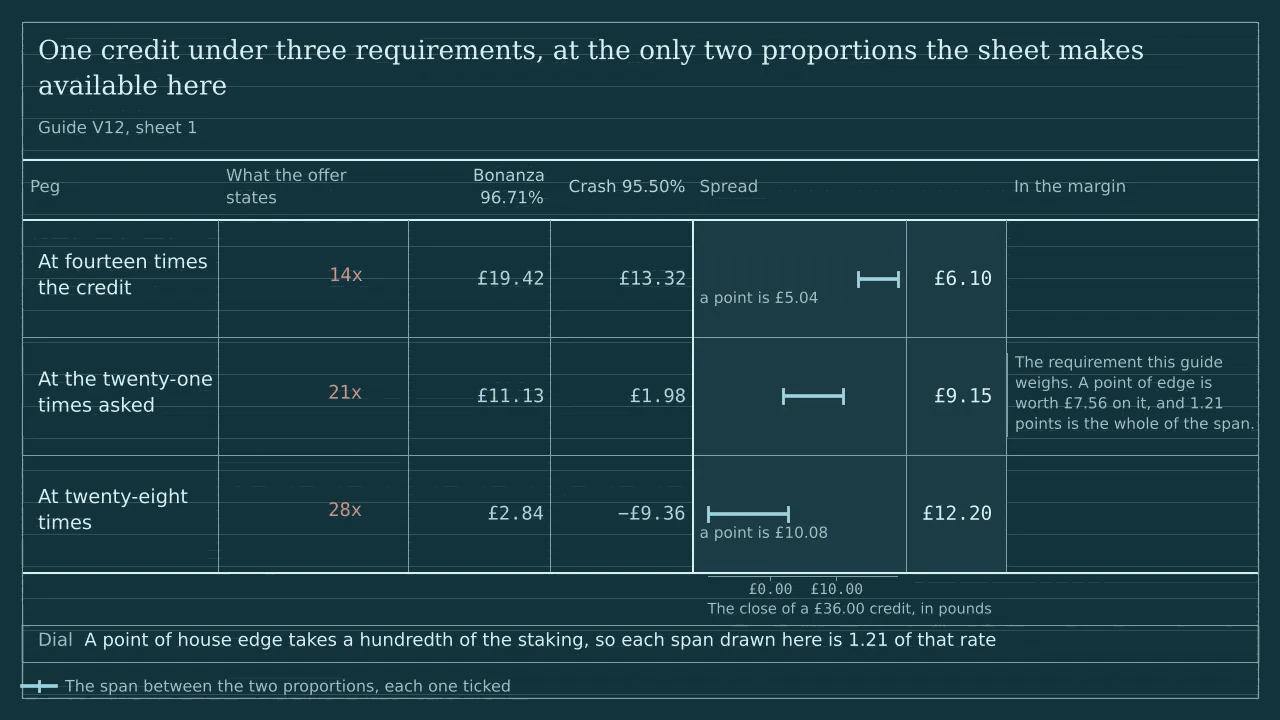
The drawing below works the same rate at the two requirements either side of the one this page weighs, which is the quickest way to see that it is a rate and not a coincidence. At fourteen times the staking is £504.00 and a point is worth £5.04; at twenty-one it is £756.00 and £7.56; at twenty-eight it is £1,008.00 and £10.08. Each span drawn across the two columns is 1.21 of those, being £6.10, £9.15 and £12.20, because 1.21 points is what separates the two published figures the sheet makes available. So the span on that sheet is not a separate calculation from the one in this part: it is the same arithmetic drawn at three requirements rather than one, and a reader who doubts either can multiply the other.
The one page on this site that cannot assume a stake
Every other page on this domain spends 10p a turn and says so in the sentence that spends it. It is an assumption, and what sits under it is published: the original’s own data reports a cheapest turn, and a tenth of a pound is it, which is why this domain spends that rather than a rounder sum no reel would sell. The assumption is cheap precisely because it is anchored.
On this key the anchor is gone. There is no published range for a dealt product on either sheet, so a stake put up here would be an assumption resting on nothing, and an assumption resting on nothing is a figure with a confident tone. This report declines to make one, and the refusal costs something exact, which is worth setting out rather than passing over.
Without a least stake there is no conversion from money into a count of cycles. The £756.00 of staking above therefore has no cycle count attached to it, and with no cycle count the published pace of 720 an hour cannot be turned into a length of time or into a sum per hour. Every one of those sums is available on a reel and none of them is available here, and the chain breaks at the same link each time: money into cycles. The clock is published and has nothing to count.
What a reader can still do here is worth saying, since it is not nothing. The staking is theirs to compute before any money moves, £756.00 on this page’s terms, and the rules they are owed have to be in front of them before they commit to anything. What no source reachable here will give them is the figure that turns the first of those into an expected sum, and a reader handed that figure by somebody with nothing behind it has been given the most expensive kind of guess there is.
Which is a useful way of seeing why the two missing inputs are not interchangeable losses. Without the proportion the method cannot say what a credit is worth. Without the least stake it cannot say how long anything takes or what an hour costs. The first absence removes the money, the second removes the time, and what is left is one exact rate, £7.56 a point, and the published pace standing on its own with no price beside it.
Adding up a product with one factor missing
The figure first, since this page has one. A credit of £36.00 carrying a requirement of 21 times puts £756.00 across whatever product the terms permit, and every point of house edge in that product is worth £7.56 of the credit. That is exact, it needs no proportion and no stake, and it is this page’s product column. What it wants in order to become a sum of money is a count of points, and the fourth part of this page establishes that nobody is obliged to publish one and no source reachable from here does.
The inputs next, as a result. Of the four this method takes, two arrive. The offer’s face and requirement arrive in full. The floor under a cycle arrives at 5 seconds rather than 2.5, which puts the licensed pace at 720 cycles in an hour instead of 1,440. The proportion given back does not arrive, because the requirement a licensee has to meet about a reader’s chances can be satisfied without any percentage at all. The least stake does not arrive either, so money cannot be turned into cycles and the published pace has nothing to count.
The demonstration sits in the family itself, which is the part worth keeping. Of the thirty-six game pages the studio lists under this series, thirty-five are slots and the thirty-sixth publishes a proportion of 95.50 per cent and nothing else, every other figure for it marked not reachable. Run this page’s credit at that figure and at the 96.71 per cent the original publishes, and the closes are £1.98 and £11.13, which is £9.15 apart, and 1.21 points multiplied by £7.56 is the same £9.15. Lose the reel and one of two primary sources goes. Lose the studio as well and both do.
So the finding of this page is the limit itself, stated as arithmetic rather than as a disclaimer. The method is not broken by this key and it is not stretched to fit it: it produces one exact rate, names the factor it is missing, shows on the family’s own boundary case what that factor is worth where it exists, and stops. A page that had quietly put a reel’s 96.71 per cent into the gap would have printed four complete sums about a product none of them was about, and it would have looked like the best page here instead of the worst.
Questions readers ask
Why can this report not price a dealt table the way it prices a reel
Because two of the four inputs the method takes are missing. The offer’s face and requirement arrive, and the floor under a cycle arrives at 5 seconds, but no sanctioned source reachable from here publishes a proportion given back or a least stake for a product of this kind.
Is there a published clock on a product of this kind
Yes, and it runs at half a reel’s pace. Where a casino game is dealt rather than reel-based, peer-to-peer poker aside, the rule book holds one cycle to 5 seconds at the least, so an hour here stops at 720 cycles against a reel’s 1,440. The figure took effect on 17 January 2025.
Where does that commencement date come from
From a separate page the regulator publishes listing what took effect on that date, which names the five-second minimum among the changes. The standard setting out the requirement itself gives no commencement date for any of them, so the date is cited to the updates page and not to the standard.
Does the stake cap on one game cycle apply here
No. Both stake figures are written for online slots alone, and the guidance beside them puts other casino games outside the pair, giving a wheel and a card game as its examples. The instrument’s own definition turns on a game that displays reels, so the licence bounds this product’s pace and not the size of one commitment.
Must a licensed operator publish a return to player figure
No. What a licensee owes before any commitment is enough for an informed decision about the chances of winning, and the requirement offers four ways of discharging it, any one on its own: a sketch of the way a game runs and how a winner gets settled, a house edge, a percentage given back, or the likelihood of the winning events.
What is a reader at a dealt table actually owed
An explanation rather than a figure. The rules in full before committing, an account of the prizes and of the way they are reached, enough on screen while the game runs to follow where it stands, and a result that stays legible long enough to be read. Four entitlements, and none of them a quantity to multiply.
Why is Big Bass Crash in the table on this page
Because it is the family’s one title that is not a slot, and the sheet marks it as such and warns against setting it among them. Its page publishes a proportion of 95.50 per cent and every other figure for it is marked not reachable, so one of the two primary sources answers and the other does not.
Is that 95.50 per cent a figure for a dealt table
No, and nothing here offers it as one. It belongs to one named title of one studio’s series. It stands on this page to show the method working where a proportion exists, which is how the gap left where none exists can be read in pounds instead of described in adjectives.
What is one point of house edge worth on this page’s credit
£7.56. A point of house edge takes a hundredth of the staking, and the requirement puts £756.00 through, so the rate holds at any proportion. Three points of it would be £22.68 against a face of £36.00, which decides most of the credit rather than its last decimal place.
Why does this page not assume a stake per cycle
Because the 10p spent elsewhere on this domain is anchored to the bottom of a published range, and no such range exists here on either sheet. An assumption with nothing underneath it would be a figure in a confident tone, so money cannot be turned into cycles here and the published pace has nothing to count.
Do the offers weighed in this report sit inside a Great Britain licence
They do not, which removes the information duties and the floor under a cycle together. On a reel that leaves the studio’s own published proportion untouched, because a studio publishes it about its product rather than because a regulator asked. Here the rule’s figure was the only one, so nothing remains on that side.
Before you play
Read on
- Online bingo, and the room that sets the clock
- The quantity deciding how long a credit lasts belongs to the caller rather than the player, and it has no publisher at all.
- Best gambling sites, and the ordering nobody publishes
- The quantities a reader can read about a venue are shared across every licensee, and the ones that would separate them are unread.
- Fast withdrawal casinos, weighed against the reel’s own clock
- One stretch of the route out carries a published interval and it belongs to the reel, which leaves a comparative with a single term.
- How a figure is weighed here
- Which figures are read off the machine, which off the offer, and which this publisher assumes.