Slots not on Gamstop: the reel is identical and everything round it is not
A reel carries its figures with it. The same published return of 96.71 per cent, a biggest round still fixed at 2,100 stakes, the same trigger and the same span of stakes hold good wherever the machine is loaded, because the maker publishes them and not the lobby.
- Updated 13 November 2026
- Licence status shown for every offer
- Assumptions marked in the text
Offers of this shape, weighed against a reel whose figures do not move
These offers are paid placements, so this site is owed a fee whenever a reader opens an account through one of the buttons below.
-

Tweedbet
Welcome pack 470%
- Licence
- Not stated, no Great Britain licence
- Play-through
- Not published
- Min deposit
- £20
Bonus up to£14,000 Free spins470Read the offer18+ only. Terms apply.
Licence, terms and working
The site does not say where it is licensed or which company runs it.
The reel
- Build of the reel
- Big Bass Bonanza
- Return it publishes
- 96.71 per cent
- Stake it accepts on one turn
- 10p to £250.00
The offer
- Turns advertised
- 470 turns Turns valued at the cheapest turn this reel sells, no worth for one being stated anywhere in the offer
- Price of one turn
- 10p the smallest stake the reel accepts, this operator publishing no figure of its own
- Credit as a sum
- £14,000.00
- Credit waiting on a payment
- Stated in words Casino Welcome Pack 470% up to £14,000 + 470 FS. Crypto Welcome Bonus 110% up to 1,300 USDT + 110 FS. VIP Welcome Pack 770% up to £13,000
- Advertised, priced
- £14,047.00 140,470 turns of this reel
Hung on it
- Play-through
- Not published
- Credited towards it
- 100 per cent nobody has published a share, so the whole of a stake is credited, which is the kindest reading available
- Ceiling on winnings
- Not published
- Qualifying payment
- £20.00 200 turns of this reel at the price above, and it enters no weight
Not weighed, for want of the play-through multiple as a number.
Stated in words means the condition is set down in words that cost something and give nothing to subtract. Not published means the operator sets the figure down nowhere.
-

EliteSpin
£5,000 + 500 FS
- Licence
- Costa Rica, no Great Britain licence
- Play-through
- 40×
- Min deposit
- £20
Bonus up to£5,000 Free spins500Read the offer18+ only. Terms apply.
Licence, terms and working
Licence held in Costa Rica, by PrimeTier Limited.
The reel
- Build of the reel
- Big Bass Bonanza
- Return it publishes
- 96.71 per cent
- Stake it accepts on one turn
- 10p to £250.00
The offer
- Turns advertised
- 500 turns Turns valued at the cheapest turn this reel sells, no worth for one being stated anywhere in the offer
- Price of one turn
- 10p the smallest stake the reel accepts, this operator publishing no figure of its own
- Credit as a sum
- £5,000.00
- Credit waiting on a payment
- Stated in words Welcome bonus €/£5,000 + 500 FS. Elite lootboxes unlock surprise rewards up to €/£20,000 or 500 FS. Summer Festival by BGaming: win €80,000
- Advertised, priced
- £5,050.00 50,500 turns of this reel
Hung on it
- Play-through
- 40 times the bonus and the winnings from the spins
- Credited towards it
- 100 per cent nobody has published a share, so the whole of a stake is credited, which is the kindest reading available
- Ceiling on winnings
- Stated in words Five times the bonus
- Qualifying payment
- £20.00 200 turns of this reel at the price above, and it enters no weight
Priced at 10p a turn, the banner comes to £5,050.00, of which £5,048.36 survives the spins. At the reel's published return of 96.71 per cent, a play-through of 40 times asks for £201,934.20 of staking and costs £6,643.64, more than there is to pay it with, so the offer weighs £0.00.
Stated in words means the condition is set down in words that cost something and give nothing to subtract.
-

WinBeast
€5,000 + 500 FS
- Licence
- Curaçao, no Great Britain licence
- Min deposit
- €20
- Free spins
- 500
Bonus up to€5,000 Play-through40×Read the offer18+ only. Terms apply.
Licence, terms and working
Licence held in Curaçao, by a company the site does not name.
The reel
- Build of the reel
- Big Bass Bonanza
- Return it publishes
- 96.71 per cent
- Stake it accepts on one turn
- 10c to €250.00
The offer
- Turns advertised
- 500 turns Turns valued at the cheapest turn this reel sells, no worth for one being stated anywhere in the offer
- Price of one turn
- 10c the smallest stake the reel accepts, this operator publishing no figure of its own
- Credit as a sum
- €5,000.00
- Credit waiting on a payment
- Stated in words Welcome pack €5,000 + 500 FS + €650 free bet. Fortune wheel on €40+ deposits with code FORTUNE. 40% up to €300 Beast Boost Monday with code BOOST1 on €20 deposit
- Advertised, priced
- €5,050.00 50,500 turns of this reel
Hung on it
- Play-through
- 40 times the bonus and the winnings from the spins
- Credited towards it
- 100 per cent nobody has published a share, so the whole of a stake is credited, which is the kindest reading available
- Ceiling on winnings
- Stated in words €100 a batch of spins
- Qualifying payment
- €20.00 200 turns of this reel at the price above, and it enters no weight
Priced at 10c a turn, the banner comes to €5,050.00, of which €5,048.36 survives the spins. At the reel's published return of 96.71 per cent, a play-through of 40 times asks for €201,934.20 of staking and costs €6,643.64, more than there is to pay it with, so the offer weighs €0.00.
Stated in words means the condition is set down in words that cost something and give nothing to subtract.
-

Betportal
300% + 150 FS
- Licence
- Anjouan, Comoros, no Great Britain licence
- Play-through
- 35×
- Min deposit
- €20
- Stake cap
- €5.00
Bonus up to€1,000 Free spins150Read the offer18+ only. Terms apply.
Licence, terms and working
Licence held in Anjouan, Comoros, by BetPortal Gaming Ltd and Excite Ultra Media Ltd, numbered ALSI-202601040-FI2.
The reel
- Build of the reel
- Big Bass Bonanza
- Return it publishes
- 96.71 per cent
- Stake it accepts on one turn
- 10c to €250.00
The offer
- Turns advertised
- 150 turns Turns valued at the cheapest turn this reel sells, no worth for one being stated anywhere in the offer
- Price of one turn
- 10c the smallest stake the reel accepts, this operator publishing no figure of its own
- Credit as a sum
- €1,000.00
- Credit waiting on a payment
- Stated in words Welcome package 300% up to €1,000 + 150 free spins. 1st deposit 150% up to €500 + 100 FS. 2nd deposit 100% up to €300 + 50 FS
- Advertised, priced
- €1,015.00 10,150 turns of this reel
Hung on it
- Play-through
- 35 times the bonus
- Credited towards it
- 100 per cent nobody has published a share, so the whole of a stake is credited, which is the kindest reading available
- Ceiling on winnings
- Stated in words Five times the bonus
- Largest stake while it runs
- €5.00 under the largest stake the reel accepts, so part of the machine's own range is shut off while the credit runs
- Qualifying payment
- €20.00 200 turns of this reel at the price above, and it enters no weight
Priced at 10c a turn, the banner comes to €1,015.00, of which €1,014.51 survives the spins. At the reel's published return of 96.71 per cent, a play-through of 35 times asks for €35,507.73 of staking and costs €1,168.20, more than there is to pay it with, so the offer weighs €0.00.
Stated in words means the condition is set down in words that cost something and give nothing to subtract.
-

Night Luck
805% + 280 FS
- Licence
- Not stated, no Great Britain licence
- Play-through
- Not published
- Min deposit
- €20
Bonus up to€6,400 Free spins280Read the offer18+ only. Terms apply.
Licence, terms and working
The site does not say where it is licensed or which company runs it.
The reel
- Build of the reel
- Big Bass Bonanza
- Return it publishes
- 96.71 per cent
- Stake it accepts on one turn
- 10c to €250.00
The offer
- Turns advertised
- 280 turns Turns valued at the cheapest turn this reel sells, no worth for one being stated anywhere in the offer
- Price of one turn
- 10c the smallest stake the reel accepts, this operator publishing no figure of its own
- Credit as a sum
- €6,400.00
- Credit waiting on a payment
- Stated in words Casino welcome bonus 805% up to €6,400 + 280 FS. Crypto welcome bonus 140% up to 1,600 USDT + 140 FS. VIP welcome pack 800% up to €14,500
- Advertised, priced
- €6,428.00 64,280 turns of this reel
Hung on it
- Play-through
- Not published
- Credited towards it
- 100 per cent nobody has published a share, so the whole of a stake is credited, which is the kindest reading available
- Ceiling on winnings
- Not published
- Qualifying payment
- €20.00 200 turns of this reel at the price above, and it enters no weight
Not weighed, for want of the play-through multiple as a number.
Stated in words means the condition is set down in words that cost something and give nothing to subtract. Not published means the operator sets the figure down nowhere.
What a Great Britain licence would add to these offers
A licence from the Gambling Commission for Great Britain carries rules that an offer licensed elsewhere does not have to follow, and some figures in this ranking would not survive them. Social responsibility code provision 5.1.1 stops a British licensee applying a wagering requirement of more than ten times the bonus funds, and that limit has applied since 19 January 2026. A play-through above ten times in this list is therefore one a British licence would not allow.
Regulation 5(2) of the Gambling Act 2005 (Operating Licence Conditions) (Amendment) Regulations 2025, made on 25 February 2025, limits what a player can stake on one game cycle of an online slot to £5, or £2 for a player under 25. It is a condition of a British remote casino licence and not a property of the game, so a player at an operator licensed elsewhere does not have it behind them.
Remote technical standard 14D asks for at least two and a half seconds from the start of one slot game cycle to the start of the next, with the player pressing start each time. It is addressed to the game and not to the money, so no figure in this ranking measures it.
GAMSTOP is the free scheme that closes your accounts with online gambling companies licensed in Great Britain, and every one of them must join it. An operator licensed elsewhere is not required to, so a GAMSTOP registration cannot be counted on to reach these offers. If gambling is costing more than money, the National Gambling Helpline is free and answers on 0808 8020 133 at any hour.
Ranking last changed 8 November 2026. Operator terms change without notice, so open the offer page and read the terms there before you register.
At a glance
What the British licence held was never the machine’s mathematics: it was a limit on what one cycle could take, a floor beneath the speed at which cycles could follow, a duty to put the chances in reach, and a ceiling on what an incentive could demand. Priced at the last multiple a regulator measured, sixty times, a credit of £20.00 on this reel closes at −£19.48, which is the whole credit and most of another pound besides.
- What the machine states96.71 per centUnchanged by any of this. The maker prints one figure per title on its own page and the game reports the same one, and neither document asks where the reel has been loaded or under whose licence.
- What the offer states£20.00 at 60 timesSixty times is the figure the Commission itself gave for what some licensed sites were asking before a ceiling was put on it. It is used here as the last measured point of reference anybody has, not as a claim about any particular cashier.
- What the two make when multiplied−£19.48The expected close once £1,200.00 of staking has crossed a reel returning that figure. The machine did nothing unusual to produce it: the multiple did all of the work, and no rule outside the licence holds a multiple anywhere.
On this page
- The reel is the same reel, and the first thing to say is the hard one
- Six provisions that bind the machine, and a rulebook carrying none of them
- One credit at the last multiple anybody measured
- What one cycle may take, and what the reel itself will sell
- The hour with no ceiling on it
- What stays true about the machine whoever runs it
- The one thing about the machine nobody is obliged to tell you
- How far the scheme reaches, which is a fact about licences
- What a reader gives up that is not money at all
- The machine and its surroundings, totalled
The reel is the same reel, and the first thing to say is the hard one
Start with the thing this page will not do. Nothing below helps anybody reach a lobby they have shut themselves out of, nothing below points at the sort of cashier that asks for less, and no route of any kind is set out here. A bank or a card scheme that refuses to move money towards such a lobby is doing the same work as the scheme itself, and this page treats it the same way: as a protection, and not as an obstacle with a way round it.
If the subject of this page is a live question for somebody, the useful tools are the national self-exclusion scheme, which is Gamstop Online in full, and the blocking software GamCare publishes a free British route to through its own helpline, under the name TalkBanStop. One caveat belongs with that second one, since both halves of it should be given together: the software company’s own pages carry a trial and an American state’s free arrangement, and no free British route appears on them, so the helpline is where the free route is published. Both tools appear at the foot of this page with their addresses.
Now the finding, which is narrower than the search phrase suggests. The phrase asks about slots, and a slot is a machine. This machine does not change. The maker publishes 96.71 per cent for the title this page weighs, the game reports the same figure when a session opens, the biggest round it can pay is 2,100 times the stake, its feature opens on three, four or five scatters for ten, fifteen or twenty turns, and the fourth wild retriggers it with ten more the title’s own figures, all of them. Not one of those depends on which cashier has loaded the game.
So a reader asking whether the slot is different is asking the wrong question, and the right one is what has been taken away from around it. That answer is specific, it is published in two places a reader can hold side by side, and some of it is priceable. Six provisions bind the machine inside a British licence: a cap on the stake one cycle may take, a floor set under the interval before another may begin, a bar on any feature that speeds the result forward, a bar on cycles running without a separate commitment to each, a bar on the game dressing up a return that only equals the stake as though it were a win, and a ceiling on what an incentive may demand. The rest of this page takes them in turn against the machine’s own published figures.
Six provisions that bind the machine, and a rulebook carrying none of them
The six are worth setting out as what they do rather than as what they say, because what they do is arithmetic. One caps a cycle at £5.00 of stake, with the cap standing lower, at £2.00, until a player is twenty-five. One holds the interval before a cycle may be followed by another, and that floor is what puts 1,440 cycles at the top of an hour. One forbids any feature that brings a result forward, naming turbo, quick spin and slam stop as examples of what is not permitted. One requires a separate commitment to every cycle, which is what makes automatic play unavailable. One forbids the game marking a return no bigger than the stake with the sounds and pictures of a win. And one stops an incentive demanding that bonus funds be staked more than ten times over.
Now the part a reader cannot get anywhere else, because it needs two rulebooks open at once. Curaçao’s gaming authority publishes a list of mandatory responsible gaming requirements for the operators it licenses, and the list is not short. Age verification is on it. So is accessible information, so are self-assessments a player can take, cooling-off and self-exclusion at the operator’s own level, the tracking of behaviour, limits on deposits, the training of employees and of whatever marketing partners and influencers an operator uses, and a set of principles for advertising that authority’s own policy. A reader might reasonably expect the machine rules to be in there somewhere.
They are not. Nothing in it caps a wagering requirement. No stake is capped either. Nothing sets a least length for a game cycle. Nothing bars turbo, and nothing bars automatic play. Nothing stops a game treating a return that merely matches its stake as though a win had happened. On incentives the policy spends two lines: bonuses are to be communicated transparently, with their terms clear, and an operator is not to push excessive gambling by promoting them aggressively. So the subject is not untouched, and the multiple is simply not bounded. That set of absences, held against the six British provisions above, is where the subject of this page actually lies, and it is a comparison of two published documents rather than a claim about how anybody behaves.
One caution this page holds to throughout. No figure exists anywhere for how many cashiers hold which licence, and none exists for the spread of wagering multiples, of withdrawal ceilings or of stake values anywhere past the edge of the licence. Every discussion of those turned up while this publisher’s sheets were being assembled sat on a trade publication, on a law firm’s briefing or on an affiliate page, and not one is citable. So this page makes the structural point and never a market one, and the figures it prices are the machine’s own and its own suppositions.
One credit at the last multiple anybody measured
To price the missing ceiling on an incentive, a multiple is needed, and inventing one would be worthless. The best available is the Commission’s own: in setting out why it was capping the requirement at ten times, it recorded a practice of up to sixty times among some licensees the figure the Commission gave for what it was putting a stop to. On this publisher’s regulatory sheet it stands alone as a multiple of the market that a regulator put its name to. It describes licensed sites before a ceiling existed rather than any cashier today, and it is used here for that reason: it is measured, it is published, and it is the last point of reference anybody has before the rules changed.
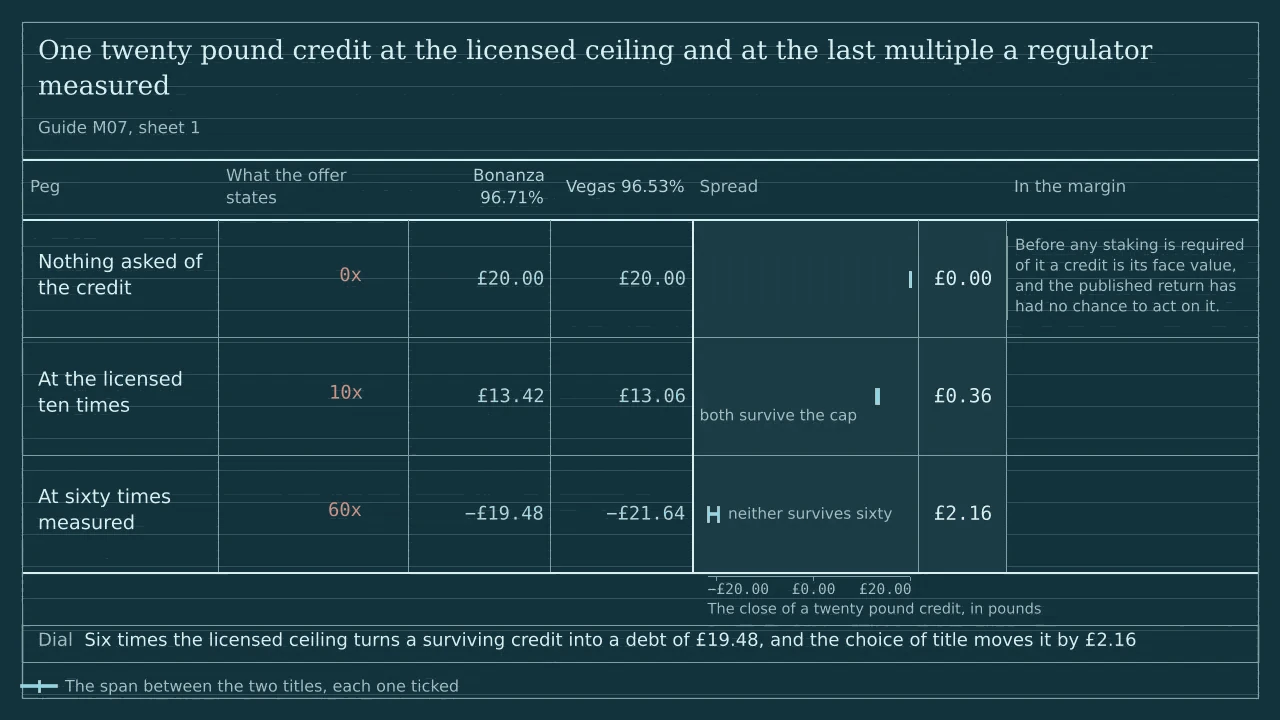
Take a credit of £20.00 and ask sixty times of it. That is £1,200.00 of staking, and the reel’s own share of staking is a hundred less its published return, so 3.29 points of £1,200.00 is £39.48. The credit closes at −£19.48, which is to say the credit is gone and the reader is expected to be nineteen pounds and forty-eight pence of their own money down as well. B is this page’s £20.00 and W its sixty times, so E = B × (1 − W × (1 − RTP) ∕ g) runs out at that figure with g standing at one, which is what the weighting is wherever a slot counts in full.
| The title weighed | Published return | Break-even play-through | The offer asks | What £20.00 is worth |
|---|---|---|---|---|
| Big Bass Bonanza | 96.71 per cent | 30.40 times | 60 times | −£19.48 |
| Big Bass Vegas 1000 | 96.53 per cent | 28.82 times | 60 times | −£21.64 |
| What the title decides here | 0.18 points of return | 1.58 times | no change | £2.16 |
Two things in that table deserve saying out loud. The first is that both figures sit roughly twice the break-even multiple, so the question of which title to pick has become almost irrelevant: at sixty times the credit is lost on either, and the £2.16 between them is the difference between two ways of losing it. The second is that the ceiling the licence imposes would have made the same credit worth £13.42 on the first of those titles, because ten times over, a £20.00 credit is £200.00 put across the reel, and 3.29 points of that is £6.58. The distance between a licensed ceiling and the last measured practice is therefore £32.90 on one £20.00 credit.
What one cycle may take, and what the reel itself will sell
The stake cap is the rule with the widest gap between what a licence permits and what the machine is built to accept. Inside, one cycle of an online slot may take no more than £5.00, and no more than £2.00 from a player not yet twenty-five, under regulations made in February 2025 the instrument itself. The reel, meanwhile, sells a turn anywhere from 0.10 up to 250.00 the steps the game’s own data carries. Fifty times the licensed maximum is available on the machine and reachable nowhere a British licence applies.
What that is worth is best read through the ceiling rather than the stake, because the biggest round this reel can pay is published as a multiple of whatever was staked. At the £2.00 cycle a younger player is held to, 2,100 stakes is £4,200. At £5.00 it is £10,500. At the 250.00 the machine itself will accept, the same multiple is £525,000, and the same reel, the same mathematics and the same 96.71 per cent produced all three. A ceiling is not a sum of money at all until a stake is fixed beneath it, and the licence is the only thing that fixes one.
The symmetry is the part worth carrying away. A stake cap caps the loss per cycle in exactly the proportion it caps the win per cycle, because both are the same multiplication. Lifting it multiplies the largest round by fifty and multiplies the expected cost of an hour by fifty as well, and the published return decides nothing about which of those a particular reader meets.
One figure to keep the scale honest: the stake range above is the game’s own and came off the maker’s free-play service, so it describes what the machine will sell rather than what any cashier offers. What a reader is actually able to stake anywhere is a fact about that lobby, and this page has no figure for it and does not guess at one.
The hour with no ceiling on it
Two rules together decide how much of a reel a reader can get through in an hour. One puts a floor under the interval before a cycle may be followed by another, which caps the hour at 1,440 cycles. One forbids any feature that shortens the wait before a result appears, and a third forbids a sequence of cycles running without a separate commitment to each. Inside the licence, therefore, the most expensive hour available on this reel is 1,440 cycles at £5.00, which is £7,200.00 of staking, expected to cost £236.88 at the published figure.
That is already a large number and it is a ceiling. Outside, there is no equivalent in the rulebook examined in part two: no minimum for a cycle and no bar on turbo or on automatic play appears in it anywhere. The hour therefore has no published maximum at all, because the two quantities that would bound it, the interval and the stake, are both unbounded there. A page that wanted to be dramatic could multiply something here; this one simply says that no figure exists, which is the honest state of it.
£7,200.00of staking in the most expensive hour a licensed build permits, and no stated maximum for an hour where neither the cycle floor nor the stake cap applies
The practical consequence is about speed rather than about money, and it is the one readers underestimate. A requirement of £1,200.00 of staking, which is what part three priced, is 12,000 turns at ten pence. On a licensed build those 12,000 turns cannot be compressed below eight hours and twenty minutes, every one of them separately committed to. Where nothing holds the interval, the same requirement can be put through in whatever time the software allows, and the expected cost of £39.48 arrives that much sooner.
What stays true about the machine whoever runs it
Having listed what goes, it is worth being equally precise about what does not, because a page that implied the machine itself becomes unknowable would be as misleading as one that implied nothing changes.
The maker publishes a return for each title on its own game page, and that page does not ask who has loaded the game. The same figure arrives in the configuration handed to a game as a session opens, and that configuration is where this publisher reads the ceiling of 2,100 stakes, a grid of five reels and three rows, a payline count of ten, and the span of stakes. The feature’s mechanics are described in the maker’s own prose: a wild gathers up the money symbols on show, the top of those symbols is worth 2,000 stakes, and every fourth wild both retriggers the round and moves the multiplier on, 2x to 3x to 10x. None of that is a licence condition and none of it travels with a licence.
The maker’s own position is published too: it stands on the public register the Gambling Commission keeps, under account 56015, where Gambling Software has been a remote activity of its since 30 January 2020. That licence authorises it to supply software and settles nothing whatever about a cashier running the result, and the regulator has said as much itself. Its warning notice to the industry in January 2025 records games from licensed suppliers showing up where no licence stood behind the website at all, and in July 2026 a supplier agreed to pay £4.75m over six such websites, all of them reachable by consumers here. A familiar reel in a lobby is evidence about a workshop and not about a cashier, and establishing that it is only that has carried a price.
So the arithmetic on this site works identically on both sides of the licence, and that is the genuinely useful thing about holding the machine fixed. A reader can price any offer against 96.71 per cent wherever they meet the reel. What the licence changes is not the machine’s figures but the limits on what may be asked of a reader who sits down in front of it.
The one thing about the machine nobody is obliged to tell you
There is a single quantity this page cannot settle, and it is better to name it than to let it hide. The return a game displays comes from the maker’s server at the start of each session rather than from anything downloaded with the game, so what a player reads on an information screen is whatever that server sent for that session. This publisher has read that response on the maker’s own free-play service, where every session for the title weighed here returned 96.71, including sessions opened with seven different jurisdiction values against the same server.
What follows from that is narrow and this page stops exactly there. A figure delivered per session is consistent with one fixed value and equally consistent with something chosen per deployment, and the mechanism is not evidence that anybody chooses anything. Nothing in this publisher’s regulatory sheet obliges a licensed operator to publish a return as a percentage: a house edge discharges the same duty, so do the odds of a winning event, and nothing anywhere in it requires anybody to disclose which configuration is running. The absence is the finding: the question of who would have to say is answered by nobody.
That is why this page prices the maker’s published figure and says where it came from every time it spends it. It is the only figure with two primary sources behind it for this title, since its page and its session data agree to the decimal, and a reader who wants a different one has nowhere to get it that this publisher would print.
The practical reading for somebody meeting a reel outside the licence: the machine’s published figure is the right one to weigh an offer against, because it is the only published one, and the arithmetic done with it is a floor on what the offer costs rather than a measurement of the particular build in front of them.
How far the scheme reaches, which is a fact about licences
The scheme in the search phrase is the national online self-exclusion scheme, written Gamstop and Gamstop Online in full. Its reach is set by a licence condition rather than by its own ambition: taking part is required of every gambling business Great Britain licenses to operate online, which is what makes one registration close every account a reader holds in that name across all of them at once.
Its own terms state that limit plainly, and the sentence they state it in is the most useful thing a page of this kind can quote: it can exclude a person from services offered by the gambling operators that participate, and it is unable to prevent them reaching services provided by organisations that do not. That is a consequence of how the reach is defined and not a weakness anybody is hiding, and it is stated here as a limit on the protection a registered reader has rather than as anything else.
Two further facts from the scheme’s own terms belong beside it, because they bear on somebody deciding. A registration is not a switch. The minimum period has to run out before it can be lifted at all, it does not fall away by itself when that period ends, and lifting it goes through the scheme’s own contact centre with a day’s cooling-off at the very least, and the exclusion stays live for the whole of it. Four lengths are offered to somebody registering, the shortest of them half a year and the longest five years that renew themselves. Those terms carried their last revision in May 2026.
What this page will not do with any of that is obvious from part one and worth repeating once: it describes no procedure and points at no sort of cashier. The facts are here because a reader using the scheme is entitled to know what it covers, and because the honest answer to the search phrase is that the machine is the same machine and the scheme was never a property of the machine at all.
What a reader gives up that is not money at all
Three of the six provisions above bear on money and three bear on how the reel behaves from one second to the next. What this part covers is a third sort of loss altogether, and nothing in it can be priced, which is why it comes last rather than first.
The first is checkability. A licensed business has an entry on a public register, and the regulator asks players in terms to click through and satisfy themselves that what a site claims matches what the register shows, down to which activities it covers and which domain names it lists. That check takes a minute and it is available for every licensed cashier and for none that is not licensed, which makes it the plainest practical difference on this page.
The second is recourse, and here this page is careful in both directions. It does not say that no complaints route exists once a British licence is no longer in play: the Curaçao authority publishes a complaints policy with a six-month window, stated timelines and free alternative dispute resolution, so a flat claim of no route would be wrong. What can be said is the regulator’s own published statement about unlicensed sites, which is that consumers meet higher risks of unfair gaming, of losing money, and of finding nowhere to take a complaint once something has gone wrong, and that it has watched sites block payouts outright and put withdrawal limits where nobody could reach them.
And the third thing, which is the subject of part eight, is that a tool a reader has already used to protect themselves stops at the edge of the licence. One detail of the offshore rulebook belongs here because it cuts against a tidy conclusion: it requires the website footer to point at addiction support, whether based in the player’s country or elsewhere, and the three bodies it names as examples are GamCare, Gamblers Anonymous and GambleAware. The British bodies are pointed at from both sides. None of these three is measured in pounds, all three were part of what the licence was holding, and a page that totalled only the money would have understated the difference by whatever those are worth to the particular reader.
The machine and its surroundings, totalled
In the machine’s own figures, nothing has changed: 96.71 per cent, 2,100 stakes in one round, three to five scatters for ten to twenty turns, ten more on every fourth wild, a range of stakes from 0.10 to 250.00, and a maker on the public register since January 2020. Every page on this site works its arithmetic on those figures and they are as true in one lobby as in another.
In what may be asked of the reader, a set of limits has gone. A cycle has no cap, so the largest round moves from £10,500 at the licensed maximum to £525,000 at the stake the machine will accept, and the expected cost of an hour moves by the same factor of fifty. An hour has no floor under its cycles, so the £7,200.00 ceiling on a licensed hour’s staking has no counterpart. A requirement has no ceiling, so the £20.00 credit that would close at £13.42 under the licensed ten times closes at −£19.48 at the sixty times a regulator last measured, a distance of £32.90. The bar on marking a return no bigger than its stake as a win has gone, which costs a reader nothing and changes what an hour of the reel feels like. And the scheme stops where the licence stops.
The honest summary for somebody who came here asking whether the slots are different: they are not, and that is the difficulty rather than the comfort. A machine whose published return stops short of a hundred per cent runs against the player by precisely the margin its maker prints, in every lobby, and the rules that were doing the protecting were never in the machine. They were in the licence, and they are what the search phrase proposes leaving behind.
If any of this is a live question rather than an arithmetical one, the tools named in part one are the right place to go, and the care block below carries the helpline and the addresses.
Questions readers ask
Are slots not on Gamstop different machines?
No. The maker publishes one return per title on its own page and the game reports the same figure when a session opens, and neither asks which cashier has loaded it. The title weighed here publishes 96.71 per cent and a biggest round of 2,100 times the stake wherever it runs.
What rules stop applying to a slot outside the British licence?
Six, and every one of them is a provision on the licence rather than a part of the reel: the £5.00 cap on one cycle and £2.00 under twenty-five, the hold on the interval before another cycle may begin, the bar on anything that brings the result forward, the requirement of a separate commitment to every cycle, the bar on marking a return no bigger than the stake as a win, and the ceiling of ten times that a requirement may not pass.
Is there really no cap on wagering requirements outside Great Britain?
The structural point is sourced and a market figure is not. Curaçao’s own list of mandatory responsible gaming requirements carries nothing that caps a wagering requirement, nothing that caps a stake, nothing that puts a floor beneath the length of one game cycle, and nothing set against turbo or against automatic play. What any particular cashier asks is published nowhere this publisher could check.
What would a £20 credit at sixty times be worth on this slot?
Sixty times a £20.00 credit comes to £1,200.00 of staking, of which 3.29 points is £39.48, so the credit closes £19.48 below nothing. Held to the ten times a British licence allows, that same credit closes at £13.42, and the distance between the two is £32.90.
Why is sixty times the multiple used on this page?
Because on this publisher’s regulatory sheet it is the one multiple of the market a regulator put its name to. The Commission recorded it in explaining why it was capping requirements at ten, as the figure some licensees were reaching by then. It describes licensed sites before the cap and not any cashier today, and nothing on this page attributes it to one.
Does the maximum win change outside the licence?
The multiple does not: 2,100 times the stake is the game’s own figure. The sum does, because a multiple is not money until a stake is fixed. At the £2.00 cycle cap it is £4,200, at £5.00 it is £10,500, and at the 250.00 the machine itself will sell it is £525,000.
How far does Gamstop Online actually reach?
Exactly as far as a British licence reaches, taking part being one of the conditions of holding one. Its own terms put the boundary at the list of participants, and a reader registered with the scheme is protected to that line and no further.
What does an hour of this reel cost at the licensed maximum?
At £5.00 a cycle and the 1,440 cycles a licensed hour holds at the outside, £7,200.00 crosses the reel in an hour and 3.29 points of that is £236.88. Beyond the licence neither the cap on a cycle nor the floor under the pace applies, so an hour there has no published maximum to price at all.
Before you play
Read on
- Online slots UK
- The same five duties priced from the inside: on a £15.00 credit the licensed ceiling alone is worth £14.81.
- Free slots no deposit
- A demonstration build returns nothing and costs nothing, and what it proves about a paid one is nothing either.
- Pragmatic slots
- A maker’s name settles where to look a figure up and not what the figure is: twelve returns stand under one name.
- Staying in control
- The tools a reader can use, with what each one covers and where each one stops.