40 free spins no deposit: against a feature round that nobody times
Anybody handed forty turns on this machine wants to know one thing: is forty enough to reach the feature round. The answer has no publisher.
- Updated 13 November 2026
- Licence status shown for every offer
- Assumptions marked in the text
Offers of this kind, weighed against the same reel
These offers are paid placements, so this site is owed a fee whenever a reader opens an account through one of the buttons below.
-

Tweedbet
Welcome pack 470%
- Licence
- Not stated, no Great Britain licence
- Play-through
- Not published
- Min deposit
- £20
Bonus up to£14,000 Free spins470Read the offer18+ only. Terms apply.
Licence, terms and working
The site does not say where it is licensed or which company runs it.
The reel
- Build of the reel
- Big Bass Bonanza
- Return it publishes
- 96.71 per cent
- Stake it accepts on one turn
- 10p to £250.00
The offer
- Turns advertised
- 470 turns Turns valued at the cheapest turn this reel sells, no worth for one being stated anywhere in the offer
- Price of one turn
- 10p the smallest stake the reel accepts, this operator publishing no figure of its own
- Credit as a sum
- £14,000.00
- Credit waiting on a payment
- Stated in words Casino Welcome Pack 470% up to £14,000 + 470 FS. Crypto Welcome Bonus 110% up to 1,300 USDT + 110 FS. VIP Welcome Pack 770% up to £13,000
- Advertised, priced
- £14,047.00 140,470 turns of this reel
Hung on it
- Play-through
- Not published
- Credited towards it
- 100 per cent nobody has published a share, so the whole of a stake is credited, which is the kindest reading available
- Ceiling on winnings
- Not published
- Qualifying payment
- £20.00 200 turns of this reel at the price above, and it enters no weight
Not weighed, for want of the play-through multiple as a number.
Stated in words means the condition is set down in words that cost something and give nothing to subtract. Not published means the operator sets the figure down nowhere.
-

EliteSpin
£5,000 + 500 FS
- Licence
- Costa Rica, no Great Britain licence
- Play-through
- 40×
- Min deposit
- £20
Bonus up to£5,000 Free spins500Read the offer18+ only. Terms apply.
Licence, terms and working
Licence held in Costa Rica, by PrimeTier Limited.
The reel
- Build of the reel
- Big Bass Bonanza
- Return it publishes
- 96.71 per cent
- Stake it accepts on one turn
- 10p to £250.00
The offer
- Turns advertised
- 500 turns Turns valued at the cheapest turn this reel sells, no worth for one being stated anywhere in the offer
- Price of one turn
- 10p the smallest stake the reel accepts, this operator publishing no figure of its own
- Credit as a sum
- £5,000.00
- Credit waiting on a payment
- Stated in words Welcome bonus €/£5,000 + 500 FS. Elite lootboxes unlock surprise rewards up to €/£20,000 or 500 FS. Summer Festival by BGaming: win €80,000
- Advertised, priced
- £5,050.00 50,500 turns of this reel
Hung on it
- Play-through
- 40 times the bonus and the winnings from the spins
- Credited towards it
- 100 per cent nobody has published a share, so the whole of a stake is credited, which is the kindest reading available
- Ceiling on winnings
- Stated in words Five times the bonus
- Qualifying payment
- £20.00 200 turns of this reel at the price above, and it enters no weight
Priced at 10p a turn, the banner comes to £5,050.00, of which £5,048.36 survives the spins. At the reel's published return of 96.71 per cent, a play-through of 40 times asks for £201,934.20 of staking and costs £6,643.64, more than there is to pay it with, so the offer weighs £0.00.
Stated in words means the condition is set down in words that cost something and give nothing to subtract.
-
WinBeast
€5,000 + 500 FS
- Licence
- Curaçao, no Great Britain licence
- Min deposit
- €20
- Free spins
- 500
Bonus up to€5,000 Play-through40×Read the offer18+ only. Terms apply.
Licence, terms and working
Licence held in Curaçao, by a company the site does not name.
The reel
- Build of the reel
- Big Bass Bonanza
- Return it publishes
- 96.71 per cent
- Stake it accepts on one turn
- 10c to €250.00
The offer
- Turns advertised
- 500 turns Turns valued at the cheapest turn this reel sells, no worth for one being stated anywhere in the offer
- Price of one turn
- 10c the smallest stake the reel accepts, this operator publishing no figure of its own
- Credit as a sum
- €5,000.00
- Credit waiting on a payment
- Stated in words Welcome pack €5,000 + 500 FS + €650 free bet. Fortune wheel on €40+ deposits with code FORTUNE. 40% up to €300 Beast Boost Monday with code BOOST1 on €20 deposit
- Advertised, priced
- €5,050.00 50,500 turns of this reel
Hung on it
- Play-through
- 40 times the bonus and the winnings from the spins
- Credited towards it
- 100 per cent nobody has published a share, so the whole of a stake is credited, which is the kindest reading available
- Ceiling on winnings
- Stated in words €100 a batch of spins
- Qualifying payment
- €20.00 200 turns of this reel at the price above, and it enters no weight
Priced at 10c a turn, the banner comes to €5,050.00, of which €5,048.36 survives the spins. At the reel's published return of 96.71 per cent, a play-through of 40 times asks for €201,934.20 of staking and costs €6,643.64, more than there is to pay it with, so the offer weighs €0.00.
Stated in words means the condition is set down in words that cost something and give nothing to subtract.
-

Betportal
300% + 150 FS
- Licence
- Anjouan, Comoros, no Great Britain licence
- Play-through
- 35×
- Min deposit
- €20
- Stake cap
- €5.00
Bonus up to€1,000 Free spins150Read the offer18+ only. Terms apply.
Licence, terms and working
Licence held in Anjouan, Comoros, by BetPortal Gaming Ltd and Excite Ultra Media Ltd, numbered ALSI-202601040-FI2.
The reel
- Build of the reel
- Big Bass Bonanza
- Return it publishes
- 96.71 per cent
- Stake it accepts on one turn
- 10c to €250.00
The offer
- Turns advertised
- 150 turns Turns valued at the cheapest turn this reel sells, no worth for one being stated anywhere in the offer
- Price of one turn
- 10c the smallest stake the reel accepts, this operator publishing no figure of its own
- Credit as a sum
- €1,000.00
- Credit waiting on a payment
- Stated in words Welcome package 300% up to €1,000 + 150 free spins. 1st deposit 150% up to €500 + 100 FS. 2nd deposit 100% up to €300 + 50 FS
- Advertised, priced
- €1,015.00 10,150 turns of this reel
Hung on it
- Play-through
- 35 times the bonus
- Credited towards it
- 100 per cent nobody has published a share, so the whole of a stake is credited, which is the kindest reading available
- Ceiling on winnings
- Stated in words Five times the bonus
- Largest stake while it runs
- €5.00 under the largest stake the reel accepts, so part of the machine's own range is shut off while the credit runs
- Qualifying payment
- €20.00 200 turns of this reel at the price above, and it enters no weight
Priced at 10c a turn, the banner comes to €1,015.00, of which €1,014.51 survives the spins. At the reel's published return of 96.71 per cent, a play-through of 35 times asks for €35,507.73 of staking and costs €1,168.20, more than there is to pay it with, so the offer weighs €0.00.
Stated in words means the condition is set down in words that cost something and give nothing to subtract.
-

Night Luck
805% + 280 FS
- Licence
- Not stated, no Great Britain licence
- Play-through
- Not published
- Min deposit
- €20
Bonus up to€6,400 Free spins280Read the offer18+ only. Terms apply.
Licence, terms and working
The site does not say where it is licensed or which company runs it.
The reel
- Build of the reel
- Big Bass Bonanza
- Return it publishes
- 96.71 per cent
- Stake it accepts on one turn
- 10c to €250.00
The offer
- Turns advertised
- 280 turns Turns valued at the cheapest turn this reel sells, no worth for one being stated anywhere in the offer
- Price of one turn
- 10c the smallest stake the reel accepts, this operator publishing no figure of its own
- Credit as a sum
- €6,400.00
- Credit waiting on a payment
- Stated in words Casino welcome bonus 805% up to €6,400 + 280 FS. Crypto welcome bonus 140% up to 1,600 USDT + 140 FS. VIP welcome pack 800% up to €14,500
- Advertised, priced
- €6,428.00 64,280 turns of this reel
Hung on it
- Play-through
- Not published
- Credited towards it
- 100 per cent nobody has published a share, so the whole of a stake is credited, which is the kindest reading available
- Ceiling on winnings
- Not published
- Qualifying payment
- €20.00 200 turns of this reel at the price above, and it enters no weight
Not weighed, for want of the play-through multiple as a number.
Stated in words means the condition is set down in words that cost something and give nothing to subtract. Not published means the operator sets the figure down nowhere.
What a Great Britain licence would add to these offers
A licence from the Gambling Commission for Great Britain carries rules that an offer licensed elsewhere does not have to follow, and some figures in this ranking would not survive them. Social responsibility code provision 5.1.1 stops a British licensee applying a wagering requirement of more than ten times the bonus funds, and that limit has applied since 19 January 2026. A play-through above ten times in this list is therefore one a British licence would not allow.
Regulation 5(2) of the Gambling Act 2005 (Operating Licence Conditions) (Amendment) Regulations 2025, made on 25 February 2025, limits what a player can stake on one game cycle of an online slot to £5, or £2 for a player under 25. It is a condition of a British remote casino licence and not a property of the game, so a player at an operator licensed elsewhere does not have it behind them.
Remote technical standard 14D asks for at least two and a half seconds from the start of one slot game cycle to the start of the next, with the player pressing start each time. It is addressed to the game and not to the money, so no figure in this ranking measures it.
GAMSTOP is the free scheme that closes your accounts with online gambling companies licensed in Great Britain, and every one of them must join it. An operator licensed elsewhere is not required to, so a GAMSTOP registration cannot be counted on to reach these offers. If gambling is costing more than money, the National Gambling Helpline is free and answers on 0808 8020 133 at any hour.
Ranking last changed 8 November 2026. Operator terms change without notice, so open the offer page and read the terms there before you register.
At a glance
No trigger frequency appears on any of the studio’s thirty-six pages, no field exists for one in the configuration its server sends, and the two figures circulating in the trade contradict each other. So this page refuses to average the two cases and prices each instead. Forty turns at ten pence stake £4.00, a published 96.71 per cent gives £3.87 back across both cases together, and a fifteen-times requirement closes the award at £1.96. The one arrival rate the machine does publish is worth about a fifth of a penny on it.
- What the machine states96.71 per centOne figure covering a base game and a feature round together, at claims 20 and 21. The split between the two halves is published nowhere, which is the whole difficulty this page sets out to handle rather than to hide.
- What the offer states40 turns at 15 timesForty turns for nothing paid in, with the winnings going round fifteen times before a withdrawal. Forty is a floor rather than a figure: reaching the round adds turns at no further stake, and the offer says nothing about that either way.
- What the two make when multiplied£1.96The close at a turn costing ten pence, a price supposed by this page and repeated wherever it is leaned on. It is an expectation across both cases at once, which is precisely what entries four and five say it cannot be read as.
On this page
- The question forty turns raises and nobody answers
- What the machine does publish about its feature round
- The absence, established rather than asserted
- Why one return cannot describe either case
- The case where the round never opens
- The case where it does, and the count stops being forty
- The one arrival rate anybody publishes, priced
- What the award comes to across both cases together
- Which statements survive and which have to be withdrawn
The question forty turns raises and nobody answers
Forty is a count large enough to make a reader hopeful and small enough to make them calculate. Nobody wonders whether five turns will reach the feature round and nobody wonders whether a thousand will. At forty the question is live, and it is the first question anybody asks of an award of this size: how often does the round come, and is forty enough.
Every honest answer to that begins by saying that no source worth citing gives a rate. This page spends an entry establishing the absence properly rather than stating it, because an absence asserted is worth no more than the claim it denies, and because two other pages on this site hand the question here rather than guessing at it. Having established it, the page does the only thing left that is not invention: it prices the two cases separately and declines to average them.
The award weighed is forty turns for nothing paid in, winnings carrying fifteen times before they may be withdrawn a count and a multiple taken as typical by this page rather than read off anything, with a turn bought at ten pence the cheapest rung the reel sells, chosen here. Both suppositions are named again wherever they do any work below.
What the machine does publish about its feature round
A good deal is published about the round itself, and all of it is primary. Ten free spins are what three scatters are worth, fifteen what four are worth and twenty what five are worth, a mapping printed on the studio’s page and repeated inside the session data game sheet, claim 35. Every fourth wild collected during the round starts it again with ten further spins claim 42. A multiplier arrives with the first of those restarts at two, becomes three at the second and ten at the third claim 43. Money symbols carry values reaching 2,000 times the stake, and it is a wild landing alongside them that collects them claims 37 and 39.
Set beside that list, the thing missing from it is conspicuous. Everything published describes what the round pays once it has started. Nothing published describes how often it starts. A reader therefore holds a complete account of the prize and no account whatever of the chance, which is the reverse of the position they would be in with almost any other published quantity on this machine.
One more published fact belongs here because entry seven will spend it. The game’s own data gives exactly one hit rate, and it is for the ceiling rather than for the round: a round paying the published 2,100 of one stake arrives at 1 in 3,880,481 game data, claims 29 and 123. That figure is the original’s and the sheet carries no equivalent for any other title, so nothing below attaches it to a second reel.
The absence, established rather than asserted
An absence is worth only as much as the search behind it, so here is the search. Two primary sources were searched and both come back empty. All thirty-six Big Bass game pages were read, and the information block on each carries a return to player and stops: no frequency of any kind, and for that matter no ceiling, no count of lines, no range of stakes and no date of release game sheet, claims 76 and 109. The session response a game client receives was read too. It holds a paytable, reel strips, the scatter mapping and a hit rate for the ceiling, and it holds no field for how often the round begins, nor for how often anything in the base game lands claims 30 and 105. Nothing on the regulatory sheet requires anybody to publish one, as entry nine works out.
Figures do circulate, and they do not agree. One affiliate review gives the round as arriving at 1 in 113 turns. Another gives it at approximately 1 in 182.8. One exceeds the other by more than half, the session data contains neither, and nothing the studio publishes would choose between them game sheet, claim 122, which prints both and picks no winner. On a site whose whole method is to read an offer against a published figure, a figure with two values and no publisher is not a figure. It is printed here so that a reader who meets one of the two elsewhere knows what they are meeting, and it is used nowhere below.
That refusal has a price and the price is worth stating. A page willing to borrow 1 in 113 could compute the chance of reaching the round inside forty turns, give it to two decimal places and look authoritative doing it. The figure would rest on nothing and every number built on it would inherit the nothing. The alternative, which is what follows, is less tidy and is the only one available.
Why one return cannot describe either case
96.71 per cent is a single figure covering a machine with two quite different modes of paying. In one, the reels turn and the line symbols pay or do not. In the other, the round is running, money symbols are on the reels and a wild collects them, with a multiplier climbing behind it. The published return is the two of those averaged together, weighted by exactly the quantity nobody publishes.
It follows, with no further assumption required, that the published figure describes neither case on its own. Where the round stays shut, a reader’s turns never meet the half of the machine that a substantial part of the figure comes from. In the case where it does, their turns meet it more than the average supposes. The number is correct and it is correct about a population rather than about an afternoon.
This is not a complaint about the studio, which publishes what the testing it describes is about. It is a statement about what a reader may infer. The split between the two halves of the return is the quantity that would make the inference possible, and the sheet records that it is published in neither place: not on the thirty-six pages and not in the data. So an honest page prices two cases and says so, which is what the next two entries do.
The case where the round never opens
Take the first case on its own. Forty turns pass, no combination of three or more scatters lands, and the round does not start. What is there to say about the money? The stake is settled: forty turns at the ten pence this page supposes lay £4.00 over the reel, and that figure is exact because a count multiplied by a price always is.
What comes back is not settled, and this page will not pretend otherwise. The studio publishes no return for the base game taken alone, so the 96.71 per cent cannot be applied to a sequence of turns that never reached the other half of the machine. One thing can be said about the direction, and it rests on a published statement rather than on a guess: money symbols pay when a wild lands with them during the round, and the studio publishes no statement that they pay outside it game sheet, claims 41 and 111. Whatever share of the published return those symbols account for, a reader in this case did not collect it.
One further published fact bears on the case and stops short of settling it. The session data carries a paytable, and its four highest-paying rows top out at 2000, 1000 and 500 game data, claim 49, so large single outcomes are described somewhere in the machine’s own figures. What the sheet does not record is which of those rows belong to symbols that pay outside the round and which do not, and a page that guessed at the division would be inventing the very split entry four has just said is unpublished. The figures are printed and left where they are.
So the honest account of the first case is a stake of £4.00, a return the machine’s own headline figure does not describe, and a requirement of fifteen times still to be faced on whatever the turns did produce. A reader who ends forty turns without the round has not been unlucky against a published figure. They have had an experience the published figure was never a description of.
That is an uncomfortable thing for a site built on published figures to print, and it is the honest consequence of the method rather than an exception to it. The method says: take the machine’s figure, take the offer’s figure, and work out what happens where they meet. Where the machine’s figure is an average over a mechanism whose frequency is unpublished, the meeting point is two answers rather than one, and printing one of them would be the error.
The case where it does, and the count stops being forty
Now the second case, which has a feature this page can price exactly. When the round opens, the count of turns a reader gets is no longer forty. Three scatters add ten spins, four add fifteen, five add twenty, and every fourth wild collected inside the round adds ten more. None of those costs a further penny of stake.
Put the price beside it. At ten pence a turn the award itself puts £4.00 across the reel; ten extra spins are £1.00 of further stake, fifteen are £1.50 and twenty are £2.00, and a single restart adds another £1.00. So the round, on its least generous opening and with no restart at all, raises the stake crossing the reel by a quarter, and on its most generous opening by half. The award said forty. Forty is the floor of what it pays, and the ceiling is unbounded, since restarts have no stated limit.
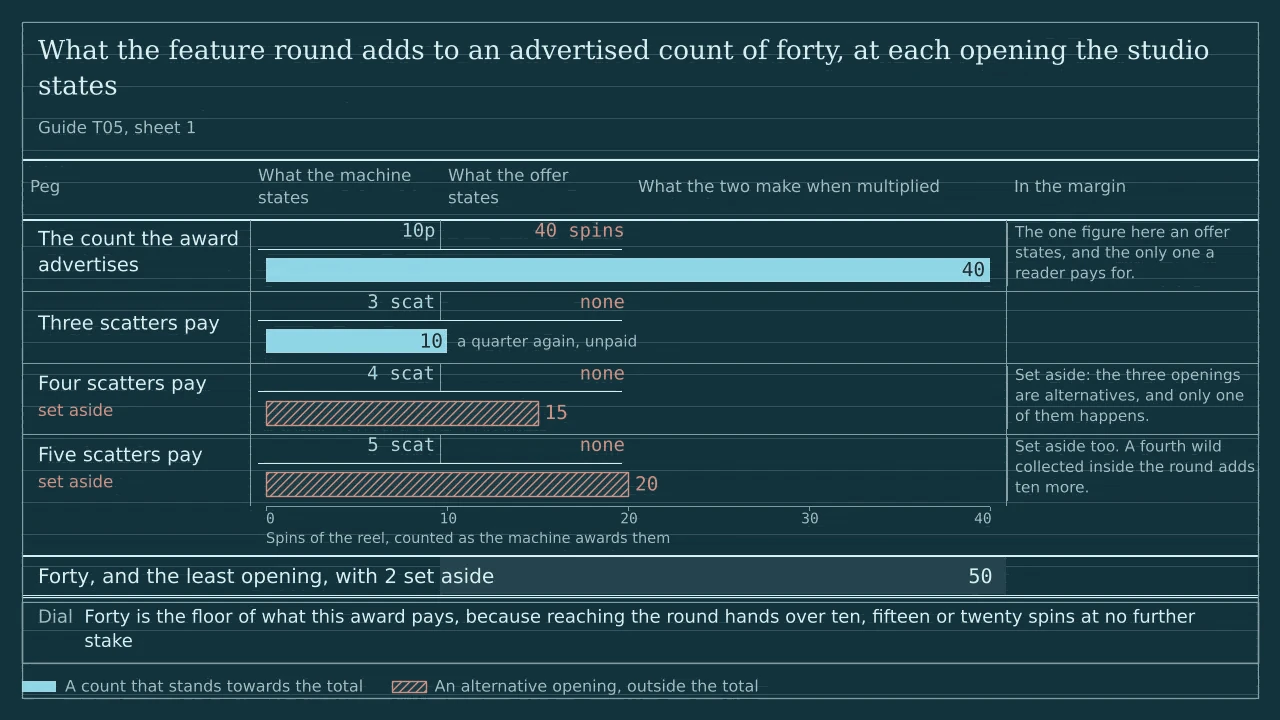
There is a second thing worth taking from the second case, and it cuts the other way. The extra spins are worth having, and they are the reason the published return is as high as it is. A reader who reaches the round has met the half of the machine that carries the money symbols, the collecting wild and a multiplier climbing to ten, and the published figure understates what their forty turns did rather than overstating it. These are not a lucky case and an unlucky one with the truth sitting between them. They are two different machines under a single headline.
The one arrival rate anybody publishes, priced
Among all the rates a reader might want, exactly one is published, and it is not the one anybody argues about. A round that pays out at the ceiling, 2,100 times the stake, comes along at 1 in 3,880,481 in the original’s own data, and two secondary sources agree with the figure, which is why the sheet records the agreement claims 29 and 123. It is the only arrival rate on this machine with a publisher behind it, so it is the only one this page may put through an arithmetic.
Carry it through and the answer is small enough to print whole. Forty turns against one in nearly four million comes to roughly one chance in ninety-seven thousand of meeting the ceiling. Price a turn at ten pence, as this page does throughout, and the ceiling stands at £210.00, which puts its share of the award’s expectation at about a fifth of a penny.
The same published rate answers a second question, and the answer is the most vivid figure on this page. How many turns would it take before meeting the ceiling was likelier than not? Not 3,880,481, which is the average wait rather than the even-money point: the even-money point is a shade over two-thirds of it, at about 2.69 million turns this page’s own arithmetic on a published rate. Price those turns at ten pence each and they are about £269,000 of stake. Set them running at one round every 2.5 seconds, which is as quick as a licensed build goes RTS 14D, and they are about seventy-eight days without pausing. An award of forty turns is a hundred seconds of the same clock.
About a fifth of a penny is what the only published arrival rate on this machine contributes to an award of forty turns bought at ten pence
Two conclusions follow, and the second is the useful one. The first is that the ceiling is not where the published return comes from: a fifth of a penny out of £3.87 is a rounding of the figure rather than a pillar of it, so a reader imagining the headline percentage is held up by a once-in-four-million round has the structure of the machine backwards. The second is that the arithmetic above is the only one of its kind this page could perform. Every other question about arrival rates on this machine, including the one a reader actually asked, ends at a sheet that says the figure is not published.
What the award comes to across both cases together
With the cases separated and the warning given, the across-both figure is worth printing, because it is what the published return entitles anybody to say. Forty turns at ten pence stake £4.00; 96.71 per cent sends £3.87 back; and a fifteen-times requirement over the winnings leaves what the house expression gives. Its letters, taken from the right, run: g for what an offer reckons a round of the clearing slot contributes, a whole round unless its terms say less a round counted whole, in the terms; then that slot’s own published percentage as RTP; then fifteen as W; and the £3.87 the forty turns produce as B. Written out that is E = B × (1 − W × (1 − RTP) ∕ g).
| The title the staking crosses | Published return | Break-even play-through | The offer asks | What £3.87 is worth |
|---|---|---|---|---|
| Big Bass Bonanza | 96.71 per cent | 30.4 times | 15 times | £1.96 |
| Big Bass Bonanza: Reel Action | 96.50 per cent | 28.6 times | 15 times | £1.84 |
| What the choice of reel comes to | 0.21 of a point | 1.8 times fewer | unchanged | £0.12 |
The second reel is chosen deliberately. Big Bass Bonanza: Reel Action is one of only a handful of titles in the family sharing the original’s ceiling of 2,100 times the stake, so the two rows differ in their published return and agree about the largest thing either machine can do game sheet, claim 75i. Twelve pence separates them on this award. The arrival rate does not carry across. That 1 in 3,880,481 sits in the original’s own data, the sheet offering no counterpart anywhere else in the family, so the fifth of a penny from entry seven describes the upper row and no other.
And the figure in the last column is an expectation across both cases at once. It is the right number to put in the third column of the instrument, it is what the published return supports, and it describes neither the afternoon in which the round never came nor the afternoon in which it came three times.
Which statements survive and which have to be withdrawn
Gather what is left. Four statements about this award survive the absence of a trigger frequency, and they are the useful ones. The stake is £4.00 at the price supposed here and scales with that price exactly. The advertised count of forty is a floor rather than a figure, because the round adds ten, fifteen or twenty turns at no further stake and a restart adds ten more. The expectation across both cases is £1.96 at the title weighed and £1.84 one step down the family. And the ceiling, which is the only published arrival rate, contributes about a fifth of a penny.
Three statements do not survive, and any page making them is making them up. How often the round arrives is the first. What forty turns return in the case where it never opens is the second, since the published figure covers both halves of the machine together and the split is nowhere. The chance that forty turns reach the round is the third, which is the first question restated and has the same empty answer.
It is worth saying why none of that is likely to change. The regulatory duty nearest the question offers four ways of satisfying it, and only the last of the four, the probability of winning events occurring, would produce a trigger frequency. Because the four stand joined by the word or, publishing a return to player discharges the duty completely, and every licensee that does so has no occasion to publish anything else. The absence is not an oversight anybody is going to correct. It is the predictable outcome of a rule written as a choice.
So an award of forty turns is worth £1.96 in expectation and is worth saying four things about. The question it raises first is the one nobody can answer, and the useful work was finding out that it cannot be answered rather than answering it badly. Readers after the neighbouring counts are better served elsewhere: what a count is worth when expectation says nothing at all is settled at 5 free spins no deposit, and the count at which a published return begins to describe an outcome is settled at 100 free spins no deposit.
Questions readers ask
How often does the feature round arrive on this machine
Nobody publishes it. Thirty-six game pages from the studio carry no such frequency, the session data a client receives has no field for one, and the two figures in circulation, 1 in 113 turns and approximately 1 in 182.8, come from affiliate reviews and contradict each other. Both are printed here and neither is used.
Are 40 free spins enough to reach the bonus round
That is the same question and it has the same empty answer. What can be said is what the round pays once it starts: ten spins for three scatters, fifteen for four, twenty for five, ten more on every fourth wild collected, and a multiplier climbing to ten.
What is an award of forty free turns worth
£1.96 at ten pence a turn, which is this page’s supposed price. The forty turns stake £4.00, a published 96.71 per cent gives £3.87 back, and a fifteen-times requirement over the winnings leaves the rest. On Big Bass Bonanza: Reel Action, published at 96.50 per cent, the same award closes at £1.84.
Why can the published return not answer the question
Because 96.71 per cent averages a base game and a feature round together, weighted by the very frequency that is unpublished. It is accurate about a population and silent about an afternoon, so it describes neither the case where the round opens nor the case where it does not.
Does the award really pay only forty turns
Forty is the floor. Reaching the round adds ten, fifteen or twenty spins at no further stake, and every fourth wild collected inside it adds ten more with no stated limit. At ten pence a turn that is between £1.00 and £2.00 of extra stake crossing the reel against the £4.00 the award itself puts there.
What chance do forty turns have of the maximum win
About one in ninety-seven thousand, which is the only arrival rate on this machine with a publisher behind it: a round paying 2,100 times the stake comes at 1 in 3,880,481 in the game’s own data. At ten pence a turn the ceiling is £210.00 and its contribution to the award is about a fifth of a penny.
Would a British licence have supplied the missing figure
No. The rule about a game’s chances of winning can be discharged four ways and a licensee picks one. Only the fourth, how probable the winning events are, would produce a trigger frequency, and a return to player settles the whole duty by itself, so nobody has reason to reach further.
What does a reader give up with an award of this kind
Nothing about the machine itself: the return, the ceiling and the scatter mapping belong to the studio and hold wherever the reel runs. What goes is everything attaching to the cashier. Fifteen times is unremarkable where ten would be the limit, a round may be sold at any rung of a ladder a licensed site would stop at £5, and an incentive’s terms need not stay within reach. Gamstop Online reaches a British-licensed operator’s accounts and no others.
Before you play
Read on
- 100 free spins no deposit
- A published return needs at least four thousand turns before it describes an outcome, and a hundred is about a fortieth of that.
- 5 free spins no deposit
- At five turns the mean is the wrong instrument altogether and only the published ceiling says anything.
- 30 free spins no deposit required keep what you win
- The phrase is worth whatever the reel’s dispersion makes it worth, which is a figure the phrase never mentions.
- How a figure is weighed here
- Which figures are read off the machine, which off the offer, and which this publisher supposes.