The machine and its figures: one from the maker, four from the game, two from nobody
Seven quantities have to be in hand before any advertised award on this domain can be turned into money, and the maker’s own game pages carry one of the seven. It is the return to player.
- Updated 13 November 2026
- Licence status shown for every offer
- Assumptions marked in the text
Awards weighed against the same published figure
These offers are paid placements, so this site is owed a fee whenever a reader opens an account through one of the buttons below.
-

Tweedbet
Welcome pack 470%
- Licence
- Not stated, no Great Britain licence
- Play-through
- Not published
- Min deposit
- £20
Bonus up to£14,000 Free spins470Read the offer18+ only. Terms apply.
Licence, terms and working
The site does not say where it is licensed or which company runs it.
The reel
- Build of the reel
- Big Bass Bonanza
- Return it publishes
- 96.71 per cent
- Stake it accepts on one turn
- 10p to £250.00
The offer
- Turns advertised
- 470 turns Turns valued at the cheapest turn this reel sells, no worth for one being stated anywhere in the offer
- Price of one turn
- 10p the smallest stake the reel accepts, this operator publishing no figure of its own
- Credit as a sum
- £14,000.00
- Credit waiting on a payment
- Stated in words Casino Welcome Pack 470% up to £14,000 + 470 FS. Crypto Welcome Bonus 110% up to 1,300 USDT + 110 FS. VIP Welcome Pack 770% up to £13,000
- Advertised, priced
- £14,047.00 140,470 turns of this reel
Hung on it
- Play-through
- Not published
- Credited towards it
- 100 per cent nobody has published a share, so the whole of a stake is credited, which is the kindest reading available
- Ceiling on winnings
- Not published
- Qualifying payment
- £20.00 200 turns of this reel at the price above, and it enters no weight
Not weighed, for want of the play-through multiple as a number.
Stated in words means the condition is set down in words that cost something and give nothing to subtract. Not published means the operator sets the figure down nowhere.
-

EliteSpin
£5,000 + 500 FS
- Licence
- Costa Rica, no Great Britain licence
- Play-through
- 40×
- Min deposit
- £20
Bonus up to£5,000 Free spins500Read the offer18+ only. Terms apply.
Licence, terms and working
Licence held in Costa Rica, by PrimeTier Limited.
The reel
- Build of the reel
- Big Bass Bonanza
- Return it publishes
- 96.71 per cent
- Stake it accepts on one turn
- 10p to £250.00
The offer
- Turns advertised
- 500 turns Turns valued at the cheapest turn this reel sells, no worth for one being stated anywhere in the offer
- Price of one turn
- 10p the smallest stake the reel accepts, this operator publishing no figure of its own
- Credit as a sum
- £5,000.00
- Credit waiting on a payment
- Stated in words Welcome bonus €/£5,000 + 500 FS. Elite lootboxes unlock surprise rewards up to €/£20,000 or 500 FS. Summer Festival by BGaming: win €80,000
- Advertised, priced
- £5,050.00 50,500 turns of this reel
Hung on it
- Play-through
- 40 times the bonus and the winnings from the spins
- Credited towards it
- 100 per cent nobody has published a share, so the whole of a stake is credited, which is the kindest reading available
- Ceiling on winnings
- Stated in words Five times the bonus
- Qualifying payment
- £20.00 200 turns of this reel at the price above, and it enters no weight
Priced at 10p a turn, the banner comes to £5,050.00, of which £5,048.36 survives the spins. At the reel's published return of 96.71 per cent, a play-through of 40 times asks for £201,934.20 of staking and costs £6,643.64, more than there is to pay it with, so the offer weighs £0.00.
Stated in words means the condition is set down in words that cost something and give nothing to subtract.
-
WinBeast
€5,000 + 500 FS
- Licence
- Curaçao, no Great Britain licence
- Min deposit
- €20
- Free spins
- 500
Bonus up to€5,000 Play-through40×Read the offer18+ only. Terms apply.
Licence, terms and working
Licence held in Curaçao, by a company the site does not name.
The reel
- Build of the reel
- Big Bass Bonanza
- Return it publishes
- 96.71 per cent
- Stake it accepts on one turn
- 10c to €250.00
The offer
- Turns advertised
- 500 turns Turns valued at the cheapest turn this reel sells, no worth for one being stated anywhere in the offer
- Price of one turn
- 10c the smallest stake the reel accepts, this operator publishing no figure of its own
- Credit as a sum
- €5,000.00
- Credit waiting on a payment
- Stated in words Welcome pack €5,000 + 500 FS + €650 free bet. Fortune wheel on €40+ deposits with code FORTUNE. 40% up to €300 Beast Boost Monday with code BOOST1 on €20 deposit
- Advertised, priced
- €5,050.00 50,500 turns of this reel
Hung on it
- Play-through
- 40 times the bonus and the winnings from the spins
- Credited towards it
- 100 per cent nobody has published a share, so the whole of a stake is credited, which is the kindest reading available
- Ceiling on winnings
- Stated in words €100 a batch of spins
- Qualifying payment
- €20.00 200 turns of this reel at the price above, and it enters no weight
Priced at 10c a turn, the banner comes to €5,050.00, of which €5,048.36 survives the spins. At the reel's published return of 96.71 per cent, a play-through of 40 times asks for €201,934.20 of staking and costs €6,643.64, more than there is to pay it with, so the offer weighs €0.00.
Stated in words means the condition is set down in words that cost something and give nothing to subtract.
-

Betportal
300% + 150 FS
- Licence
- Anjouan, Comoros, no Great Britain licence
- Play-through
- 35×
- Min deposit
- €20
- Stake cap
- €5.00
Bonus up to€1,000 Free spins150Read the offer18+ only. Terms apply.
Licence, terms and working
Licence held in Anjouan, Comoros, by BetPortal Gaming Ltd and Excite Ultra Media Ltd, numbered ALSI-202601040-FI2.
The reel
- Build of the reel
- Big Bass Bonanza
- Return it publishes
- 96.71 per cent
- Stake it accepts on one turn
- 10c to €250.00
The offer
- Turns advertised
- 150 turns Turns valued at the cheapest turn this reel sells, no worth for one being stated anywhere in the offer
- Price of one turn
- 10c the smallest stake the reel accepts, this operator publishing no figure of its own
- Credit as a sum
- €1,000.00
- Credit waiting on a payment
- Stated in words Welcome package 300% up to €1,000 + 150 free spins. 1st deposit 150% up to €500 + 100 FS. 2nd deposit 100% up to €300 + 50 FS
- Advertised, priced
- €1,015.00 10,150 turns of this reel
Hung on it
- Play-through
- 35 times the bonus
- Credited towards it
- 100 per cent nobody has published a share, so the whole of a stake is credited, which is the kindest reading available
- Ceiling on winnings
- Stated in words Five times the bonus
- Largest stake while it runs
- €5.00 under the largest stake the reel accepts, so part of the machine's own range is shut off while the credit runs
- Qualifying payment
- €20.00 200 turns of this reel at the price above, and it enters no weight
Priced at 10c a turn, the banner comes to €1,015.00, of which €1,014.51 survives the spins. At the reel's published return of 96.71 per cent, a play-through of 35 times asks for €35,507.73 of staking and costs €1,168.20, more than there is to pay it with, so the offer weighs €0.00.
Stated in words means the condition is set down in words that cost something and give nothing to subtract.
-

Night Luck
805% + 280 FS
- Licence
- Not stated, no Great Britain licence
- Play-through
- Not published
- Min deposit
- €20
Bonus up to€6,400 Free spins280Read the offer18+ only. Terms apply.
Licence, terms and working
The site does not say where it is licensed or which company runs it.
The reel
- Build of the reel
- Big Bass Bonanza
- Return it publishes
- 96.71 per cent
- Stake it accepts on one turn
- 10c to €250.00
The offer
- Turns advertised
- 280 turns Turns valued at the cheapest turn this reel sells, no worth for one being stated anywhere in the offer
- Price of one turn
- 10c the smallest stake the reel accepts, this operator publishing no figure of its own
- Credit as a sum
- €6,400.00
- Credit waiting on a payment
- Stated in words Casino welcome bonus 805% up to €6,400 + 280 FS. Crypto welcome bonus 140% up to 1,600 USDT + 140 FS. VIP welcome pack 800% up to €14,500
- Advertised, priced
- €6,428.00 64,280 turns of this reel
Hung on it
- Play-through
- Not published
- Credited towards it
- 100 per cent nobody has published a share, so the whole of a stake is credited, which is the kindest reading available
- Ceiling on winnings
- Not published
- Qualifying payment
- €20.00 200 turns of this reel at the price above, and it enters no weight
Not weighed, for want of the play-through multiple as a number.
Stated in words means the condition is set down in words that cost something and give nothing to subtract. Not published means the operator sets the figure down nowhere.
What a Great Britain licence would add to these offers
A licence from the Gambling Commission for Great Britain carries rules that an offer licensed elsewhere does not have to follow, and some figures in this ranking would not survive them. Social responsibility code provision 5.1.1 stops a British licensee applying a wagering requirement of more than ten times the bonus funds, and that limit has applied since 19 January 2026. A play-through above ten times in this list is therefore one a British licence would not allow.
Regulation 5(2) of the Gambling Act 2005 (Operating Licence Conditions) (Amendment) Regulations 2025, made on 25 February 2025, limits what a player can stake on one game cycle of an online slot to £5, or £2 for a player under 25. It is a condition of a British remote casino licence and not a property of the game, so a player at an operator licensed elsewhere does not have it behind them.
Remote technical standard 14D asks for at least two and a half seconds from the start of one slot game cycle to the start of the next, with the player pressing start each time. It is addressed to the game and not to the money, so no figure in this ranking measures it.
GAMSTOP is the free scheme that closes your accounts with online gambling companies licensed in Great Britain, and every one of them must join it. An operator licensed elsewhere is not required to, so a GAMSTOP registration cannot be counted on to reach these offers. If gambling is costing more than money, the National Gambling Helpline is free and answers on 0808 8020 133 at any hour.
Ranking last changed 8 November 2026. Operator terms change without notice, so open the offer page and read the terms there before you register.
At a glance
A ceiling on one round, the grid and its lines, the range a turn may be bought in and the arrival rate of the largest win were read out of a second primary document instead. Two of the seven are published nowhere at all. The twelve weighings booked below stand on that split and together they close at £4.46 against £208.00 of advertised credit and 250 turns. Into the space those six missing figures left, this trade has put a claim about several returns and a choice among them. Hunting that source is what this page does.
- What the machine states96.71 per centBig Bass Bonanza, printed by its maker as the whole of that page’s basic game information and reported again in what a session is handed at its opening. Eleven of the twelve rows below are weighed on it and part eight accounts for the twelfth.
- What the offer states£208.00 and 250 turns at 20 to 60 timesNine credits totalled as their cashiers advertise them, plus three awards totalled as counts, with required staking running from twenty times a face up to the sixty the regulator itself put on the record.
- What the two make when multiplied£4.46Twelve closes added precisely as the list books them, each worked where one turn costs 10p, a price this page supposes because the game’s data starts its range at that rung and names again wherever it is spent.
On this page
- One of seven quantities on the maker’s pages, and where the rest were found
- What rests on that single figure across twelve weighings
- The second primary document, and two titles where the pair part company
- A claim everybody repeats, and what the hunt for its source turned up
- What that claim would be worth to a reader if it were true
- The published figure that really does move, and why it is not that one
- The quantity in neither document, with nobody answerable for it
- How the figure beneath the double rule was reached, and what sits outside it
The guides in this section
- Twenty turns, worked through to the pennyTwenty turns send £2.00 over the reel and bring £1.93 back, and thirty-five times asked of those winnings costs £2.22.Rests on the published return−£0.29
- One name over twelve different returnsA maker’s name fixes where a figure gets published and never what the figure is, there being twelve distinct returns under this one.Rests on the published return£5.26
- One name, thirty-six pagesThe reel this family is named for carries neither the commonest return among its relatives nor the commonest ceiling.Rests on the published return£0.83
- New to the lobby, not new in its figuresEverything a reel will ever state it states at the first session, and here the pages dated most recently print the smaller figures.Rests on the published return£9.00
- Ordering twenty reels, and what the order costsTwo published quantities will sort these reels, only one shifts any money, and the cut at twentieth place lands inside a tie.Rests on the published return£5.52
- Five senses of best, pulling against each otherFive readings of one word, of which a single reading yields a figure, one has no answer here, and one sorts cleanly for nothing.Rests on the published return£7.10
- A count that came off another maker’s reelA count will not travel, the reel named in that headline having no figure on either sheet and the advertisement supplying none.Rests on the published return£2.58
- Eighty turns on a handsetNot one quantity is published per device, and what does shift between two reels a telephone might load is the price of their cheapest rung.Rests on the stake range£1.12
- Which document the rail is inA session’s reading holds no field for how a balance got funded, so a rail cannot reach a published figure at all.Rests on the published return−£2.57
- Free twice over, and only once for nothingStaking nothing, a demonstration build closes at nought whatever gets asked, and so serves as evidence rather than as an award.Rests on the published return£0.13
- What the licence makes a reel beEvery duty binding the reel itself acts on the stake, the pace or the return, and a ceiling over one cycle decides a count of turns.Rests on the cycle time−£4.74
- The reel stays the same, the rules do notA reel’s own figures travel unaltered, and what falls away instead is six provisions plus every ceiling standing over a multiple.Rests on the published return−£19.48
Twelve weighings added and not one set aside, being nine credits advertised at £208.00 and three awards totalling 250 turns, eleven of them crossed against 96.71 per cent and the twelfth against the 96.50 on this maker’s newest page£4.46
One of seven quantities on the maker’s pages, and where the rest were found
Ask what must be known before one advertised award becomes a sum of money and the answer runs to seven items. What proportion of turnover comes back. How large a single round may grow. How many reels and rows there are and how many lines they pay across. What the cheapest and the dearest turn cost. How often the largest win arrives. How widely results scatter. And the day the thing arrived.
Each title has a page, and that page opens with a block of basic game information. The block holds the return to player. Across all thirty-six Bass pages it holds the return to player and no second item claim 76, game sheet. No ceiling is in it, no layout, no tally of lines, no stake range, no arrival rate, no date. Six items of the seven are not there.
Four of the six were recoverable from a different primary document. Each title’s free-play build is launched by an address naming that title’s internal symbol, and posting the symbol with a session key to the service behind the build returns what the maker sends a client for the session claim 14, game sheet. Out of that reading come a ceiling of 2,100 stakes on one round, five reels and three rows paying across ten lines, a stake range whose foot is 0.10 and whose head, at 250.00, no licensed British build may sell, a cycle there being capped at £5.00 and lower again below the age of twenty-five, and one arrival rate, 1 in 3,880,481, belonging to the largest win alone.
Which document gets the credit matters, and the game sheet is blunt: for the ceiling, the grid, the lines and the range, cite the session reading and never the page claim 109, game sheet. The maker’s prose for the original does mention something near a ceiling, a money symbol carrying values up to two thousand stakes, and that is a different quantity from the 2,100 the game reports.
Two of the seven came from nowhere. One is the scatter, which part seven takes up alone. The other is the date: no release date appears on the original’s page, while two documents of the maker’s own give two different days, 14 December 2020 in its announcement and 2 December 2020 in the structured data behind the game’s page. Twelve days between them, and neither is labelled as the day of release claims 33 and 34.
What rests on that single figure across twelve weighings
Read the quantity column of the list downwards. Ten rows of the twelve turn on the published return, one on the price of the cheapest rung a reel sells and one on the ceiling over a single cycle. That column is this section’s argument set out as a list: the solitary quantity the maker does publish is the quantity deciding almost everything beneath it.
Nine rows of the twelve open on a sum of credit. Totalled as their cashiers advertise them the nine reach £208.00, and the staking demanded of the nine reaches £6,252.00, each face multiplied by the requirement its own terms attach. Those two sums are all the arithmetic wants, because expectation on a credit is E = B × (1 − W × (1 − RTP) ∕ g) and nine of them at once collapse into one line: face less staking times house edge. RTP here is whichever published figure a credit is crossed against, g is one throughout because no term in this section weights a slot under full, and B and W are each face and each requirement in turn.
Crossed against 96.71 per cent, the original’s own, the nine close at £2.31, being £208.00 less £6,252.00 at a house edge of 3.29 per cent. Crossed instead against 96.50 per cent, which stands on more pages of this family than any other figure, those same nine credits under those same unaltered terms close at −£10.82. A name on a lobby tile is thus worth £13.13 across this section’s credits, over five times the £2.31 surviving at the top of the range.
The other three rows open on a count of turns, and a count is no sum until the price of one turn is stated. At the 10p this page supposes, that being the rung the game’s data starts its range at, the three counts come to 250 turns and £25.00 of staking, and as their own pages book them they close at £3.41. The nine credits as the list books them close at £1.05. Those two halves make the £4.46 beneath the double rule.
One consequence belongs to the return alone. A credit’s required staking is settled when its terms are drafted, £6,252.00 whichever reel it crosses. A count’s is not: expected winnings are the count times the turn price times the published figure, so the three counts ask £631.54 of staking against the original and a different sum against every other title.
Seven quantities this section has to spend, of which the maker’s thirty-six game pages publish one, a session’s own reading four and nobody the remaining two, with the twelve weighings resting on them closing at £4.46
The second primary document, and two titles where the pair part company
Two primary readings stand behind the return on nearly every page of this domain, which is the strongest thing this section can say about its figures. The maker prints one. The game reports the other. For thirty-three slot titles out of the thirty-five taken the two agree exactly.
On two titles they part company. For Big Bass Bonanza Megaways the page gives 96.70 per cent where the session reading gives 96.72 claim 118. For Big Bass Halloween the page gives 96.04 per cent where the session reading gives 96.06 claim 119. Each gap is 0.02 points. The sheet prints both readings and refuses to choose, which is the only honest course when one publisher stands behind the pair.
Halloween is the gap that costs something, 96.04 per cent being the smallest figure this maker publishes for any slot in the family. A reader reaching for the foot of the range reaches for a number two primary documents cannot settle between them. The table prices that gap on this section’s own credits, holding all nine faces and all nine requirements where their terms put them and moving nothing but the reading.
| Where the figure is read | Published return | Break-even play-through | What £208.00 is worth |
|---|---|---|---|
| The session’s own reading | 96.06 per cent | 25.38 times | −£38.33 |
| The maker’s own game page | 96.04 per cent | 25.25 times | −£39.58 |
| What the two documents differ by | 0.02 points of return | 0.13 times | £1.25 |
A fiftieth of a point between two documents of one publisher is thus worth £1.25 across this section’s credits, and which of the pair a given session reports cannot be settled from either document on its own.
One figure lower does stand on these pages, 95.50 per cent, and the title holding it is no reel-based machine. No session reading could be taken for it, and it therefore has no business in a table of slots claim 75d.
A claim everybody repeats, and what the hunt for its source turned up
It is said throughout this trade that the maker ships its games at more than one return and lets whoever runs them pick one. The claim gets repeated so widely that it reads as background rather than as an assertion wanting support, and a reader who has met it three times has usually met a single source three times over. So the game sheet went looking.
The maker’s pages were read, all thirty-six. Every information block carries a single return with no alternative beside it, no range and no note that anything might differ anywhere claims 50 and 51. Nowhere on any of the thirty-six does the maker say a game is available at more than one figure, and nowhere does it say that anybody picks. Its one corporate page about return-to-player testing names no game and prints no figure claims 10 and 11.
Then the maker’s own service was asked, repeatedly. Every session opened against the free-play build came back with 96.71 per cent for the original. The launch address accepts a jurisdiction parameter and seven values of it were tried, six resolving to a British identifier inside the client and one to nothing recognisable, and all seven returned that same figure claims 62 and 63. The response also carries a field counting configurations, which read one for every slot title taken. That looks conclusive and is not: the field is documented nowhere, and a free-play deployment would be expected to hold a single one whatever the commercial arrangement might be claims 64 and 114.
What exists instead is three affiliate reviews, read on 19 October 2026. All three head with 96.71 per cent and all three say other versions are about. Two count three versions; the third lists five while its own prose speaks of three, so that source disagrees with itself inside one page. Between them those reviews assert five figures the maker does not publish anywhere, 95.67, 94.5, 94.02, 92.05 and 90.63 per cent, and the sole reason any of them can be printed here is that this sentence says who asserts them and that no primary source carries one claims 59, 60 and 120.
A named executive is on record describing the practice in detail, including the several levels his company certifies. He works for a different maker, and the sheet is firm that his interview is evidence about his employer and about nothing further claim 68. A practice existing in a market is not a practice existing at a particular maker, and the step between those two propositions is the step every repetition quietly takes.
The evidence that would settle this is obvious and unusable. One game’s information screen, as a named venue serves it, showing anything but the figure on the maker’s page, would finish the argument in a line. Citing it would mean naming the venue, and this domain names none claim 61. So the honest consequence is the sheet’s own wording: every source for the claim is secondary, and no statement from the maker, from a regulator or from a testing house was reached claim 58.
No rule obliges anybody to say, either. The duty entitling a reader to information about their chances before committing lists alternatives and asks for any one of them, so a house edge discharges it and no return need be printed at all claims 69 and 72. Where no rule compels the figure, none compels a statement of which version is loaded, and the absence sits in the sourced record as an absence and not as a denial claims 70 and 108. This page accordingly neither asserts the claim nor denies it, and no page here says that any venue runs any particular configuration of this game.
What that claim would be worth to a reader if it were true
A claim with no primary source cannot be priced as a figure. It can be priced as a distance, and that costs nothing in honesty, because the arithmetic needs no number out of any review. It needs only to know what one point of published return is worth once a requirement has acted on it.
On this section’s nine credits that is exact and it is one multiplication. The nine close at face less staking times house edge; the staking is £6,252.00; a point of return shifts the house edge by a point. A point is therefore worth £62.52 across the nine, and nothing else in the expression can move it.
That rate prices the question without touching the claim. A reader unable to establish which of two figures a point apart was loaded would be unable to account for £62.52 of their own nine awards. Across this maker’s published range for a slot, which is 0.67 points wide, the same nine awards stand £41.89 apart. Against the 0.02 points two of its documents already differ by, they stand £1.25 apart, which is where part three arrives by the longer route.
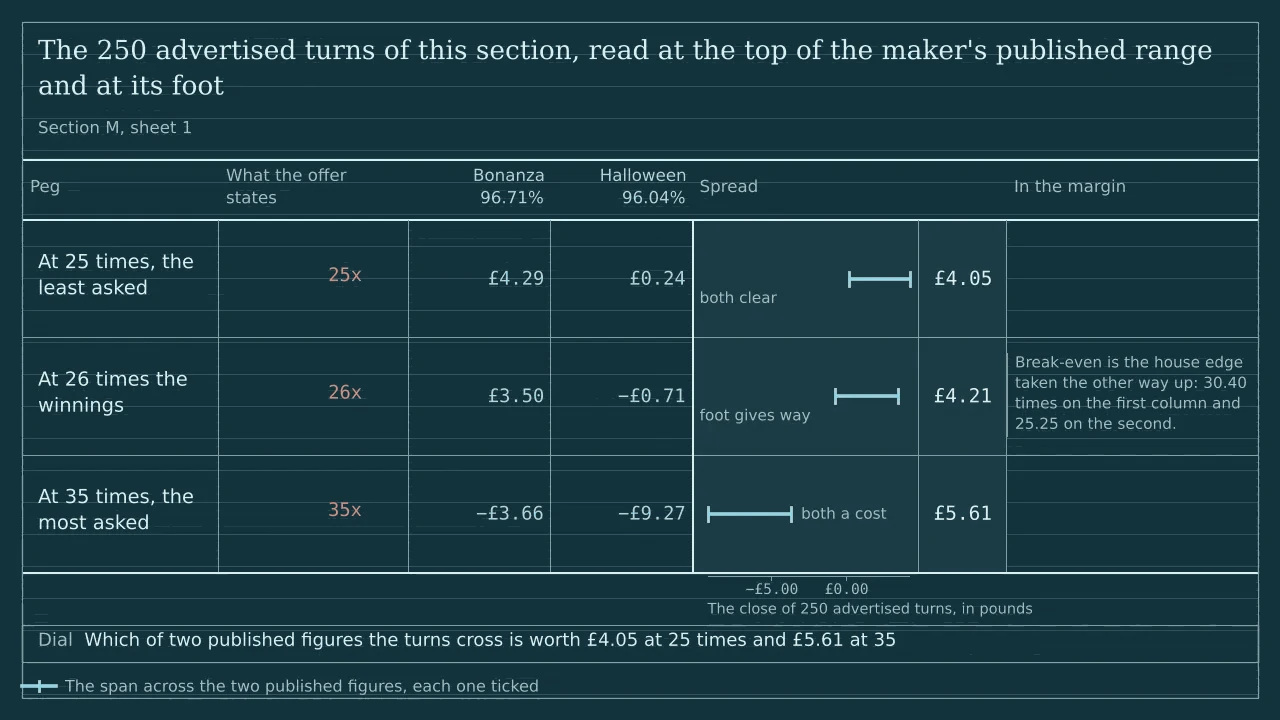
The three counts answer the same question at a smaller scale and in a shape worth seeing, a count’s worth moving twice over with the published figure: once through the winnings it is expected to produce and again through what a requirement takes off them. Two hundred and fifty turns bought at 10p are worth £4.05 more at the head of the published range than at its foot where twenty-five times is asked, and £5.61 more where thirty-five times is.
The published figure that really does move, and why it is not that one
A genuine multi-figure fact does exist in this family. It is primary, the arithmetic may spend it freely, and it is constantly mistaken for the claim in part four. A session’s reading carries, for thirty-three slot titles out of the thirty-five taken, an object holding a separate return for each named mode of play: the base game, ante-bet play and every level at which the feature round can be bought claim 55.
The sheet supplies two worked examples so that nobody runs the two things together. Big Bass Floats My Boat reports 96.07 per cent for regular play, 96.06 for ante-bet play, and 96.08 and 96.09 for its two purchase levels. Big Bass Splash 1000 reports 96.52, 96.53, 96.53 and 96.51 across the same four claim 56. The pair without such an object are the original and Bigger Bass Bonanza, each carrying one flat 96.71 per cent instead claims 48 and 57. The restriction runs that way about and not the other: thirty-three publish per-mode figures, two do not.
Here is the distinction, and it is the whole of why one of these may be printed freely while the other may not. A mode of play is picked by the reader, at the machine, with its own figure published beforehand. A configuration would have been picked about the machine by somebody else before the reader arrived, with nothing published about it. The first is a published fact. The second is unverified at the primary level.
The published axis is also the wrong instrument for a wide demonstration. Within one title the modes stand within hundredths of a point of one another, worth about the £1.25 part three measured. Across titles the range is 0.67 points, worth £41.89 on the same credits, better than thirty times as much.
The nearest thing to a per-deployment statement in this maker’s own writing is a phrase about a feature offered in selected markets, which concerns whether a round can be bought and not what comes back claim 79.
The quantity in neither document, with nobody answerable for it
Six of the seven quantities are now accounted for. The seventh is how widely results scatter, and the word every reader and every review reaches for to name it is volatility. Go through the maker’s thirty-six pages looking for that word and no page has it; take a session’s reading apart item by item and no field could hold such a number claims 31 and 104. Three secondary sources characterise it, one of them twice over and inconsistently, and since the characterisations run three ways with nobody authoritative publishing any of them, each belongs to the reviewer who made it. No page here prints a grade or a figure for it and no drawing carries one.
What is published does the work instead. The paytable arrives whole in a session’s reading, its top rows and a symbol value reaching two thousand stakes. A single round is capped at 2,100 stakes, confirmed twice inside that reading by a maximum-round field and a win-limit field agreeing. And there is one arrival rate, 1 in 3,880,481, for the largest win alone claims 27, 29 and 49. Those three are the material any derivation of dispersion has to be built from, that derivation belongs to another section of this domain, and the guide here that names the arrival rate leaves it deliberately unpriced.
Two further rates have no publisher and both are worth naming as absences. How often the base game pays anything is in neither document. How often the feature round opens is in neither either, and the only rates circulating for it come from secondary sources that differ widely claims 105 and 122. The payments section holds that disagreement and prices the gap between the answers.
Put the seven back together and the distribution is the finding. One quantity on the maker’s pages. Four inside the data its service sends a client. Two with no publisher anywhere, one of those being the quantity most readers ask about first.
How the figure beneath the double rule was reached, and what sits outside it
The £4.46 under that rule is twelve figures added, each taken off the three ruled columns of whichever guide produced it and none of them worked again here. Nine of the twelve price a sum of credit and three price a count of turns, and all twelve end on one quantity: the expectation, in pounds, on whatever the award advertises, once the staking its own terms demand has crossed a reel with a published figure. Every figure in that column rests on a turn costing 10p, this publisher’s supposition and the rung the game’s own data begins its range at.
Because all twelve are that quantity, all twelve are added and not one is set aside. That was settled row by row rather than assumed, and the settling matters more than the total. A guide pricing an hour of play, one pricing a turnover and one pricing a cost spread over a span would each be a sound page, and adding any of those to a close makes a figure of nothing. Such a row keeps its place on the list, a head that has read every guide being in no position to hide one quietly; the stylesheet sets it back from the measure, the addition passes over it, and the sentence under the rule names it and says what it priced instead. This section holds no row of that kind, so the sentence says twelve added and nothing left out.
Eleven of the twelve cross the original’s 96.71 per cent. The twelfth crosses 96.50 per cent, and the reason is not arithmetical. That guide’s axis is the order in which the maker published its pages, so the most recent page stands in its upper row and the first of the thirty-six in its lower one, which is the right way about for a question concerning what a machine states on its opening day. It is no outlier. Taken at the original’s figure throughout, the twelve would reach £5.72 rather than £4.46, a difference of £1.26.
What the figure leaves outside is everything this page has had to report as absent. Which version of a return a deployment is loaded with. How widely results scatter. How often the feature round opens. And the day the machine arrived. Not one of those four absences is a quantity this page may print, so not one of them is inside the £4.46.
Three of the twelve close under nothing, the lowest at −£19.48, which is a £20.00 credit asked for sixty times its face. That multiple is not invented: it is the figure the regulator itself recorded as the requirement some licensed sites were applying before it acted. Inside a Great Britain licence the ceiling over such a requirement is ten times whatever the bonus funds amount to, in force since 19 January 2026 claim 91, UK sheet, and not one of this section’s twelve awards asks ten.
Questions readers ask
Where does the 96.71 per cent figure come from and who publishes it
Two documents of one publisher, agreeing. It is the whole of the basic game information the maker prints for Big Bass Bonanza, and it is also what the maker’s service reports to a client as a session opens.
Does Big Bass Bonanza run at more than one return to player
Nothing primary says so and nothing primary says otherwise. The maker prints one figure a title over thirty-six pages, says nowhere that a figure varies, and seven jurisdiction values opened against its own service all returned the same number. The sources asserting otherwise are affiliate reviews that disagree with each other.
Why is there no figure for volatility anywhere on this domain
Because nobody authoritative publishes one. No page of the thirty-six uses the word and a session’s reading has no field it could occupy. Three reviews characterise it three ways, so a characterisation is attributed to whichever reviewer made it.
How does a bet mode differ from a configuration
A mode of play is picked by the reader at the machine, with its own return published beforehand for thirty-three slot titles out of the thirty-five taken. A configuration would have been picked about the machine by somebody else before the reader arrived, with nothing published about it.
Why did the ceiling and the stake range come from somewhere other than the maker’s page
Because that page does not carry them. Its information block holds the return and no second item on any of the thirty-six, so a ceiling of 2,100 stakes on one round, the layout, the tally of lines and the stake range were all read out of what the maker’s service sends a client.
What is the figure under the list and what went into it
It is £4.46, twelve closes added with none set aside. Nine are credits advertised at £208.00 between them and three are awards reaching 250 turns, every one worked where a turn costs 10p. Eleven cross the original’s published figure and the twelfth crosses the 96.50 per cent on this maker’s newest page.
Which title of this family publishes the lowest return
The smallest figure on these pages is 95.50 per cent, but the title holding it is no reel-based machine, so it belongs in no table of slots. For a slot the smallest is 96.04 per cent, and the game reports 96.06 per cent for that very title.
When was Big Bass Bonanza released
No release date appears on its page, and two documents of the maker’s own give two different days: 14 December 2020 in its announcement and 2 December 2020 in the structured data behind the game’s page. Neither is labelled a release date and twelve days separate them.
Before you play
Read on
- The price of one turn
- The advertised unit is the one unit the machine never sets, and the published range it gets chosen from spans a factor of two and a half thousand.
- A credit, weighed against the reels
- Break-even is no constant here. It moves with the published figure, and across this family the swing is eight times a credit.
- How a figure is weighed here
- Which figures are read off the machine, which off the offer, which off the rule book, and which this publisher supposes.