150 free spins no deposit Book of Dead: one count weighed against a published return
A hundred and fifty turns is the whole of what such a headline measures, and a count of turns buys nothing until somebody says what one turn is staked at and what return it has to cross. Spent at ten pence, which this page assumes and says so wherever it spends it, the count carries £15.00 of staking.
- Updated 13 November 2026
- Licence status shown for every offer
- Assumptions marked in the text
Counts of turns posted without a reel named, at this end of the market
These offers are paid placements, so this site is owed a fee whenever a reader opens an account through one of the buttons below.
-

Tweedbet
Welcome pack 470%
- Licence
- Not stated, no Great Britain licence
- Play-through
- Not published
- Min deposit
- £20
Bonus up to£14,000 Free spins470Read the offer18+ only. Terms apply.
Licence, terms and working
The site does not say where it is licensed or which company runs it.
The reel
- Build of the reel
- Big Bass Bonanza
- Return it publishes
- 96.71 per cent
- Stake it accepts on one turn
- 10p to £250.00
The offer
- Turns advertised
- 470 turns Turns valued at the cheapest turn this reel sells, no worth for one being stated anywhere in the offer
- Price of one turn
- 10p the smallest stake the reel accepts, this operator publishing no figure of its own
- Credit as a sum
- £14,000.00
- Credit waiting on a payment
- Stated in words Casino Welcome Pack 470% up to £14,000 + 470 FS. Crypto Welcome Bonus 110% up to 1,300 USDT + 110 FS. VIP Welcome Pack 770% up to £13,000
- Advertised, priced
- £14,047.00 140,470 turns of this reel
Hung on it
- Play-through
- Not published
- Credited towards it
- 100 per cent nobody has published a share, so the whole of a stake is credited, which is the kindest reading available
- Ceiling on winnings
- Not published
- Qualifying payment
- £20.00 200 turns of this reel at the price above, and it enters no weight
Not weighed, for want of the play-through multiple as a number.
Stated in words means the condition is set down in words that cost something and give nothing to subtract. Not published means the operator sets the figure down nowhere.
-

EliteSpin
£5,000 + 500 FS
- Licence
- Costa Rica, no Great Britain licence
- Play-through
- 40×
- Min deposit
- £20
Bonus up to£5,000 Free spins500Read the offer18+ only. Terms apply.
Licence, terms and working
Licence held in Costa Rica, by PrimeTier Limited.
The reel
- Build of the reel
- Big Bass Bonanza
- Return it publishes
- 96.71 per cent
- Stake it accepts on one turn
- 10p to £250.00
The offer
- Turns advertised
- 500 turns Turns valued at the cheapest turn this reel sells, no worth for one being stated anywhere in the offer
- Price of one turn
- 10p the smallest stake the reel accepts, this operator publishing no figure of its own
- Credit as a sum
- £5,000.00
- Credit waiting on a payment
- Stated in words Welcome bonus €/£5,000 + 500 FS. Elite lootboxes unlock surprise rewards up to €/£20,000 or 500 FS. Summer Festival by BGaming: win €80,000
- Advertised, priced
- £5,050.00 50,500 turns of this reel
Hung on it
- Play-through
- 40 times the bonus and the winnings from the spins
- Credited towards it
- 100 per cent nobody has published a share, so the whole of a stake is credited, which is the kindest reading available
- Ceiling on winnings
- Stated in words Five times the bonus
- Qualifying payment
- £20.00 200 turns of this reel at the price above, and it enters no weight
Priced at 10p a turn, the banner comes to £5,050.00, of which £5,048.36 survives the spins. At the reel's published return of 96.71 per cent, a play-through of 40 times asks for £201,934.20 of staking and costs £6,643.64, more than there is to pay it with, so the offer weighs £0.00.
Stated in words means the condition is set down in words that cost something and give nothing to subtract.
-
WinBeast
€5,000 + 500 FS
- Licence
- Curaçao, no Great Britain licence
- Min deposit
- €20
- Free spins
- 500
Bonus up to€5,000 Play-through40×Read the offer18+ only. Terms apply.
Licence, terms and working
Licence held in Curaçao, by a company the site does not name.
The reel
- Build of the reel
- Big Bass Bonanza
- Return it publishes
- 96.71 per cent
- Stake it accepts on one turn
- 10c to €250.00
The offer
- Turns advertised
- 500 turns Turns valued at the cheapest turn this reel sells, no worth for one being stated anywhere in the offer
- Price of one turn
- 10c the smallest stake the reel accepts, this operator publishing no figure of its own
- Credit as a sum
- €5,000.00
- Credit waiting on a payment
- Stated in words Welcome pack €5,000 + 500 FS + €650 free bet. Fortune wheel on €40+ deposits with code FORTUNE. 40% up to €300 Beast Boost Monday with code BOOST1 on €20 deposit
- Advertised, priced
- €5,050.00 50,500 turns of this reel
Hung on it
- Play-through
- 40 times the bonus and the winnings from the spins
- Credited towards it
- 100 per cent nobody has published a share, so the whole of a stake is credited, which is the kindest reading available
- Ceiling on winnings
- Stated in words €100 a batch of spins
- Qualifying payment
- €20.00 200 turns of this reel at the price above, and it enters no weight
Priced at 10c a turn, the banner comes to €5,050.00, of which €5,048.36 survives the spins. At the reel's published return of 96.71 per cent, a play-through of 40 times asks for €201,934.20 of staking and costs €6,643.64, more than there is to pay it with, so the offer weighs €0.00.
Stated in words means the condition is set down in words that cost something and give nothing to subtract.
-

Betportal
300% + 150 FS
- Licence
- Anjouan, Comoros, no Great Britain licence
- Play-through
- 35×
- Min deposit
- €20
- Stake cap
- €5.00
Bonus up to€1,000 Free spins150Read the offer18+ only. Terms apply.
Licence, terms and working
Licence held in Anjouan, Comoros, by BetPortal Gaming Ltd and Excite Ultra Media Ltd, numbered ALSI-202601040-FI2.
The reel
- Build of the reel
- Big Bass Bonanza
- Return it publishes
- 96.71 per cent
- Stake it accepts on one turn
- 10c to €250.00
The offer
- Turns advertised
- 150 turns Turns valued at the cheapest turn this reel sells, no worth for one being stated anywhere in the offer
- Price of one turn
- 10c the smallest stake the reel accepts, this operator publishing no figure of its own
- Credit as a sum
- €1,000.00
- Credit waiting on a payment
- Stated in words Welcome package 300% up to €1,000 + 150 free spins. 1st deposit 150% up to €500 + 100 FS. 2nd deposit 100% up to €300 + 50 FS
- Advertised, priced
- €1,015.00 10,150 turns of this reel
Hung on it
- Play-through
- 35 times the bonus
- Credited towards it
- 100 per cent nobody has published a share, so the whole of a stake is credited, which is the kindest reading available
- Ceiling on winnings
- Stated in words Five times the bonus
- Largest stake while it runs
- €5.00 under the largest stake the reel accepts, so part of the machine's own range is shut off while the credit runs
- Qualifying payment
- €20.00 200 turns of this reel at the price above, and it enters no weight
Priced at 10c a turn, the banner comes to €1,015.00, of which €1,014.51 survives the spins. At the reel's published return of 96.71 per cent, a play-through of 35 times asks for €35,507.73 of staking and costs €1,168.20, more than there is to pay it with, so the offer weighs €0.00.
Stated in words means the condition is set down in words that cost something and give nothing to subtract.
-

Night Luck
805% + 280 FS
- Licence
- Not stated, no Great Britain licence
- Play-through
- Not published
- Min deposit
- €20
Bonus up to€6,400 Free spins280Read the offer18+ only. Terms apply.
Licence, terms and working
The site does not say where it is licensed or which company runs it.
The reel
- Build of the reel
- Big Bass Bonanza
- Return it publishes
- 96.71 per cent
- Stake it accepts on one turn
- 10c to €250.00
The offer
- Turns advertised
- 280 turns Turns valued at the cheapest turn this reel sells, no worth for one being stated anywhere in the offer
- Price of one turn
- 10c the smallest stake the reel accepts, this operator publishing no figure of its own
- Credit as a sum
- €6,400.00
- Credit waiting on a payment
- Stated in words Casino welcome bonus 805% up to €6,400 + 280 FS. Crypto welcome bonus 140% up to 1,600 USDT + 140 FS. VIP welcome pack 800% up to €14,500
- Advertised, priced
- €6,428.00 64,280 turns of this reel
Hung on it
- Play-through
- Not published
- Credited towards it
- 100 per cent nobody has published a share, so the whole of a stake is credited, which is the kindest reading available
- Ceiling on winnings
- Not published
- Qualifying payment
- €20.00 200 turns of this reel at the price above, and it enters no weight
Not weighed, for want of the play-through multiple as a number.
Stated in words means the condition is set down in words that cost something and give nothing to subtract. Not published means the operator sets the figure down nowhere.
What a Great Britain licence would add to these offers
A licence from the Gambling Commission for Great Britain carries rules that an offer licensed elsewhere does not have to follow, and some figures in this ranking would not survive them. Social responsibility code provision 5.1.1 stops a British licensee applying a wagering requirement of more than ten times the bonus funds, and that limit has applied since 19 January 2026. A play-through above ten times in this list is therefore one a British licence would not allow.
Regulation 5(2) of the Gambling Act 2005 (Operating Licence Conditions) (Amendment) Regulations 2025, made on 25 February 2025, limits what a player can stake on one game cycle of an online slot to £5, or £2 for a player under 25. It is a condition of a British remote casino licence and not a property of the game, so a player at an operator licensed elsewhere does not have it behind them.
Remote technical standard 14D asks for at least two and a half seconds from the start of one slot game cycle to the start of the next, with the player pressing start each time. It is addressed to the game and not to the money, so no figure in this ranking measures it.
GAMSTOP is the free scheme that closes your accounts with online gambling companies licensed in Great Britain, and every one of them must join it. An operator licensed elsewhere is not required to, so a GAMSTOP registration cannot be counted on to reach these offers. If gambling is costing more than money, the National Gambling Helpline is free and answers on 0808 8020 133 at any hour.
Ranking last changed 8 November 2026. Operator terms change without notice, so open the offer page and read the terms there before you register.
At a glance
Sent across Big Bass Bonanza, published by its studio at 96.71 per cent, and then asked for twenty-five times its winnings, the count closes at £2.58. Sent across Big Bass: Keeping it Reel, a title of that same family published at 96.07 per cent, the identical count closes at £0.25. The reel in the headline is a third machine again, and no figure for it exists on the sheet this publisher reads returns from, which is where this page starts.
- What the machine states96.71 per centBig Bass Bonanza, the figure its studio prints in the one information item on its own game page and the figure the game’s own session data reports in the same breath. Two primary sources, agreeing, and the only return on this page that needs no sentence of apology around it.
- What the offer states150 turns at 25 timesA count with no payment asked for it, and winnings that must be staked twenty-five times over before a withdrawal is reachable. Those are the two figures such a headline states, in the units it states them in, and between them they fix nothing until a reel is named.
- What the two make when multiplied£2.58What survives on the higher of the two titles weighed here, at a turn price of ten pence, which this page assumes and restates at every sentence that spends it. On the lower title the same count leaves a tenth of that.
On this page
- What a hundred and fifty turns is a count of
- The reel the headline names, and the figure nobody here holds for it
- What one count credits on two titles of one family
- Where the multiple takes the count past nothing
- Ten times, and what a licensed ceiling would have left standing
- A count of turns set beside a credit of the same face
- The figures a portable count would have to print
- What this family publishes about a reel, and what nobody does
- The same count read back as minutes and as turnover
What a hundred and fifty turns is a count of
One number is all such a headline is obliged to carry, and it is the one number that converts into money only with help. Three further quantities settle what the count comes to, and a headline prints none of them: the stake each turn is spent at, the return those turns cross, and the multiple the winnings have to be staked at before a withdrawal is reachable. The first belongs to whoever wrote the terms, the second belongs to the machine, and the third belongs to the terms again.
So this page supplies the stake itself and keeps saying so. Ten pence a turn is the figure used from here on, this page’s own supposition, and it is chosen because the game’s own session data puts the bottom of its stake range at that exact figure, running from 0.10 to 250.00 a spin the range in the game’s own data. The studio prints no range on its page for this title, which is why the figure has to come off the game rather than off the page. The top of that range is not a figure any licensed British build reaches, a cycle there stopping at £5.00, or at £2.00 before the age of twenty-five SI 2025 No. 215.
At ten pence a turn, assumed, a hundred and fifty turns is £15.00 of staking. That sum is not a prize and it is not a credit: it is the quantity of money the reel will be asked to handle on the reader’s behalf, and the count fixes it without help from anything else on this page. What comes back out of it is the published return’s business, and the two titles weighed in part three hand back different sums of it for reasons the advertisement never mentions.
The count also fixes a length of time, which is worth having early because a reader chasing a hundred and fifty turns may be imagining a quarter of an hour. The floor under a licensed cycle is 2.5 seconds RTS 14D, so a hundred and fifty turns cannot be spent in less than six minutes and a quarter. Nothing the reader presses lowers that: features of the turbo and quick-spin sort are out RTS 14E, and a reader has to commit to each cycle singly, which is the rule that leaves no automatic run of turns available anywhere RTS 8A.
The reel the headline names, and the figure nobody here holds for it
This publisher reads one fact sheet for anything it says about a machine or a studio, and that sheet covers a single series: thirty-six game pages carrying the word Bass, every one of them read on the day the sheet was built, with the studio’s published return beside each and the figure the game’s own data reports beside that. The reel named in the headline above is not in it. No return, no stake range, no maximum win, no trigger. A publisher with nothing sourced to print prints nothing, so this page does not tell you what that machine returns, and anybody who does tell you is either reading a source this sheet has not seen or repeating one that was never checked.
That is a stricter answer than it looks, because the count in the headline is attached to that machine and to no other. A hundred and fifty turns is being offered on a named reel, and the sum those turns come to is decided by the reel’s return, which means the headline is a price quoted in a currency whose rate it declines to publish. The honest move is not to guess the rate. It is to show how much the answer moves when the rate moves, which is what two titles of a family this publisher does hold figures for will do for us.
There is a second reason not to read anything into the name on the tile. A game from a known studio is not evidence about the place running it: the regulator has recorded that casino games supplied by licensed firms turn up on unlicensed websites industry warning notice, 20 January 2025, and £4.75m was settled in July 2026 by a supplier whose own titles had turned up in six websites holding no licence here. A familiar reel in the lobby tells a reader that the lobby has the reel. It tells them nothing about who holds the money, which rules bind the cashier, or what happens to a balance that nobody here is obliged to pay out.
What the studio’s own licence settles is narrower still, and it is worth naming because the name is the thing being borrowed. The studio behind the series this page weighs is on the Gambling Commission’s public register under account number 56015, with Gambling Software as a remote activity held since 30 January 2020. That licence authorises the supply of software. It says nothing whatever about any casino running that software, nor about which of its games any casino has loaded, nor about whether a British player may lawfully be offered them there. A supplier’s licence and a cashier’s licence are two different documents, and only one of them is in question when a count of turns is posted with no payment asked.
What one count credits on two titles of one family
Here is the arithmetic that the headline leaves to the reader, done twice over on two machines whose returns are published, read off the sheet, with page and game data in agreement on each of them. A hundred and fifty turns at ten pence, assumed as before, puts £15.00 of staking through a reel. What a reel hands back out of a quantity of staking is that quantity multiplied by its published return, which is the whole of what a published return means. Big Bass Bonanza, carrying 96.71 per cent on its own page the studio’s figure, matched by the game, hands back £14.51 of winnings, to the nearest penny. Big Bass: Keeping it Reel at 96.07 per cent returns £14.41 on the same staking. Ten pence between them, on a count advertised at the same hundred and fifty turns either way.
Ten pence is not the finding. The finding arrives when the second term of the offer goes to work, because winnings from a count of this kind are not cash in a balance until they have been staked again, and the multiple attaches to the winnings and not to the count. Twenty-five times £14.51 is £362.75 of staking asked on the higher title; twenty-five times £14.41 is £360.25 on the lower. Each of those sums then crosses the same reel it came off, and the reel takes its published share out of it: 3.29 points of everything staked on the first title, 3.93 points on the second.
The expectation of the whole package is the winnings the count produced, minus the expected cost of putting them through again, which the house writes as E = B × (1 − W × (1 − RTP) ∕ g) where B stands for the winnings the count produced, W for the multiple the terms ask, RTP for the return read off the sheet and g for the weight the terms give the game. Slots count in full at this end of the market, so g is one here taken from what such terms say, and the sentence that spends it says so rather than assuming the reader remembers.
Worked at those two returns, the same count closes at £2.58 and at £0.25. The second figure is a tenth of the first, and not one word of the offer has changed between them.
| The title this count is spent on | Published return | Break-even play-through | The offer asks | What 150 turns credit | What the count is worth once that staking is done |
|---|---|---|---|---|---|
| Big Bass Bonanza itself | 96.71 per cent | 30.40 times | 25 times | £14.51 | £2.58 |
| Big Bass: Keeping it Reel | 96.07 per cent | 25.45 times | 25 times | £14.41 | £0.25 |
| What choosing between them is worth | 0.64 points of return | 4.95 times | no change | £0.10 | £2.33 |
Read the closing row from the right. Choosing between two titles of one family, on a count whose wording is identical on both, is worth £2.33 of the £2.58 available. The column beside it says the winnings differed by ten pence, so almost none of that £2.33 came from the first pass across the reel. It came from the staking afterwards, where a difference of 0.64 points of return is multiplied by twenty-five and then applied to three hundred and sixty pounds of turnover. That multiplication is the reason this publisher works every figure at the return its own subject carries instead of at a round number, and the reason it never averages two titles into one figure: the distance between them is not a rounding error, it is nine tenths of the result.
Where the multiple takes the count past nothing
There is a multiple at which a count of this kind ceases to be worth anything, and the figure behind it is nobody’s opinion. Staking a sum repeatedly through a reel costs the reel’s own share each time around, so the multiple at which that cost eats the winnings whole is the reciprocal of the share. On Big Bass Bonanza the share is 3.29 points of each pound put through one hundred less the published return, and one divided by 0.0329 is 30.40. On Big Bass: Keeping it Reel the share is 3.93 points and the same division gives 25.45. Those two figures are printed in the table above beside the returns they come from, because they are not constants of this trade: they travel with the title, and a reader who carries a single break-even figure from one machine to another is carrying an error of about five times.
Set the offer’s twenty-five times beside those two figures and the arithmetic sorts itself. On the higher title the multiple sits inside the break-even, which is why £2.58 survives. On the lower title it sits a fifth of a time inside it, which is why £0.25 survives: not a different kind of offer, just a multiple that has nearly eaten its own winnings. Two tenths of a time more and the same count would close at nothing at all, and the reader would have put three hundred and sixty pounds of staking through a reel to arrive there.
£362.75of staking asked of a count advertised with no payment at all, which is 3,628 turns at the ten pence this page assumes
The span above is the quantity a reader is most likely to have no picture of. A hundred and fifty turns sounds like a short sitting; the staking those turns trigger is twenty-four times as long again. At the assumed ten pence a turn, £362.75 of required staking is 3,628 turns. At 1,440 cycles an hour, which is the ceiling a licensed build is built to, that staking runs to two hours and thirty-one minutes of play, every cycle of it separately committed to because nothing may run them automatically. A count offered on a machine whose return is a point lower than the one assumed in the reader’s head does not shorten that work. It lowers what that work is expected to leave behind.
None of this says anything about what a particular hundred and fifty turns will do, and nothing on this page should be read as a schedule of outcomes. A published return averages a distribution and promises nothing about a sitting, and the reel is never due, never warm and never owed: no sequence of turns on it makes the next turn likelier. What the arithmetic above measures is the expectation, which is the only figure a reader can compare between two offers before committing to either.
Ten times, and what a licensed ceiling would have left standing
The multiple this page prices is one that no licensed British incentive may ask. Ten times over is where the ceiling sits on a licensed site, dated 19 January 2026 in the code provision that reaches every incentive, and the same provision tells whoever drew up the terms to publish them plainly and keep them easy to find SR Code 5.1.1. The regulator’s own account of what that cap was for puts the previous practice at up to sixty times, which is the only market multiple on this publisher’s regulatory sheet attributable to the regulator itself rather than to anybody selling anything.
Price the same count at ten times and the difference is not rhetorical. On Big Bass Bonanza, £14.51 of winnings staked ten times over is £145.10 of turnover, costing an expected £4.77 at 3.29 points, and the count closes at £9.74 instead of £2.58. On Big Bass: Keeping it Reel the same ten times leaves £8.75 instead of £0.25. So the twenty-five times in the terms is worth £7.16 of the reader’s expectation on the higher title and £8.50 on the lower one, and the lower title is where the ceiling would have mattered most, which is the opposite of how the two offers would be ranked by their headline.
Two cautions, both of which this publisher would rather print than be asked about. That ceiling is written about bonus funds. Whether a count of free turns counts as bonus funds for the purpose is published nowhere this publisher could reach: what can be said is that where winnings from such a count are credited as bonus funds, the staking asked of those funds is capped at ten times on a licensed site. And the cap is a ceiling rather than a going rate, so the arithmetic above compares the offer with a ceiling no licensed cashier may pass, not with whatever one would have chosen to ask. Both figures are the publisher’s own arithmetic on a published rule, which is the only kind of figure on this page besides the machine’s own.
A count of turns set beside a credit of the same face
A reader deciding between a count of turns and a sum of bonus money is comparing two things that behave differently, and the difference is exactly one pass across the reel. Fifteen pounds of bonus credit arrives as money: it is already in the balance, and the staking asked of it is asked of the whole fifteen. A hundred and fifty turns at the assumed ten pence arrives as staking: the reel takes its published share before the reader has anything at all, which is why the count produces £14.51 of winnings on the higher title rather than £15.00.
Follow both through the same twenty-five times. The credit of £15.00 closes at £2.66 on Big Bass Bonanza. A hundred and fifty turns, counted instead, close at £2.58. Eight pence separates them, and the eight pence is the house’s first bite, taken on the single pass the count has to make before its winnings exist. On the lower title the same comparison is £0.26 against £0.25. Neither shape is the generous one. What the eight pence says is that a count and a credit of equal face are not equal offers, and that what opens the gap between them is the machine and not the cashier.
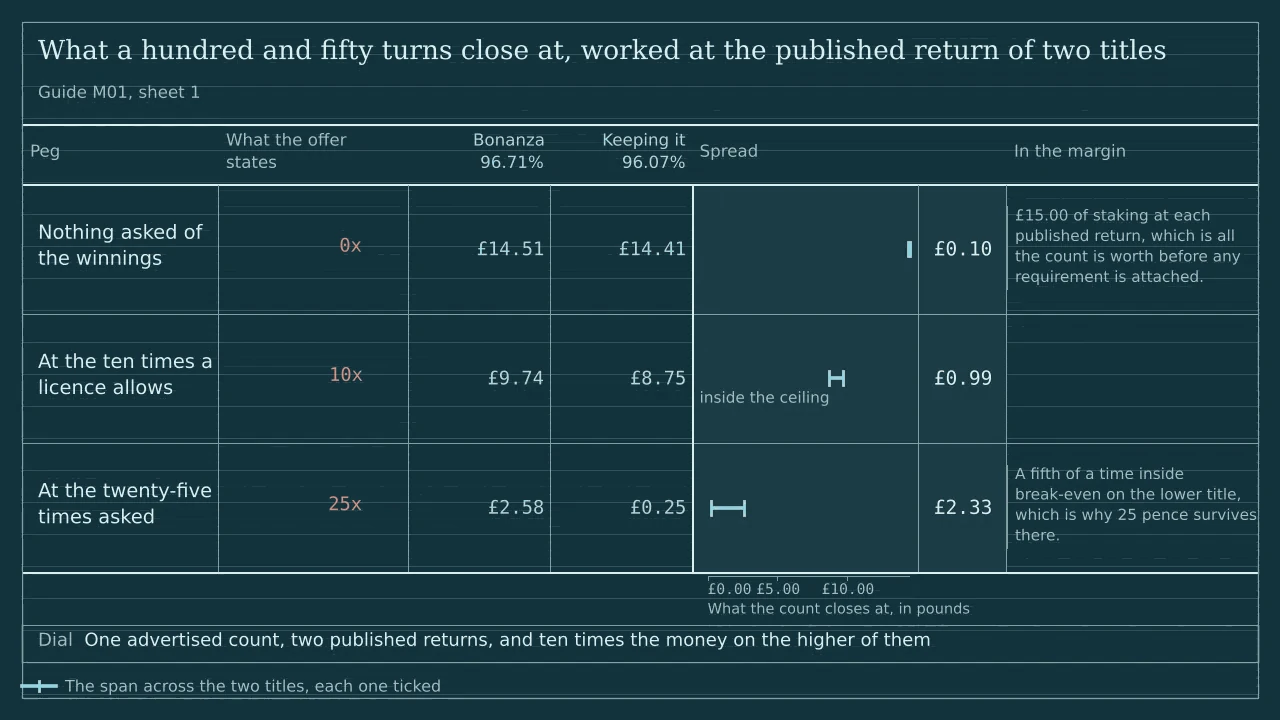
One further shape is worth separating from both, because it is the one most often confused with a count. Where winnings from turns are paid as cash with no staking asked, the arithmetic stops at the first pass: £14.51 on the higher title, £14.41 on the lower, and nothing further to work out. Where they are paid as bonus funds, every figure in part three applies. The difference between those two wordings is worth £11.93 on the higher title at the twenty-five times priced here, which is over four fifths of what the count could have come to, and it is settled by a clause rather than by a reel.
The figures a portable count would have to print
Four figures make a count of turns portable, in the sense that a reader could carry it from one lobby to another and know what they were comparing. The stake each turn is spent at, which decides the staking the count represents. The published return of the reel the turns are spent on, which decides what comes back. The multiple asked of the winnings, which decides how much of that is given back again. And the weight the terms give that reel, which decides what share of each pound staked is credited against the multiple. Three of the four figures belong to whoever wrote the terms. Only one of the four figures can be checked by a reader against a source that is not selling them anything, and that one belongs to the machine.
The weight is the one of the four figures most often left out, and leaving it out does more damage than leaving out any of the others. Where a reel counts at less than full, a pound staked is credited at under a pound, so the staking needed to satisfy the terms climbs in proportion while the reel keeps taking its share of every pound of it. At the rate of thirty per cent that appears in the regulator’s own record of this practice, £362.75 of required contribution needs about £1,209.17 of actual staking, and on Big Bass Bonanza the expected cost of putting that through at 3.29 points is £39.78, against winnings of £14.51. There is no arrangement of wording that makes those two figures into a positive expectation.
This is also where a reader should be most suspicious of a figure that looks sourced and is not. A return is a published quantity for every title this publisher weighs, and it is published once per title: a single item in the studio’s own information block, matched by the game’s own data on all but two titles of the thirty-six, both of which this sheet records as disagreements of 0.02 points rather than resolving them. The multiple, the weight, the cap on a withdrawal and the window the count has to be used inside are not published by anybody at all. They are terms, they change when somebody changes them, and a page that sourced its arithmetic to today’s wording would be wrong by the weekend. That is why the method here fixes the machine and lets the offer move.
What this family publishes about a reel, and what nobody does
The figures this page has leaned on are published, and exactness about the word published is worth a paragraph here, because a reader who has been told that a return is the only number that matters has been told something wrong in both directions. For the title at the head of this page, the studio publishes exactly one quantity on its own game page: the return, as a single item, with no range and no alternative beside it. The grid of 5 reels and 3 rows, the 10 paylines, the one-round ceiling of 2,100 times the stake, the stake range and the hit rate of the maximum win all come out of the game’s own session data, and a page citing the studio for any of them has reached for the wrong source.
And one quantity a reader is almost certain to have seen quoted is published by nobody. No volatility figure exists anywhere in the family of thirty-six titles: the word appears on none of the studio’s pages, a session’s own data holds no field it could go in, and the studio’s announcements state none. Three secondary sources that do state one disagree three ways, and one of them disagrees with itself inside a single page, calling the original high in a specification table and medium to highly volatile in its own prose. So nothing on this page describes the dispersion of either title as a published property of it, because no publisher stands behind such a figure to be quoted.
What is published, and what this page uses instead, is sharper than an adjective. 2,100 times the stake is the most one round can return, which at the assumed ten pence is £210.00, and £10,500 at the ceiling a licensed cycle carries. The rate at which that maximum arrives is published too, once in every 3,880,481 turns, which is the one rate the game reports at all: no base-game rate and no rate for the feature exist in the data, and the figures that circulate for both disagree with each other. The feature itself is published in full, opening on three scatters for 10 turns, on four for 15 and on five for 20, retriggering on every fourth wild for 10 more, and a multiplier that steps to 2x, to 3x and to 10x. A reader weighing a count of a hundred and fifty turns against that ceiling and that rate is reasoning about the machine on the machine’s own published terms, which is all anybody can honestly do.
The same count read back as minutes and as turnover
Three readings of one count, to close. As turns, it is a hundred and fifty, which is the only figure the headline gives. As staking, at the ten pence this page assumes, it is £15.00 across the reel, becoming £14.51 of winnings on the higher of the two titles weighed here and £14.41 on the lower. As an obligation, at the twenty-five times the terms ask, it is £362.75 of further staking on the higher title, which is 3,628 turns at the same assumed stake and therefore a minimum of two hours and thirty-one minutes of play that nothing is permitted to speed up.
Those three readings are the same offer. A reader who holds only the first of them cannot tell a good count from a poor one, because the count is identical in both cases and everything that separates them sits in the other two. A reader who holds all three can do the comparison this page has done twice: the identical hundred and fifty turns, on two machines whose returns differ by 0.64 points, differ in expectation by £2.33, which is nine tenths of the better of the two outcomes.
The practical consequence is narrow and it is the only advice on this page. Before a count of turns is worth anything to anybody, four figures have to be in hand, and three of them are only in the terms. If the terms do not give the stake a turn is spent at, the count cannot be converted into money. If they do not give the multiple, the close cannot be worked. If they do not name the reel, or name one whose return no source this publisher trusts has printed, then the headline is a number with no unit attached, and the arithmetic above is the most anybody can do with it: show what the same count is worth across a published spread, and leave the reader to notice that the figure moved by a factor of ten while the advertisement stayed the same.
Questions readers ask
What is the Book of Dead offer of 150 free spins, with no deposit, actually worth?
Nothing can be worked out from the count alone, and the sheet this publisher reads for machine figures holds no published return for the reel in that headline. Worked on two reels whose returns are published, a hundred and fifty turns at an assumed ten pence a turn, with winnings staked twenty-five times over, closes at £2.58 at a return of 96.71 per cent and at £0.25 at 96.07 per cent.
Why can the same count of spins be worth ten times as much on one slot as another?
Because the multiple attaches to the winnings and not to the count, and every pound of that staking crosses the reel again, so a gap of 0.64 points of published return is multiplied by twenty-five and applied to about £360 of turnover. The first pass across the reel differs by only ten pence; the staking afterwards accounts for the rest of the £2.33 difference.
What play-through turns a count of free spins into nothing at all?
The reciprocal of the reel’s own share of each pound staked, which is a different figure on every title. At the 96.71 per cent published for Big Bass Bonanza it is 30.40 times; at the 96.07 per cent published for Big Bass: Keeping it Reel it is 25.45 times. Above those multiples the expectation of the package is below nothing.
Could a British licensed site ask twenty-five times on a no-deposit offer?
No. The ceiling on bonus funds at a licensed cashier is ten times over, dated 19 January 2026. At ten times, on the 96.71 per cent published for Big Bass Bonanza, the same count closes at £9.74 rather than £2.58, so the offshore multiple priced here is worth £7.16 of a reader’s expectation on that title alone.
Is a count of free spins worth the same as bonus money of the same face value?
No, and the difference is one pass across the reel. Fifteen pounds of credit is already in the balance, while a hundred and fifty turns at the assumed ten pence must cross the reel to produce winnings at all, which at 96.71 per cent is £14.51 rather than £15.00. Through the same twenty-five times, the credit closes at £2.66 and the count at £2.58.
How long does a count of a hundred and fifty turns take to play out?
At least six minutes and a quarter: the floor under a licensed cycle is 2.5 seconds, nothing a reader presses lowers it, and each cycle is committed to singly. The staking the offer then asks is 3,628 turns at the assumed ten pence, which is a further two hours and thirty-one minutes at 1,440 cycles an hour.
Does the studio behind the Big Bass series say how volatile its games are?
It publishes no volatility figure for any of the thirty-six titles, no field in a session’s own data could hold one, and the secondary sources that state one disagree three ways with one of them contradicting itself. What is published for the title weighed here is a one-round ceiling, 2,100 times the stake, reached at 1 in 3,880,481 turns.
Does a familiar slot in the lobby say anything about the cashier running it?
No. The regulator has recorded that games from licensed suppliers appear on unlicensed websites, and £4.75m was settled in July 2026 by a supplier whose own titles had turned up in six websites holding no licence here. A studio’s own software licence authorises supply and settles nothing about the cashier running the game.
Before you play
Read on
- 20 free spins no deposit big bass bonanza
- The same arithmetic run end to end on the reel this domain is named for, with every step from the turn price to the close sourced as it is spent.
- Big Bass slots
- Title by title, every published return that differs from the original’s and what each difference is worth.
- Pragmatic slots
- A maker’s name settles who built a machine and nothing else: twelve distinct returns stand across the family.
- How a figure is weighed here
- Which figures are read off the machine, which off the offer, and which this publisher assumes.