Figures read 20 October 2026 Card T11, weigh-in 1
Slots sign up bonus, and the figure that decides how it divides
A package quotes one headline, and the two things it is made of are not priced in the same unit. Twenty pounds of credit at twenty-four times closes at £4.21 whatever one turn costs, because no part of that arithmetic has a price of a turn in it. The 80 turns bundled beside it are the reverse: value them at the cheapest rung Big Bass Bonanza sells and they close at minus £0.41, so the whole package comes to £3.80, while valuing the same turns at the £2.00 the game’s own data opens on takes it to minus £3.96 instead. Solve for the price at which the package closes at nothing and the answer is £1.03 a turn. No line of an arrangement like this one says which side of that figure its turns were valued at.
What the machine states 96.71 per cent One return, serving both halves of the package, since both of them are cleared on the same reel. Both halves share that figure and share nothing else, and what they do not share is what this card is about. What the offer states £20.00 and 80 turns A credit asking twenty-four times of itself, and a count of turns asking thirty-two times of whatever they win. Two multiples, two units of account, and one headline figure over the pair of them. What the two make when multiplied £3.80 The package added up where a turn is priced at the bottom rung of this reel’s ladder, which is this report’s own choice and is declared again wherever it earns its keep. One half of that total is positive and the other is not.
Offers of this kind, weighed against the same reel
The destinations below are paid placements. Registering through one of them earns this publisher a fee, and the scale is not told which destination is which: a figure on the card would read identically either way.
-
01The Weigh-In
Betportal
Three deposits, 35x
What the reel states96.71 per centBig Bass BonanzaWhat the offer advertises€15.00150 turns at 10cWhat the two make€0.00No turns of this reelThe reel
Build of the reelBig Bass BonanzaReturn it publishes96.71 per centStake it accepts on one turn10c to €250.00The offer
Turns advertised150 turnsTurns valued at the cheapest turn this reel sells, no worth for one being stated anywhere in the offerPrice of one turn10cthe smallest stake the reel accepts, this operator publishing no figure of its ownCredit as a sumunpublishedCredit waiting on a paymentstated300% over three deposits, up to €1,000Advertised, priced€15.00150 turns of this reelHung on it
Play-through35 timesthe bonusCredited towards it100 per centnobody has published a share, so the whole of a stake is credited, which is the kindest reading availableCeiling on winningsstatedFive times the bonusLargest stake while it runs€5.00under the largest stake the reel accepts, so part of the machine's own range is shut off while the credit runsQualifying payment€20.00200 turns of this reel at the price above, and it enters no weightThe dial, read at every return this reel is published at Return Breaks even at Staking asked Costs Weight In turns 96.71 per centpriced out 30.4 times 5,077 turns −16.70 €0.00 No turns No Great Britain licence
Licence held in Anjouan, Comoros, by BetPortal Gaming Ltd and Excite Ultra Media Ltd, numbered ALSI-202601040-FI2.
Open the offer at Betportal, opens in a window of its own -
02The Weigh-In
WinBeast
Five deposits and a free bet
What the reel states96.71 per centBig Bass BonanzaWhat the offer advertises€50.00500 turns at 10cWhat the two make€0.00No turns of this reelThe reel
Build of the reelBig Bass BonanzaReturn it publishes96.71 per centStake it accepts on one turn10c to €250.00The offer
Turns advertised500 turnsTurns valued at the cheapest turn this reel sells, no worth for one being stated anywhere in the offerPrice of one turn10cthe smallest stake the reel accepts, this operator publishing no figure of its ownCredit as a sumunpublishedCredit waiting on a paymentstatedFive matched deposits of 50% to 100%, each up to €1,000, with a €650 free betAdvertised, priced€50.00500 turns of this reelHung on it
Play-through40 timesthe bonus and the winnings from the spinsCredited towards it100 per centnobody has published a share, so the whole of a stake is credited, which is the kindest reading availableCeiling on winningsstated€100 a batch of spinsQualifying payment€20.00200 turns of this reel at the price above, and it enters no weightThe dial, read at every return this reel is published at Return Breaks even at Staking asked Costs Weight In turns 96.71 per centpriced out 30.4 times 19,342 turns −63.64 €0.00 No turns No Great Britain licence
Licence held in Curaçao, by a company the site does not name.
Open the offer at WinBeast, opens in a window of its own -
03The Weigh-In
EliteSpin
Five deposits, 40x
What the reel states96.71 per centBig Bass BonanzaWhat the offer advertises£50.00500 turns at 10pWhat the two make£0.00No turns of this reelThe reel
Build of the reelBig Bass BonanzaReturn it publishes96.71 per centStake it accepts on one turn10p to £250.00The offer
Turns advertised500 turnsTurns valued at the cheapest turn this reel sells, no worth for one being stated anywhere in the offerPrice of one turn10pthe smallest stake the reel accepts, this operator publishing no figure of its ownCredit as a sumunpublishedCredit waiting on a paymentstatedFive matched deposits of 50% to 100%, each up to £1,000Advertised, priced£50.00500 turns of this reelHung on it
Play-through40 timesthe bonus and the winnings from the spinsCredited towards it100 per centnobody has published a share, so the whole of a stake is credited, which is the kindest reading availableCeiling on winningsstatedFive times the bonusQualifying payment£20.00200 turns of this reel at the price above, and it enters no weightThe dial, read at every return this reel is published at Return Breaks even at Staking asked Costs Weight In turns 96.71 per centpriced out 30.4 times 19,342 turns −63.64 £0.00 No turns No Great Britain licence
Licence held in Costa Rica, by PrimeTier Limited.
Open the offer at EliteSpin, opens in a window of its own -
04The Weigh-In
Crown Jewelz
200% on the first
What the reel statesNO RETURN RECORDEDBig Bass BonanzaWhat the offer advertises£15.00150 turns at 10pWhat the two makeNOT WEIGHEDNot weighed, for want of the play-through multiple as a number.The reel
Build of the reelBig Bass BonanzaReturn it publishes96.71 per centStake it accepts on one turn10p to £250.00The offer
Turns advertised150 turnsTurns valued at the cheapest turn this reel sells, no worth for one being stated anywhere in the offerPrice of one turn10pthe smallest stake the reel accepts, this operator publishing no figure of its ownCredit as a sumunpublishedCredit waiting on a paymentstated200% up to £1,000 with 50 cash spins, then 150% twice with 50 cash spins eachAdvertised, priced£15.00150 turns of this reelHung on it
Play-throughunpublishedCredited towards it100 per centnobody has published a share, so the whole of a stake is credited, which is the kindest reading availableCeiling on winningsunpublishedQualifying payment£20.00200 turns of this reel at the price above, and it enters no weightNo Great Britain licence
Licence held in Curaçao, number not verified, by a company the site does not name.
Open the offer at Crown Jewelz, opens in a window of its own
Of everything in a row, the weight alone was worked out here; the rest was copied. It comes off E = B × (1 − W × (1 − RTP) ∕ g), in which W is the play-through, g the portion of a stake this reel is credited with towards it, RTP the figure the machine publishes about itself, and B the credit still standing when the condition arrives. A batch of turns gives part of itself up before that moment, each turn having staked its own value and taken the machine's return on it, while credit handed over as a sum gives up nothing yet, nothing having been staked with it. Beyond the break-even multiple the condition costs more than it has to work on, and the dial rests at nothing rather than swinging below the pin: a condition cannot take out more than arrived.
No return is kept in this software. Each one is copied off one named machine, build by build, which is why a row may carry several and why the break-even multiple is different from row to row. That multiple is the credited portion of a stake divided by the machine's house edge, so crediting the whole stake on a build published at 96 per cent puts break-even at twenty-five times, and nothing asked for above twenty-five times survives being cleared. A creel holding several settings is read at all of them and the distance between the ends is printed, because the build an operator chose to run is published nowhere a reader can get at.
Turns are not money until a turn has a price. An operator stating what one of its own turns is worth supplies it, and the row credits the operator with having said so. Otherwise the cheapest turn this reel sells supplies it, which is a figure off the machine and not an estimate, no cheaper turn being on sale, and again the row names its source. Everything below that line moves when the price moves. On a row advertising turns and no credit, halve the price and the weight halves while the count of turns the weight buys does not budge, which is as plainly as it can be shown that a count of turns and a quantity of money are different things.
A qualifying payment belongs to the reader. The card prices it in turns, that being the useful thing to know, and no weight is allowed near it. Where a figure has no business existing, one of three words stands instead. Stated marks a condition set down in words, costing something, offering nothing to subtract. Unpublished marks a condition set down nowhere whatever. Unpriced marks a count of turns that is published plainly enough while nothing anywhere says what one of them is worth. None of the three conceals an estimate, and no operator is credited on this card with a figure it never gave.
Two columns of this card are pinned by rules that a Great Britain licence writes and a licence from elsewhere does not. The play-through column: Social Responsibility Code 5.1.1 bars a licence holder from asking more than ten times the bonus funds, so any multiple above ten times on this card is one a British licence would never have let through. The stake column: regulation 5(2) of the Gambling Act 2005 (Operating Licence Conditions) (Amendment) Regulations 2025, made on 25 February 2025, caps the total an individual may stake on any one game cycle at £5, and at £2 for anybody under 25. That cap is attached to a remote casino operating licence and not to the machine, which means a reader who steps outside the licence meets the reel's own stake range with nothing on top of it. Remote technical standard 14D requires a minimum of two and a half seconds from the time a game is started until the next game cycle can be commenced. That one is addressed to the machine rather than to the money, and no column here reports it. Gamstop Online reaches exactly as far as the British licence reaches, that being the condition the scheme was built on, so an offer licensed outside it stands outside the scheme by construction and a registration made with the scheme does not reach as far as this offer. The National Gambling Helpline answers on 0808 8020 133, 24 hours a day, every day of the year.
Conditions quoted in a row are quoted in the wording of the operator that published them, and each row carries the date it was checked. The earliest date on this card is 27 October 2026. A reader is bound by an operator's own terms in full, never by a line of this card.
1
One headline over two quantities in different units
Almost every arrangement offered to somebody opening an account is a bundle rather than a single thing. A sum of credit arrives, and beside it a count of turns, and the two are advertised together under one figure or one phrase. A reader reasonably treats that figure as the size of the thing on offer. It is not: it is the sum of two quantities measured in units that do not convert into one another until a third figure has been supplied, and the third figure is nowhere in the advertisement.
Here is the asymmetry in one line, and everything below is the working. A sum of credit does not care what one turn costs, because the multiple it has to clear is written in money and cleared in money. A count of turns is the opposite case: its whole value is the count times the price times the return, so the price is a factor in every term. Put a credit and a count side by side and one of them is indifferent to the price of a turn while the other is made of nothing else.
So a package has a property no single award has. The figure a reader cannot see does not merely scale the answer; it decides which of the two halves the answer is mostly about. At one end of the ladder the credit is almost the whole of the package and the turns are a rounding. At the other the turns dwarf the credit and the credit is the rounding. Both ends are the same advertisement.
The arrangement weighed below is a typical one of its kind. A payment of twenty pounds is matched one for one, so twenty pounds of credit arrives, and eighty turns come with it. The credit asks twenty-four times of itself before anything can leave; the turns ask thirty-two times of whatever they happen to win. Both multiples are this report’s own supposition about the shape rather than a reading of any document supposed, not read, and the reasoning below holds whatever pair of multiples is put in their place.
Two things are deliberately kept out. The reader’s own twenty pounds is not part of the arithmetic, a payment being the reader’s money before and after, and the sheet that governs this network’s working says to keep a payment and a credit apart and show them separately. And no part of this card totals a package by adding a credit’s face to a count’s face, which is the operation the headline performs and the one this whole card exists to replace.
2
The credit half, and the figure that never enters it
Work the credit on its own first. Twenty pounds arrives as bonus funds and twenty-four times is asked of it, which is £480.00 of turnover before any of the balance belongs to the reader. The reel’s published figure is 96.71 per cent claims 20 and 21, so the share the machine keeps is 3.29 points of everything put across it, and £480.00 of turnover is expected to hand the machine £15.79 of that credit. What survives is £4.21.
The house expectation behind that is E = B × (1 − W × (1 − RTP) ∕ g). Here g is a weighting of one, which is what the terms of an arrangement like this one say for a slot in the terms; RTP is the figure above; W is the twenty-four times this half asks; and B is the £20.00 itself, because a credit arrives already denominated in money and needs nothing done to it before the multiple bites.
That last clause is the whole of this entry. There is no price of a turn anywhere in £20.00 at twenty-four times at 96.71 per cent. A reader could clear the requirement in four hundred and eighty one-pound turns, or in four thousand eight hundred ten-penny ones, and the expected close is £4.21 either way. The machine is taking a fixed share of a fixed turnover, and how that turnover is chopped up changes nothing about the share.
The crossing for this reel sits at 30.4 times, that figure being the reciprocal of the share the machine keeps. Twenty-four is comfortably under it, which is why this half is worth having at all, and the margin is what makes the rest of the card interesting: a positive half is the only kind that can be cancelled by a negative one.
The cashier behind an arrangement like this is licensed somewhere outside the British licensing regime, and three licensed duties would have landed straight on the two multiples above. One holds a play-through to ten times the bonus funds, so inside the licence neither of this package’s multiples could have been written as it stands and one of them would have had to come down by more than two thirds. One bars a single arrangement from spanning more than one kind of gambling product, which this package survives rather than breaches, a count of slot turns and a casino credit being the same kind, so a reader should not imagine that rule doing any work here. And one stops a slot’s cycle at £5, with a tighter figure again standing behind it for the youngest adults, and that is the one published figure anywhere putting a ceiling over the price of a turn and so over the arithmetic in entries five and six. Gamstop Online closes every account held in one name at a British-licensed cashier, and its own terms are plain that it reaches no further than that.
3
The turns half, where that same figure is in every factor
Now the other half, and the first thing it needs is the figure the credit half did not. Eighty turns are an instruction to a machine and not a sum, so a price has to come from somewhere. This card pays the bottom rung of the ladder the reel publishes, which is ten pence a turn claim 25, the game’s own data, and that choice is stated again at every point where it does any work. That is a pick taken because the alternative is silence: no rule anywhere fixes what one free turn is worth, and the figure is whatever a cashier’s own terms made it no rule sets one.
At that rung the eighty turns put £8.00 across the reels and the published figure sends £7.74 of it back, which is what the multiple then works on. Thirty-two times £7.74 is £247.68 of turnover, the machine keeps 3.29 points of it, and the expectation lands at minus £0.41. Thirty-two is past the 30.4 crossing, so the sign is not a surprise and it is not the price’s doing either.
Three things about that half are worth separating, because they behave differently. The count of eighty is fixed by the advertisement. The multiple of thirty-two is fixed by the terms. The price of a turn is fixed by nobody a reader can consult, and it multiplies the first two. So two of the three inputs are published and the third, which scales the answer, is not.
It is also worth noticing how small the half is in money and how large it is in work. Minus forty-one pence looks like nothing beside a twenty pound headline. The staking behind it is £247.68, which at the rung this card pays is about 2,477 further turns, and the floor under a cycle makes that an hour and forty-three minutes at the briskest pace a licence allows. The card about Slots free spins prices what happens to an award of turns when the reel is not named at all; here the reel is named and the price is still missing, which is the narrower and more awkward case.
4
The addition the headline leaves to somebody else
Put the two halves on one sheet and the package is £4.21 less £0.41, which closes at £3.80. That is the figure the headline was standing in for, and it is worth saying plainly what has been done to get it: one half was worked in money and the other had to have a price supplied before it could be worked at all.
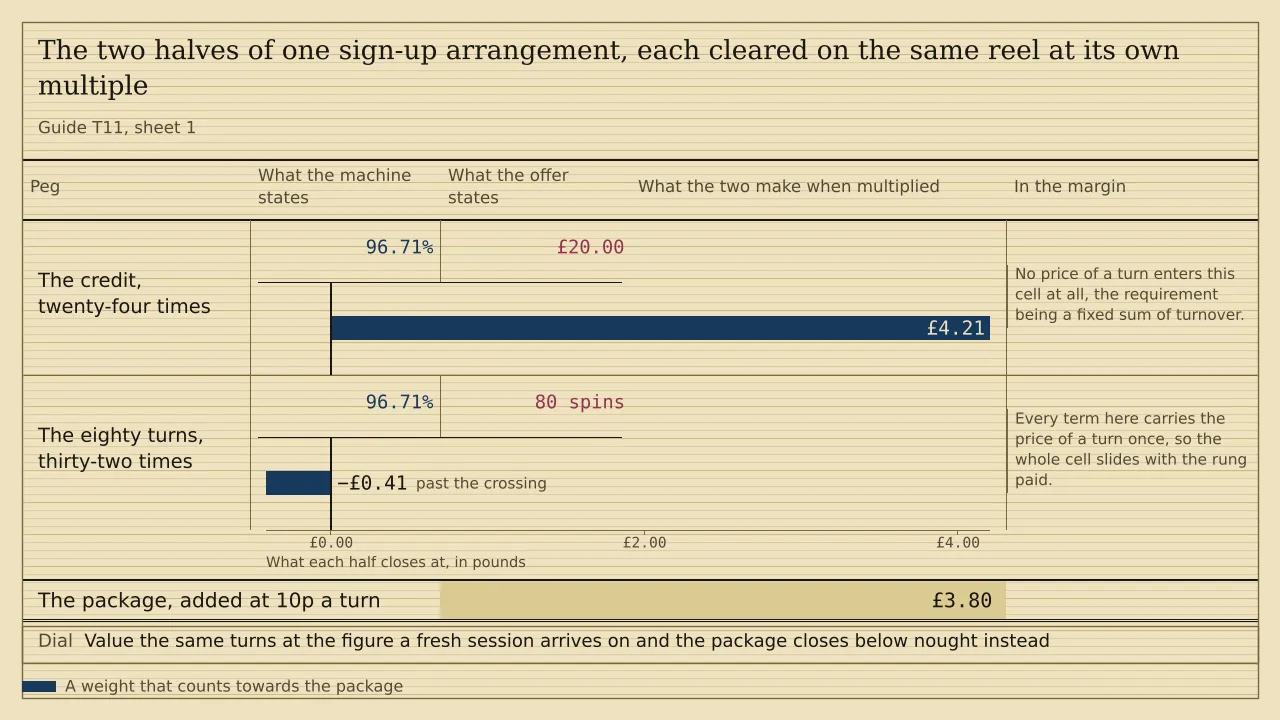
The slip under the second cell crosses the nought rule, which is the point of drawing the pair rather than describing it. These are not a large gain and a small gain. They are a gain and a cost, standing in one arrangement, under one figure, and a reader adding the two faces together in their head gets no hint that one of the two addends is pulling the other way.
How much of the package each half contributes is the quantity entry five moves, so it is worth a line here. At the rung paid here the credit half supplies £4.21 of a £3.80 close and the turns half takes £0.41 of it away, so the credit is doing all the work and a little over. Anybody reading the headline would have guessed the opposite: eighty turns sounds like the generous part, and at this price it is the part that costs.
A further addition the advertisement declines to do is the staking. The two halves ask £480.00 and £247.68 of turnover respectively, which comes to £727.68 in all, and no line of an arrangement like this one prints that total. The card about Casino welcome bonus does the same addition where every part of a package is a credit and the parts carry different multiples; what makes this one different is that one of the addends could not be computed until a price of a turn had been chosen.
5
The identical package at the value a session opens on
Nothing in the terms has to change for the answer to change. Keep the credit at twenty pounds, keep both multiples, keep the reel, and value the eighty turns at £2.00 instead. That figure is not invented: it is the total stake the game’s own data arrives at by default, being its opening coin value taken across ten lines claim 25, and it is under the £5.00 a licensed cycle may not pass, so it is a price a build could legitimately sell a turn at.
At £2.00 the eighty turns put £160.00 across the reels and the published figure hands £154.74 of that back. Thirty-two times £154.74 is £4,951.68 of turnover, the machine keeps its 3.29 points of it, and the half closes at minus £8.17. The credit half has not moved: it is £4.21 as it was. So the package closes at minus £3.96.
| What one turn is valued at | What the credit half closes at | What the turns half closes at | What the package closes at |
|---|---|---|---|
| 10p, the bottom rung published | £4.21 | −£0.41 | £3.80 |
| £1.03, solved for in entry six | £4.21 | −£4.21 | £0.00 |
| £2.00, the value a session opens on | £4.21 | −£8.17 | −£3.96 |
That table is not the instrument this site usually reaches for and it deliberately wears the plainer class. Its middle row is a figure solved for rather than a figure read, so the quantity running down its first column is not a published property of the machine from top to bottom, and a table working one sum against a published quantity is a different object. Entry ten carries the instrument proper, where the quantity that moves is the published return.
Two readings of the second column are worth putting side by side. The credit half is the same figure three times, which is not an artefact of the worked example but a property of what a credit is. And the turns half runs from minus forty-one pence to minus £8.17, a factor of twenty, which is exactly the factor between the two prices, because every term in that half carries the price once.
So the composition of the package has been turned inside out without a word of the offer changing. At the bottom rung the credit was the whole of the package and the turns a rounding against it. At the value a session opens on the turns are nearly twice the credit in magnitude and they point the other way. The headline was the same in both readings, and a reader who had been told the one missing figure would have known which reading applied to them.
6
Solving for the price at which the package closes at nothing
Between a close of £3.80 and a close of minus £3.96 there is a price at which the package closes at nothing, and it can be solved for exactly. The credit half is fixed at £4.21. The turns half comes to the count, times the price, times the return, times the amount by which thirty-two times overshoots the crossing, so it is proportional to the price and to nothing else on this card. For every pound a turn is valued at, the eighty turns give back £77.37 of winnings, and thirty-two times over that staked at a cost of 3.29 points a time comes to £4.085 of loss for the same pound.
Set that against the £4.208 the credit half actually survives at and the price comes out at £1.03 a turn. Put it back into the arithmetic to check: eighty turns at £1.03 stake £82.40, the published figure returns £79.69, and thirty-two times over £79.69 costs £83.90, so the half closes at minus £4.21 and cancels the credit half to the penny.
£1.03 a turn is the price at which this arrangement closes at nothing, the eighty turns handing back to their own requirement exactly the £4.21 the credit half survives at
A crossing price is a different object from the crossings this section usually works with, and the difference is worth naming. A break-even multiple is a property of the reel: the reciprocal of the share it keeps, and it moves only when the published return moves. This crossing is a property of the arrangement, and it moves whenever any term of the arrangement does. Raise the credit and the crossing rises with it. Raise the count of turns and it falls. Raise either multiple and it falls again.
Which gives the reading that makes the figure useful, and it is shorter than the derivation. Any package built out of a credit that survives its own multiple and a count of turns that does not has a price of a turn above which the whole thing is worth less than nothing. The price is whatever the surviving half comes to divided by what a pound of turn price costs the other half, and on an arrangement of this size it is a little over a pound. That is not a large figure, and it is not printed anywhere.
Outside the licence that matters more than it would inside. Inside, a cycle of a slot stops at £5.00, so the worst reading of this package is bounded: at £5.00 a turn the turns half closes at minus £20.43 and the package at minus £16.22. Outside it, the only ceiling on the price is the ladder the reel itself publishes, whose dearest rung is two and a half thousand of its cheapest, and at the top of that the arithmetic of this arrangement stops being about the credit in any sense at all.
7
Which selectable rung sits nearest it, and why no answer is given
The obvious next question is which of the prices the machine actually sells sits nearest £1.03, and this card cannot answer it. The configuration a session opens with offers twenty-eight selectable coin values, each of them taken across ten lines, and the sheet records the two ends of that ladder, the count of twenty-eight and the value the game starts at claim 25. There is no list of the twenty-eight anywhere in it. So this report declines to name a rung rather than inventing a plausible one.
What can be said without a list is still worth having. £1.03 sits between the bottom rung, which is a confirmed price the reel will sell, and the figure a session starts at, which is another. So the crossing lies inside the stretch of the ladder a reader is most likely to be standing on, and the default the machine itself opens at is already past it. Whatever the twenty-eight rungs turn out to be, those two statements hold.
Saying so has a cost and it is worth being honest about it. A card that named the nearest rung would read better and would be making a figure up, and a worked example resting on a price the machine may not sell is a purchase nobody can make. Two writers on this domain have now asked for that list and it is not on the sheet; the honest form of the finding is a crossing price with a declared gap beside it rather than a tidy rung.
There is a second gap in the same place and it runs the other way. Even a complete list of the twenty-eight would not say which rung an arrangement’s turns were valued at, because that is not a property of the machine at all. It is a line in somebody’s terms, it is published nowhere as a rule, and the only duty in the neighbourhood is the general one that an incentive’s conditions be clear and reachable before anybody takes it up. A reader hunting the price of a turn in an arrangement of this kind is hunting a commercial choice, not a specification.
So the position at the end of this entry is precise rather than comfortable. The crossing is £1.03. The ladder has twenty-eight rungs and three of them are on the record. Which rung the turns were sold at is in a document the reader has to find, and nothing obliges that document to contain it.
8
Two halves, two clocks, and the duality between them
There is a tidier way to hold all of this, and it comes out of asking how long each half takes rather than what each half is worth. The answer is the exact mirror of the answer in money, and once it is seen the whole card follows from it.
The credit half has to turn over £480.00. Turnover is a fixed sum of money, so how many turns it takes depends on the price: 4,800 of them at the bottom rung and 240 at the figure a session starts at. Its close in money, meanwhile, never moves. The turns half has to turn over thirty-two times its own winnings, and its winnings are themselves the count times the price, so the price cancels: the staking comes to about 2,476 turns whichever rung is paid. Its close in money, meanwhile, moves with the price twenty for twenty.
So the two halves are duals of each other. A credit is a fixed close and a sliding clock. A count of turns is a fixed clock and a sliding close. The price of a turn is the hinge between the two descriptions, and a package quoting one headline over both of them has bundled a quantity of money with a quantity of time and called the result a figure.
The clock is worth printing because it is the part a reader experiences. At the bottom rung the package needs 4,800 turns for the credit and about 2,477 for the turns half, which is 7,277 turns in all. The floor under a single cycle on a licensed build is 2.5 seconds, so an hour of one holds 1,440 turns at the outside, and 7,277 turns is five hours and three minutes of uninterrupted play at that limit. At the value a session opens on the same arrangement is 2,716 turns, which is one hour and fifty-three minutes. The money went one way and the clock went the other.
One consequence falls out of the duality, and it is the line to carry away from this card. Raising the price of a turn makes a package look faster and makes it worth less, because it shortens the half whose clock moves and inflates the half whose close moves. A reader who speeds a package up by stepping up the ladder is not trading time for money at a fair rate; they are shortening the part of the obligation that was never the problem and enlarging the part that was.
9
What the price of a turn did not do to either half
A card that has just moved a package from £3.80 to minus £3.96 by changing the price of a turn owes the section an exact account of what happened, because on its own that looks like the price deciding a sign, and the price never decides a sign. The card about 10 free spins settles that for an award standing on its own, and it is settled: the price moves magnitude and the multiple moves the sign, and three cards of this section rest on it.
Nothing on this card disturbs it. The credit half was positive at every price because twenty-four times is under the reel’s crossing of 30.4, and it stayed positive. The turns half was negative at every price because thirty-two times is over that same crossing, and it stayed negative. Neither half ever changed sign, and neither could have: the price of a turn appears in each half as a multiplier on the whole of it, and multiplying a quantity by a positive number cannot alter which side of nought it sits on.
What changed sign was their sum, and that is a property of a sum rather than of either term in it. Add a fixed positive quantity to a negative one whose magnitude slides, and there is a crossing. The crossing is a fact about the pair, not about either half, and a single award of turns has no such crossing because it has nothing to pair with.
That is why a package needs its own card in a section about the price of one turn, and it is the one thing this card establishes that no other page here could. On a single award the price is a question of how much. On a pair of unlike halves the price is a question of which half the arrangement is mostly about, and because the halves can point in opposite directions, that question reaches the sign of the total without ever touching the sign of anything inside it.
Stated carefully, then: the price of a turn moved no sign on this card, and the package’s total has a crossing in it anyway. Both statements are true. Take only the first away and the missing figure looks cheaper than it is; take only the second and three pages of this section have been contradicted.
10
The same package on two reels of the family
One figure has been held fixed throughout, and it is the machine’s rather than the arrangement’s. Both halves were cleared at 96.71 per cent, which is the figure the studio prints for the reel this domain is named for. Move the arrangement to another title of the same family and both halves move at once, which is a thing no term of the offer can do.
Big Bass Day at the Races will do for the comparison. The studio prints 96.07 per cent for it and the game’s own data agrees claim 74, and the title opens its ladder at the same bottom rung, so the only quantity that differs between the two rows below is the published return. Its crossing sits at 25.4 times, which is under both of this package’s multiples, so on that reel the credit half is worth £1.14 rather than £4.21 and the turns half closes at minus £1.98 rather than minus £0.41.
| The title both halves are cleared on | Published return | Break-even play-through | What the £20.00 and the 80 turns are worth together |
|---|---|---|---|
| Big Bass Bonanza | 96.71 per cent | 30.4 times | £3.80 |
| Big Bass Day at the Races | 96.07 per cent | 25.4 times | −£0.84 |
| What the title is worth here | 0.64 of a point | 5.0 times fewer | £4.64 |
Two thirds of a point of return comes to £4.64 on this arrangement, which is more than the arrangement is worth at all on the better of the two reels. Set that beside the £7.76 the price of a turn moved between the bottom rung and the value a session opens on, and the two unpublished choices are the same order of magnitude: whoever decides which title the turns run on and whoever decides what a turn is valued at are between them worth more than everything the headline prints.
The lower row also shows something the upper row hides. On a reel whose crossing is 25.4 times, both of the package’s multiples are past it, so both halves are costs and the sum has no crossing in it at all: no price of a turn makes that arrangement worth anything, because there is no positive half left for a negative one to cancel. The crossing in entry six existed only because one of the two multiples was under the reel’s own figure, and whether it is under depends on which title the arrangement is cleared on.
So the last word belongs where this section’s does. A package prints one figure, and that figure is the sum of a quantity the price of a turn cannot touch and a quantity made of nothing but the price of a turn, cleared on a reel whose published return decides whether either half survives its own multiple. Three figures decide the answer and the advertisement prints one of them.
Questions
- What is a package of twenty pounds of credit and eighty turns worth
- £3.80 where a turn is valued at ten pence, against a reel that prints 96.71 per cent. The credit at twenty-four times closes at £4.21 and the eighty turns at thirty-two times close at minus £0.41, so one half of the package is a gain and the other is a cost.
- Why does the price of a turn change one half and not the other
- A credit arrives already measured in money, so its requirement is a fixed sum of turnover and the expected close is the same whatever a turn costs. A count of turns has to be converted first, and its worth is the count times the price times the return, so the price is a factor in every term of it.
- At what price of a turn does the package stop being worth anything
- £1.03 a turn. At that price the eighty turns stake £82.40, the published figure returns £79.69, and thirty-two times over those winnings costs £83.90, so the turns half closes at minus £4.21 and cancels the credit half to the penny.
- Which selectable price of a turn sits nearest £1.03
- This report does not say, because the figure is not available to it. The configuration names twenty-eight selectable coin values over ten lines and what is on the record is the two ends of the ladder, the count of twenty-eight and the value a session opens on. £1.03 lies between the bottom rung and that default, and the default is already past the crossing.
- Does raising the price of a turn make the package better or worse
- Worse, and faster at the same time. The credit half keeps its close and loses turns, so it takes less time; the turns half keeps its count of turns and loses money twenty for twenty with the price. At ten pence the arrangement is 7,277 turns and closes at £3.80, and at £2.00 it is 2,716 turns and closes at minus £3.96.
- Did the price of a turn decide the sign of anything
- No. Each half kept its sign at every price, the credit half being under the reel’s crossing of 30.4 times and the turns half over it. What crossed nought was the sum of the two, which is a property of a pair of unlike halves and not of either half, and a single award of turns has no such crossing.
- How much staking does an arrangement like this actually ask for
- £727.68 in all at the price paid here, being £480.00 on the credit and £247.68 on what the turns win, and no line of an arrangement of this shape prints that total. At ten pence a turn it comes to 7,277 turns, which is five hours and three minutes at the fastest pace a licence permits.
- Does the reel the package is cleared on matter
- It decides both halves at once. Against 96.71 per cent the same arrangement closes at £3.80, and on Big Bass Day at the Races at 96.07 it closes at minus £0.84, so the choice of title is worth £4.64 here. On the lower reel both multiples are past the crossing, so neither half survives and no price of a turn rescues it.
- What is lost on an arrangement advertised this way
- It is sold from beyond the edge of the British licence. So the ceiling holding a play-through to ten times the bonus funds has gone, and with it the £5 limit over one cycle of a slot, which is the only published figure that would have bounded the price of a turn and so the worse half of this package. Gamstop Online shuts British-licensed accounts in one stroke and says plainly that it reaches no further.