Figures read 20 October 2026 Card X03, weigh-in 1
No KYC casinos, and the check behind a stake ceiling
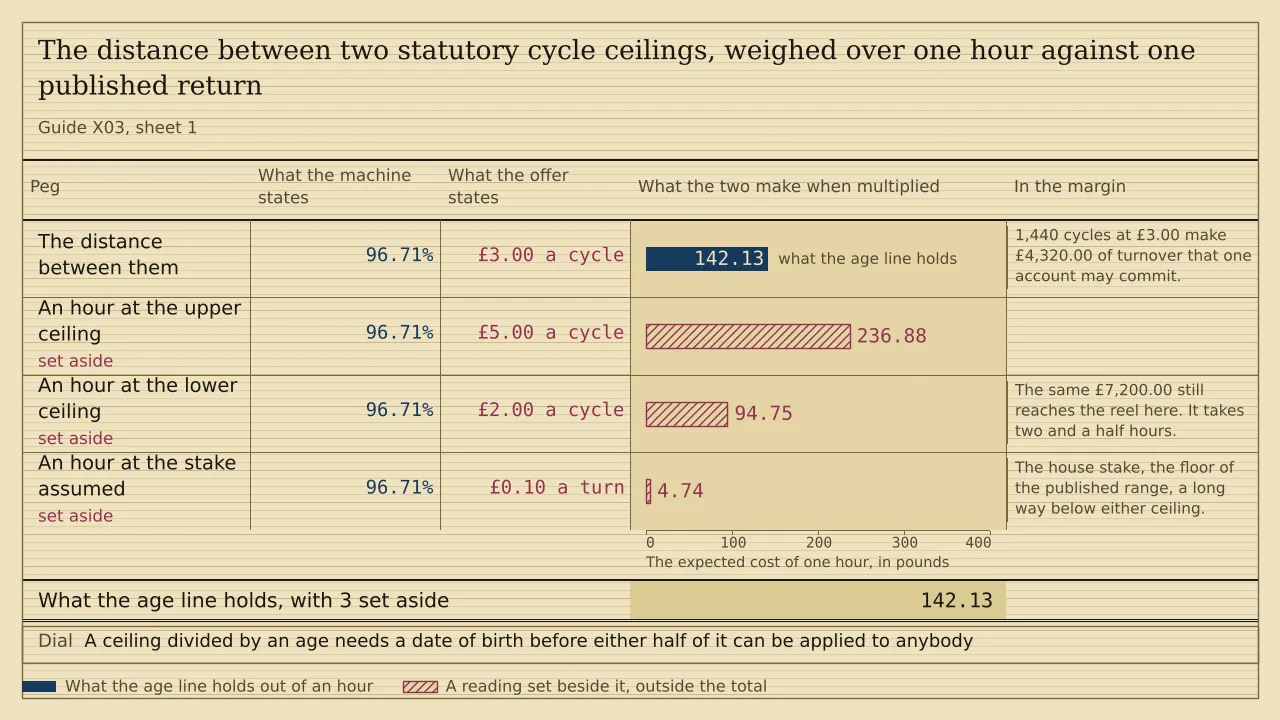
British law lets one cycle of a licensed slot take up to £5.00 where the account holder has turned twenty-five, and £2.00 where they have not, and the whole of that distinction rests on an account whose date of birth somebody has established. The £3.00 between the two ceilings is the identity duty’s price, converted at the floor under a turn: across one hour it is £142.13 of expected cost on Big Bass Bonanza. A check nobody performs does not merely leave a door unlocked. It removes the one term that tells two ceilings apart, and with it the lower of the two.
What the machine states 96.71 per cent The original’s published return, which turns any quantity of turnover into an expected cost. The reel applies it the same way to every account at it, knowing nothing whatever about whose account that is. What the offer states £3.00 a cycle Not an offer’s figure but the law’s: the distance between what a cycle may take from somebody who has turned twenty-five and what it may take from anybody younger. Across the 1,440 cycles an hour will hold, that distance is £4,320.00 of turnover, and it exists only where a date of birth has been established. What the two make when multiplied £142.13 That turnover at a house edge of 3.29 points. It is what one hour costs an account on the upper side of the age line rather than the lower, and therefore what the identity duty is worth per hour on this reel at the permitted limit.
Places of play with no Great Britain licence behind them, weighed against one named reel
The destinations below are paid placements. Registering through one of them earns this publisher a fee, and the scale is not told which destination is which: a figure on the card would read identically either way.
-
01The Weigh-In
Betportal
Three deposits, 35x
What the reel states96.71 per centBig Bass BonanzaWhat the offer advertises€15.00150 turns at 10cWhat the two make€0.00No turns of this reelThe reel
Build of the reelBig Bass BonanzaReturn it publishes96.71 per centStake it accepts on one turn10c to €250.00The offer
Turns advertised150 turnsTurns valued at the cheapest turn this reel sells, no worth for one being stated anywhere in the offerPrice of one turn10cthe smallest stake the reel accepts, this operator publishing no figure of its ownCredit as a sumunpublishedCredit waiting on a paymentstated300% over three deposits, up to €1,000Advertised, priced€15.00150 turns of this reelHung on it
Play-through35 timesthe bonusCredited towards it100 per centnobody has published a share, so the whole of a stake is credited, which is the kindest reading availableCeiling on winningsstatedFive times the bonusLargest stake while it runs€5.00under the largest stake the reel accepts, so part of the machine's own range is shut off while the credit runsQualifying payment€20.00200 turns of this reel at the price above, and it enters no weightThe dial, read at every return this reel is published at Return Breaks even at Staking asked Costs Weight In turns 96.71 per centpriced out 30.4 times 5,077 turns −16.70 €0.00 No turns No Great Britain licence
Licence held in Anjouan, Comoros, by BetPortal Gaming Ltd and Excite Ultra Media Ltd, numbered ALSI-202601040-FI2.
Open the offer at Betportal, opens in a window of its own -
02The Weigh-In
WinBeast
Five deposits and a free bet
What the reel states96.71 per centBig Bass BonanzaWhat the offer advertises€50.00500 turns at 10cWhat the two make€0.00No turns of this reelThe reel
Build of the reelBig Bass BonanzaReturn it publishes96.71 per centStake it accepts on one turn10c to €250.00The offer
Turns advertised500 turnsTurns valued at the cheapest turn this reel sells, no worth for one being stated anywhere in the offerPrice of one turn10cthe smallest stake the reel accepts, this operator publishing no figure of its ownCredit as a sumunpublishedCredit waiting on a paymentstatedFive matched deposits of 50% to 100%, each up to €1,000, with a €650 free betAdvertised, priced€50.00500 turns of this reelHung on it
Play-through40 timesthe bonus and the winnings from the spinsCredited towards it100 per centnobody has published a share, so the whole of a stake is credited, which is the kindest reading availableCeiling on winningsstated€100 a batch of spinsQualifying payment€20.00200 turns of this reel at the price above, and it enters no weightThe dial, read at every return this reel is published at Return Breaks even at Staking asked Costs Weight In turns 96.71 per centpriced out 30.4 times 19,342 turns −63.64 €0.00 No turns No Great Britain licence
Licence held in Curaçao, by a company the site does not name.
Open the offer at WinBeast, opens in a window of its own -
03The Weigh-In
EliteSpin
Five deposits, 40x
What the reel states96.71 per centBig Bass BonanzaWhat the offer advertises£50.00500 turns at 10pWhat the two make£0.00No turns of this reelThe reel
Build of the reelBig Bass BonanzaReturn it publishes96.71 per centStake it accepts on one turn10p to £250.00The offer
Turns advertised500 turnsTurns valued at the cheapest turn this reel sells, no worth for one being stated anywhere in the offerPrice of one turn10pthe smallest stake the reel accepts, this operator publishing no figure of its ownCredit as a sumunpublishedCredit waiting on a paymentstatedFive matched deposits of 50% to 100%, each up to £1,000Advertised, priced£50.00500 turns of this reelHung on it
Play-through40 timesthe bonus and the winnings from the spinsCredited towards it100 per centnobody has published a share, so the whole of a stake is credited, which is the kindest reading availableCeiling on winningsstatedFive times the bonusQualifying payment£20.00200 turns of this reel at the price above, and it enters no weightThe dial, read at every return this reel is published at Return Breaks even at Staking asked Costs Weight In turns 96.71 per centpriced out 30.4 times 19,342 turns −63.64 £0.00 No turns No Great Britain licence
Licence held in Costa Rica, by PrimeTier Limited.
Open the offer at EliteSpin, opens in a window of its own -
04The Weigh-In
Crown Jewelz
200% on the first
What the reel statesNO RETURN RECORDEDBig Bass BonanzaWhat the offer advertises£15.00150 turns at 10pWhat the two makeNOT WEIGHEDNot weighed, for want of the play-through multiple as a number.The reel
Build of the reelBig Bass BonanzaReturn it publishes96.71 per centStake it accepts on one turn10p to £250.00The offer
Turns advertised150 turnsTurns valued at the cheapest turn this reel sells, no worth for one being stated anywhere in the offerPrice of one turn10pthe smallest stake the reel accepts, this operator publishing no figure of its ownCredit as a sumunpublishedCredit waiting on a paymentstated200% up to £1,000 with 50 cash spins, then 150% twice with 50 cash spins eachAdvertised, priced£15.00150 turns of this reelHung on it
Play-throughunpublishedCredited towards it100 per centnobody has published a share, so the whole of a stake is credited, which is the kindest reading availableCeiling on winningsunpublishedQualifying payment£20.00200 turns of this reel at the price above, and it enters no weightNo Great Britain licence
Licence held in Curaçao, number not verified, by a company the site does not name.
Open the offer at Crown Jewelz, opens in a window of its own
Of everything in a row, the weight alone was worked out here; the rest was copied. It comes off E = B × (1 − W × (1 − RTP) ∕ g), in which W is the play-through, g the portion of a stake this reel is credited with towards it, RTP the figure the machine publishes about itself, and B the credit still standing when the condition arrives. A batch of turns gives part of itself up before that moment, each turn having staked its own value and taken the machine's return on it, while credit handed over as a sum gives up nothing yet, nothing having been staked with it. Beyond the break-even multiple the condition costs more than it has to work on, and the dial rests at nothing rather than swinging below the pin: a condition cannot take out more than arrived.
No return is kept in this software. Each one is copied off one named machine, build by build, which is why a row may carry several and why the break-even multiple is different from row to row. That multiple is the credited portion of a stake divided by the machine's house edge, so crediting the whole stake on a build published at 96 per cent puts break-even at twenty-five times, and nothing asked for above twenty-five times survives being cleared. A creel holding several settings is read at all of them and the distance between the ends is printed, because the build an operator chose to run is published nowhere a reader can get at.
Turns are not money until a turn has a price. An operator stating what one of its own turns is worth supplies it, and the row credits the operator with having said so. Otherwise the cheapest turn this reel sells supplies it, which is a figure off the machine and not an estimate, no cheaper turn being on sale, and again the row names its source. Everything below that line moves when the price moves. On a row advertising turns and no credit, halve the price and the weight halves while the count of turns the weight buys does not budge, which is as plainly as it can be shown that a count of turns and a quantity of money are different things.
A qualifying payment belongs to the reader. The card prices it in turns, that being the useful thing to know, and no weight is allowed near it. Where a figure has no business existing, one of three words stands instead. Stated marks a condition set down in words, costing something, offering nothing to subtract. Unpublished marks a condition set down nowhere whatever. Unpriced marks a count of turns that is published plainly enough while nothing anywhere says what one of them is worth. None of the three conceals an estimate, and no operator is credited on this card with a figure it never gave.
Two columns of this card are pinned by rules that a Great Britain licence writes and a licence from elsewhere does not. The play-through column: Social Responsibility Code 5.1.1 bars a licence holder from asking more than ten times the bonus funds, so any multiple above ten times on this card is one a British licence would never have let through. The stake column: regulation 5(2) of the Gambling Act 2005 (Operating Licence Conditions) (Amendment) Regulations 2025, made on 25 February 2025, caps the total an individual may stake on any one game cycle at £5, and at £2 for anybody under 25. That cap is attached to a remote casino operating licence and not to the machine, which means a reader who steps outside the licence meets the reel's own stake range with nothing on top of it. Remote technical standard 14D requires a minimum of two and a half seconds from the time a game is started until the next game cycle can be commenced. That one is addressed to the machine rather than to the money, and no column here reports it. Gamstop Online reaches exactly as far as the British licence reaches, that being the condition the scheme was built on, so an offer licensed outside it stands outside the scheme by construction and a registration made with the scheme does not reach as far as this offer. The National Gambling Helpline answers on 0808 8020 133, 24 hours a day, every day of the year.
Conditions quoted in a row are quoted in the wording of the operator that published them, and each row carries the date it was checked. The earliest date on this card is 27 October 2026. A reader is bound by an operator's own terms in full, never by a line of this card.
1
Three things one check settles before anything is staked
The identity check at the door of a licensed account is usually described as a formality that stands between a reader and a reel. Read against the rules that govern the reel, it is something else: it is the input three other duties need in order to do anything at all. The regulator’s own account of why the check exists gives three purposes, and each of the three is a rule that cannot run without an answer from it the regulator’s guide for players.
The first asks whether an adult holds the account, which decides whether it may exist at all. The second asks whether the holder has put themselves on the national register, which decides whether it may be opened. The third asks whether the holder is the person named, which decides whose money is in it. Under the licence condition itself the question has to be settled before any gambling happens licence condition 17.1.1. The condition names three items the information must reach, and this card follows the third of the three. A name and an address settle who is at the keyboard; the date of birth settles which of two ceilings the account sits under.
There is a second duty in the same condition, running the other way round, and it is worth stating here because it is what makes the check a check at the door rather than a toll at the exit. An operator may not sit on a withdrawal while it asks for something it could have put to the customer at the start, and the regulator tells players the same about anti-money-laundering material, which should be sought early rather than kept back for the day a payout is wanted same condition, and the player guide. What that pair of duties produces, between them, is a door with a question at it and a corridor with no question in it.
One thing the rules do not settle is what the check consists of. The regulator names a few kinds of document by way of illustration while stating that it declines to prescribe which a business should ask for the player guide, which is older than most of this sheet, so the shape of the question at the door belongs to the operator even though the duty to ask it does not. A second duty runs alongside and is easy to overlook: before any money can be deposited, the customer has to be told what may be required of them, when it might be wanted and how to supply it, and what is held has to be kept accurate afterwards.
Between them those two make the check an obligation with a published purpose and an unpublished form, which is worth knowing before anybody treats a difference in what is asked as evidence of anything at all.
None of the places of play this card is about holds a Great Britain licence, so none of the duties above is imposed on one by the British regulator, and this card prices the consequence rather than describing a route to anything. The consequence worth stating first is the register. Gamstop Online reaches exactly as far as the licensing does, because taking part in it is one of the conditions of being licensed here. The scheme states the limit in the document every registrant signs up to, rather than leaving it to be found out later: it cannot prevent access to services run by businesses that are not in it. For somebody who has registered that is the shape of the protection they hold, and not a gap for anybody to fill in. GamCare runs the National Gambling Helpline for nothing at all, at whatever hour it is wanted: 0808 8020 133. Where a bank or a card network will not carry a payment of this kind, the refusal is protective in the same way the register is, and it is doing the work it exists to do.
2
A ceiling written against a person, not a terminal
Now the rule that needs the answer. A licensed slot cycle has had a ceiling over it since the spring of 2025, and the ceiling comes in two figures rather than one: fifty of the cheapest stakes this reel sells for an account that has turned twenty-five, and twenty of them for anybody younger the 2025 regulations, regulation 5(2). Written in pounds those are £5.00 and £2.00, and written as multiples of the reel’s own least stake they show what the ceiling is doing, which is cutting a published range off at a point the machine has no opinion about.
Two features of the drafting are what this card turns on. The ceiling attaches to the individual rather than to the game or to the session, so it needs a person to attach to. And it is two figures divided by an age, so it needs that person’s date of birth before either figure can be applied to anything.
Put those together and the dependency is complete. Without an established date of birth there is no way to know which of the two ceilings an account is under. Without an established identity there is no individual for either ceiling to bind, only a session. The stake ceiling is not a rule the licence could keep while dropping the check; the check is the mechanism by which the ceiling exists at all, and the same is true of the lower figure’s entire reason for being there.
The rest of the instrument is worth stating precisely, because the dates and the scope both get reported loosely. Table games sit outside it, the limits having been written for reels alone, and the definition the instrument uses for a reel-based game played online covers this machine without any difficulty the regulator’s stake limit guidance. That is why every figure on this card is a figure about this machine and not about casino play in general.
The dates need the same care. The instrument fixes its own commencement by counting weeks from the day it was made rather than by naming a day, so the guidance supplies the calendar the instrument declines to print, putting the upper ceiling in force on 9 April 2025 and the lower one six weeks later, on 21 May 2025. Those six weeks were a transition in which one flat ceiling applied to everybody, whatever age they were regulation 6, through the rule sheet. For a month and a half, in other words, the rule ran without the limb that needs a date of birth, which is as close to a controlled experiment as this subject offers.
The lower figure is the limb that depends on the check most completely. An unidentified account cannot be placed on either side of an age line, so the ceiling that could be applied to it is the only one that could be applied to anybody, which is the higher of the two. A rule written as a pair collapses into its looser half the moment the term dividing them goes missing, and that is a general property of rules written that way rather than anything peculiar to this one.
One more thing the pairing settles, which is easy to miss. The ceiling is a limit on a cycle and not on a day, a week or an account. It does not cap what anybody may commit in an evening, and nothing on the rule sheet does. What it caps is the rate at which a commitment can be made, which is the whole of its relationship with the floor under a turn, and part four is where that becomes arithmetic.
3
The three pounds between the ceilings, priced by the hour
The distance between the two ceilings is £3.00 a cycle. To turn that into money it needs a count of cycles, and the count comes from the floor beneath a turn: a licensed cycle stands for two and a half seconds, which is 1,440 of them in an hour RTS 14D, off the rule sheet. So the distance over one hour is £4,320.00 of turnover that one account may commit and another may not, and at the original’s published return the expected cost of that distance is £142.13.
That figure is the identity duty priced in the only unit this section works in. It is not the cost of being checked, which is nothing, and it is not a claim about what anybody does. It is the arithmetic the licence performs when it learns a date of birth, done at the limit of what the rules allow, and it is the clearest answer available to the question of what a check at the door has to do with a reel.
| The title weighed | Published return | Break-even play-through | The gap over one hour | To commit £7,200.00 at £2.00 |
|---|---|---|---|---|
| The original | 96.71 per cent | 30.4 times | £142.13 | 2.5 hours |
| A reel of the same family | 96.07 per cent | 25.4 times | £169.78 | 2.5 hours |
| The original, less the other reel | 0.64 points of return | 5.0 times | −£27.65 | no change |
Two readings are worth taking from that. The gap is larger on the lower-returning reel, by £27.65 an hour, because a bigger house edge takes more out of the same extra turnover: the identity duty is worth more on the machines that return less, which is the opposite of the order a reader might expect. And the last column does not move at all, because the time needed to commit a given sum at a given ceiling is set by the floor and by the ceiling, and a published return has nothing to do with it.
Both of those readings are at the limit of what the rules permit, so one more belongs beside them. At the 10p a turn assumed throughout this card the house stake, named as it is spent, an hour of 1,440 cycles is £144.00 of turnover and £4.74 of expected cost on the original, which sits a long way below either ceiling. That is worth printing beside the ceiling figures, because a ceiling limits what somebody may do rather than describing what anybody does, and the arithmetic pricing it works at the limit by design.
A reader setting the least stake the reel sells is therefore nowhere near either ceiling, and the duty that tells the two ceilings apart costs them nothing at all on the day. What it is worth is what it holds back, and holding something back is only visible at the edge of a range rather than in the middle of it. That is the usual shape of a protection and the usual reason one is hard to value: the hours in which it does nothing look exactly like the hours in which there was nothing to do.
£142.13 an hour separates the two statutory ceilings on this reel, and a date of birth is the only thing that decides which of the two an account is under
4
A rate limit rather than a total, and the clock it moves
Here is the part that makes the lower ceiling less of a protection than it sounds, and it is pure arithmetic. An account at £5.00 a cycle commits £7,200.00 in an hour. An account at £2.00 a cycle commits the same £7,200.00 in 3,600 cycles, which the floor stretches to 9,000 seconds, or two and a half hours. The expected cost of the two is identical, at £236.88 on the original, because expected cost follows turnover and turnover is the same sum in both cases.
So the lower ceiling does not cap what an account may lose. It caps how fast the account may lose it, and the difference it makes to a given sum of money is a difference in hours rather than in pounds. On the face of it that reads as a weakness. It is better read as a description of what a ceiling of this kind is for: what the lower ceiling buys is elapsed time, and time is the thing a reader can use, because a licensed build also makes somebody commit to each cycle on its own rather than letting a sequence run itself. It is a protection worth having and not the protection its figures appear to describe.
The per-hour figure and the per-sum figure are therefore two honest answers to two different questions, and quoting one for the other is where most confusion about stake caps comes from. Over an hour, the age distinction is worth £142.13 on this reel. Over a fixed sum of £7,200.00 committed, it is worth nothing at all in expectation, and it is worth an hour and a half of elapsed time. Both answers come out of the same two numbers, and a card printing only the first would make the ceiling sound like a cap on losses, which is not what it is.
One more conversion closes the part. At the cheapest stake the reel will take, which is the 10p this publisher assumes throughout the house stake, and the published floor, the higher ceiling is fifty of those stakes in a single cycle and the lower is twenty. That is the range the two figures sit in: a ceiling written in pounds is a multiple of a stake written in pence, and the machine’s own range is wide enough that both ceilings are a long way above where most turns are actually set.
5
What the reel itself knows about who is at it
It is worth saying plainly what the machine contributes to any of this, because the answer is nothing. The game’s own data carries a return, a paytable, a grid of five reels by three rows with ten paylines, a maximum win and a stake range running from 0.10 to 250.00 the family table, title by title. There is no field in it for an age, for an account, for a jurisdiction’s stake ceiling or for anything else about the person at the screen. The reel does not narrow its own range for anybody.
Everything that narrows it is applied somewhere else, by somebody with an answer to the question at the door. That is the structural point this card exists to make: the ceiling is a machine-side duty in its effect, since what it limits is a game cycle, and it is an account-side duty in its mechanism, since what it needs is an identified individual. A rule can be both, and this one is, which is why it is the right rule to read a missing identity check against.
The consequence for a reader is a short sentence with a long shadow. Where no licence stands behind a build, the range the machine will accept is the range the machine publishes, which runs to 250.00 a turn, and the cap that would have held it to £5.00 is not absent because the machine is different. It is absent because the thing that applied it is not there. The machine is the constant on this domain and this is the clearest case of it: the identical reel, the identical published return, and a fifty-fold difference in what one cycle may take.
The family makes the same point from the other direction. Twelve distinct returns stand across the studio’s thirty-six Big Bass pages, two of which surface only when the game itself is asked the table of the family, read page by page, so the figure deciding the cost of any turnover at all moves with which reel somebody opens and with nothing else whatever. None of it varies with an account, an age or a jurisdiction. A reader on the original meets 96.71 per cent wherever they meet it, and the only quantities that change between one place of play and another are the ones somebody imposes on the account from outside the game.
That has a bearing on how a return should be read, too. A published return describes the proportion of turnover expected back, so it says nothing at all about how much turnover there is. Two accounts on the same reel at the same 96.71 per cent, one capped at £5.00 a cycle and one not capped, face the same percentage and entirely different sums, because the percentage is a rate and the ceiling decides what it is a rate of.
6
Why the register needs the same answer the ceiling does
The national register and the stake ceiling are usually filed under different headings, and they depend on the same input. A register of people who have excluded themselves can only be consulted about a named person, so an operator checking it has to know who is applying; the scheme requires licensed operators to look at their whole customer base against it at least daily the scheme’s own account of its history. The ceiling needs a date of birth. The register needs a name. Both are answered by one check, and where that check is not made neither question has an answer to be acted on.
The cadence matters as much as the question. A licensee here has to put its entire customer list past the register no less often than daily the scheme’s account of how it came in, so the answer given at the door is not a single event but something looked at again while the account goes on existing. A register consulted once at registration would protect somebody for a day; a register consulted daily protects them for the term they chose, which is what makes the licence condition behind it worth more than the registration taken by itself.
Two sourced statements about the register’s reach belong here, and nothing beyond them. Taking part is a condition of the British licence, which is what makes the licence and the register one and the same boundary. And the scheme is explicit, in the terms every registrant accepts, that an operator outside it is beyond what it can do for them the scheme’s terms of use. A reader holding a registration should know the shape of what they hold: it is complete within the licensing and it is not a fence around the whole of the internet.
The regulator has published its own view of what an unlicensed site means for the person at one, and the clause that matters here is short: sites of that kind often make a target of those who have already excluded themselves the industry warning notice of January 2025. That is the regulator describing a market, not this publisher describing one, and this card adds nothing to it and names nobody.
The periods are worth knowing for the same reason the ceiling’s figures were. A registration runs for a term the registrant picks, the shortest six months and the longest five years with a renewal on it, and it cannot be lifted before that term has run the scheme’s terms, last updated May 2026. More than one registrant in two has taken the longest term and about one in four the shortest, out of 614,738 people on the register when the scheme last published a count.
The end of a term is worth knowing about for the same reason the beginning was. A registration does not simply run out: at the end of a minimum period it carries on unless the person takes a step, and the step itself brings a wait of at least a day, through which the exclusion still stands. For seven years after any deactivation, operators are told that the person was registered before, though they are not obliged to keep them out over that time. Every one of those arrangements is addressed to an identified person, which is the thread this card has been following.
One figure in that count belongs on this card more than the others. Under twenty-fives added 26 per cent to their numbers in a year, and the band is now nearly a third of the whole register the scheme’s own half-yearly release, which is the same age line the lower ceiling is drawn along. The rule that halves what a cycle may take below twenty-five and the register that most often receives people below twenty-five are pointed at one group, and the input both of them need is the same answer from the same check. Where that check is not made, both arrangements lose the same term at once, which is the sharpest way of putting what this card is about.
7
The limb that reaches a free turn and a demonstration
The limb of the identity rule that surprises people is the one with no money in it. When the current rules were announced, the age requirement was extended to cover play funded by the operator as well as play funded by the customer, and to free versions of a licensee’s games that take no stake at all the regulator’s announcement of the rules. Operators had previously been allowed three days to complete an age check; after the change, the check comes first.
The regulator gave its reason in its own terms: a free-to-play game is not technically gambling, since no prize is involved, and it saw no legitimate reason for children to be reaching one. The effect, read from the machine’s end, is that the first contact anybody has with a licensed build of this reel is behind the same door as the last, whether or not a penny is at stake. A demonstration is not a lobby outside the licence. It is inside it.
That matters to the arithmetic on this card in one specific way. Both ceilings reach a cycle whatever the money in it came from, so an account under twenty-five playing a credit is held to £2.00 a cycle exactly as it would be with its own money, and the £142.13 an hour computed in part three is the same figure in either case. The identity duty and the stake duty are therefore attached to each other at both ends: one supplies the answer the other needs, and the other applies whether the funds are the player’s or the operator’s.
The consumer guide that states the rule most plainly is older than most of the rest of this card’s sources, published in 2020 and last revised in 2022, so where the wording matters the licence condition is the better reading said here because the page says it. The announcement itself is dated February 2019 and gives its commencement as 7 May without printing the year, which the network reads as 7 May 2019 and this card will not present as something the source states.
8
What this card will not count, and why it stops there
Everything above is either a published rule applied to a published figure, or an arithmetic step between the two. What this card does not have, and will not supply from anywhere, is the other half of the comparison a reader might expect: how many places of play ask for less, which licences they hold, or what any of them do at the door. No primary source read for the rule sheet gives a count of operators under any particular offshore licence, or says which one a given brand holds recorded as unverified, not as a figure, and nothing of that sort appears here.
That refusal is not squeamishness. It follows from the method: every sum on this card can be followed back to a numbered claim, and a figure with no publisher behind it would be doing the same work on the page while resting on nothing. It also follows from the subject. The duties being described are protections, and a page that described how to arrive anywhere, or compared doors by how little they ask, would be working against the thing it had spent eight parts pricing.
This card describes no route to anywhere and names no place of play, which is a condition of writing honestly about a protection rather than a stylistic preference. The duties set out above exist to keep people out of places, and a page spending its length on how a door opens would be undoing the arithmetic in the rest of itself. What a reader gets instead is the price of each duty, stated in the one unit that lets them be compared, and the source of every figure named closely enough to be followed back. That is the whole of the method, and it is why the gaps in it are printed rather than filled.
What a reader can take away is one sentence about a rule and one about a machine. The rule: a ceiling written against an individual cannot be applied to an unidentified one, so the check at the door is not a separate inconvenience from the limit on a cycle but the thing that limit is made of. The machine: the reel applies 96.71 per cent to whatever turnover reaches it and has no opinion about any of this, which means the entire difference between a capped cycle and an uncapped one is made somewhere other than the game, and is worth £142.13 an hour at the limit of what the licence permits.
The ceilings belong to the licence and the return belongs to the studio, and the check at the door is the only thing that lets the first of those two reach the second at all. Take it away and the reel is unchanged, the licence has nothing to attach to, and the whole of the difference is the figure this card has been measuring.
Questions
- What has an identity check got to do with a slot machine?
- The statutory ceiling on what one cycle may take is written against an individual and comes in two figures, £5.00 and £2.00, divided by whether that individual is twenty-five. Neither figure can be applied to an account nobody has identified, and the lower one cannot be applied without a date of birth, so the check is the mechanism the ceiling runs on rather than a separate formality.
- How much is the age distinction worth over an hour?
- The two ceilings are £3.00 a cycle apart, and the floor under a licensed turn puts 1,440 cycles in an hour, so the distance is £4,320.00 of turnover. Set against the published return of the original, that is £142.13 of expected cost. Worked on the reel at 96.07 per cent instead, the same gap is worth £169.78, because a larger house edge takes more out of the same extra turnover.
- Does the lower ceiling limit what an account can lose?
- No, it limits the rate. The same £7,200.00 takes one hour at £5.00 a cycle and two and a half hours at £2.00, and the expected cost is £236.88 on this reel either way. What the lower ceiling buys is time rather than money, which is a protection worth having and not the protection its figures appear to describe.
- Do the stake ceilings apply to every casino game?
- They reach online slots and nothing else, on the regulator’s own guidance, so a table game is outside them. The instrument defines a reel-based game played online, which covers this machine. The upper limit bound from 9 April 2025 and the lower one six weeks afterwards, both dates coming from the guidance rather than from the instrument.
- Does the reel know anything about the person playing it?
- Nothing at all. The game’s own data carries a return, a paytable, a grid, a maximum win and a stake range from 0.10 to 250.00, and no field relating to an account or an age. Every narrowing of that range is applied elsewhere by somebody who has an answer from the door, which is why the same build can be capped at £5.00 a cycle in one place and uncapped in another.
- Why does the national register depend on the same check?
- A register of people who have excluded themselves can only be consulted about a named person, so an operator has to know who is applying before it can look. Taking part is one of the conditions of a British licence, so the register and the licensing cover the same ground, and the scheme’s terms say what it cannot do about an operator that is not in it.
- Does the check reach free turns and demonstration games?
- Yes. The announcement of the current rules extended the age requirement to play funded by the operator and to free versions of a licensee’s games that take no stake, having previously allowed three days for a check to be completed. Both stake ceilings reach a cycle whatever the money in it came from, so an account under twenty-five is held to £2.00 a cycle on a credit as much as on its own money.
- How many sites ask for less at the door?
- This card does not say, and no primary source read for the rule sheet supports an answer. There is no published count of operators under any particular offshore licence, and no published statement of which licence a given brand holds. Every figure here can be followed back to a numbered claim, and a count without a publisher behind it would look exactly like one that had a source.