Slots free spins: tied to a named reel and tied to none
An award of 75 turns advertised against a word rather than against a machine is a count nobody can convert.
- Updated 13 November 2026
- Licence status shown for every offer
- Assumptions marked in the text
Offers of this kind, weighed against the same reel
These offers are paid placements, so this site is owed a fee whenever a reader opens an account through one of the buttons below.
-

Tweedbet
Welcome pack 470%
- Licence
- Not stated, no Great Britain licence
- Play-through
- Not published
- Min deposit
- £20
Bonus up to£14,000 Free spins470Read the offer18+ only. Terms apply.
Licence, terms and working
The site does not say where it is licensed or which company runs it.
The reel
- Build of the reel
- Big Bass Bonanza
- Return it publishes
- 96.71 per cent
- Stake it accepts on one turn
- 10p to £250.00
The offer
- Turns advertised
- 470 turns Turns valued at the cheapest turn this reel sells, no worth for one being stated anywhere in the offer
- Price of one turn
- 10p the smallest stake the reel accepts, this operator publishing no figure of its own
- Credit as a sum
- £14,000.00
- Credit waiting on a payment
- Stated in words Casino Welcome Pack 470% up to £14,000 + 470 FS. Crypto Welcome Bonus 110% up to 1,300 USDT + 110 FS. VIP Welcome Pack 770% up to £13,000
- Advertised, priced
- £14,047.00 140,470 turns of this reel
Hung on it
- Play-through
- Not published
- Credited towards it
- 100 per cent nobody has published a share, so the whole of a stake is credited, which is the kindest reading available
- Ceiling on winnings
- Not published
- Qualifying payment
- £20.00 200 turns of this reel at the price above, and it enters no weight
Not weighed, for want of the play-through multiple as a number.
Stated in words means the condition is set down in words that cost something and give nothing to subtract. Not published means the operator sets the figure down nowhere.
-

EliteSpin
£5,000 + 500 FS
- Licence
- Costa Rica, no Great Britain licence
- Play-through
- 40×
- Min deposit
- £20
Bonus up to£5,000 Free spins500Read the offer18+ only. Terms apply.
Licence, terms and working
Licence held in Costa Rica, by PrimeTier Limited.
The reel
- Build of the reel
- Big Bass Bonanza
- Return it publishes
- 96.71 per cent
- Stake it accepts on one turn
- 10p to £250.00
The offer
- Turns advertised
- 500 turns Turns valued at the cheapest turn this reel sells, no worth for one being stated anywhere in the offer
- Price of one turn
- 10p the smallest stake the reel accepts, this operator publishing no figure of its own
- Credit as a sum
- £5,000.00
- Credit waiting on a payment
- Stated in words Welcome bonus €/£5,000 + 500 FS. Elite lootboxes unlock surprise rewards up to €/£20,000 or 500 FS. Summer Festival by BGaming: win €80,000
- Advertised, priced
- £5,050.00 50,500 turns of this reel
Hung on it
- Play-through
- 40 times the bonus and the winnings from the spins
- Credited towards it
- 100 per cent nobody has published a share, so the whole of a stake is credited, which is the kindest reading available
- Ceiling on winnings
- Stated in words Five times the bonus
- Qualifying payment
- £20.00 200 turns of this reel at the price above, and it enters no weight
Priced at 10p a turn, the banner comes to £5,050.00, of which £5,048.36 survives the spins. At the reel's published return of 96.71 per cent, a play-through of 40 times asks for £201,934.20 of staking and costs £6,643.64, more than there is to pay it with, so the offer weighs £0.00.
Stated in words means the condition is set down in words that cost something and give nothing to subtract.
-
WinBeast
€5,000 + 500 FS
- Licence
- Curaçao, no Great Britain licence
- Min deposit
- €20
- Free spins
- 500
Bonus up to€5,000 Play-through40×Read the offer18+ only. Terms apply.
Licence, terms and working
Licence held in Curaçao, by a company the site does not name.
The reel
- Build of the reel
- Big Bass Bonanza
- Return it publishes
- 96.71 per cent
- Stake it accepts on one turn
- 10c to €250.00
The offer
- Turns advertised
- 500 turns Turns valued at the cheapest turn this reel sells, no worth for one being stated anywhere in the offer
- Price of one turn
- 10c the smallest stake the reel accepts, this operator publishing no figure of its own
- Credit as a sum
- €5,000.00
- Credit waiting on a payment
- Stated in words Welcome pack €5,000 + 500 FS + €650 free bet. Fortune wheel on €40+ deposits with code FORTUNE. 40% up to €300 Beast Boost Monday with code BOOST1 on €20 deposit
- Advertised, priced
- €5,050.00 50,500 turns of this reel
Hung on it
- Play-through
- 40 times the bonus and the winnings from the spins
- Credited towards it
- 100 per cent nobody has published a share, so the whole of a stake is credited, which is the kindest reading available
- Ceiling on winnings
- Stated in words €100 a batch of spins
- Qualifying payment
- €20.00 200 turns of this reel at the price above, and it enters no weight
Priced at 10c a turn, the banner comes to €5,050.00, of which €5,048.36 survives the spins. At the reel's published return of 96.71 per cent, a play-through of 40 times asks for €201,934.20 of staking and costs €6,643.64, more than there is to pay it with, so the offer weighs €0.00.
Stated in words means the condition is set down in words that cost something and give nothing to subtract.
-

Betportal
300% + 150 FS
- Licence
- Anjouan, Comoros, no Great Britain licence
- Play-through
- 35×
- Min deposit
- €20
- Stake cap
- €5.00
Bonus up to€1,000 Free spins150Read the offer18+ only. Terms apply.
Licence, terms and working
Licence held in Anjouan, Comoros, by BetPortal Gaming Ltd and Excite Ultra Media Ltd, numbered ALSI-202601040-FI2.
The reel
- Build of the reel
- Big Bass Bonanza
- Return it publishes
- 96.71 per cent
- Stake it accepts on one turn
- 10c to €250.00
The offer
- Turns advertised
- 150 turns Turns valued at the cheapest turn this reel sells, no worth for one being stated anywhere in the offer
- Price of one turn
- 10c the smallest stake the reel accepts, this operator publishing no figure of its own
- Credit as a sum
- €1,000.00
- Credit waiting on a payment
- Stated in words Welcome package 300% up to €1,000 + 150 free spins. 1st deposit 150% up to €500 + 100 FS. 2nd deposit 100% up to €300 + 50 FS
- Advertised, priced
- €1,015.00 10,150 turns of this reel
Hung on it
- Play-through
- 35 times the bonus
- Credited towards it
- 100 per cent nobody has published a share, so the whole of a stake is credited, which is the kindest reading available
- Ceiling on winnings
- Stated in words Five times the bonus
- Largest stake while it runs
- €5.00 under the largest stake the reel accepts, so part of the machine's own range is shut off while the credit runs
- Qualifying payment
- €20.00 200 turns of this reel at the price above, and it enters no weight
Priced at 10c a turn, the banner comes to €1,015.00, of which €1,014.51 survives the spins. At the reel's published return of 96.71 per cent, a play-through of 35 times asks for €35,507.73 of staking and costs €1,168.20, more than there is to pay it with, so the offer weighs €0.00.
Stated in words means the condition is set down in words that cost something and give nothing to subtract.
-

Night Luck
805% + 280 FS
- Licence
- Not stated, no Great Britain licence
- Play-through
- Not published
- Min deposit
- €20
Bonus up to€6,400 Free spins280Read the offer18+ only. Terms apply.
Licence, terms and working
The site does not say where it is licensed or which company runs it.
The reel
- Build of the reel
- Big Bass Bonanza
- Return it publishes
- 96.71 per cent
- Stake it accepts on one turn
- 10c to €250.00
The offer
- Turns advertised
- 280 turns Turns valued at the cheapest turn this reel sells, no worth for one being stated anywhere in the offer
- Price of one turn
- 10c the smallest stake the reel accepts, this operator publishing no figure of its own
- Credit as a sum
- €6,400.00
- Credit waiting on a payment
- Stated in words Casino welcome bonus 805% up to €6,400 + 280 FS. Crypto welcome bonus 140% up to 1,600 USDT + 140 FS. VIP welcome pack 800% up to €14,500
- Advertised, priced
- €6,428.00 64,280 turns of this reel
Hung on it
- Play-through
- Not published
- Credited towards it
- 100 per cent nobody has published a share, so the whole of a stake is credited, which is the kindest reading available
- Ceiling on winnings
- Not published
- Qualifying payment
- €20.00 200 turns of this reel at the price above, and it enters no weight
Not weighed, for want of the play-through multiple as a number.
Stated in words means the condition is set down in words that cost something and give nothing to subtract. Not published means the operator sets the figure down nowhere.
What a Great Britain licence would add to these offers
A licence from the Gambling Commission for Great Britain carries rules that an offer licensed elsewhere does not have to follow, and some figures in this ranking would not survive them. Social responsibility code provision 5.1.1 stops a British licensee applying a wagering requirement of more than ten times the bonus funds, and that limit has applied since 19 January 2026. A play-through above ten times in this list is therefore one a British licence would not allow.
Regulation 5(2) of the Gambling Act 2005 (Operating Licence Conditions) (Amendment) Regulations 2025, made on 25 February 2025, limits what a player can stake on one game cycle of an online slot to £5, or £2 for a player under 25. It is a condition of a British remote casino licence and not a property of the game, so a player at an operator licensed elsewhere does not have it behind them.
Remote technical standard 14D asks for at least two and a half seconds from the start of one slot game cycle to the start of the next, with the player pressing start each time. It is addressed to the game and not to the money, so no figure in this ranking measures it.
GAMSTOP is the free scheme that closes your accounts with online gambling companies licensed in Great Britain, and every one of them must join it. An operator licensed elsewhere is not required to, so a GAMSTOP registration cannot be counted on to reach these offers. If gambling is costing more than money, the National Gambling Helpline is free and answers on 0808 8020 133 at any hour.
Ranking last changed 8 November 2026. Operator terms change without notice, so open the offer page and read the terms there before you register.
At a glance
Tie the same count to Big Bass Bonanza and one line of arithmetic settles it: the cheapest rung that reel sells is ten pence, so the turns put £7.50 across it, a published 96.71 per cent sends £7.25 back, and twenty-seven times over those winnings closes the award at £0.81. Leave the machine unnamed and the same seventy-five turns sit somewhere in a band £2.09 wide inside this one family, from £1.58 at the top to minus £0.51 at the foot, with the sign of the answer still open. The tie is worth the band.
- What the machine states96.71 per centTwo primary sources agree on that figure for the title named in the headline below, and the same name carries a cheapest rung of ten pence with it. Both are quantities an award gets only once a reel has been named, and this page prices the pair.
- What the offer states75 turns at 27 timesA count handed over for registering, with a requirement over the winnings and no machine named anywhere in the headline. The count is the only quantity of the three that an award of this shape reliably prints.
- What the two make when multiplied£0.81The close once the count has been tied to one reel and priced at the foot of that reel’s own ladder, a price this report puts up and repeats wherever it works. Untie it and this column has a band in it instead of a figure.
On this page
- What an advertised count is tied to, and what it is not
- The same count, tied to the reel this domain is named for
- The cheapest rung that arrives with a title, and the two that do not
- The return that arrives with it, and the crossing that travels
- The band an untied count leaves across the family
- Three things a name settles less firmly than it looks
- Two more quantities a name delivers and nobody can cost
- The opposite failure, and why the band is only a floor
- What a reader can settle before committing anything
What an advertised count is tied to, and what it is not
A count of turns is an instruction to a machine, and it does not become a sum of money until somebody says which machine and what one turn on it costs. Most headlines in this trade supply the count and stop. Some go one step further and attach a word for the kind of game the turns will run on, which reads like the missing information and is not: that word names a class of machine and not a machine, so nothing in it reaches a figure.
Put the two shapes side by side and the difference is exact rather than rhetorical. An award tied to a title hands a reader a name, and the name is a key into a published document. An award tied to a category hands a reader a word, and there is no document a word opens. The count is identical in both. What differs is whether anything at all can be computed before money or identity has been committed, and that is a larger difference than any gap between two offers’ terms.
So the useful question is not whether naming the reel is nicer. It is what the name is worth in pounds, which this report can answer, because the studio behind the family this domain is named for publishes a figure for every title it has put a page up for, and the game itself hands over several more when a session opens.
Four quantities arrive with a title’s name and not one of them arrives without it. The first is the return the studio prints for that title. The second is the ladder of stakes the machine will sell, whose cheapest rung is what a careful reader uses when no price has been stated. The third is the largest sum one round may hand over, written as a multiple of whatever is staked. The fourth is the mapping from scatters to free turns inside the feature round. Only the first two can be turned into money on an award of this shape, and entries three to five do that; entry seven takes the other two as far as the published figures reach and stops where they stop.
| The quantity | Which document carries it | Can it be priced on this award |
|---|---|---|
| The published return | that title’s page on the maker’s site, where the session data agrees | yes, and it decides the sign |
| The cheapest rung of the stake ladder | the data a session opens with, the studio’s page stating no range at all | yes, and it decides the size |
| The largest sum one round may pay | the data a session opens with | no, the rates beneath it being unpublished |
| Scatters, and the turns they award | the studio’s page and the data, which agree | no, nobody publishing how often they land |
Every figure below the first column of that table comes out of one of two primary sources and never out of a review, and the second column is worth reading twice. The studio’s own page carries a return and nothing else, so three of the four quantities had to be read out of the configuration its game server sends a client when a session opens claim 109. A reader who goes to the maker for the figures gets one of them, which is a finding about the maker rather than about any offer.
The same count, tied to the reel this domain is named for
Take the award at its advertised count and give it a title. Seventy-five turns bought at ten pence put £7.50 across the reels, and at a published 96.71 per cent £7.25 of that comes back claims 20 and 21. Ten pence is what this report pays for one turn, that being the cheapest rung the configuration names claim 25, and the figure is owned up to wherever it does any work. The £7.25 rather than the £7.50 is the point at which the machine has already been paid, and it is the sum every later step here operates on.
Then the requirement. Twenty-seven times is what an award of this shape tends to ask of the winnings, and it is this report’s own supposition supposed, not read anywhere. The house expectation is E = B × (1 − W × (1 − RTP) ∕ g). In that expression B is the £7.25 seventy-five turns hand back, W the twenty-seven times asked of those winnings, RTP the studio’s own figure and g a weighting of one, that last being a term an offer sets and no sheet about a machine carries in the terms. Working it through leaves £0.81.
Notice how little of that arithmetic belongs to the advertisement. The count is the offer’s and the requirement is the offer’s. The price of a turn came off the machine’s own ladder because nothing in the advertisement set one, and the return came off the machine’s own page. Two of the four inputs were supplied by the title, and if the title is missing those two have to be guessed, which is a different operation from arithmetic and produces a different kind of answer.
Counted in time rather than in money, the award is slight. The shortest cycle a licensed build may complete is 2.5 seconds, which puts 1,440 turns inside the busiest hour one can manage RTS 14D. Seventy-five turns under that floor run to three minutes and eight seconds, so an award of this size is finished well before a reader has worked their way through its conditions. The requirement is the long part: twenty-seven times £7.25 is £195.75 of turnover, which at the price supposed here is 1,957 further turns and something over an hour and a quarter of play at the quickest a licensed build may go.
The cheapest rung that arrives with a title, and the two that do not
The least stake is a property of the title rather than of the award, and this family prints three of them. Thirty-one of its thirty-five slot titles open their ladder at ten pence; two twelve-line titles open at twelve; and the two built on the shifting reel arrangement open at twenty claim 75f. A reader handed a count of turns and no price, who sensibly reaches for the cheapest rung the machine sells, is therefore reaching for one of three answers and has no way of telling which without the title.
That matters more than it sounds, because the cheapest rung is a factor in every term of the arithmetic above. Double the rung and the stake doubles, the winnings double and the close doubles, in whichever direction the requirement has already pointed it. So the drawing below holds the published return as nearly still as this family allows and lets only the rung move, which no other sheet on this domain does.
Three titles were chosen for it. The original opens its ladder at ten pence, Bigger Bass Bonanza at twelve pence, and the Hold and Spinner title built on a shifting reel arrangement at twenty claim 74. The first two print the identical 96.71 per cent, the second being one of only two in the family whose session reply carries a flat figure rather than a list claim 57. The third publishes 96.70, a hundredth of a point under them, and that hundredth is worth four pence at the requirement drawn here against seventy-seven pence for the rung, which is the clearest statement available of how unequal the two quantities are.
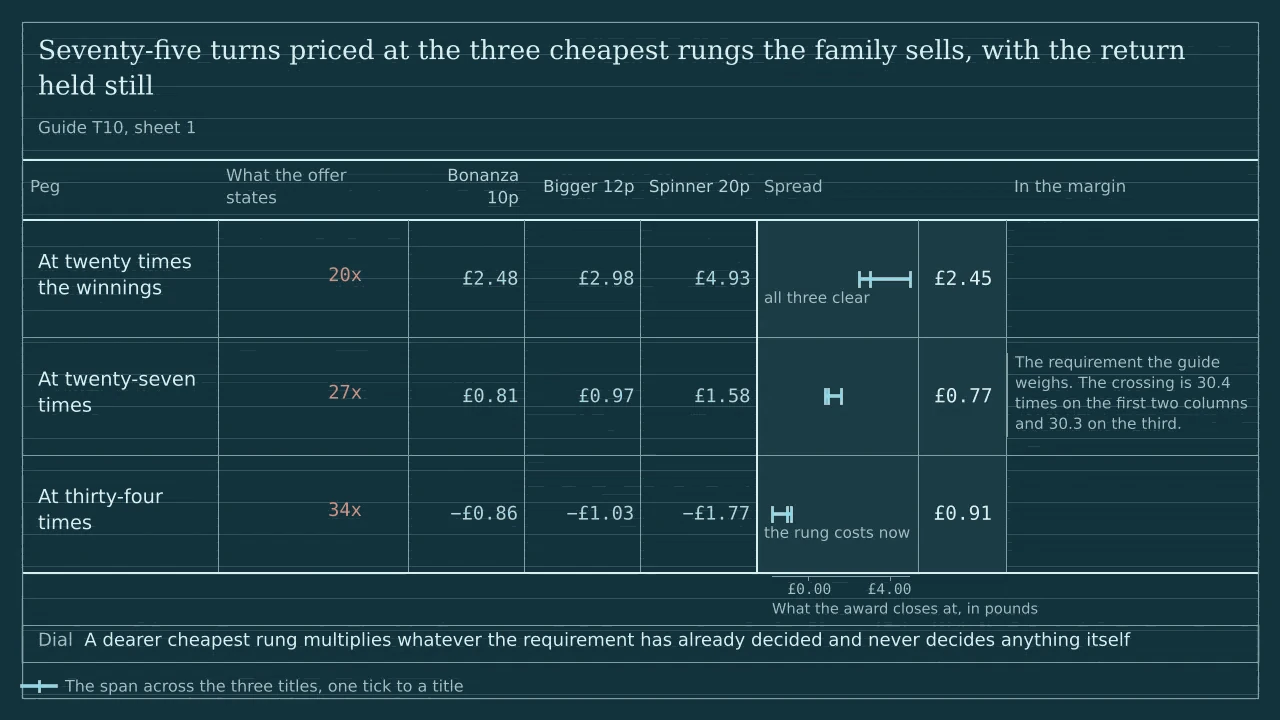
Begin with the middle row, which is the one the rest of this page leans on. At twenty-seven times the same seventy-five turns close at £0.81, £0.97 and £1.58, so the dearest of the three rungs is worth seventy-seven pence more than the cheapest on an award whose whole expectation is under two pounds. Nothing in the offer moved between those three figures. The count did not move, the requirement did not move, and the return moved by a hundredth of a point.
Then read the two rows either side of it, because together they say something the middle row cannot. At twenty times every one of the three closes above nought and the dearest rung is worth £2.45 more than the cheapest. At thirty-four times every one of them closes below nought and the dearest rung is now worth £0.91 less. So the least stake multiplies whatever the requirement has already decided, and it never decides anything itself. The page about 10 free spins settles that division for a count standing on its own, and this sheet is the same division seen from the other side: there the price moved and the reel stood still, here the reel moves and carries a price with it.
A ladder of this kind prints the span between its ends and never a total, two accounts of one award being no quantity when added. That is also the honest shape for the question this page asks. A reader holding an untied count does not hold three awards worth £0.81 and £0.97 and £1.58 between them. They hold one award that is worth one of those three and have not been told which.
The return that arrives with it, and the crossing that travels
Now hold the rung still instead and let the return move, that being the second of the two quantities a title delivers. Three titles that all open their ladder at ten pence will do it: the original at 96.71 per cent, Big Bass Trophy Catch at 96.50 and Big Bass Halloween at 96.04 claim 74. No slot in this family prints a lower figure than 96.04 per cent, which is what the studio’s page gives Big Bass Halloween, while the configuration its server sends reads 96.06 for the same title claim 119. The table uses the page figure and says so; the other would move its last column by under a penny.
The quantity that travels with the return is the crossing, which is the reciprocal of whatever share of the staking the machine keeps. Break-even moves with the published return, so it is 30.4 times on the title this domain is named for and 25.3 on the one at the foot of the family’s slot returns. The requirement supposed on this page sits at twenty-seven, which is inside that gap. A requirement inside the gap is the interesting case and it is not a rare one: it means the very same wording, applied to the very same count, is a prize on some titles of one family and a cost on others.
| The title the seventy-five turns run on | Published return | Break-even play-through | What £7.50 of stake is worth |
|---|---|---|---|
| Big Bass Bonanza | 96.71 per cent | 30.4 times | £0.81 |
| Big Bass Trophy Catch | 96.50 per cent | 28.6 times | £0.40 |
| Big Bass Halloween, on the maker’s page | 96.04 per cent | 25.3 times | −£0.50 |
| What the choice of title comes to | 0.67 of a point | 5.1 times fewer | £1.31 |
Two thirds of a point of return is worth £1.31 on an award of seventy-five turns at the cheapest rung, which is more than the award’s entire expectation on the best of the three. Put that beside the requirement for a moment. Moving the requirement from twenty-seven times to twenty-eight, a change an offer could make in a footnote, costs about twenty-four pence on the first row. Moving the title from the top of the family to the foot costs £1.31 and is a change nobody has to announce at all, because the advertisement never named a title in the first place.
The middle row is there to stop an obvious misreading. The family does not consist of a best title and a worst one with nothing in between: eleven of its slot titles print 96.50 per cent and nine print 96.07, so the two commonest figures in the family sit either side of the crossing a twenty-seven-times requirement draws. An untied count is more likely to land on one of those two than anywhere else, and which of the two decides whether the answer has a minus sign in front of it.
None of this is a statement that any particular cashier runs any particular reel, and no page here can be one. What the arithmetic shows is narrower and firmer: given a count, a requirement and a rung, the published return alone moves the answer by £1.31 across this family, and the return is the quantity a reader is not being told.
The band an untied count leaves across the family
Put the two axes together and the measurement is finished. Run the same seventy-five turns and the same twenty-seven times across every title in the family that has a slot configuration to read, each one priced at its own cheapest rung and worked at its own published figure, and the answers run from £1.58 down to minus £0.51. That band is £2.09 wide and the sign is not settled inside it, which is what declining to name the reel actually costs.
£2.09is the width of the band an unnamed reel leaves on an award of seventy-five turns at twenty-seven times, running from £1.58 to minus £0.51 across the thirty-five titles of this family with a slot configuration
The two ends are worth naming because neither is where a reader would guess. The top is Big Bass Hold & Spinner Megaways, which reaches £1.58 not by returning more than its neighbours but by selling a dearer cheapest turn: twenty pence against ten, so the same count lays twice the stake and keeps twice the surplus at a requirement under the crossing. The foot is Bigger Bass Blizzard: Christmas Catch, which reaches minus £0.51 by the same mechanism running the other way: a twelve pence rung against a published 96.08 per cent, so the requirement is past that title’s crossing of 25.5 times and the dearer rung makes the shortfall larger rather than smaller.
One title sits outside the count and the reason is worth a sentence. Thirty-six pages on the maker’s own site carry the family name, and one of them is not a reel-based game at all: no game symbol of the usual kind could be read for it and no slot configuration came back claim 75d. It carries the lowest figure anywhere in the family, and putting it into a table of slots would have widened this band with a number that cannot be reached by spinning anything. So the band is taken over thirty-five titles and not thirty-six, and it is narrower for that.
Being exact about what the band is and is not is worth a paragraph. It is not a probability: nothing here says a reader is equally likely to meet any title, and nothing published would support such a statement. It is a range of honest answers to one question, every one of them arrived at by the same arithmetic from published figures. A reader told the count and the requirement knows the method; what they do not know is which of thirty-five answers the method is going to produce, and the distance between the best and the worst is two pounds and nine pence on an award whose face looks like seven pounds fifty.
Set that beside the award’s own close and the proportion is the finding. The tied answer on the title this domain is named for is £0.81. The band an untied count leaves is £2.09, which is over two and a half times the answer it is supposed to be an answer about. Any discussion of whether twenty-seven times is a generous requirement is therefore an argument about a quantity smaller than the uncertainty sitting underneath it.
Three things a name settles less firmly than it looks
A page that priced the tie and stopped there would be overselling it, so here are three places where a title in the headline still leaves something open. None of them is large enough to disturb the band above, and saying so precisely is worth more than leaving a reader to wonder.
The first is the bet mode. Thirty-three of the thirty-five slot titles publish a separate return for each bet mode the player can select, named for ordinary play, for the raised-stake variant and for each level of bought entry to the feature round claim 55. So on most of this family a title does not carry one figure; it carries a short list, and which of them applies is settled at the machine rather than in the offer. The spread inside a single title is a few hundredths of a point, which on this award is pennies, and it is a choice the player makes rather than one made about them. The title this domain is named for is one of the two that carry a single flat figure instead, neither of them having a bonus-buy mode, so on the worked example above the question does not arise at all.
The second is the rung itself. Naming the title fixes where the ladder starts and not where an award was valued on it, and the configuration that opens a session names twenty-eight selectable coin values with ten lines over each of them, running from a penny a line up to twenty-five pounds a line claim 25. This page reaches for the cheapest rung because the sheet states only three of the twenty-eight: that one, the top of the ladder, and the value a fresh session arrives on. That is a choice made for want of anything better and not a reading of what any award is worth, and every figure above would scale with it.
The third is the distance between the two primary sources themselves. Two titles of the thirty-five have a maker’s page and a session reply that disagree, and in both cases the gap is two hundredths of a point claims 118 and 119. Neither is a review and neither can be dismissed in favour of the other, so this page prints both wherever one of the two titles comes up and does not average them. Two hundredths of a point is worth about four pence here, which is the right order of magnitude to remember: the disagreement is real and it is not the thing costing a reader money.
Add the three together and they come to a few pence against a band of £2.09. The honest summary is that a title settles almost everything an award of turns needs and a category settles none of it, and the places where a title falls short are small, countable and published, which is exactly what cannot be said about the alternative.
Two more quantities a name delivers and nobody can cost
Two of the four quantities listed in the opening table have not been priced, and the reason is the same in both cases: a size is published and the rate at which it arrives is not. They still belong in an account of what a title is worth, because a reader gets them with the name and gets nothing with a category, and because what can honestly be said about them is a good deal more than nothing.
Start with the largest sum one round may hand over. On the title this page weighs that is 2,100 times the stake, from the data a session opens with rather than from the maker’s page, which states none claims 27 and 28. At the rung supposed here that is £210.00 out of a single round, against an award whose entire expectation is £7.25 before any requirement. Across the family the same quantity runs from 2,100 up to 25,000 times the stake claims 75i and 75j, which is a factor of close to twelve, and an untied count tells a reader nothing about where in that range their turns are going to be spun. The page about Keep what you win prices what a withdrawal ceiling does to that reach, and what it finds there holds in proportion here.
What cannot be done is to convert that range into expectation, and the reason is flatly stated by both primary sources. One rate is published for this machine and it belongs to the very top of the range: the largest round arrives at 1 in 3,880,481 claims 29 and 123. Across seventy-five turns that is about one chance in fifty-two thousand, worth a fraction of a penny, and every other outcome between nothing and the ceiling has a size in the paytable and no rate anywhere. How widely one round’s outcome scatters is the one quantity nobody in this chain of documents states, so nothing here turns the reach into a cost.
The second quantity is the feature round’s entrance. Three, four or five scatters open the round with ten, fifteen and twenty turns respectively, and on that mapping the two primary sources agree claim 35. That is a mapping, not a frequency. How often three scatters land goes unpublished in both, and the two candidate rates in circulation disagree by a factor of over one and a half, so whether seventy-five turns reach the round has no answer this report may give. It is settled as far as it can be on the page about 40 free spins no deposit, and the conclusion there is that an advertised count is a floor rather than a figure wherever the round does open, since the round hands more turns back.
So the tally stands at two quantities priced and two described. A reader who gets a title gets all four; a reader who gets a category gets none of them; and the two that cannot be priced are the two a reader is most likely to be thinking about when they read a count of free turns at all.
The opposite failure, and why the band is only a floor
There is a second way an award of turns can be unpriceable, and it is the mirror image of the one weighed above. An advertisement can name a machine perfectly clearly and name one this domain holds no figure for, because it belongs to another maker entirely and nothing in either sheet here reaches it. The count is then tied, and tied to nothing a reader can open. That case has a page of its own in the section about the machine, and the finding there is that a count is not portable.
Put the two failures side by side and they bound the problem from opposite directions. An untied count has thirty-five candidate answers inside this family and a reader can at least see the band. A count tied to a machine no document reaches has one answer and no way to reach it, which is worse in principle and easier to notice. The shape a reader should be looking for is therefore not a name as such, but a name whose maker publishes.
Which is what makes the £2.09 a floor under the cost rather than a measurement of it. The band was taken inside one family, where a return is published for every title, where the stake ladder comes back with every session and where two primary sources can be set against each other. The honest limit of this measurement is that it was taken inside the best-documented case available. An untied count could be running on a machine no sheet on this domain reaches, and then the band is not £2.09 but unbounded, since there is no published figure at either end to bound it with.
A second limit belongs here too. Nothing published sets the value of one free turn, and the choice belongs to whoever wrote the offer no rule sets one. The cheapest rung is this report’s stand-in for a figure nobody is obliged to print, and it is the most favourable stand-in available rather than a neutral one: every rung above it makes the award larger in magnitude, and past the crossing larger in the wrong direction. A reader using the same method should know they are computing the mildest version of their own case.
Taken together the two limits point the same way. The arithmetic on this page is performed under the friendliest assumptions this domain can justify, on the family its sheets document most fully, and it still returns a band wider than the answer. A method that cannot be made to produce a figure under those conditions is telling a reader something about the advertisement rather than about the method.
What a reader can settle before committing anything
Three things can be settled from a published document before anything has been committed, and the list is short enough to be worth keeping. Which title the turns run on, since the name is the key to everything else. What the cheapest rung on that title is, since it bounds the stake and therefore the whole magnitude. And what requirement the winnings carry, since that alone decides whether the answer has a minus sign in it.
Only the third of those is ever in the advertisement, and it is the one that needs the other two before it can be read. Twenty-seven times means one thing against a crossing of 30.4 and the opposite against a crossing of 25.3, and the crossing is not a term of the offer at all. So a requirement quoted without a title is a number whose sign is withheld, which is a stranger thing to print than it first appears.
What a reader loses is not the figure but the ability to reach any figure at all. That is the sentence this whole page has been working towards, and it is worth separating from the complaint it resembles. Nobody here is saying an unnamed award is a worse award. Some of the thirty-five answers are better than the tied one: £1.58 beats £0.81 comfortably. The objection is that this domain’s method, which takes a figure off the machine, takes a figure off the offer and multiplies, has nothing to begin on when the first of the three is missing.
And the quantity that goes missing first is the price of one turn. A title settles it within one rung of the ladder. A category leaves three different cheapest rungs in play inside this family alone, each of which multiplies everything after it. That is why this page sits in a section about the price of a turn rather than in one about offers: the tie between a count and a machine is, in the end, the thing that puts a price on the count, and everything else follows from the price.
One last figure, because it makes the proportion concrete. On the tied arithmetic the award closes at £0.81 and all of its play is finished inside three minutes and eight seconds at the fastest pace a licence permits. The band left by not naming the reel is £2.09. A reader deciding between two advertisements is therefore choosing between quantities smaller than the one both of them have left out, and the remedy costs an advertiser one word.
Questions readers ask
What are seventy-five free turns worth on Big Bass Bonanza
£0.81, where one turn goes for ten pence and the winnings carry a twenty-seven-times requirement. The turns lay £7.50 of stake, a published 96.71 per cent hands £7.25 of it back, and the requirement takes the rest down to eighty-one pence.
Why does an advertisement naming no machine leave a count unpriceable
Because the two figures the arithmetic needs belong to the machine rather than to the advertisement. A title supplies a published return and a stake ladder whose cheapest rung sets the price of a turn. A word for a category supplies neither, and there is no document a category opens.
How much is the missing name worth in money
£2.09 on this award, which is the width of the band the same seventy-five turns at twenty-seven times produce across the thirty-five titles of this family with a slot configuration. The top is £1.58 and the foot is minus £0.51, so the sign is open as well as the size.
Does the family really sell turns at more than one cheapest price
Yes, and at three. Ten pence opens the ladder on thirty-one of the slot titles here, twelve pence on two twelve-line titles and twenty pence on two built with a shifting reel arrangement. A count priced at the cheapest rung is therefore priced three ways.
Which matters more, the published return or the cheapest rung
They do different jobs. The return sets the crossing, so it decides whether the close carries a minus sign: 30.4 times at the top of this family and 25.3 at the foot. The rung multiplies whatever the requirement has already decided and never decides anything itself.
What does a title still leave unsettled
Three small things. On thirty-three of the thirty-five slot titles a separate return is published for every bet mode, which is the player’s own choice at the machine. The rung an award was valued at is not fixed by the name. And two titles have a maker’s page and a session reply two hundredths of a point apart.
Can the chance of reaching the feature round be worked out from the count
No. Scatters of three, four and five open the round with ten, fifteen and twenty turns, and on that mapping the two primary sources agree. How often they land goes unpublished in both, and the two candidate rates in circulation disagree by a factor of over one and a half. Only the largest round carries a published rate, at 1 in 3,880,481.
What is given up on an award advertised this way
An award of this sort is sold from outside any British licence, so the £5 ceiling standing over one cycle of a slot has gone, so has the duty that keeps the means of judging a chance within reach before any commitment, and so has the prohibition on a build moving its own odds mid-session. Gamstop Online closes British-licensed accounts in one stroke and its own terms say it reaches no further.
Before you play
Read on
- Free spins no deposit
- Of the four places a price for one turn can come from, only one answers before a reader commits anything, and it answers with a range.
- 20 free spins on registration no deposit
- Every conversion between money and turns leaves a remainder, and the band at the foot of a balance strands about half a stake.
- 150 free spins no deposit book of dead
- A count is not portable: the machine in that headline has no figure on any sheet here, and the advertisement prints no way of getting one.
- Pragmatic slots
- A maker’s name settles where a figure is published rather than what it is, twelve distinct returns standing across the family.