New casino sites: against a reel with no day one at all
Almost everything worth knowing about a place of play is a record, and a record is a function of how long the place has been open. Almost everything worth knowing about a reel is a specification, and a specification is complete at the moment it is issued.
- Updated 13 November 2026
- Licence status shown for every offer
- Assumptions marked in the text
Opening offers, weighed against one named reel
These offers are paid placements, so this site is owed a fee whenever a reader opens an account through one of the buttons below.
-

Tweedbet
Welcome pack 470%
- Licence
- Not stated, no Great Britain licence
- Play-through
- Not published
- Min deposit
- £20
Bonus up to£14,000 Free spins470Read the offer18+ only. Terms apply.
Licence, terms and working
The site does not say where it is licensed or which company runs it.
The reel
- Build of the reel
- Big Bass Bonanza
- Return it publishes
- 96.71 per cent
- Stake it accepts on one turn
- 10p to £250.00
The offer
- Turns advertised
- 470 turns Turns valued at the cheapest turn this reel sells, no worth for one being stated anywhere in the offer
- Price of one turn
- 10p the smallest stake the reel accepts, this operator publishing no figure of its own
- Credit as a sum
- £14,000.00
- Credit waiting on a payment
- Stated in words Casino Welcome Pack 470% up to £14,000 + 470 FS. Crypto Welcome Bonus 110% up to 1,300 USDT + 110 FS. VIP Welcome Pack 770% up to £13,000
- Advertised, priced
- £14,047.00 140,470 turns of this reel
Hung on it
- Play-through
- Not published
- Credited towards it
- 100 per cent nobody has published a share, so the whole of a stake is credited, which is the kindest reading available
- Ceiling on winnings
- Not published
- Qualifying payment
- £20.00 200 turns of this reel at the price above, and it enters no weight
Not weighed, for want of the play-through multiple as a number.
Stated in words means the condition is set down in words that cost something and give nothing to subtract. Not published means the operator sets the figure down nowhere.
-

EliteSpin
£5,000 + 500 FS
- Licence
- Costa Rica, no Great Britain licence
- Play-through
- 40×
- Min deposit
- £20
Bonus up to£5,000 Free spins500Read the offer18+ only. Terms apply.
Licence, terms and working
Licence held in Costa Rica, by PrimeTier Limited.
The reel
- Build of the reel
- Big Bass Bonanza
- Return it publishes
- 96.71 per cent
- Stake it accepts on one turn
- 10p to £250.00
The offer
- Turns advertised
- 500 turns Turns valued at the cheapest turn this reel sells, no worth for one being stated anywhere in the offer
- Price of one turn
- 10p the smallest stake the reel accepts, this operator publishing no figure of its own
- Credit as a sum
- £5,000.00
- Credit waiting on a payment
- Stated in words Welcome bonus €/£5,000 + 500 FS. Elite lootboxes unlock surprise rewards up to €/£20,000 or 500 FS. Summer Festival by BGaming: win €80,000
- Advertised, priced
- £5,050.00 50,500 turns of this reel
Hung on it
- Play-through
- 40 times the bonus and the winnings from the spins
- Credited towards it
- 100 per cent nobody has published a share, so the whole of a stake is credited, which is the kindest reading available
- Ceiling on winnings
- Stated in words Five times the bonus
- Qualifying payment
- £20.00 200 turns of this reel at the price above, and it enters no weight
Priced at 10p a turn, the banner comes to £5,050.00, of which £5,048.36 survives the spins. At the reel's published return of 96.71 per cent, a play-through of 40 times asks for £201,934.20 of staking and costs £6,643.64, more than there is to pay it with, so the offer weighs £0.00.
Stated in words means the condition is set down in words that cost something and give nothing to subtract.
-

WinBeast
€5,000 + 500 FS
- Licence
- Curaçao, no Great Britain licence
- Min deposit
- €20
- Free spins
- 500
Bonus up to€5,000 Play-through40×Read the offer18+ only. Terms apply.
Licence, terms and working
Licence held in Curaçao, by a company the site does not name.
The reel
- Build of the reel
- Big Bass Bonanza
- Return it publishes
- 96.71 per cent
- Stake it accepts on one turn
- 10c to €250.00
The offer
- Turns advertised
- 500 turns Turns valued at the cheapest turn this reel sells, no worth for one being stated anywhere in the offer
- Price of one turn
- 10c the smallest stake the reel accepts, this operator publishing no figure of its own
- Credit as a sum
- €5,000.00
- Credit waiting on a payment
- Stated in words Welcome pack €5,000 + 500 FS + €650 free bet. Fortune wheel on €40+ deposits with code FORTUNE. 40% up to €300 Beast Boost Monday with code BOOST1 on €20 deposit
- Advertised, priced
- €5,050.00 50,500 turns of this reel
Hung on it
- Play-through
- 40 times the bonus and the winnings from the spins
- Credited towards it
- 100 per cent nobody has published a share, so the whole of a stake is credited, which is the kindest reading available
- Ceiling on winnings
- Stated in words €100 a batch of spins
- Qualifying payment
- €20.00 200 turns of this reel at the price above, and it enters no weight
Priced at 10c a turn, the banner comes to €5,050.00, of which €5,048.36 survives the spins. At the reel's published return of 96.71 per cent, a play-through of 40 times asks for €201,934.20 of staking and costs €6,643.64, more than there is to pay it with, so the offer weighs €0.00.
Stated in words means the condition is set down in words that cost something and give nothing to subtract.
-

Betportal
300% + 150 FS
- Licence
- Anjouan, Comoros, no Great Britain licence
- Play-through
- 35×
- Min deposit
- €20
- Stake cap
- €5.00
Bonus up to€1,000 Free spins150Read the offer18+ only. Terms apply.
Licence, terms and working
Licence held in Anjouan, Comoros, by BetPortal Gaming Ltd and Excite Ultra Media Ltd, numbered ALSI-202601040-FI2.
The reel
- Build of the reel
- Big Bass Bonanza
- Return it publishes
- 96.71 per cent
- Stake it accepts on one turn
- 10c to €250.00
The offer
- Turns advertised
- 150 turns Turns valued at the cheapest turn this reel sells, no worth for one being stated anywhere in the offer
- Price of one turn
- 10c the smallest stake the reel accepts, this operator publishing no figure of its own
- Credit as a sum
- €1,000.00
- Credit waiting on a payment
- Stated in words Welcome package 300% up to €1,000 + 150 free spins. 1st deposit 150% up to €500 + 100 FS. 2nd deposit 100% up to €300 + 50 FS
- Advertised, priced
- €1,015.00 10,150 turns of this reel
Hung on it
- Play-through
- 35 times the bonus
- Credited towards it
- 100 per cent nobody has published a share, so the whole of a stake is credited, which is the kindest reading available
- Ceiling on winnings
- Stated in words Five times the bonus
- Largest stake while it runs
- €5.00 under the largest stake the reel accepts, so part of the machine's own range is shut off while the credit runs
- Qualifying payment
- €20.00 200 turns of this reel at the price above, and it enters no weight
Priced at 10c a turn, the banner comes to €1,015.00, of which €1,014.51 survives the spins. At the reel's published return of 96.71 per cent, a play-through of 35 times asks for €35,507.73 of staking and costs €1,168.20, more than there is to pay it with, so the offer weighs €0.00.
Stated in words means the condition is set down in words that cost something and give nothing to subtract.
-

Night Luck
805% + 280 FS
- Licence
- Not stated, no Great Britain licence
- Play-through
- Not published
- Min deposit
- €20
Bonus up to€6,400 Free spins280Read the offer18+ only. Terms apply.
Licence, terms and working
The site does not say where it is licensed or which company runs it.
The reel
- Build of the reel
- Big Bass Bonanza
- Return it publishes
- 96.71 per cent
- Stake it accepts on one turn
- 10c to €250.00
The offer
- Turns advertised
- 280 turns Turns valued at the cheapest turn this reel sells, no worth for one being stated anywhere in the offer
- Price of one turn
- 10c the smallest stake the reel accepts, this operator publishing no figure of its own
- Credit as a sum
- €6,400.00
- Credit waiting on a payment
- Stated in words Casino welcome bonus 805% up to €6,400 + 280 FS. Crypto welcome bonus 140% up to 1,600 USDT + 140 FS. VIP welcome pack 800% up to €14,500
- Advertised, priced
- €6,428.00 64,280 turns of this reel
Hung on it
- Play-through
- Not published
- Credited towards it
- 100 per cent nobody has published a share, so the whole of a stake is credited, which is the kindest reading available
- Ceiling on winnings
- Not published
- Qualifying payment
- €20.00 200 turns of this reel at the price above, and it enters no weight
Not weighed, for want of the play-through multiple as a number.
Stated in words means the condition is set down in words that cost something and give nothing to subtract. Not published means the operator sets the figure down nowhere.
What a Great Britain licence would add to these offers
A licence from the Gambling Commission for Great Britain carries rules that an offer licensed elsewhere does not have to follow, and some figures in this ranking would not survive them. Social responsibility code provision 5.1.1 stops a British licensee applying a wagering requirement of more than ten times the bonus funds, and that limit has applied since 19 January 2026. A play-through above ten times in this list is therefore one a British licence would not allow.
Regulation 5(2) of the Gambling Act 2005 (Operating Licence Conditions) (Amendment) Regulations 2025, made on 25 February 2025, limits what a player can stake on one game cycle of an online slot to £5, or £2 for a player under 25. It is a condition of a British remote casino licence and not a property of the game, so a player at an operator licensed elsewhere does not have it behind them.
Remote technical standard 14D asks for at least two and a half seconds from the start of one slot game cycle to the start of the next, with the player pressing start each time. It is addressed to the game and not to the money, so no figure in this ranking measures it.
GAMSTOP is the free scheme that closes your accounts with online gambling companies licensed in Great Britain, and every one of them must join it. An operator licensed elsewhere is not required to, so a GAMSTOP registration cannot be counted on to reach these offers. If gambling is costing more than money, the National Gambling Helpline is free and answers on 0808 8020 133 at any hour.
Ranking last changed 8 November 2026. Operator terms change without notice, so open the offer page and read the terms there before you register.
At a glance
That difference decides what a reader can and cannot find out on an opening day, and it is why the figures below could have been worked before the venue existed. Big Bass Splash 1000 states 96.52 per cent of itself, and a credit of £35.00 asked for twenty-one times is expected to leave £9.42 standing on it. A reel whose page went up seven days earlier states 96.07, and the same wording leaves £6.11. Seven days of calendar separate the two documents. Three pounds thirty-one separates the two answers, and the calendar had nothing to do with it.
- What the machine states96.52 per centThe return of Big Bass Splash 1000, agreeing between the maker’s page and the data a session receives. It is on this page because the title is one of the family’s newer entries and because its figure was as complete on the day its page appeared as it is now, which is the whole argument in one quantity.
- What the offer states£35.00 at 21 timesAn opening balance of the size a venue with nothing behind it yet tends to advertise, with twenty-one times its face to be staked before any withdrawal, the named slot counting in full. The sum, the multiple and the weighting all three come out of the wording and out of no other document.
- What the two make when multiplied£9.42Expected to be standing when the staking is finished, with a turn priced at ten pence throughout, a figure this page chooses off the foot of the published span and repeats at each spending. It was computable on the venue’s first morning and on every morning since.
On this page
- What a venue can be asked on its opening day
- Four answers that cannot exist yet, and when each can
- A reel handed over complete every time it opens
- The one date the maker prints, and what it dates
- Seven days of calendar against £3.31 of arithmetic
- The single venue figure that does arrive on day one
- Why only one of the two documents can be young
- What eight weeks of waiting buys in each column
- Adding the column that had figures from the start
What a venue can be asked on its opening day
Begin with the inventory, because the argument on this page is an argument about which questions have answers and not about whether a new place is better or worse than an old one. A reader standing in front of a venue on its first morning can get a firm answer to five questions and no answer at all to four more, and the split is not random. It follows from what kind of thing each answer is.
Answerable at once. Whether the business is licensed in Great Britain at all: the regulator keeps a public register of businesses, and an account on it carries the activities held and the domain names held with them the public register. What the terms of play say, since a licensee has to make them available in an easily accessible way and to write them transparently. What the significant conditions on an advertised offer are, which the advertising rules require to be put where the headline is rather than in a footer. Which approved dispute entity the business will escalate a complaint to, a licensee being permitted to use only an entity the regulator has approved and eight of them being listed. And how the business rates the protection of money held to a customer’s credit if it fails, which is a disclosure owed at the first payment and is the subject of the sixth part of this page.
Not answerable at all. Whether the business has ever been penalised. Whether it pays out as it says it will. How many complaints it has had and how they went. How it behaves after six months of trading. Each of those four is a question about a track, and a track is laid by walking, so on the first morning there is nothing to read. Nobody is hiding it. It does not exist, and that distinction matters because the two situations look identical from where a reader stands.
That is the whole shape of a venue’s first day, and it is worth noticing what it does not contain. Not one of the five answerable questions produces a figure a reader can put into an arithmetic. Four of the five answer yes or no. The fifth answers with a label lifted off a scale of four. Meanwhile the offer in front of them has a sum in it, a multiple on it and a reel underneath it, and every one of those three is a number. The reel alone supplies more arithmetic in one session response than the venue’s whole opening-day prospectus contains, and the parts of this page that work out to money all draw on the reel’s side of that division.
Four answers that cannot exist yet, and when each can
The four unanswerable questions are not unanswerable for ever, and the duties themselves say when each becomes answerable. Newness as a worry cannot be weighed against anything. Newness as a set of dates can.
A complaint has fifty-six days at the outside to run from arrival to final letter, escalation and all. An acknowledgement comes far sooner, within three working days, and within twenty-four hours from a venue selling play around the clock complaints guidance. So fifty-six days after a venue takes its first complaint is the earliest its record can show how a complaint goes there, and that clock cannot start before a customer exists to start it. A customer has at least six months from an incident to raise one, so the window in which a first month’s trading can still produce a complaint runs well into the following year, and a quiet record at ten weeks is not evidence of a quiet first month.
A statement of the sum held, and of whether it would survive the business failing, comes round twice a year on either of the two ratings whose label starts by saying it would not. The duty to prompt a reader to look back over their own account and transaction history runs at a minimum of six-month intervals, and the prompt to review a decision not to set a limit on paying in runs at a minimum annually. A business four weeks old has issued none of the three and is not in breach of anything by not having issued them.
One more thing belongs in the first column and it is a caution about the register rather than a complaint. The register’s own page states no date and offers no guidance on how to read what is listed there the register page, so a reading taken off it is a reading taken on a day, and the day has to be written down by whoever took it. That is a small thing on a business ten years old and a large one on a business ten days old, where the listing a reader is looking at may be days rather than years from the state it describes.
A penalty record is the slowest of the four by a wide margin, because it needs a breach, an investigation and a published outcome. The regulator publishes its penalties and its suspensions with dates against them, and the list is a list of things that took years to arrive at.
| The question | What has to happen first | Earliest it can be answered |
|---|---|---|
| How a complaint goes here | a customer, an incident, and the process running to its final letter | 56 days after the first complaint |
| Whether the money held is safe | the disclosure at a first payment, then the repeat falling due | day one, then six months |
| Whether a limit decision gets revisited | a reader declining a limit and a year of the account existing | twelve months |
| Whether it has been penalised | a breach, an investigation and a published outcome | no date anybody can give |
One of those four rows is different from the other three and it is the second. It carries a figure, it arrives on the opening day, and it is the only entry in the whole inventory that does both. The sixth part of this page is about what it is worth.
A reel handed over complete every time it opens
Now the other column, where the mechanism matters enough to set out, because it is why the comparison is not a fair fight. When a session of this machine opens, the maker’s own server sends the game its configuration off the sheet, claim 53. What comes down the wire is not a trailer for the figures. It is the figures: the reel strips, the paytable, what the scatters pay, the stake steps a player may choose between, the counts of lines and rows, the ceiling on a single round and the return itself claim 15. The information screen a player can open is drawn from that same data.
So a reel has no equivalent of a track record, not because nobody has kept one but because there is nothing for one to be about. The quantities that decide the money are handed over at the start of every session, complete, to the first player and to the millionth. There is no such thing as an old reading of a figure that arrives fresh each time somebody opens the thing.
The honest limit on that belongs here rather than three paragraphs later. The game sheet is blunt about how far it goes: a server could be sending one fixed figure, or a figure settled somewhere else, and its arrival says nothing about which claim 54. The mechanism proves nothing beyond itself, this page does not stretch it, and the argument about what it might or might not imply belongs to the section of this site that is built on the machine rather than on the venue. What is being claimed here is narrow and sufficient: the figures arrive at the opening of a session, so the question of how long a reel has been in service does not bear on whether its figures can be read.
Against that, consider what the maker does not put on a game page claim 76. Every quantity on this page other than the return was read out of the game’s own data, since the block of basic information on a maker’s page carries the return and stops there. That is a different primary source and it has to be cited as one, which is why the readings beside the figures on this page do not all say the same thing.
It is worth pricing one of those quantities, because it shows how much of the arithmetic sits on the side the maker’s page never reaches. The newer of the two reels below caps a single round at 25,000 times a stake, so at ten pence one turn could in principle hand over £2,500.00, and the older caps it at 5,000, which is £500.00. Neither figure appears on a game page. Both are in the session data, both were there on the day each title’s page went up, and the fivefold gap between them is larger than anything the whole of a venue’s opening-day prospectus has to say.
The one date the maker prints, and what it dates
There is exactly one date in the family’s whole table and it repays reading closely. It is the publication date carried in the structured data on the maker’s own page for each title claim 74. It is a date about a document. It is not called a release date by anybody, and the sheet is explicit that no page may call it one without saying what it actually is claim 106.
Turn that over and it is a remarkable thing to find on a page about newness. The newest entry in the whole set of Big Bass pages the maker publishes has one date attached to it, and that date is the day the page itself went up. The thing a reader wants, which is the day the machine began taking money somewhere, is not published for any title at all. A reader who wanted to rank these reels by age would be ranking the maker’s publishing schedule.
And the dates are tightly packed, which makes the next part of this page possible. Big Bass Splash 1000 has a page published on 30 November 2025. Big Bass Christmas: Frozen Lake has one published on 23 November 2025. Seven days apart, inside one fortnight of one November, from one maker, in one family, under one naming convention. If the date of a document told a reader anything about the figures inside the thing it describes, those two should be close to identical.
They are not. One publishes 96.52 per cent and the other publishes 96.07, which is forty-five hundredths of a point apart. The ceiling on one round stands at £2,500.00 against £500.00 at the stake spent here, the first of those being the largest in the family. The second of the two is also the one title whose page prints its return with no per cent sign after it, a slip on the maker’s own page that the sheet records so that nobody reads the figure as a different kind of quantity claim 75k. Seven days of calendar, and two reels that behave differently enough to be worth pounds on the same offer.
Seven days of calendar against £3.31 of arithmetic
Here is the arithmetic that prices the paragraph above. The expected close of a balance is E = B × (1 − W × (1 − RTP) ∕ g), with RTP standing for the proportion a reel publishes, W for the twenty-one times this wording demands, B for its thirty-five pounds and g for the rate the named slot counts at, which the wording puts at full in the terms themselves.
Twenty-one times thirty-five pounds is £735.00 of staking to be put across the reel. At ten pence the turn, which is this page’s own figure and the foot of the published span supposed here, that is 7,350 turns. Seven thousand three hundred and fifty is the count, and a licensed build must let 2.5 seconds go by before the next cycle can be started RTS 14D, which fixes the hour at 1,440. Five hours and six minutes is therefore the shortest the staking can take, and no venue, new or old, has any say in that figure.
One divided by the margin gives the staking at which a balance is exhausted, and the margin that applies is whichever one the tile a reader opened publishes. A published 96.52 per cent leaves 3.48 points and puts that point at 28.7 times. A published 96.07 leaves 3.93 and brings it down to 25.4. Twenty-one times sits under both of those, so the balance survives on either reel, and the gap between the two survivals is what the table prints.
| The title weighed | Published return | Break-even play-through | The offer asks | What £35.00 is worth | Page published |
|---|---|---|---|---|---|
| Big Bass Splash 1000 | 96.52 per cent | 28.7 times | 21 times | £9.42 | 30 November 2025 |
| Big Bass Christmas: Frozen Lake | 96.07 per cent | 25.4 times | 21 times | £6.11 | 23 November 2025 |
| What the week decides | 0.45 points of return | 3.3 times | no change | £3.31 | 7 days |
Take the closing row as a sentence and it reads like this. Seven days of publishing schedule sit beside three pounds thirty-one of expected money, and the seven days did not cause the three pounds thirty-one. Nothing caused it except two figures the maker printed. A reader who picked the newer of the two documents happened to pick the better of the two reels on this wording, and a reader who did the same thing a fortnight later in the same family would have picked a reel at 96.50 and done slightly worse. Newness is not a direction here. It is not a quantity at all.
£3.31Seven days of publishing schedule between two of the maker’s pages, and £3.31 of expected money between the two reels they describe
The single venue figure that does arrive on day one
Back to the venue’s column, and to the one entry in it that carries anything a reader can weigh. A licensee holding money to a customer’s credit has to set out in its terms whether the money would come through the business going under, to what degree, and by what means. It follows a rating system the regulator lays down, it reaches the customer as writing rather than as a notice, and the money stays ungambleable until the customer has acknowledged it licence condition 4.2.1. It lands at the first payment, which on a venue with no history at all is the earliest moment anything could land.
The scale has four levels and the regulator names them. Two of the four open by saying the money is not protected, one of them adding that it is at least held separately. The other two rungs are named for the degree: medium protection, then high. What the regulator has pointedly left alone is the wording an operator uses to explain its own rating, so the label comes off a fixed scale and the explanation beside it is drafted by the business being described. Where the rating opens with those two words the reminder falls due twice a year, has to state the value held for that customer, and has to be acknowledged before the funds are used again, with no balance too small to qualify.
Price it against this page. The balance expected to be standing at the end of the staking is £9.42, which at ten pence a turn is ninety-four turns of play, and that is the quantity the rating is about. On the older of the two reels the same wording leaves £6.11, which is sixty-one turns, so the sum the rating would be describing is itself settled by the tile and not by whoever is holding the money. A reader on an opening day therefore has two things with figures attached: a level out of four for the money they are about to commit, and a figure to the penny for what the reel is expected to leave. The second is the more precise of the two by a wide margin, since 96.52 per cent is a number and a rung on a four-rung ladder is a name.
Then the sting, and it is the reason this part sits on this page rather than on a page about licensed venues. That duty hangs off a British operating licence and off nothing else. Where no such licence is held, there is no specified rating system, no required form of words, no acknowledgement before the money is used and no six-monthly statement of the sum held. The single venue-side figure available on an opening day is also the first one to disappear when the licence does, which leaves a reader at an unlicensed opening with an inventory of exactly nothing.
Why only one of the two documents can be young
It is worth stating the distinction behind all of this plainly, because once it is stated the rest of the page reads as arithmetic rather than as opinion. There are two kinds of document in front of a reader and they behave differently in time.
A specification is complete when it is issued. Every quantity in it is true of the thing from the first moment, and waiting adds nothing to it. The maker’s published return, the ceiling at 25,000 times the stake on the newer of the two reels above, the ten pence at the foot of the stake span, the three, four or five scatters that open the feature round for ten, fifteen or twenty turns: all of those were as readable on the day the page went up as they are now.
The feature round is worth doing in the same way, since it is the part of a reel a reader is usually buying. It opens on three scatters for ten turns, on four for fifteen and on five for twenty off the sheet, claim 35, which at the ten pence spent here hands back a pound, a pound fifty or two pounds of play. A fourth wild landing inside it adds ten turns more, and the multiplier climbs across the retriggers as far as ten times. Not one of those quantities needed a venue, a track record or a week of trading behind it. They were readable on the first day either of these two titles had a page.
A record is the opposite. It is empty when it is issued and it fills by elapsed time and by events. A penalty list, a complaints history, a pattern of payouts, a run of six-monthly statements: every one of those is worth more the longer it has been accumulating, and worth nothing at all at the start. The thing a reader instinctively wants from a venue is of the second kind. The thing they can have on an opening day is of the first.
Which gives the proper answer to the question a key like this one is usually asking. A new venue is not more dangerous than an old one because of anything it has done. It is harder to read because the instruments that read a venue are all of the second kind, and they have had no time to collect anything. A new reel, by contrast, is exactly as readable as a reel from 2020, and the reason is structural rather than lucky: there is no record to be short of.
One published fact sharpens it. One clause in a bonus wording has a published penalty standing behind it. It is the discretionary kind, which lets a business shut an account or take winnings off a reader with no clear justification offered. On 3 July 2025 the figure attached to one of those was £170,000, with the fair and open condition found breached. Two things follow and both belong on this page. Nothing else in a bonus wording has an enforcement outcome of its own to point at, so a reader going through a new venue’s terms at least knows which clause to look for. And that outcome arrived years into the business’s trading, which is precisely why it is not the kind of thing an opening day has to offer.
What eight weeks of waiting buys in each column
Suppose a reader decides to wait. Eight weeks is the natural unit, being the outer limit on a whole complaint, so waiting that long is waiting for the first thing a venue’s record could conceivably say. What does the wait buy, column by column.
On the venue’s side it buys one data point at best. A single complaint run to its final letter, if a complaint was made on the first day and ran the full distance, tells a reader how one dispute went. It is better than nothing and it is not much, and a reader who was hoping for a pattern will still be waiting a long time afterwards.
On the reel’s side the wait buys nothing whatever, because there was nothing to wait for. The figures are not maturing. They were in the session data on the first day and they are in the session data now, and a reader who spent the eight weeks reading them instead would have had, from the start, every quantity needed to price the offer in front of them. That is the asymmetry this page exists to state, and the drawing below puts a number on what it was worth to have had them.
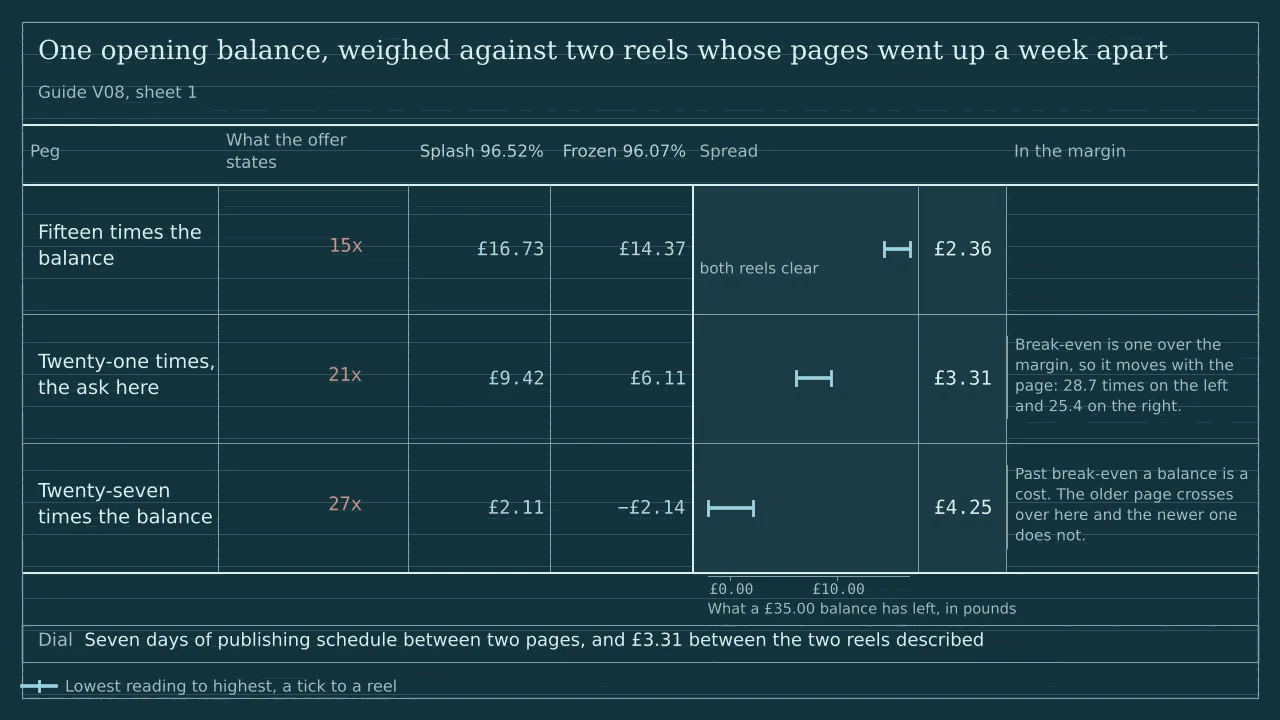
A ladder is the honest form here because the two columns are alternative accounts of one balance rather than two balances anybody could hold at once, so nothing is totalled and the band past the heavy rule measures the gap between the ends. Watch that gap widen as the wording gets harsher: £2.36 at fifteen times, £3.31 at twenty-one, £4.25 at twenty-seven, by which point the older of the two pages has gone below nothing and the newer has not. What a reel is worth rises as the wording grows harsher, which runs against the usual advice that the generosity of a wording is the thing to shop for.
And every figure in that drawing was available on the first day either document existed. None of it needed a venue to have been open for a week.
Adding the column that had figures from the start
Only one of the two columns on this page adds up, so the addition is quick. Thirty-five pounds asked for twenty-one times is £735.00 of staking. At the ten pence put up here that is 7,350 turns, and at the floor beneath a licensed cycle those turns are five hours and six minutes of unbroken play at the quickest. A reel publishing 96.52 per cent is expected to keep £25.58 of what crosses it, which leaves £9.42. Put the same wording on the reel whose page appeared a week earlier and £6.11 is what remains.
So the money on this page is £9.42, and the spread between the two reels is £3.31 on a thirty-five pound face. Set beside that, the whole of what a venue’s opening day supplies is five yes-or-no answers and one label from a scale of four, and the label is owed only by a business holding the licence these offers do not hold.
The finding is therefore not that a new venue should be avoided, which would be a recommendation and this report does not make those. It is that the newness of a venue and the newness of a reel are not the same kind of fact, because one of the two is a record and the other is a specification. A reader who treats a reel published this autumn as unproven has misread what kind of document a return is. A reader who treats a venue opened this autumn as proven has misread what kind of document a record is. Both mistakes are the same mistake, made in opposite directions.
A closing line, for a reader who wants it in one. Everything on this page that carries a figure was readable before the venue opened its doors, and everything the venue will eventually be able to tell them is still being written.
Questions readers ask
What can actually be checked about a casino that has just opened
Five things, and none of them is a figure. Whether a Great Britain licence stands behind it, what the terms say, what the significant conditions on an offer are, which approved dispute entity it escalates to, and how it rates the protection of money held to a customer’s credit. The last of those is the only one with a scale attached, and it has four levels rather than a number.
Why can a new site have no complaints record
Because the process takes time by design. A complaint has fifty-six days at the outside to run from arrival to final letter, escalation and all, and a reader may raise one up to six months after the incident. So fifty-six days past a first complaint is the earliest a record can show how one goes there.
Is a newly published slot less reliable than an older one
Its figures are no less complete. The maker’s own server hands the game its configuration when a session opens, and down that wire come the reel strips, the paytable, what the scatters pay, the stake steps, the counts of lines and rows, a ceiling on one round and the return. There is nothing for an older reel to have accumulated that a newer one lacks.
What date does the maker publish for each title
The day that title’s page went up on the maker’s site, carried in the page’s own structured data. That dates a document and not a machine, nobody labels it a release date, and this page does not treat it as one. It is the only date in the family’s whole table.
How much does the choice between two reels of one family matter
On this wording, £3.31 of a thirty-five pound face. Big Bass Splash 1000 publishes 96.52 per cent and leaves £9.42 after twenty-one times at ten pence a turn, as supposed here. Big Bass Christmas: Frozen Lake publishes 96.07 and leaves £6.11. Their pages went up seven days apart.
How long does the staking on a £35.00 balance at twenty-one times take
Seven hundred and thirty-five pounds of staking is 7,350 turns at ten pence. A licensed build has to let 2.5 seconds go by before the next cycle can begin, which fixes the hour at 1,440 turns, so five hours and six minutes is the shortest the stretch can run.
What is a customer funds insolvency rating
A four-rung statement of whether money held to a customer’s credit would survive the business failing. Two of the rungs open by saying it would not, one of them adding that the money is at least held separately, and the other two read medium protection and high protection. A British licensee owes the statement at the first payment and repeats it twice a year on the two that begin with the denial.
Does an opening-day offer come with a Great Britain licence behind it
Not here. These are advertised from beyond any Great Britain licensing, which removes the register entry that would prove a licence exists, the approved dispute entity, the ceiling of five pounds on one cycle and of two pounds below the age of twenty-five, and the rating duty that is the one day-one figure this page found.
Has the regulator ever acted over the terms attached to a new-casino bonus
Yes. A penalty of £170,000 landed on 3 July 2025 over a discretionary clause of that kind, which let the business shut an account or take winnings off a reader with no clear justification offered, and the fair and open condition was found breached. That outcome arrived years into the business’s trading, which is exactly why an opening day has none to show.
Before you play
Read on
- Online casino UK
- A test that sorts any figure on a screen into the party that settled it, and prices the result.
- Mastercard casino
- A cost named at the last of four decisions, converted into turns at a rate the reel sets.
- Mobile casinos
- The two quantities a handset moves are denominated in units no duty anywhere uses.
- How a figure is weighed here
- Which figures are read off the machine, which off the offer, and which this publisher supposes.