Ethereum casino: a charge levied once a movement, counted in turns
A rail that takes its fee per movement rather than per pound charges the same whatever is being moved, so the fee is not a proportion and cannot be compared with one. It can be compared with a turn.
- Updated 13 November 2026
- Licence status shown for every offer
- Assumptions marked in the text
Cashiers with no Great Britain licence over them, set beside one named reel
These offers are paid placements, so this site is owed a fee whenever a reader opens an account through one of the buttons below.
-

Tweedbet
Welcome pack 470%
- Licence
- Not stated, no Great Britain licence
- Play-through
- Not published
- Min deposit
- £20
Bonus up to£14,000 Free spins470Read the offer18+ only. Terms apply.
Licence, terms and working
The site does not say where it is licensed or which company runs it.
The reel
- Build of the reel
- Big Bass Bonanza
- Return it publishes
- 96.71 per cent
- Stake it accepts on one turn
- 10p to £250.00
The offer
- Turns advertised
- 470 turns Turns valued at the cheapest turn this reel sells, no worth for one being stated anywhere in the offer
- Price of one turn
- 10p the smallest stake the reel accepts, this operator publishing no figure of its own
- Credit as a sum
- £14,000.00
- Credit waiting on a payment
- Stated in words Casino Welcome Pack 470% up to £14,000 + 470 FS. Crypto Welcome Bonus 110% up to 1,300 USDT + 110 FS. VIP Welcome Pack 770% up to £13,000
- Advertised, priced
- £14,047.00 140,470 turns of this reel
Hung on it
- Play-through
- Not published
- Credited towards it
- 100 per cent nobody has published a share, so the whole of a stake is credited, which is the kindest reading available
- Ceiling on winnings
- Not published
- Qualifying payment
- £20.00 200 turns of this reel at the price above, and it enters no weight
Not weighed, for want of the play-through multiple as a number.
Stated in words means the condition is set down in words that cost something and give nothing to subtract. Not published means the operator sets the figure down nowhere.
-

EliteSpin
£5,000 + 500 FS
- Licence
- Costa Rica, no Great Britain licence
- Play-through
- 40×
- Min deposit
- £20
Bonus up to£5,000 Free spins500Read the offer18+ only. Terms apply.
Licence, terms and working
Licence held in Costa Rica, by PrimeTier Limited.
The reel
- Build of the reel
- Big Bass Bonanza
- Return it publishes
- 96.71 per cent
- Stake it accepts on one turn
- 10p to £250.00
The offer
- Turns advertised
- 500 turns Turns valued at the cheapest turn this reel sells, no worth for one being stated anywhere in the offer
- Price of one turn
- 10p the smallest stake the reel accepts, this operator publishing no figure of its own
- Credit as a sum
- £5,000.00
- Credit waiting on a payment
- Stated in words Welcome bonus €/£5,000 + 500 FS. Elite lootboxes unlock surprise rewards up to €/£20,000 or 500 FS. Summer Festival by BGaming: win €80,000
- Advertised, priced
- £5,050.00 50,500 turns of this reel
Hung on it
- Play-through
- 40 times the bonus and the winnings from the spins
- Credited towards it
- 100 per cent nobody has published a share, so the whole of a stake is credited, which is the kindest reading available
- Ceiling on winnings
- Stated in words Five times the bonus
- Qualifying payment
- £20.00 200 turns of this reel at the price above, and it enters no weight
Priced at 10p a turn, the banner comes to £5,050.00, of which £5,048.36 survives the spins. At the reel's published return of 96.71 per cent, a play-through of 40 times asks for £201,934.20 of staking and costs £6,643.64, more than there is to pay it with, so the offer weighs £0.00.
Stated in words means the condition is set down in words that cost something and give nothing to subtract.
-

WinBeast
€5,000 + 500 FS
- Licence
- Curaçao, no Great Britain licence
- Min deposit
- €20
- Free spins
- 500
Bonus up to€5,000 Play-through40×Read the offer18+ only. Terms apply.
Licence, terms and working
Licence held in Curaçao, by a company the site does not name.
The reel
- Build of the reel
- Big Bass Bonanza
- Return it publishes
- 96.71 per cent
- Stake it accepts on one turn
- 10c to €250.00
The offer
- Turns advertised
- 500 turns Turns valued at the cheapest turn this reel sells, no worth for one being stated anywhere in the offer
- Price of one turn
- 10c the smallest stake the reel accepts, this operator publishing no figure of its own
- Credit as a sum
- €5,000.00
- Credit waiting on a payment
- Stated in words Welcome pack €5,000 + 500 FS + €650 free bet. Fortune wheel on €40+ deposits with code FORTUNE. 40% up to €300 Beast Boost Monday with code BOOST1 on €20 deposit
- Advertised, priced
- €5,050.00 50,500 turns of this reel
Hung on it
- Play-through
- 40 times the bonus and the winnings from the spins
- Credited towards it
- 100 per cent nobody has published a share, so the whole of a stake is credited, which is the kindest reading available
- Ceiling on winnings
- Stated in words €100 a batch of spins
- Qualifying payment
- €20.00 200 turns of this reel at the price above, and it enters no weight
Priced at 10c a turn, the banner comes to €5,050.00, of which €5,048.36 survives the spins. At the reel's published return of 96.71 per cent, a play-through of 40 times asks for €201,934.20 of staking and costs €6,643.64, more than there is to pay it with, so the offer weighs €0.00.
Stated in words means the condition is set down in words that cost something and give nothing to subtract.
-

Betportal
300% + 150 FS
- Licence
- Anjouan, Comoros, no Great Britain licence
- Play-through
- 35×
- Min deposit
- €20
- Stake cap
- €5.00
Bonus up to€1,000 Free spins150Read the offer18+ only. Terms apply.
Licence, terms and working
Licence held in Anjouan, Comoros, by BetPortal Gaming Ltd and Excite Ultra Media Ltd, numbered ALSI-202601040-FI2.
The reel
- Build of the reel
- Big Bass Bonanza
- Return it publishes
- 96.71 per cent
- Stake it accepts on one turn
- 10c to €250.00
The offer
- Turns advertised
- 150 turns Turns valued at the cheapest turn this reel sells, no worth for one being stated anywhere in the offer
- Price of one turn
- 10c the smallest stake the reel accepts, this operator publishing no figure of its own
- Credit as a sum
- €1,000.00
- Credit waiting on a payment
- Stated in words Welcome package 300% up to €1,000 + 150 free spins. 1st deposit 150% up to €500 + 100 FS. 2nd deposit 100% up to €300 + 50 FS
- Advertised, priced
- €1,015.00 10,150 turns of this reel
Hung on it
- Play-through
- 35 times the bonus
- Credited towards it
- 100 per cent nobody has published a share, so the whole of a stake is credited, which is the kindest reading available
- Ceiling on winnings
- Stated in words Five times the bonus
- Largest stake while it runs
- €5.00 under the largest stake the reel accepts, so part of the machine's own range is shut off while the credit runs
- Qualifying payment
- €20.00 200 turns of this reel at the price above, and it enters no weight
Priced at 10c a turn, the banner comes to €1,015.00, of which €1,014.51 survives the spins. At the reel's published return of 96.71 per cent, a play-through of 35 times asks for €35,507.73 of staking and costs €1,168.20, more than there is to pay it with, so the offer weighs €0.00.
Stated in words means the condition is set down in words that cost something and give nothing to subtract.
-

Night Luck
805% + 280 FS
- Licence
- Not stated, no Great Britain licence
- Play-through
- Not published
- Min deposit
- €20
Bonus up to€6,400 Free spins280Read the offer18+ only. Terms apply.
Licence, terms and working
The site does not say where it is licensed or which company runs it.
The reel
- Build of the reel
- Big Bass Bonanza
- Return it publishes
- 96.71 per cent
- Stake it accepts on one turn
- 10c to €250.00
The offer
- Turns advertised
- 280 turns Turns valued at the cheapest turn this reel sells, no worth for one being stated anywhere in the offer
- Price of one turn
- 10c the smallest stake the reel accepts, this operator publishing no figure of its own
- Credit as a sum
- €6,400.00
- Credit waiting on a payment
- Stated in words Casino welcome bonus 805% up to €6,400 + 280 FS. Crypto welcome bonus 140% up to 1,600 USDT + 140 FS. VIP welcome pack 800% up to €14,500
- Advertised, priced
- €6,428.00 64,280 turns of this reel
Hung on it
- Play-through
- Not published
- Credited towards it
- 100 per cent nobody has published a share, so the whole of a stake is credited, which is the kindest reading available
- Ceiling on winnings
- Not published
- Qualifying payment
- €20.00 200 turns of this reel at the price above, and it enters no weight
Not weighed, for want of the play-through multiple as a number.
Stated in words means the condition is set down in words that cost something and give nothing to subtract. Not published means the operator sets the figure down nowhere.
What a Great Britain licence would add to these offers
A licence from the Gambling Commission for Great Britain carries rules that an offer licensed elsewhere does not have to follow, and some figures in this ranking would not survive them. Social responsibility code provision 5.1.1 stops a British licensee applying a wagering requirement of more than ten times the bonus funds, and that limit has applied since 19 January 2026. A play-through above ten times in this list is therefore one a British licence would not allow.
Regulation 5(2) of the Gambling Act 2005 (Operating Licence Conditions) (Amendment) Regulations 2025, made on 25 February 2025, limits what a player can stake on one game cycle of an online slot to £5, or £2 for a player under 25. It is a condition of a British remote casino licence and not a property of the game, so a player at an operator licensed elsewhere does not have it behind them.
Remote technical standard 14D asks for at least two and a half seconds from the start of one slot game cycle to the start of the next, with the player pressing start each time. It is addressed to the game and not to the money, so no figure in this ranking measures it.
GAMSTOP is the free scheme that closes your accounts with online gambling companies licensed in Great Britain, and every one of them must join it. An operator licensed elsewhere is not required to, so a GAMSTOP registration cannot be counted on to reach these offers. If gambling is costing more than money, the National Gambling Helpline is free and answers on 0808 8020 133 at any hour.
Ranking last changed 8 November 2026. Operator terms change without notice, so open the offer page and read the terms there before you register.
At a glance
The game’s own data puts the foot of this reel’s stake range at 10p, so a movement costing £1.50, which this page supposes and no sheet behind it publishes, is 15 turns of the original before anything has been staked. Those 15 turns are expected to cost 4.9p at the published return, leaving £1.45 that the reel never gets a chance to take. This page prints the reel’s figure, prints the supposed fee, and works out what the two make where they meet.
- What the machine states10p a turnThe foot of the stake range, taken from the initialisation the studio’s own server returns to a client at the opening of a session, and on this page it is doing a job no other page of this section asks of it: it is the exchange rate between a sum of money and a quantity of play, and it is the only published figure in the whole transaction that neither party to the transaction sets.
- What the offer states£1.50 a movementA fee taken once each time money travels, supposed at this size by this publisher and attributable to nobody. Every figure below moves in step with it, so a reader holding a different one multiplies rather than starts again.
- What the two make when multiplied£1.45The supposed fee less what the 15 turns it pays for are expected to cost against a return of 96.71 per cent. The fee is certain and the 4.9p is an average, and that gap between a certainty and an average is what the subtraction has in it.
On this page
- One movement, converted into turns of this reel
- The rate doing the converting, printed three times over
- A fee set against the play it pays for
- Where the fee comes from, and the figure nobody here publishes
- One fee drawn against each floor the family prints
- Three tenths of a penny, which is all the return is worth here
- A fee paid again whenever the money moves again
- What refuses to convert, and where this page stops
One movement, converted into turns of this reel
Two prices meet whenever money is put behind a cashier and a reel is opened. One is quoted per movement and the other per turn, and neither is quoted in the other’s units, so a reader is handed two figures with nothing joining them. Joining them is one division. The game’s own data states a stake range whose lowest step is 0.10 claim 25, the session’s own data, and a fee supposed here at £1.50 a movement supposed, and sourced to nobody divides into that step exactly 15 times. So the movement costs 15 turns. It is not a percentage of a payment, it does not grow when the payment grows, and it is the same 15 turns whether the sum travelling is small or large.
That count is the figure this page is about, and it is worth saying at once what kind of figure it is. The 15 is not a measurement of any rail, because the £1.50 above it is this publisher’s supposition rather than anybody’s published tariff. What the 15 does rest on is a published floor, so the division is reliable even where its numerator is not: hand this page a different fee and the count changes in exact proportion, which is the property that makes the conversion worth printing at all.
Set the count against the reel’s clock and it acquires a length. A licensed build has to hold a cycle open for 2.5 seconds before the next one may begin RTS 14D, which puts 1,440 turns at the head of an hour, so 15 turns is 37.5 seconds of the fastest play a licensed build is permitted to run. A fee that took a thirty-eighth of a minute out of somebody’s evening would be beneath anybody’s notice. That is not what has happened, and part three works out why.
The rate doing the converting, printed three times over
The division in part one has a denominator, and the denominator belongs to the machine. That makes it the one term in the whole calculation a reader can look up, and it also makes it the term that moves when the name on the lobby tile moves. The studio’s own thirty-six game pages state no stake range at all claim 109, so the figure is only there to be read in what the game itself is handed, and read that way the family prints three different lowest steps rather than one: 0.10 on thirty-one of the thirty-five slots, 0.12 on the two twelve-line titles and 0.20 on the two built as Megaways claim 75f.
Three floors means three answers to the same question. The table below holds the supposed £1.50 still and lets the floor move, and it picks the three titles that make the point hardest to argue with, because all three carry a version of the original’s own name and all three publish a return within a hundredth of a point of each other. A reader moving between them is changing almost nothing about what a turn gives back and halving what a turn costs.
| The title weighed | Published return | Break-even play-through | Least stake published | Whole turns the fee buys | What those turns cost |
|---|---|---|---|---|---|
| The original | 96.71 per cent | 30.4 times | 10p | 15 turns | 4.9p |
| The twelve-line title | 96.71 per cent | 30.4 times | 12p | 12 turns | 4.7p |
| The Megaways title | 96.70 per cent | 30.3 times | 20p | 7 turns | 4.6p |
| The original, less the Megaways title | 0.01 points of return | 0.1 times | −10p | 8 turns | 0.3p |
The three titles are Big Bass Bonanza, Bigger Bass Bonanza and Big Bass Hold & Spinner Megaways, and the closing row is negative in the stake column because the rows are ordered by that column rather than arranged to keep a minus sign out of the table. What the row says is that between the cheapest and the dearest step this family sells, one supposed fee is worth 8 turns, three tenths of a penny of expected cost, and a single hundredth of a point. The first of those three is the only one a reader would notice.
One figure in the table came with a choice attached, and a disagreement gets printed here rather than tidied away. Of the family’s two Megaways builds the table takes the one whose page and whose data agree on a figure. The other prints 96.70 where the studio’s page is read and reports 96.72 where the game is claim 118, one of only two titles in thirty-six where the two primary sources part company. Had that one been weighed here instead, the last column would have moved by less than a tenth of a penny, which is less than the smallest thing it can print. Both builds sell from the same 0.20 step, so not one figure in the stake column or the turns column would have moved at all.
A fee set against the play it pays for
Fifteen turns is a count and not a cost, so the next step is to ask what those 15 turns are expected to take. At the floor step they put £1.50 across the reel, the studio’s figure for this title is 96.71 per cent claims 20 and 21, and the 3.29 points left behind come to 4.9p. Set the supposed fee beside that figure and the comparison is stark: £1.50 certain against 4.9p expected, which is the fee standing at 30.4 times the cost of everything it buys.
That multiple is not a coincidence and it is not this page’s arithmetic either. Divide a fee by the expected cost of the turns the same fee buys and both the fee and the stake cancel, leaving nothing in the fraction but the reciprocal of the house edge. That reciprocal is the break-even play-through, the quantity this domain keeps saying is not a constant, and here it turns up as the price of a movement measured in the play that movement affords. So the answer holds at any fee and at any stake the machine sells. Against a return of 96.71 per cent a fee stands at exactly 30.4 times what the turns it pays for are expected to take, and against 96.07 at 25.4 times.
The house expectation is E = B × (1 − W × (1 − RTP) ∕ g), and the letters are worth binding to this page’s own figures rather than glossed in the abstract. RTP is this page’s 96.71 per cent, W the 30.4 that fell out of the division above, g one because a fee carries no weighting at all, and B whatever sum is being asked to survive the condition. Put W at 30.4 and the bracket closes on nought, which says the same thing the division said: at that multiple a sum is expected to be consumed exactly, and a fee is a sum consumed exactly, with the expectation taken out of it.
One thing still separates them, and it is why the identity is worth having rather than merely tidy. A play-through of 30.4 times averages out across turns beyond counting, and a reader meeting it lands above or below. A fee of £1.50 is 30.4 times the play with no distribution round it whatever. The same multiple describes a spread of outcomes in one case and a single certain outcome in the other, and this page’s view is that the certain one is the more expensive even where the arithmetic says they match.
30.4 timesA fee of any size stands at 30.4 times what the play it pays for is expected to take on the original, the fee and the stake having both cancelled and the house edge being all that is left
Where the fee comes from, and the figure nobody here publishes
Everything above rests on a number this publisher invented, and saying so loudly beats burying it in a clause. Neither sheet behind this domain carries a tariff for any rail. The game sheet is about a studio and thirty-six game pages and says nothing about what it costs to move money anywhere. The rule sheet is explicit that it found nothing primary stating what is asked outside that licence by way of a multiple, a cap on a withdrawal or a stake the sheet’s unverified entry, and a fee for moving money sits further from a regulator’s filing cabinet than any of those three.
So the £1.50 is a supposition, stated again in every sentence that spends it, and the arithmetic has been built so that the supposition does as little work as possible. The count of turns is the fee divided by a published floor, so it is linear: double the fee and the count doubles. The multiple in part three is the fee divided by the expected cost of the turns the fee bought, and the fee disappears from that fraction entirely, so that figure does not depend on the supposition at all. Of the two things this page found, one scales with a number nobody published and the other is independent of it.
It matters more than usual here that the fee’s size is settled somewhere else. A stake is chosen by the player inside a range the machine publishes. A play-through is written into terms a reader can go and read before committing. A fee of this kind is neither: its size is decided by arrangements that have nothing to do with the reel, the terms or the person at the keyboard, and it can be a different number on two consecutive days without anybody having changed a document. A quantity that moves for reasons outside the subject is exactly the quantity this publisher will not state as a figure, and the only sound response is to price the shape of the thing and let a reader supply the number.
That is also the reason this page prints no comparison between one rail and another. Comparing them needs a published figure for each, read the same way, on a stated date. Neither sheet holds one for any rail, no primary source read for this build publishes a tariff, and an ordering assembled from figures gathered anywhere else would look exactly like an ordering assembled from measurements. A reader would have no way of telling the two apart, which is the whole argument for not making one.
One fee drawn against each floor the family prints
The drawing sets three supposed fees against the three lowest steps the family publishes and prints the count of whole turns each pair produces. Whole is the operative word: a turn is bought entire or not at all, so every cell is the division taken down to the integer below it, and the fractions have been dropped rather than rounded. Across the head of the page the quantity moving is the least stake, which is a published quantity of each title, and the spread between the ends is what the page closes on, because three counts of turns bought by one fee are three readings of one transaction, so a total of them would count nothing.
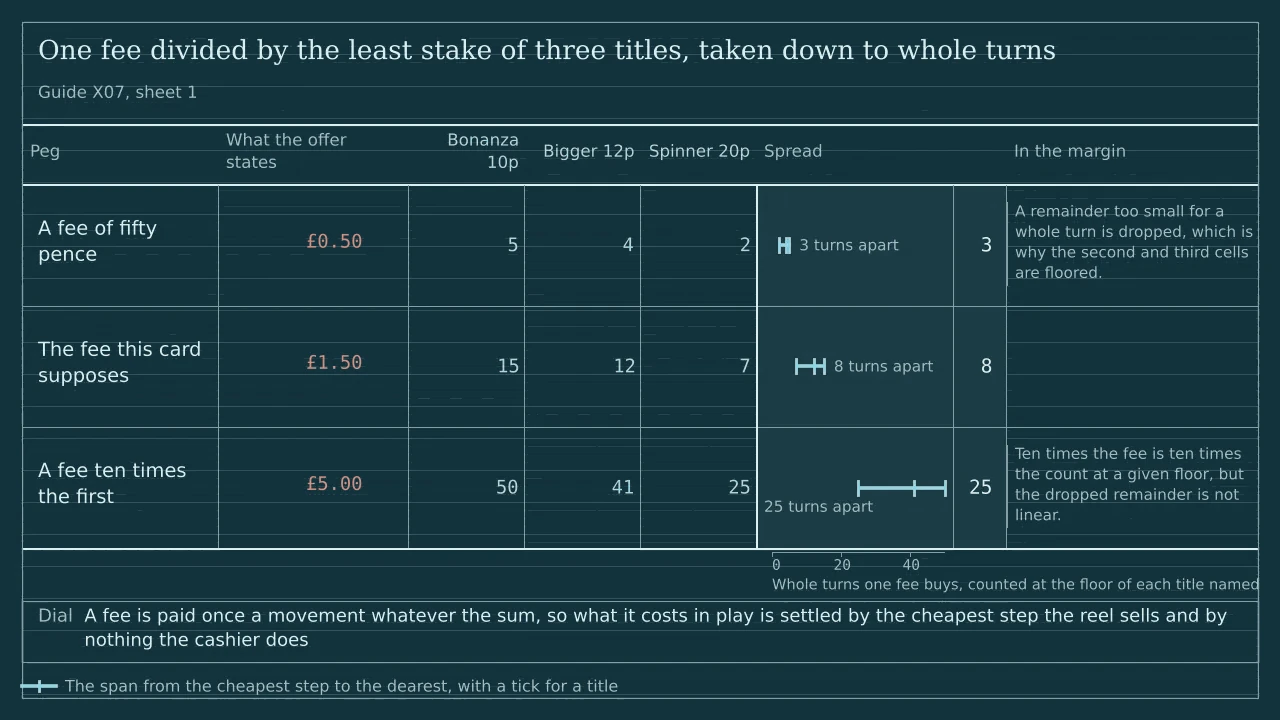
Take the far column on its own: the largest of the three fees still buys 25 turns where the cheapest step is twice the house figure, which is a minute and three seconds of play at the licensed floor. Read across the bottom row and the same fee is 50 turns at the step this page assumes elsewhere, which is two minutes and five seconds. The spread between the ends of that row is 25 turns, and 25 turns is the whole of what the family’s own price list does to a fee of that size.
Nothing in the drawing is a statement about how long anybody would play or about what any build runs at. The seconds come from the licensed floor under a cycle and are a statement about what the rules permit; the counts come from a division of a supposed fee by a published step. Both are ceilings dressed as spans, and a reader who treats either as a forecast has read them as the opposite of what they are.
Three tenths of a penny, which is all the return is worth here
Every other page in this section finds the published return doing most of the deciding. This one finds it doing almost none, and the reason is worth setting out because it is a property of fees rather than an accident of the figures chosen. The return acts on turnover. A fee does not cross the reel, so no return acts on it: it is taken once, in full, and the machine never sees it. The only place the return can touch this page at all is the small expected cost of the turns the fee bought, and that quantity is the fee divided by the break-even multiple, which is to say about a thirtieth of it.
Put numbers on that. Across the whole of the family’s published slot returns, from the 96.71 per cent of the original down to the 96.04 per cent printed for the lowest of them claims 75b and 75e, the expected cost of 15 turns at the house step moves from 4.9p to 5.9p. One penny. The supposed fee standing over those turns is £1.50 in every one of those cases, so choosing the best-returning reel in the family rather than the worst changes the total cost of a single movement by one part in a hundred and fifty.
That inverts the usual advice on this domain, and both halves of the inversion are worth holding at once. Where a sum is crossing the reel repeatedly, the published return is the quantity that decides what survives, and a page on this site will say so with the arithmetic beside it. Where a sum is taken before the reel is reached, the published return has no purchase on it whatever, and a reader optimising the reel to recover a fee is working on the wrong term. The reel decides what happens to money that is staked. A fee is money that is not.
There is one way a return reaches a fee, and it runs the other way round. Because the fee is 30.4 times the expected cost of the turns it buys on the original and 25.4 times on a reel at 96.07, the fee is relatively worse on the better reel. A higher return means a smaller edge, a smaller edge means cheaper turns, and cheaper turns mean the fixed fee stands taller over them. It is a real effect and it is small, and printing it is how a reader can tell the difference between a page that worked the arithmetic out and one that assumed the answer.
A fee paid again whenever the money moves again
A charge per movement is charged per movement, which sounds like a tautology until somebody counts the movements. Money that arrives and later leaves has moved twice. On the supposition this page has been spending, that is £3.00 and 30 turns at the house step, or a minute and fifteen seconds at the licensed floor under a cycle, and the expected cost of those 30 turns is 9.9p. The multiple from part three is unchanged at 30.4, since it survives any scaling of the fee, and the certain outlay has doubled while the play it corresponds to has done the same.
The useful consequence is about the size of the sum rather than the number of movements. A fixed charge taken twice is a fixed charge taken twice whether the sum travelling is £10.00 or £1,000.00, so the share of the sum it represents falls as the sum rises, and the share rises as the sum falls. Expressed in turns rather than in shares, the same fact reads more plainly still: the 30 turns are 30 turns in both cases, and what changes is how many other turns they are standing next to. A sum buying 100 turns loses 30 of them to two movements. A sum buying 10,000 loses the same 30.
| What the sum buys at the house step | Turns the two movements take | Turns left for the reel |
|---|---|---|
| 100 turns | 30 | 70 |
| 1,000 turns | 30 | 970 |
| 10,000 turns | 30 | 9,970 |
None of the three rows is a recommendation to move more money, and this publisher has no view on what anybody should put behind a cashier. The table is there because a per-movement charge is the one cost on this domain whose weight depends on something the reader decides and the machine does not, which makes it the opposite of everything else weighed on this site. The reel’s return, its ceiling, its trigger and its clock are the same quantities whoever is at the keyboard. A fee divided by the play it is spread over is not.
What refuses to convert, and where this page stops
Three quantities a reader might reasonably want converted into turns will not convert, and a page that quietly left them out would be worth less than one that names them. The first is how long a movement takes. A conversion from time into turns needs a rate, the licensed rate is a floor rather than a measurement, and nothing on either sheet states what any build outside that licence does with its clock. So the hours in a wait can be counted and the turns in them cannot, and this page declines the multiplication rather than supplying a rate for it.
The second is the fee itself over time. Part four said the size is settled elsewhere; the consequence is that a fee cannot be converted into turns once and left on the page, because the numerator is not the kind of quantity that holds still between one reading and the next. Everything printed here is therefore a conversion at one supposed value, with the method shown so that the division can be done again at another. That is a weaker thing than a priced tariff and it is the strongest thing available.
The third is the one a reader would most like. A fee is a certain cost and the reel’s edge is an average, and there is no published quantity on either sheet that puts a distribution round a sum of turns on this machine. The published ceiling is 2,100 times the stake and its published frequency 1 in 3,880,481 claims 27 and 29, and between them they describe the far tail and say nothing of the middle. No spread is printed on any of the maker’s game pages for this family, and the data a browser is handed has no field that could hold one, so the comparison between a certain £1.50 and an uncertain 4.9p stays qualitative on this page and is left there deliberately.
What is left standing is small and solid. One movement at the supposed fee is 15 turns of the original, 12 of a twelve-line title and 7 of a Megaways build. A fee of any size stands at 30.4 times what the play it pays for is expected to take on the original, which is the break-even multiple and comes out of the house edge alone. And the entire range of published returns in this family moves the cost of a single movement by three tenths of a penny, which is the one figure on this page that nobody would have guessed.
Questions readers ask
What does one transaction fee cost in turns of Big Bass Bonanza?
At 0.10 a turn, which the game’s data puts at the foot of its range, a fee supposed here at £1.50 is 15 whole turns, and this page supposes that fee rather than reading it anywhere. The count is the fee divided by the stake, so a reader with a different fee divides again: the figure that does not change is the stake, which the game publishes and nobody at a cashier sets.
Does a fee on this rail alter anything the slot publishes about itself?
Nothing at all. A fee is taken before anything is staked and never crosses the reel, so none of the machine’s published quantities moves: the return stays where the studio printed it, the published ceiling at 2,100 times the stake and its frequency at 1 in 3,880,481. What a fee changes is the count of turns a given sum buys, and a count of turns is not a property of the game.
Is a fee per movement cheaper on a reel with a higher published return?
It is relatively dearer, which is the opposite of what most readers expect. A higher return leaves a smaller edge, a smaller edge makes each turn cost less in expectation, and a fixed fee therefore stands taller over the play it buys: 30.4 times the expected cost of those turns at 96.71 per cent against 25.4 times at 96.07. In absolute money the difference across the family is three tenths of a penny on one movement.
Why does this page not say what a transaction actually costs?
Because no source this publisher may use carries one. The game sheet covers a studio and its thirty-six game pages and the rule sheet covers a regulator, and neither states a tariff for moving money by any route. Every fee printed here is this publisher’s own supposition, named as such in the sentence that spends it, and the arithmetic is linear in it so that a reader holding a real figure can redo the division.
How long is 15 turns of this slot?
37.5 seconds, where the build is licensed in Great Britain. A licence condition holds a game cycle open for 2.5 seconds before the next may start, so an hour will not hold more than 1,440 of them, and 15 is a little over half a minute at the quickest anybody is permitted to run them. Outside that licence the interval has no publisher and the conversion cannot be done at all.
Does the stake floor differ between Big Bass titles?
It does, and the game’s own data is the only place to read it, the studio’s own pages stating no stake range for any title. Of the thirty-five slots, 0.10 is the step on thirty-one, 0.12 on the two twelve-line titles and 0.20 on the two Megaways builds. One supposed fee of £1.50 is therefore 15 whole turns, 12 or 7 depending only on which title of one family is open.
What does paying a fee twice do to a hundred turns of play?
It takes 30 of them. Money that arrives and later leaves has moved twice, so at the supposed £1.50 a movement that is £3.00, which at the 10p this page spends is 30 turns and a minute and a quarter at the licensed floor. The same 30 turns come out of a thousand or of ten thousand, so the proportion falls as the sum rises while the count stays exactly where it was.
Which protections fall away where no Great Britain licence stands over the cashier?
The duties that reach the game itself: the floor holding a cycle open, a cycle capped at £5.00, or at £2.00 for a younger account, a prohibition on any build moving its own payouts or probabilities while it runs, and a wagering requirement held to ten times. Gamstop Online is a condition of the British licence, so where that licence is absent the scheme is absent with it, and its terms say plainly that it cannot help there.
Before you play
Read on
- Crypto casino
- Not one quantity the reel publishes is a sum of money, so a unit that moves leaves the price list exactly where it was.
- USDT casino
- A unit slipping by less than the distance between two titles of one family has cost a reader less than the name on the tile did.
- Best non Gamstop casinos
- Two licensed duties carry figures and both land on the game, capping an hour at £7,200.00 of turnover and £236.88 of expected cost.
- How a figure is weighed here
- Which figures are read off the machine, which off the offer, and which this publisher assumes.