Online casino UK: three parties on one screen, and the test that tells them apart
Everything a reader meets at a British casino arrives on the same screen in the same typeface, and nothing about the presentation says who decided it. Three parties did.
- Updated 13 November 2026
- Licence status shown for every offer
- Assumptions marked in the text
Offers at this end of the market, each weighed against the same reel
These offers are paid placements, so this site is owed a fee whenever a reader opens an account through one of the buttons below.
-

Tweedbet
Welcome pack 470%
- Licence
- Not stated, no Great Britain licence
- Play-through
- Not published
- Min deposit
- £20
Bonus up to£14,000 Free spins470Read the offer18+ only. Terms apply.
Licence, terms and working
The site does not say where it is licensed or which company runs it.
The reel
- Build of the reel
- Big Bass Bonanza
- Return it publishes
- 96.71 per cent
- Stake it accepts on one turn
- 10p to £250.00
The offer
- Turns advertised
- 470 turns Turns valued at the cheapest turn this reel sells, no worth for one being stated anywhere in the offer
- Price of one turn
- 10p the smallest stake the reel accepts, this operator publishing no figure of its own
- Credit as a sum
- £14,000.00
- Credit waiting on a payment
- Stated in words Casino Welcome Pack 470% up to £14,000 + 470 FS. Crypto Welcome Bonus 110% up to 1,300 USDT + 110 FS. VIP Welcome Pack 770% up to £13,000
- Advertised, priced
- £14,047.00 140,470 turns of this reel
Hung on it
- Play-through
- Not published
- Credited towards it
- 100 per cent nobody has published a share, so the whole of a stake is credited, which is the kindest reading available
- Ceiling on winnings
- Not published
- Qualifying payment
- £20.00 200 turns of this reel at the price above, and it enters no weight
Not weighed, for want of the play-through multiple as a number.
Stated in words means the condition is set down in words that cost something and give nothing to subtract. Not published means the operator sets the figure down nowhere.
-

EliteSpin
£5,000 + 500 FS
- Licence
- Costa Rica, no Great Britain licence
- Play-through
- 40×
- Min deposit
- £20
Bonus up to£5,000 Free spins500Read the offer18+ only. Terms apply.
Licence, terms and working
Licence held in Costa Rica, by PrimeTier Limited.
The reel
- Build of the reel
- Big Bass Bonanza
- Return it publishes
- 96.71 per cent
- Stake it accepts on one turn
- 10p to £250.00
The offer
- Turns advertised
- 500 turns Turns valued at the cheapest turn this reel sells, no worth for one being stated anywhere in the offer
- Price of one turn
- 10p the smallest stake the reel accepts, this operator publishing no figure of its own
- Credit as a sum
- £5,000.00
- Credit waiting on a payment
- Stated in words Welcome bonus €/£5,000 + 500 FS. Elite lootboxes unlock surprise rewards up to €/£20,000 or 500 FS. Summer Festival by BGaming: win €80,000
- Advertised, priced
- £5,050.00 50,500 turns of this reel
Hung on it
- Play-through
- 40 times the bonus and the winnings from the spins
- Credited towards it
- 100 per cent nobody has published a share, so the whole of a stake is credited, which is the kindest reading available
- Ceiling on winnings
- Stated in words Five times the bonus
- Qualifying payment
- £20.00 200 turns of this reel at the price above, and it enters no weight
Priced at 10p a turn, the banner comes to £5,050.00, of which £5,048.36 survives the spins. At the reel's published return of 96.71 per cent, a play-through of 40 times asks for £201,934.20 of staking and costs £6,643.64, more than there is to pay it with, so the offer weighs £0.00.
Stated in words means the condition is set down in words that cost something and give nothing to subtract.
-
WinBeast
€5,000 + 500 FS
- Licence
- Curaçao, no Great Britain licence
- Min deposit
- €20
- Free spins
- 500
Bonus up to€5,000 Play-through40×Read the offer18+ only. Terms apply.
Licence, terms and working
Licence held in Curaçao, by a company the site does not name.
The reel
- Build of the reel
- Big Bass Bonanza
- Return it publishes
- 96.71 per cent
- Stake it accepts on one turn
- 10c to €250.00
The offer
- Turns advertised
- 500 turns Turns valued at the cheapest turn this reel sells, no worth for one being stated anywhere in the offer
- Price of one turn
- 10c the smallest stake the reel accepts, this operator publishing no figure of its own
- Credit as a sum
- €5,000.00
- Credit waiting on a payment
- Stated in words Welcome pack €5,000 + 500 FS + €650 free bet. Fortune wheel on €40+ deposits with code FORTUNE. 40% up to €300 Beast Boost Monday with code BOOST1 on €20 deposit
- Advertised, priced
- €5,050.00 50,500 turns of this reel
Hung on it
- Play-through
- 40 times the bonus and the winnings from the spins
- Credited towards it
- 100 per cent nobody has published a share, so the whole of a stake is credited, which is the kindest reading available
- Ceiling on winnings
- Stated in words €100 a batch of spins
- Qualifying payment
- €20.00 200 turns of this reel at the price above, and it enters no weight
Priced at 10c a turn, the banner comes to €5,050.00, of which €5,048.36 survives the spins. At the reel's published return of 96.71 per cent, a play-through of 40 times asks for €201,934.20 of staking and costs €6,643.64, more than there is to pay it with, so the offer weighs €0.00.
Stated in words means the condition is set down in words that cost something and give nothing to subtract.
-

Betportal
300% + 150 FS
- Licence
- Anjouan, Comoros, no Great Britain licence
- Play-through
- 35×
- Min deposit
- €20
- Stake cap
- €5.00
Bonus up to€1,000 Free spins150Read the offer18+ only. Terms apply.
Licence, terms and working
Licence held in Anjouan, Comoros, by BetPortal Gaming Ltd and Excite Ultra Media Ltd, numbered ALSI-202601040-FI2.
The reel
- Build of the reel
- Big Bass Bonanza
- Return it publishes
- 96.71 per cent
- Stake it accepts on one turn
- 10c to €250.00
The offer
- Turns advertised
- 150 turns Turns valued at the cheapest turn this reel sells, no worth for one being stated anywhere in the offer
- Price of one turn
- 10c the smallest stake the reel accepts, this operator publishing no figure of its own
- Credit as a sum
- €1,000.00
- Credit waiting on a payment
- Stated in words Welcome package 300% up to €1,000 + 150 free spins. 1st deposit 150% up to €500 + 100 FS. 2nd deposit 100% up to €300 + 50 FS
- Advertised, priced
- €1,015.00 10,150 turns of this reel
Hung on it
- Play-through
- 35 times the bonus
- Credited towards it
- 100 per cent nobody has published a share, so the whole of a stake is credited, which is the kindest reading available
- Ceiling on winnings
- Stated in words Five times the bonus
- Largest stake while it runs
- €5.00 under the largest stake the reel accepts, so part of the machine's own range is shut off while the credit runs
- Qualifying payment
- €20.00 200 turns of this reel at the price above, and it enters no weight
Priced at 10c a turn, the banner comes to €1,015.00, of which €1,014.51 survives the spins. At the reel's published return of 96.71 per cent, a play-through of 35 times asks for €35,507.73 of staking and costs €1,168.20, more than there is to pay it with, so the offer weighs €0.00.
Stated in words means the condition is set down in words that cost something and give nothing to subtract.
-

Night Luck
805% + 280 FS
- Licence
- Not stated, no Great Britain licence
- Play-through
- Not published
- Min deposit
- €20
Bonus up to€6,400 Free spins280Read the offer18+ only. Terms apply.
Licence, terms and working
The site does not say where it is licensed or which company runs it.
The reel
- Build of the reel
- Big Bass Bonanza
- Return it publishes
- 96.71 per cent
- Stake it accepts on one turn
- 10c to €250.00
The offer
- Turns advertised
- 280 turns Turns valued at the cheapest turn this reel sells, no worth for one being stated anywhere in the offer
- Price of one turn
- 10c the smallest stake the reel accepts, this operator publishing no figure of its own
- Credit as a sum
- €6,400.00
- Credit waiting on a payment
- Stated in words Casino welcome bonus 805% up to €6,400 + 280 FS. Crypto welcome bonus 140% up to 1,600 USDT + 140 FS. VIP welcome pack 800% up to €14,500
- Advertised, priced
- €6,428.00 64,280 turns of this reel
Hung on it
- Play-through
- Not published
- Credited towards it
- 100 per cent nobody has published a share, so the whole of a stake is credited, which is the kindest reading available
- Ceiling on winnings
- Not published
- Qualifying payment
- €20.00 200 turns of this reel at the price above, and it enters no weight
Not weighed, for want of the play-through multiple as a number.
Stated in words means the condition is set down in words that cost something and give nothing to subtract. Not published means the operator sets the figure down nowhere.
What a Great Britain licence would add to these offers
A licence from the Gambling Commission for Great Britain carries rules that an offer licensed elsewhere does not have to follow, and some figures in this ranking would not survive them. Social responsibility code provision 5.1.1 stops a British licensee applying a wagering requirement of more than ten times the bonus funds, and that limit has applied since 19 January 2026. A play-through above ten times in this list is therefore one a British licence would not allow.
Regulation 5(2) of the Gambling Act 2005 (Operating Licence Conditions) (Amendment) Regulations 2025, made on 25 February 2025, limits what a player can stake on one game cycle of an online slot to £5, or £2 for a player under 25. It is a condition of a British remote casino licence and not a property of the game, so a player at an operator licensed elsewhere does not have it behind them.
Remote technical standard 14D asks for at least two and a half seconds from the start of one slot game cycle to the start of the next, with the player pressing start each time. It is addressed to the game and not to the money, so no figure in this ranking measures it.
GAMSTOP is the free scheme that closes your accounts with online gambling companies licensed in Great Britain, and every one of them must join it. An operator licensed elsewhere is not required to, so a GAMSTOP registration cannot be counted on to reach these offers. If gambling is costing more than money, the National Gambling Helpline is free and answers on 0808 8020 133 at any hour.
Ranking last changed 8 November 2026. Operator terms change without notice, so open the offer page and read the terms there before you register.
At a glance
The machine settled some of it, the wording of an offer settled some more, and the venue settled the rest, and only the first two appear anywhere in the line of arithmetic that decides how much money there is. This page sets out a test that takes any figure a reader is looking at and says which of the three it belongs to, runs the test on the figures a cashier actually puts in front of somebody, and prices the answer. A credit of £25.00 at eighteen times, weighed against a reel stating 96.71 per cent of itself, leaves £10.20, and every quantity in the venue’s column, moved as far as it will go, leaves that figure exactly where it is.
- What the machine states96.71 per centBig Bass Bonanza’s own proportion, printed by its maker and repeated in the data a session opens with, the two in agreement. It belongs to the first of the three parties and is the one figure here that no choice made by either of the others can shift.
- What the offer states£25.00 at 18 timesA face value with eighteen times itself to be turned over before a withdrawal, counting the named reel at full rate. Those belong to the second party, whoever drafted the wording, and they are figures about the offer rather than about any machine.
- What the two make when multiplied£10.20What the arithmetic leaves once £450.00 of turnover has gone across reels giving back that much, a turn bought at the 0.10 this page spends and names at each place it spends it. No figure belonging to the third party enters the calculation at any point.
On this page
- Three parties, one screen, and no label on any of it
- The test, which is one line of arithmetic long
- Running it on what a cashier actually shows
- Moving every venue figure as far as it will go
- Moving one machine figure by two thirds of a point
- The single place where two columns do touch
- Figures the test cannot sort, because nobody states them
- The same test, run the other way round
- Two things the test is no good for at all
- Adding the three columns up separately
Three parties, one screen, and no label on any of it
A lobby is a single surface. The proportion a reel gives back, the staking a credit demands, the hours a payout takes, the ceiling on a cycle, the limit a reader may set on themselves, the count of titles on the tile wall: all of it is set in the same face, at the same size, with the same confidence. Nothing in the presentation distinguishes a figure somebody is obliged to publish from a figure somebody has chosen to advertise, and nothing distinguishes either from a figure a third party supplied and neither of the first two can alter.
There are three parties behind that surface. A studio built the machine and publishes what it does. Somebody drafted the wording of an offer and publishes what it asks. And a venue runs the place, handles the money, and publishes a good deal about how it does so. Those are three separate authorships with three separate interests, and a reader who cannot tell them apart is reading a document with no byline on any paragraph.
The useful observation is not that the three exist. It is that they are not symmetrical. Two of the three contribute terms to the arithmetic that says how much money a reader is expected to be left with, and the third contributes nothing to it whatever. That asymmetry is not a matter of degree or of emphasis, and it is not an opinion about which party is more trustworthy. It is a fact about which letters appear in one line, and it can be checked by anybody in about a minute.
So this page does three things in order. It sets out a test that assigns any figure to one of the three parties. It runs the test on the figures a cashier actually puts in front of a reader, as a table. And it prices the result by moving each column as far as that column can move and watching what happens to the money. The answer is not that the third party is unimportant, which would be silly, and this page says plainly in part eight what the test is no good for. The answer is narrower than that, and more useful.
The test, which is one line of arithmetic long
Here is the whole instrument: E = B × (1 − W × (1 − RTP) ∕ g). B is the face the offer advertises and W the turnover it demands, both set by whoever wrote the terms; RTP is what the named machine gives back of everything crossing it; g is the rate the machine counts at, which these terms put at full. Four letters, and each one has an owner.
Take any figure a reader is looking at and ask two questions of it in order. Is it one of those four. If not, does it change one of those four. A figure answering yes to the first belongs to the machine or to the offer, and which of the two is obvious from the letter it fills. A figure answering yes only to the second is the interesting case and gets its own part below. A figure answering no to both belongs to the third party, and no amount of attention paid to it will alter what the arithmetic comes to.
Worth being clear about what this test is not. It says nothing about whether a figure is good, large, generous or honest. A payout clock of two days is a worse thing than a payout clock of two hours and the test has no opinion on that, because the test asks only who set the figure and whether the figure enters the close. A reader who has run it on a lobby knows the authorship of everything they are looking at and knows nothing yet about whether any of it is favourable. Those are two separate pieces of work, and doing the first badly is how the second goes wrong.
And worth saying why authorship is worth a page at all. The three parties publish on different terms. The machine’s figures are the same wherever the machine is running, which is why this site can hold them still and let everything else move. The offer’s figures change with every campaign. The venue’s figures describe the venue and change when the venue decides. A reader comparing two lobbies on a figure that belongs to the machine is comparing nothing at all, since the figure stands at the same place in each of them, and a reader comparing them on a venue’s own figure is comparing something real that does not reach the money. Both mistakes are common and the test catches both.
Running it on what a cashier actually shows
The table below takes the figures a reader meets on the way to committing money and runs each through the two questions. It is not an inventory of everything a venue prints about itself, which would be a longer and duller list. It is the set of quantities somebody is likely to compare two places on.
| The figure a reader meets | Which party set it | Does it enter the close |
|---|---|---|
| The proportion the reel gives back | the machine | yes, as RTP |
| The ceiling on one game cycle | the machine | no, but it bounds the largest outcome |
| The span of stakes on offer | the machine, then the venue | no, but it sets the count of turns |
| The face value advertised | the offer | yes, as B |
| The turnover demanded of it | the offer | yes, as W |
| The rate the named reel counts at | the offer | yes, as g |
| The hours a payout is said to take | the venue | no |
| Which rails the cashier carries | the venue | no |
| The number of titles on the wall | the venue | no |
| Whether the place works on a handset | the venue | no |
Two rows in that table deserve a sentence each, because they are the rows a careless reading gets wrong. The ceiling on a cycle is a figure of the machine’s and it is not in the close: expectation is an average and a ceiling is a limit on one tail of a distribution, so the two are different quantities and a ceiling moves the shape of an outcome without moving its mean. And the span of stakes has two owners, which is the subject of part six and the one place in this whole table where a venue’s decision reaches into a figure of the machine’s.
The rest of the table is as plain as it looks. Six rows belong to the machine or the offer and four belong to the venue, and nothing in the four touches B, W, RTP or g. That is not a criticism of the four. A reader waiting on a payout cares a great deal about the hours, and a reader without a particular rail cannot use the place at all. It is a statement about which figures decide the sum at the end, and the next two parts put money against it.
Moving every venue figure as far as it will go
The clean way to price a column is to move everything in it to its extreme and see what happens to the figure at the end. So take the venue’s four rows and push each one as hard as it can be pushed. Let the payout clock run from immediate to the longest a reader would tolerate. Let the rails run from one to every rail in circulation. Let the tile wall run from a handful of titles to a thousand. Let the handset work perfectly or not at all.
Now recompute. B is still £25.00, because none of those four touched the face value. W is still eighteen, because none of them touched the turnover demanded. RTP is still 96.71 per cent, because the proportion a reel gives back is the studio’s and arrives with the session rather than with the venue. And g is still full, because the rate a named slot counts at is a term of the offer. Every letter is where it was, so the close is where it was: £10.20, the same figure, after the most violent possible movement of an entire column.
The price of that column, measured this way, is £0.00. It is worth sitting with that for a moment, because it is a stronger result than it first sounds. This is not a claim that the venue’s figures are small. It is that they are of a different kind: they are not inputs to the arithmetic at all, so there is no size they could be. Asking how much a payout clock is worth in the close is like asking how heavy Tuesday is.
Which does not make the column useless, and the honest version of the finding has to say so. A payout clock decides when a reader gets money that the arithmetic has already settled the size of. A rail decides whether they can put money in at all. A handset decides the number of occasions on which they will. Those are real and a reader is right to care. What they are not is the thing that sets the number of pounds, and a reader who has spent an evening comparing payout clocks has spent an evening on a column that cannot move the figure they were comparing clocks in order to improve.
There is a second way of pricing the same column, and it arrives at the same place by a shorter road. Ask what it would take for one of those figures to reach the close. It would have to become a face value, or a turnover demand, or a rate at which a named reel counts, or the proportion the reel gives back. In other words it would have to stop being a figure about the venue and start being a figure about the offer or about the machine. The column is not outvoted in the arithmetic; it is not standing for election.
One further way to see it. Everything in the venue’s column is a fact about the reader’s experience of a place, and everything in the other two columns is a fact about a transaction. The transaction is where the money is decided; the experience is what it feels like while it is being decided. Both matter. Only one of them is arithmetic.
Moving one machine figure by two thirds of a point
Now the other side of the same experiment, and it needs far less violence. Leave the venue’s column alone entirely. Leave the wording alone: the same £25.00, the same eighteen times, the same full rate. Change one thing, which is the title the turnover crosses, and change it by the width of the family’s own published spread between slots.
One divided by the house edge gives break-even, and the house edge follows the tile, so break-even follows the tile too. Big Bass Bonanza at 96.71 per cent carries an edge of 3.29 points and reaches break-even at 30.40 times a credit. Big Bass Halloween, which the maker’s own page publishes at 96.04 per cent, carries 3.96 points and reaches it at 25.25. That title is worth a caveat in the same breath as its figure: 96.06 is what the game’s own data reports for that title rather than 96.04 off the sheet, claim 119, so two primary sources disagree by two hundredths of a point and this page prints both and settles neither. The row below uses the maker’s page figure and says so.
| The title weighed | Published return | Break-even play-through | The offer asks | What £25.00 is worth |
|---|---|---|---|---|
| Big Bass Bonanza | 96.71 per cent | 30.40 times | 18 times | £10.20 |
| Big Bass Halloween | 96.04 per cent | 25.25 times | 18 times | £7.18 |
| What the tile decides | 0.67 points of return | 5.15 times | no change | £3.02 |
Three pounds and two pence out of a face worth twenty-five, produced by two thirds of one percentage point and by nothing else at all. Set that against the nought the whole venue column came to and the shape of this page is complete. One decision nobody presents as a decision, taken on a tile wall where the figures are not printed, is worth about a third of everything the reader was going to keep. Four decisions a reader is invited to weigh carefully are worth nothing in that figure at all.
£3.02of a £25.00 credit turns on which tile the turnover crosses, and nought of it turns on anything the venue publishes about itself
The single place where two columns do touch
There is one row in the table with two owners, and leaving it unexamined would make the rest of this page too tidy to trust. The machine publishes a span of stakes: a whole cycle opens at 0.10 and tops out at 250.00 from the game’s own data at claim 25, and the bottom of that is what this page spends supposed here, named wherever spent. A licence then holds one cycle to five pounds, and to two where the holder of the account is not yet twenty-five. And a venue decides which part of what is left a reader can actually reach on the screen in front of them.
So three parties have a hand in one quantity, and the quantity matters because it is the divisor. Eighteen times a face of twenty-five pounds puts £450.00 across the reels. Divide that by the cheapest turn the machine sells, 0.10, which this page spends and names wherever it spends it, and 4,500 turns fall out. No licensed cycle may be opened again inside 2.5 seconds of itself RTS 14D, so an hour holds 1,440 turns and 4,500 of them occupy three hours and seven minutes at the very least.
Raise the stake and the same turnover is fewer turns and fewer minutes. Take it up to the five pounds a licensed cycle is kept inside and £450.00 of turnover becomes ninety turns and under four minutes. Same face value, same eighteen times, same reel, same close of £10.20, and a session that lasts either three hours or four minutes depending on a figure sitting in two parties’ gift. What 96.71 per cent fails to hand back comes to 3.29 points of everything turned over, so £450.00 carries an expected subtraction of £14.81 and £10.20 of a twenty-five pound face survives, whichever of those two sessions it was.
That is the honest exception to this page’s result, and it is narrower than it looks. A venue’s reach into the stake changes the number of turns, the number of minutes and the shape of what happens inside them. It does not change the close, because the close divides out: turnover is the face times the multiple whatever one turn costs. So even at the one point where the columns touch, the touching reaches duration and not money.
Figures the test cannot sort, because nobody states them
A test that assigned every figure to a party would be too good to be true, and this one is not. There is a set of quantities a reader will meet in conversation, in reviews and in their own head, which the test cannot place, for the plainest of reasons: no party publishes them, so there is no author to assign them to.
Nobody states a volatility anywhere in the family. The maker’s game pages do not print the word, and the data a session opens with carries no field that could hold such a figure. Characterisations circulate and they disagree with each other, one source calling the original high on a five-point scale, another calling it low, and a third contradicting itself inside one page off the sheet, claim 121. Each of those belongs to the reviewer who wrote it and to nobody else, and none of them is a figure of the machine’s.
Nor is there a base-game hit frequency, for any title, from any party. The game’s own data carries exactly one rate, and it is for the ceiling: one turn in 3,880,481 off the sheet, claim 29. The frequency with which the feature round begins is not published either, and the two figures that circulate for it are nowhere near one another off the sheet, claim 122.
What follows for this page is a rule rather than a complaint. A figure with no author cannot be sorted into a column, and a figure that cannot be sorted cannot be priced, and a page that priced one anyway would have invented the most important number on it. So those quantities appear here as gaps, named, with the claim that records the gap. A reader who wanted them is entitled to know that the wanting is not the problem: they are not being withheld by a venue, and a different venue would not have them either.
A consequence for anybody comparing two places. Dispersion is the quantity most readers actually have in mind when they ask which machine is kinder over an evening, and it is the quantity no party anywhere publishes, so two lobbies cannot be ranked on it however carefully either one is read. What can be ranked is what is published, which on the machine’s side is a proportion, a ceiling, a span of stakes, a trigger and one rate. A ranking built on those is thin and real. A ranking built on the other thing is thick and made up.
And one consequence worth carrying away. Because those quantities are unpublished, every statement a reader hears about how a machine behaves over an evening is somebody’s characterisation, while every statement about what it gives back over everything crossing it is a published figure with two sources behind it. Those two kinds of sentence sound identical and are not, and telling them apart is the same skill as telling the three parties apart.
The same test, run the other way round
Sorting figures is what the test does forwards. Run it the other way and it becomes a diagnosis, because it says where a difference between two places could possibly have come from. That turns out to be the more useful direction, and it is also the position a reader is in: nobody sits down to classify a lobby, and everybody sits down with two of them open.
Suppose a reader has two lobbies open and one of them seems to be worth more. There are two places that feeling can be coming from and no third place. Either the wording differs, which moves B or W or g, or the turnover is crossing a different title, which moves RTP. If the wording is word for word the same and the turnover is crossing the same title, the close is the same to the penny, and whatever is producing the impression sits in a column the arithmetic cannot reach.
Work both branches on the credit this page has been using. Two places running the original title on identical terms: £10.20 and £10.20, and a reader who prefers one of them is preferring something true about the experience and nothing about the sum. Two places on identical terms where one tile is the original and the other is Big Bass Halloween: £10.20 and £7.18, and the thing that produced the gap is printed on neither lobby, because a tile wall carries names and pictures rather than proportions.
Now the branch that matters most, which is the wording. A multiple is the only letter in the line with no ceiling on it, so the distance two wordings can open up between them is bounded by nothing but the face value. At eighteen times the face keeps £10.20; at twenty-six times it keeps £3.62; and at thirty times, on the lower of the two tiles, the arithmetic has already gone under nought. A gap of that size dwarfs two thirds of a point, so a multiple is what a reader reads first rather than last.
So the order of attention runs multiple first, tile second, and then everything else, which is not a close third so much as a different kind of question. And the backwards test has a tidy property worth stating: it never produces a false negative about the venue. If two places genuinely differ in the close, the difference is in one of the first two columns, always, and a reader who has checked both and found them equal can stop looking for an explanation in the third.
Two things the test is no good for at all
First, it is silent on quality. Sorting a figure into the machine’s column says nothing about whether the figure is a good one, and 96.04 per cent and 96.71 per cent sit in the same column while being three pounds apart on a twenty-five pound face. A reader who finishes the sorting and stops has learned the authorship of a lobby and not one thing about whether to use it. The sorting is the first half of a job and this page is only the first half.
Second, and more easily missed, it can be run on a figure that is not true. The test asks who set a figure and whether it enters the close. It does not ask whether the figure is accurate, and nothing about a figure sitting in the machine’s column makes it so. What makes the machine’s column checkable is something else entirely: those figures are published in two places that can be opened and compared, and where the two disagree the disagreement is recorded rather than averaged away, as the two readings for Big Bass Halloween show. That is a property of how the figures are published, not of which column they sit in.
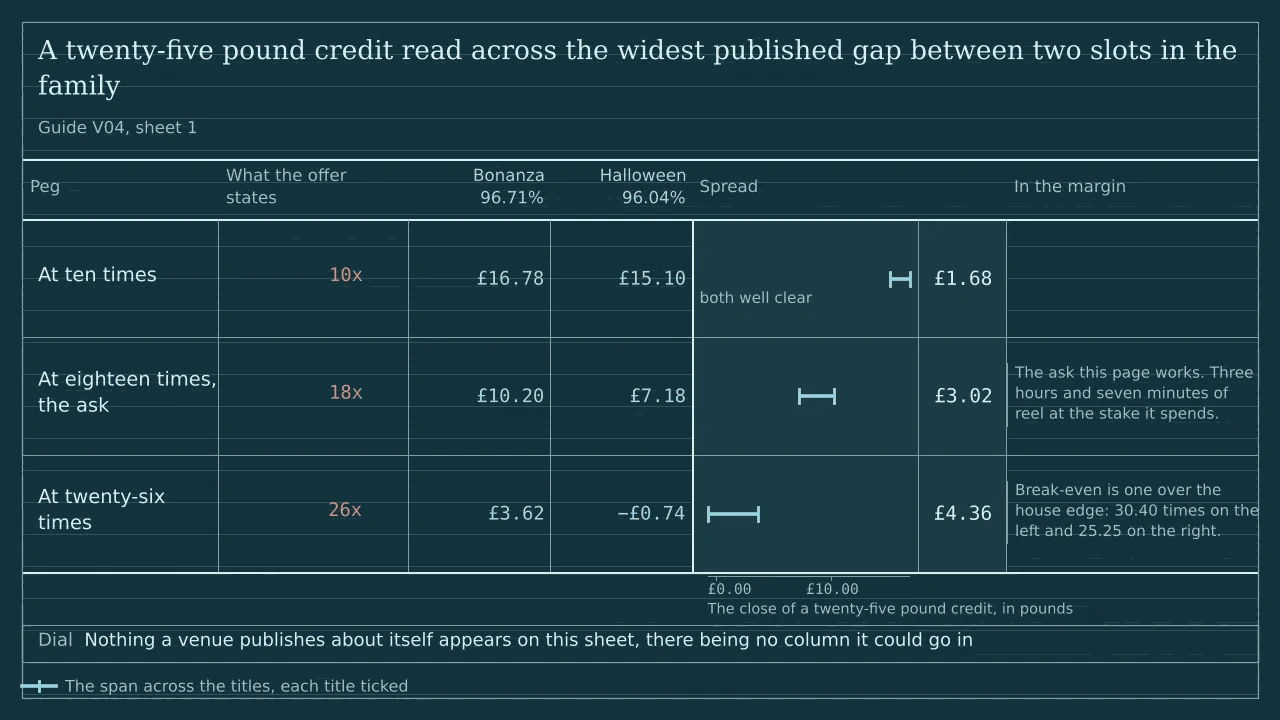
The drawing is the experiment of parts four and five in one frame. Across the head sit two authors’ figures and down the side sits a third quantity the wording supplies, and the strip beyond the heavy rule records the distance between the two readings at each demand: £1.68 where the turnover asked is lightest, £3.02 at the eighteen times this page works, and £4.36 by twenty-six times, where one reading has already gone under nought. Nowhere on that sheet is there a column for the venue, and that absence is the finding rather than an oversight.
Adding the three columns up separately
The machine’s column, on this credit: 96.71 per cent of everything crossing the reels, a ceiling of 2,100 times a stake, a span of turns opening at 0.10, a cycle that may not restart inside 2.5 seconds, and one published rate, for the ceiling alone. Those decide that £450.00 of turnover carries an expected subtraction of £14.81 and that £10.20 of the face is expected to survive.
The offer’s column: a face of £25.00 and a demand of eighteen times it, with the named reel counting at full rate. Those decide the £450.00. Halve the multiple and the subtraction halves with it, a relation worth more than anything else in the wording and almost never printed in a headline.
The venue’s column: £0.00, measured by moving every figure in it as far as it will go and finding the close unchanged. The column decides when, where, how often and on what device, and none of those is a term in the line. The one exception is the stake it makes reachable, which changes three hours and seven minutes into four minutes and leaves £10.20 exactly where it was.
Three totals, and they are not three answers to one question. They are answers to three questions that a lobby presents as one. How much is this expected to leave me, which the first two columns settle between them. How long will it take and how will it feel, which the third settles on its own. And how much of what I have just read is checkable, which is settled by where each figure was published rather than by what it says.
A reader who keeps those three apart has the whole of this page. The arithmetic belongs to the machine and the wording; the experience belongs to the venue; and the checkability belongs to whichever source will open in front of somebody who goes and looks. Nothing here says the third column does not matter. It says the third column is not where the £3.02 came from.
So £3.02 is the honest total for this key, and it comes out of the column nobody invites a reader to compare: one credit, one wording, one venue, two tiles on the same wall, and three pounds and two pence between them. A reader who runs the test on a lobby and then spends their attention where the test says the money is has done, in a minute, the thing an evening of comparing cashiers cannot do.
Questions readers ask
How can a reader tell which party set a figure
Ask whether the figure is one of the four letters in the expected-close line, and if not, whether it changes one of them. A figure answering no to both was set by the venue and cannot move the sum at the end.
Does a faster payout leave a reader with more money
Not a penny more. The hours belong to the venue and appear nowhere in the calculation, so a credit of £25.00 at eighteen times leaves £10.20 against a reel stating 96.71 per cent whether the money arrives the same day or the following week.
Why does the ceiling on a game cycle sit in the machine’s column but not in the close
Because expectation is an average and a ceiling bounds one tail of a distribution. The two are different quantities, so a ceiling changes the shape of what can happen without changing what is expected to happen.
Where do a venue and a machine both have a hand in one figure
In the stake. A whole cycle opens at 0.10 in the game’s own data and tops out at 250.00, a licence keeps it to five pounds, or two under twenty-five, and the venue settles how much of that a reader can reach. It moves the count of turns and leaves the close alone.
What is the widest a single title can move the money here
£3.02 on a £25.00 credit at eighteen times, between 96.71 per cent and the 96.04 per cent the maker’s page gives Big Bass Halloween. The game’s own data puts that second title at 96.06, so two primary sources differ by two hundredths and both are printed.
How long does £450.00 of turnover take
At the 0.10 a turn this page spends it is 4,500 turns, and no licensed cycle may be opened again inside 2.5 seconds of itself, so no hour holds more than 1,440 turns. The shortest it can run is three hours and seven minutes.
Why is there no volatility figure in any column
Because no party publishes one, for any title at all. The maker’s game pages do not print the word and the data a session opens with has no field that could hold such a figure, so the characterisations in circulation belong to whoever wrote them.
Does an offer weighed on this page hold a Great Britain licence
Not one. The duties going missing alongside that licence can be read off the figures above rather than taken on anybody’s word.
Before you play
Read on
- Online bingo
- The one product where a venue reaches the pace, and the two rules that give a reel its clock and its ceiling do not name it.
- Visa casino
- The only self-announcing event at a cashier, and the only figure on the domain that names no publisher at all.
- Mobile casinos
- A handset moves the number of occasions and the taps to a term, and moves nothing whatever about the machine.
- Who weighs this
- How much of the domain stands on a numbered claim a reader can open, and how much on this publisher’s word.