Figures read 20 October 2026 Card M08, weigh-in 1
Free slots no deposit: one of those two words is doing no work at all
There are two separate things behind that phrase and only one of them is free in the sense a reader would recognise. A demonstration build takes no money in and pays none out, and its expected close is therefore exactly £0.00 whatever is asked of it, and that is precisely what makes it evidence rather than an offer. A credit handed over without a deposit is the other thing, and it can be priced: at thirty times, a £10.00 credit against a published return of 96.71 per cent is expected to close at £0.13, and that is four tenths of a multiple away from closing at nothing.
What the machine states 96.71 per cent Read twice over: on the maker’s published page for this title, and out of the data its server hands the game as a session opens. The two agree to the second decimal, which is true of no other figure about this reel. What the offer states £10.00 at 30 times A credit of ten pounds with £300.00 of staking asked before anything can be withdrawn. Both numbers are this card’s own supposition, chosen because they are the shape of thing weighed on this domain and because thirty sits near the edge of what the reel can carry. What the two make when multiplied £0.13 Thirteen pence expected out of a ten pound credit, because 3.29 points of £300.00 is £9.87. The demonstration build beside it has no such figure, since nothing was staked on it in the first place.
Offers of this shape, weighed against the figures a demonstration build gives up
The destinations below are paid placements. Registering through one of them earns this publisher a fee, and the scale is not told which destination is which: a figure on the card would read identically either way.
-
01The Weigh-In
Betportal
Three deposits, 35x
What the reel states96.71 per centBig Bass BonanzaWhat the offer advertises€15.00150 turns at 10cWhat the two make€0.00No turns of this reelThe reel
Build of the reelBig Bass BonanzaReturn it publishes96.71 per centStake it accepts on one turn10c to €250.00The offer
Turns advertised150 turnsTurns valued at the cheapest turn this reel sells, no worth for one being stated anywhere in the offerPrice of one turn10cthe smallest stake the reel accepts, this operator publishing no figure of its ownCredit as a sumunpublishedCredit waiting on a paymentstated300% over three deposits, up to €1,000Advertised, priced€15.00150 turns of this reelHung on it
Play-through35 timesthe bonusCredited towards it100 per centnobody has published a share, so the whole of a stake is credited, which is the kindest reading availableCeiling on winningsstatedFive times the bonusLargest stake while it runs€5.00under the largest stake the reel accepts, so part of the machine's own range is shut off while the credit runsQualifying payment€20.00200 turns of this reel at the price above, and it enters no weightThe dial, read at every return this reel is published at Return Breaks even at Staking asked Costs Weight In turns 96.71 per centpriced out 30.4 times 5,077 turns −16.70 €0.00 No turns No Great Britain licence
Licence held in Anjouan, Comoros, by BetPortal Gaming Ltd and Excite Ultra Media Ltd, numbered ALSI-202601040-FI2.
Open the offer at Betportal, opens in a window of its own -
02The Weigh-In
WinBeast
Five deposits and a free bet
What the reel states96.71 per centBig Bass BonanzaWhat the offer advertises€50.00500 turns at 10cWhat the two make€0.00No turns of this reelThe reel
Build of the reelBig Bass BonanzaReturn it publishes96.71 per centStake it accepts on one turn10c to €250.00The offer
Turns advertised500 turnsTurns valued at the cheapest turn this reel sells, no worth for one being stated anywhere in the offerPrice of one turn10cthe smallest stake the reel accepts, this operator publishing no figure of its ownCredit as a sumunpublishedCredit waiting on a paymentstatedFive matched deposits of 50% to 100%, each up to €1,000, with a €650 free betAdvertised, priced€50.00500 turns of this reelHung on it
Play-through40 timesthe bonus and the winnings from the spinsCredited towards it100 per centnobody has published a share, so the whole of a stake is credited, which is the kindest reading availableCeiling on winningsstated€100 a batch of spinsQualifying payment€20.00200 turns of this reel at the price above, and it enters no weightThe dial, read at every return this reel is published at Return Breaks even at Staking asked Costs Weight In turns 96.71 per centpriced out 30.4 times 19,342 turns −63.64 €0.00 No turns No Great Britain licence
Licence held in Curaçao, by a company the site does not name.
Open the offer at WinBeast, opens in a window of its own -
03The Weigh-In
EliteSpin
Five deposits, 40x
What the reel states96.71 per centBig Bass BonanzaWhat the offer advertises£50.00500 turns at 10pWhat the two make£0.00No turns of this reelThe reel
Build of the reelBig Bass BonanzaReturn it publishes96.71 per centStake it accepts on one turn10p to £250.00The offer
Turns advertised500 turnsTurns valued at the cheapest turn this reel sells, no worth for one being stated anywhere in the offerPrice of one turn10pthe smallest stake the reel accepts, this operator publishing no figure of its ownCredit as a sumunpublishedCredit waiting on a paymentstatedFive matched deposits of 50% to 100%, each up to £1,000Advertised, priced£50.00500 turns of this reelHung on it
Play-through40 timesthe bonus and the winnings from the spinsCredited towards it100 per centnobody has published a share, so the whole of a stake is credited, which is the kindest reading availableCeiling on winningsstatedFive times the bonusQualifying payment£20.00200 turns of this reel at the price above, and it enters no weightThe dial, read at every return this reel is published at Return Breaks even at Staking asked Costs Weight In turns 96.71 per centpriced out 30.4 times 19,342 turns −63.64 £0.00 No turns No Great Britain licence
Licence held in Costa Rica, by PrimeTier Limited.
Open the offer at EliteSpin, opens in a window of its own -
04The Weigh-In
Crown Jewelz
200% on the first
What the reel statesNO RETURN RECORDEDBig Bass BonanzaWhat the offer advertises£15.00150 turns at 10pWhat the two makeNOT WEIGHEDNot weighed, for want of the play-through multiple as a number.The reel
Build of the reelBig Bass BonanzaReturn it publishes96.71 per centStake it accepts on one turn10p to £250.00The offer
Turns advertised150 turnsTurns valued at the cheapest turn this reel sells, no worth for one being stated anywhere in the offerPrice of one turn10pthe smallest stake the reel accepts, this operator publishing no figure of its ownCredit as a sumunpublishedCredit waiting on a paymentstated200% up to £1,000 with 50 cash spins, then 150% twice with 50 cash spins eachAdvertised, priced£15.00150 turns of this reelHung on it
Play-throughunpublishedCredited towards it100 per centnobody has published a share, so the whole of a stake is credited, which is the kindest reading availableCeiling on winningsunpublishedQualifying payment£20.00200 turns of this reel at the price above, and it enters no weightNo Great Britain licence
Licence held in Curaçao, number not verified, by a company the site does not name.
Open the offer at Crown Jewelz, opens in a window of its own
Of everything in a row, the weight alone was worked out here; the rest was copied. It comes off E = B × (1 − W × (1 − RTP) ∕ g), in which W is the play-through, g the portion of a stake this reel is credited with towards it, RTP the figure the machine publishes about itself, and B the credit still standing when the condition arrives. A batch of turns gives part of itself up before that moment, each turn having staked its own value and taken the machine's return on it, while credit handed over as a sum gives up nothing yet, nothing having been staked with it. Beyond the break-even multiple the condition costs more than it has to work on, and the dial rests at nothing rather than swinging below the pin: a condition cannot take out more than arrived.
No return is kept in this software. Each one is copied off one named machine, build by build, which is why a row may carry several and why the break-even multiple is different from row to row. That multiple is the credited portion of a stake divided by the machine's house edge, so crediting the whole stake on a build published at 96 per cent puts break-even at twenty-five times, and nothing asked for above twenty-five times survives being cleared. A creel holding several settings is read at all of them and the distance between the ends is printed, because the build an operator chose to run is published nowhere a reader can get at.
Turns are not money until a turn has a price. An operator stating what one of its own turns is worth supplies it, and the row credits the operator with having said so. Otherwise the cheapest turn this reel sells supplies it, which is a figure off the machine and not an estimate, no cheaper turn being on sale, and again the row names its source. Everything below that line moves when the price moves. On a row advertising turns and no credit, halve the price and the weight halves while the count of turns the weight buys does not budge, which is as plainly as it can be shown that a count of turns and a quantity of money are different things.
A qualifying payment belongs to the reader. The card prices it in turns, that being the useful thing to know, and no weight is allowed near it. Where a figure has no business existing, one of three words stands instead. Stated marks a condition set down in words, costing something, offering nothing to subtract. Unpublished marks a condition set down nowhere whatever. Unpriced marks a count of turns that is published plainly enough while nothing anywhere says what one of them is worth. None of the three conceals an estimate, and no operator is credited on this card with a figure it never gave.
Two columns of this card are pinned by rules that a Great Britain licence writes and a licence from elsewhere does not. The play-through column: Social Responsibility Code 5.1.1 bars a licence holder from asking more than ten times the bonus funds, so any multiple above ten times on this card is one a British licence would never have let through. The stake column: regulation 5(2) of the Gambling Act 2005 (Operating Licence Conditions) (Amendment) Regulations 2025, made on 25 February 2025, caps the total an individual may stake on any one game cycle at £5, and at £2 for anybody under 25. That cap is attached to a remote casino operating licence and not to the machine, which means a reader who steps outside the licence meets the reel's own stake range with nothing on top of it. Remote technical standard 14D requires a minimum of two and a half seconds from the time a game is started until the next game cycle can be commenced. That one is addressed to the machine rather than to the money, and no column here reports it. Gamstop Online reaches exactly as far as the British licence reaches, that being the condition the scheme was built on, so an offer licensed outside it stands outside the scheme by construction and a registration made with the scheme does not reach as far as this offer. The National Gambling Helpline answers on 0808 8020 133, 24 hours a day, every day of the year.
Conditions quoted in a row are quoted in the wording of the operator that published them, and each row carries the date it was checked. The earliest date on this card is 27 October 2026. A reader is bound by an operator's own terms in full, never by a line of this card.
1
Two different free things, and the one that is free in a different sense
The phrase at the top of this card covers two arrangements that have almost nothing in common except the word. The first is a demonstration build: the reel runs, a balance moves up and down, and no money enters or leaves at any point. The second is a credit of real money handed over without a deposit, carrying a condition that has to be worked through before a penny of it can be withdrawn.
The difference between them is not one of degree. On the demonstration nothing exists for a published return to act upon, so the expected close is £0.00 and stays £0.00 however long anybody sits there and whatever multiple a notional condition might ask. On the credit the published return acts on every pound of staking the condition requires, and the result is a figure this card can print: £0.13 out of £10.00 at thirty times, with the published return standing at 96.71.
So the useful finding is a division rather than a number. One of these two things is evidence, and a rather good piece of it, because everything this publisher knows about the machine was read off a demonstration server. The other is an offer, and it is weighed the same way every offer on this domain is weighed. Treating the second as though the first proved something about it is the mistake this card exists to head off.
One caution before any of it. A demonstration build is a reading instrument and it is also the front end of a sales process, since the maker puts it on its own game page and a lobby puts it in front of a cashier. Nothing here recommends sitting in front of either, and the arithmetic below runs against the player on both sides of the line, by the margin the game sheet prints and by no other. Where an offer of this kind is advertised, the cashier advertising it is trading outside any British licence, and this card prices what is published rather than vouching for anybody.
2
Where every machine figure on this domain came from, and how to go and get it again
This part is method, and it is here because a reader is entitled to check anything on this site rather than take it on trust. Every figure on this domain that cites the game’s own data as its source came out of a single request, and the request can be repeated by anybody.
The maker’s page for a title embeds its free-play demonstration in a frame whose address names the game’s internal symbol, which for the original of this family is a symbol beginning vs10bbbonanza. Opening that address redirects to the game client and issues a session key. Posting an initialisation request with that key and the symbol to the maker’s own game service returns the configuration its server sends the client for that session, and that response is the source behind every machine figure this publisher prints.
What arrives is not a summary. The response carries the return to player, the count of lines, the count of rows, the reel strips themselves, the paytable, the mapping from scatters to free turns, the selectable stake steps and a maximum win for one round. The information screen a player can open inside the game is drawn from the same data. That is why this publisher ranks it above any review: a review reports what somebody understood, and this is the arithmetic the game was handed.
Two honest limits travel with the method and both are recorded. The session used to read the family was opened in pounds, while the original’s own first reading was taken in dollars, and the stake steps came back identical either way. And those steps belong to the demonstration service. They are the game’s own numbers and they are not a statement that any cashier anywhere offers that range, which is a distinction part eight returns to.
3
A build that stakes nothing has an expected close of exactly nothing
The house formula on this site takes a credit, applies the staking a condition demands, and charges the reel’s own share of it: E = B × (1 − W × (1 − RTP) ∕ g). B on a demonstration build is £0.00, because nothing was ever handed over. Multiply a bracket of any size by nought and nought is what comes back, so a demonstration is expected to close at £0.00 at ten times, at thirty times, at six hundred times, and at no times at all.
Hold that for a moment, because it is the one place on this domain where the published return can do nothing whatever. Everywhere else 96.71 per cent is the quantity that decides the outcome. Here it decides nothing, and it decides nothing for the plainest possible reason: a percentage of nothing is nothing, whichever percentage it is.
£0.00 expected from a demonstration build at every multiple there is, because 96.71 per cent of nothing staked is nothing lost and nothing won
One consequence follows, and it is the one most often missed. A demonstration cannot pay, so a large balance on one is a reading and not a return. If the counter climbs to two thousand times what the demonstration called a stake, what has been observed is the paytable behaving as the paytable says it will. Nothing has been won, because nothing was at risk, and the same sequence on a paid build would have cost whatever the stakes behind it cost.
The symmetry holds the other way too, and this is the part that makes a demonstration genuinely useful rather than merely harmless. A run of nothing on a free build has cost nothing as well. A reader curious about the look of the feature round, about how often the money symbols fall, or about what the grid does with four wilds can settle all of it for £0.00, and the only figure that changes if they go on to stake money is the one in the third column of the board above.
4
The other free thing, priced on two titles
Now the credit, which is the half of the phrase that costs something. Take £10.00 with thirty times of staking asked of it. That is £300.00 put across the reel. What the reel takes is a hundred less the figure it publishes, so 3.29 points of £300.00 is £9.87. The credit closes at £0.13.
Thirteen pence is a strange sort of answer and the strangeness is the finding. It is neither a loss nor a gift, but one and three tenths of a per cent of the credit, which is what is left of a ten pound note after a condition has taken the rest of it. B is this card’s £10.00 and W its thirty times, and with g at one, which is the weighting wherever a slot counts in full, the formula lands four tenths of a multiple short of handing back nothing whatever.
| The title weighed | Published return | Break-even play-through | The offer asks | What £10.00 is worth |
|---|---|---|---|---|
| Big Bass Bonanza | 96.71 per cent | 30.40 times | 30 times | £0.13 |
| Bigger Bass Blizzard – Christmas Catch | 96.08 per cent | 25.51 times | 30 times | −£1.76 |
| What the title decides here | 0.63 points of return | 4.89 times | no change | £1.89 |
The lower row is the point of the table. The same credit, the same condition, a different title of the same family, and the answer has crossed from thirteen pence to one pound and seventy-six pence owed. Its break-even sits at 25.51 times, so thirty times is already five multiples past the point where the credit stops surviving its own conditions. The title decided £1.89 on a £10.00 credit, which is nineteen per cent of the face value, on 0.63 points of published return.
The lower row is not merely a smaller number either, and the family table says so. That title runs five reels by four rows where the original runs three, it pays on twelve lines where the original pays on ten, its least stake is two pence higher at 0.12, and the biggest round it can pay is 4,000 times the stake against the original’s 2,100. None of that enters the arithmetic above, because a credit priced in money is indifferent to how many rows a grid has. It is here because a reader comparing two rows of one table deserves to know that the two machines differ in four published ways besides the one the table prices.
Both rows are supposition on the offer’s side and published on the machine’s side. The two returns are the maker’s own, taken from the family table behind this site; the credit and the multiple are mine. Nothing here says that any cashier asks thirty times, and a British licence has not permitted that figure since January 2026, when a ceiling of ten times came into force. Thirty is used because it is the shape of thing this domain weighs, and because it lands near the edge of what this reel can carry.
5
The pence that give the published figure straight back to you
There is a small piece of arithmetic in this card that is worth isolating, because it turns the published return into something a reader can hold.
Take the same £10.00 credit and ask ten times of it instead, which is the ceiling a British licence now sets. That is £100.00 of staking and 3.29 points of £100.00 is £3.29, so the credit closes at £6.71. On the other title in the table it closes at £6.08. Set those two beside each title’s published figure, 96.71 per cent and 96.08, and the digits are the same digits.
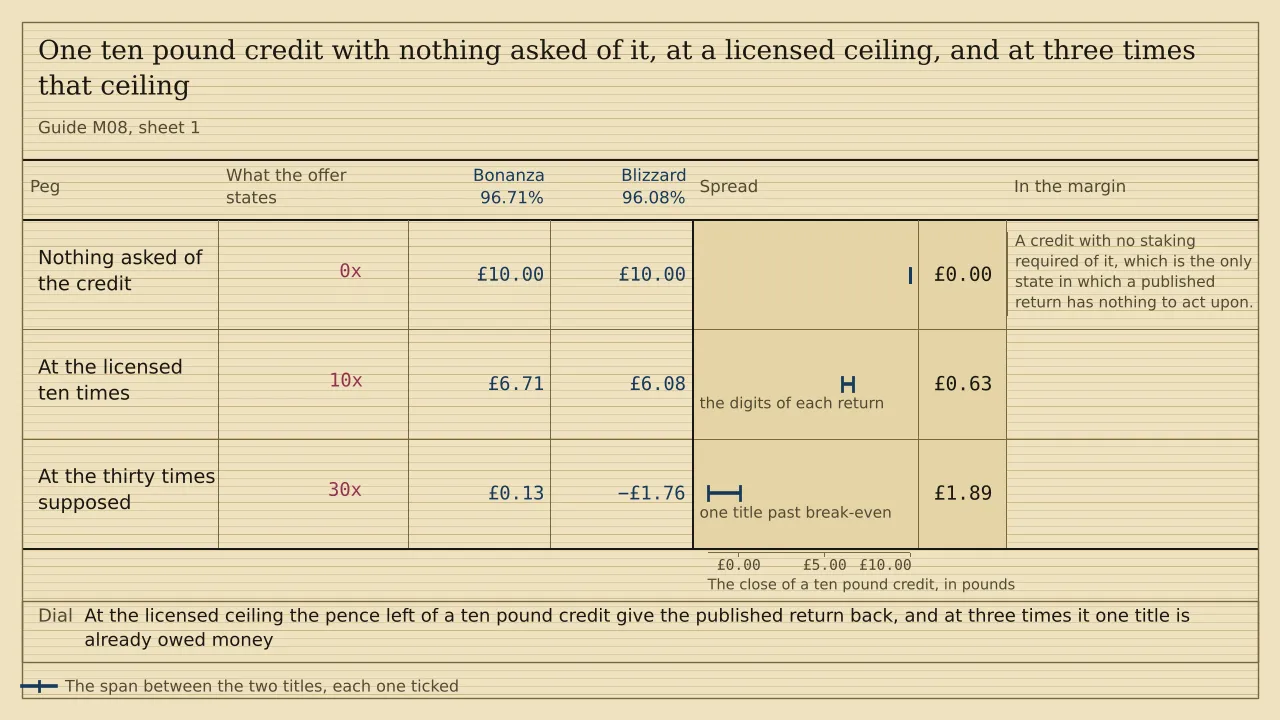
It is a coincidence of scale rather than a law of anything: a credit of ten pounds at ten times gives a hundred pounds of staking, and a hundred pounds is the base the percentage is quoted on. It is still worth keeping, because it makes the house edge concrete. The 3.29 points nobody can picture turns out to be the £3.29 that leaves a £10.00 credit when a licensed ceiling is applied to it, and the whole of the published return turns out to be the pence that survive.
It also shows how little room there is. Those same 3.29 points, asked three times over at thirty, take £9.87 of the £10.00. A licensed ceiling leaves two thirds of the credit standing. Three times that ceiling leaves one and three tenths of a per cent of it.
6
Whether the demonstration and the paid build are one machine
This is the question the ground for this card puts at its centre, and the honest answer has three parts: what was read, what the reading establishes, and what it does not.
What was read is on the record above. The return to player is not baked into the assets a browser downloads: it arrives as a field in the initialisation response, which the maker’s own server sends as each session begins. For the title weighed here that field came back as 96.71 on every reading, and it came back as 96.71 when sessions were opened against the same server with seven different values of the jurisdiction parameter the launch address accepts. Six of the seven resolved to a United Kingdom identifier inside the game client and the seventh resolved to its own number, and all seven returned the same figure.
What that establishes is narrow and precise. On the maker’s demonstration service, for this title, one figure came back every time it was asked for, including when the question was dressed up as coming from somewhere else. It is also the figure printed on the maker’s public page for the title, so two independent documents agree.
What it does not establish is anything whatever about a build somebody has paid to play. A field that arrives afresh each time sits equally well with a single value that never moves and with one picked for each deployment, and how a figure travels is no evidence about who picked it. The reading reaches that far and this card goes no further. The wider question of what this whole section can and cannot establish about the figures a family of games ships with belongs to the section’s own head page, which is where the argument is made and where the sources for it are weighed.
7
Who would have to tell you, which is where the finding is
If the two builds were ever to differ, the question that matters to a reader is not whether somebody somewhere knows. It is who would be obliged to say. This publisher went looking for that duty in the regulatory sheet behind this network, and what came back is the finding this card was written for.
There is no such duty. The British standard covering a game’s rules and the chance of winning sets out four things, and it joins them with the word or, which means a licensee has discharged it by publishing a house edge, or by giving the chance of a winning event, with no percentage anywhere. For certain other kinds of game the guidance goes further still and accepts an account of the game’s workings and of how a winner is settled. That disjunction is misread across this trade, so it is worth stating flatly: no licensed site is required to publish a return to player figure at all.
If nothing requires the figure, nothing can require a statement about which version of the figure is running. There is no provision anywhere on the sheet behind this network about disclosing a configuration, a version, or a choice among them, and where no source exists this publisher adds none. The absence is the finding, and it is the answer to the question in the heading: nobody would have to tell you.
There is one thing the demonstration does about all that, and it is the best argument for reading a free build rather than a review. Because the response can be read, the maker’s published page can be checked against the maker’s own software, title by title. Across the thirty-five slots read, the two agreed exactly on thirty-three. On two of them they did not: one Megaways title is published at 96.70 and reports 96.72, and one Halloween title is published at 96.04 and reports 96.06. On the £300.00 of staking this card supposes, two hundredths of a point is £0.06, which is what a conflict between a maker’s own two documents is worth in money, and nobody would know of either conflict without a free build to read.
8
Four things a demonstration cannot settle, listed so nobody leans on it for them
A free build is the best source this publisher has about the machine. It is a poor source about almost everything else, and the four limits below are worth having explicitly, because each one is a place where a reader could reasonably assume it had told them something it has not.
The first is the stake. The range this publisher read runs from 0.10 to 250.00 on the original of the family and from 0.12 to 240.00 on the other title in the table above, whose twelve lines put its least stake two pence higher. Those are the demonstration service’s steps. What a reader can actually stake in a particular lobby is a fact about that lobby, and a licensed British one could not offer the top of either range at all, because a cycle there is capped at £5.00.
The second is the condition. A demonstration has no terms, so it says nothing about what multiple a cashier asks, what a game is weighted at while the multiple is being worked off, what the maximum withdrawal is, or how long any of it is open. Those belong to whatever document the offer is published in, and this domain’s whole method is to read them from there and weigh them against the machine.
The third is presence. A title running in a demonstration frame on the maker’s page is no evidence at all that any particular lobby carries it, and the maker’s own licence on the public register, which authorises it to supply software, settles nothing about who has licensed that software or on what terms.
The fourth is the build. This is part six’s answer, restated as a limit rather than as a question: the reading was taken on the demonstration service, so it is a fact about the demonstration service. Where a paid build would be read, nobody publishes a way of reading it, and nobody is obliged to describe it.
9
What the free build is worth, measured in the one way that counts
So what is the demonstration worth? Its expected close is £0.00 by construction, which makes the usual measure useless. The measure that works is what it tells a reader that nothing else would, and on that measure it is worth a great deal.
It is the only public route to the inside of the machine. The grid of five reels by three rows, the ten paylines, the whole paytable including its top four paying rows, the strips the symbols sit on, the mapping that turns three, four or five scatters into ten, fifteen or twenty turns, and the biggest round the game will pay at 2,100 times one stake are all in that one response. Not one of them is on a review, and every one of them is checkable by anybody who repeats the request in part two.
Set against that, consider what the paid side of the same machine publishes about itself: a percentage on the maker’s page, which the demonstration confirms, and nothing else that this publisher could find. So the free build is not a lesser version of the paid one as a source. On everything except the question of which build is running, it is the better source by a wide margin, and it is free in the sense that matters to a reader who wants to check something rather than win something.
That is the sense in which the phrase at the top of this card is worth searching for. A free slot with no deposit is a way of establishing what a machine does, at a price of nothing and with no condition tied to it. A credit with no deposit is an offer, it has a condition attached, and the condition is where all the arithmetic lives.
10
Both free things, totalled
The demonstration build: nothing staked, nothing paid, expected close £0.00 at every multiple that could be asked of it, and the source of the published grid, paylines, paytable, scatter mapping, stake steps and 2,100 times ceiling that every page on this domain spends. Its limits are the stake range belonging to the service rather than to any cashier, the absence of any terms to read, the absence of any evidence about which lobbies carry a title, and the absence of any way to read a paid build.
The credit: £10.00 at thirty times is £300.00 of staking, 3.29 points of which is £9.87, leaving £0.13 expected where the published return is 96.71 and £1.76 owed where it is 96.08. Break-even stands at 30.40 times on the one and 25.51 on the other, so one title is just inside the edge at thirty and the other is five multiples beyond it. At the ten times a British licence allows, the same credit leaves £6.71 and £6.08. The title decided £1.89 of a £10.00 credit, and the condition decided £6.58.
The finding, for anybody who came here for one sentence: the free build is the better source, the credit is the half of the phrase with a price on it, and a reader who treats the first as a reason to accept the second has let a reading do the work of an offer document. Everything the demonstration proves is about the machine. Nothing it proves is about the condition, and the condition is where the money goes.
Questions
- Are free demo slots the same game as the paid version?
- For the title weighed here the demonstration service returned 96.71 per cent on every reading, including sessions opened against it under seven different values of the jurisdiction parameter, and the maker’s public page prints the same figure. That is a fact about the demonstration service. A figure delivered per session is equally consistent with one fixed value and with a value chosen per deployment, and the delivery route proves neither.
- What is a free demonstration build worth in money?
- Exactly £0.00, and that is the point rather than a complaint. Nothing is staked and nothing is paid, so the published return has nothing to act on and no multiple can change the answer. Its value is as evidence: the grid, the paylines, the paytable, the scatter mapping and the 2,100 times ceiling all come out of it.
- What would a £10 no-deposit credit be worth at thirty times?
- Thirty times £10.00 is £300.00 of staking, and 3.29 points of that is £9.87, so the credit is expected to close at £0.13. On a title publishing 96.08 per cent the same arithmetic gives £1.76 owed, because its break-even sits at 25.51 times and thirty is past it.
- Can a winning spin on a demo build be withdrawn?
- No, and nothing about the arrangement suggests otherwise: no money went in and none comes out. A large counter on a demonstration is the paytable doing what the paytable says it does, which is a reading rather than a return.
- Does anybody have to publish which version of a slot is running?
- No. The British standard covering a game’s rules and the chance of winning joins its four items with the word or, so a house edge discharges it, and so does the chance of a winning event, with no percentage anywhere. Nothing requires the figure at all, so nothing can require a statement about which version of it is in use.
- Why does this card use thirty times rather than ten?
- Because thirty is the shape of condition this domain weighs, and because it lands four tenths of a multiple inside the point where the credit stops surviving. A British licence has capped a requirement at ten times since January 2026, and part five prices the same credit at that ceiling: £6.71 survives.
- Is the stake range on a demo the range a casino offers?
- No. The 0.10 to 250.00 read for the original title and the 0.12 to 240.00 read for the other belong to the demonstration service. What any lobby offers is a fact about that lobby, and a licensed British one could not sell the top of either range, because a cycle there is capped at £5.00.
- Which title in the family holds up better under a condition like this?
- The one with the higher published return, by exactly the margin between them. On this £10.00 credit at thirty times the two titles are £1.89 apart, which is nineteen per cent of what the credit says on its face, produced by 0.63 points of return.