Figures read 20 October 2026 Card M02, weigh-in 1
20 free spins with no deposit on Big Bass Bonanza, worked from the turn price to the close
This is the pairing the domain is named for, so it is worked here in full and every figure is sourced where it is spent. Twenty turns, priced at the ten pence this card supposes, send £2.00 across a reel whose studio publishes 96.71 per cent for it, which hands back £1.93 of winnings. Staking those winnings the thirty-five times this part of the market asks means £67.55 of turnover, and the reel’s published share of that turnover is £2.22, which is more than the winnings were. The close is −£0.29, and the multiple at which it would have closed at nothing is 30.40 times.
What the machine states 96.71 per cent Big Bass Bonanza, a grid of 5 reels and 3 rows paying on 10 lines. The studio prints the return as the single item in its own information block, and the game’s session data reports the identical figure, so this one needs no hedging and carries none. What the offer states 20 turns at 35 times A count handed over before any payment, with winnings that have to be staked thirty-five times before a withdrawal opens. Both figures are the offer’s own, in the units offers of this shape use, and neither is a quantity of money yet. What the two make when multiplied −£0.29 The expected close, on a turn costing ten pence, which this card supposes and names again at each sentence spending it. The figure is below nothing because the multiple asked sits above the reel’s own break-even of 30.40 times.
Counts handed over before a payment, priced against the same published return
The destinations below are paid placements. Registering through one of them earns this publisher a fee, and the scale is not told which destination is which: a figure on the card would read identically either way.
-
01The Weigh-In
Betportal
Three deposits, 35x
What the reel states96.71 per centBig Bass BonanzaWhat the offer advertises€15.00150 turns at 10cWhat the two make€0.00No turns of this reelThe reel
Build of the reelBig Bass BonanzaReturn it publishes96.71 per centStake it accepts on one turn10c to €250.00The offer
Turns advertised150 turnsTurns valued at the cheapest turn this reel sells, no worth for one being stated anywhere in the offerPrice of one turn10cthe smallest stake the reel accepts, this operator publishing no figure of its ownCredit as a sumunpublishedCredit waiting on a paymentstated300% over three deposits, up to €1,000Advertised, priced€15.00150 turns of this reelHung on it
Play-through35 timesthe bonusCredited towards it100 per centnobody has published a share, so the whole of a stake is credited, which is the kindest reading availableCeiling on winningsstatedFive times the bonusLargest stake while it runs€5.00under the largest stake the reel accepts, so part of the machine's own range is shut off while the credit runsQualifying payment€20.00200 turns of this reel at the price above, and it enters no weightThe dial, read at every return this reel is published at Return Breaks even at Staking asked Costs Weight In turns 96.71 per centpriced out 30.4 times 5,077 turns −16.70 €0.00 No turns No Great Britain licence
Licence held in Anjouan, Comoros, by BetPortal Gaming Ltd and Excite Ultra Media Ltd, numbered ALSI-202601040-FI2.
Open the offer at Betportal, opens in a window of its own -
02The Weigh-In
WinBeast
Five deposits and a free bet
What the reel states96.71 per centBig Bass BonanzaWhat the offer advertises€50.00500 turns at 10cWhat the two make€0.00No turns of this reelThe reel
Build of the reelBig Bass BonanzaReturn it publishes96.71 per centStake it accepts on one turn10c to €250.00The offer
Turns advertised500 turnsTurns valued at the cheapest turn this reel sells, no worth for one being stated anywhere in the offerPrice of one turn10cthe smallest stake the reel accepts, this operator publishing no figure of its ownCredit as a sumunpublishedCredit waiting on a paymentstatedFive matched deposits of 50% to 100%, each up to €1,000, with a €650 free betAdvertised, priced€50.00500 turns of this reelHung on it
Play-through40 timesthe bonus and the winnings from the spinsCredited towards it100 per centnobody has published a share, so the whole of a stake is credited, which is the kindest reading availableCeiling on winningsstated€100 a batch of spinsQualifying payment€20.00200 turns of this reel at the price above, and it enters no weightThe dial, read at every return this reel is published at Return Breaks even at Staking asked Costs Weight In turns 96.71 per centpriced out 30.4 times 19,342 turns −63.64 €0.00 No turns No Great Britain licence
Licence held in Curaçao, by a company the site does not name.
Open the offer at WinBeast, opens in a window of its own -
03The Weigh-In
EliteSpin
Five deposits, 40x
What the reel states96.71 per centBig Bass BonanzaWhat the offer advertises£50.00500 turns at 10pWhat the two make£0.00No turns of this reelThe reel
Build of the reelBig Bass BonanzaReturn it publishes96.71 per centStake it accepts on one turn10p to £250.00The offer
Turns advertised500 turnsTurns valued at the cheapest turn this reel sells, no worth for one being stated anywhere in the offerPrice of one turn10pthe smallest stake the reel accepts, this operator publishing no figure of its ownCredit as a sumunpublishedCredit waiting on a paymentstatedFive matched deposits of 50% to 100%, each up to £1,000Advertised, priced£50.00500 turns of this reelHung on it
Play-through40 timesthe bonus and the winnings from the spinsCredited towards it100 per centnobody has published a share, so the whole of a stake is credited, which is the kindest reading availableCeiling on winningsstatedFive times the bonusQualifying payment£20.00200 turns of this reel at the price above, and it enters no weightThe dial, read at every return this reel is published at Return Breaks even at Staking asked Costs Weight In turns 96.71 per centpriced out 30.4 times 19,342 turns −63.64 £0.00 No turns No Great Britain licence
Licence held in Costa Rica, by PrimeTier Limited.
Open the offer at EliteSpin, opens in a window of its own -
04The Weigh-In
Crown Jewelz
200% on the first
What the reel statesNO RETURN RECORDEDBig Bass BonanzaWhat the offer advertises£15.00150 turns at 10pWhat the two makeNOT WEIGHEDNot weighed, for want of the play-through multiple as a number.The reel
Build of the reelBig Bass BonanzaReturn it publishes96.71 per centStake it accepts on one turn10p to £250.00The offer
Turns advertised150 turnsTurns valued at the cheapest turn this reel sells, no worth for one being stated anywhere in the offerPrice of one turn10pthe smallest stake the reel accepts, this operator publishing no figure of its ownCredit as a sumunpublishedCredit waiting on a paymentstated200% up to £1,000 with 50 cash spins, then 150% twice with 50 cash spins eachAdvertised, priced£15.00150 turns of this reelHung on it
Play-throughunpublishedCredited towards it100 per centnobody has published a share, so the whole of a stake is credited, which is the kindest reading availableCeiling on winningsunpublishedQualifying payment£20.00200 turns of this reel at the price above, and it enters no weightNo Great Britain licence
Licence held in Curaçao, number not verified, by a company the site does not name.
Open the offer at Crown Jewelz, opens in a window of its own
Of everything in a row, the weight alone was worked out here; the rest was copied. It comes off E = B × (1 − W × (1 − RTP) ∕ g), in which W is the play-through, g the portion of a stake this reel is credited with towards it, RTP the figure the machine publishes about itself, and B the credit still standing when the condition arrives. A batch of turns gives part of itself up before that moment, each turn having staked its own value and taken the machine's return on it, while credit handed over as a sum gives up nothing yet, nothing having been staked with it. Beyond the break-even multiple the condition costs more than it has to work on, and the dial rests at nothing rather than swinging below the pin: a condition cannot take out more than arrived.
No return is kept in this software. Each one is copied off one named machine, build by build, which is why a row may carry several and why the break-even multiple is different from row to row. That multiple is the credited portion of a stake divided by the machine's house edge, so crediting the whole stake on a build published at 96 per cent puts break-even at twenty-five times, and nothing asked for above twenty-five times survives being cleared. A creel holding several settings is read at all of them and the distance between the ends is printed, because the build an operator chose to run is published nowhere a reader can get at.
Turns are not money until a turn has a price. An operator stating what one of its own turns is worth supplies it, and the row credits the operator with having said so. Otherwise the cheapest turn this reel sells supplies it, which is a figure off the machine and not an estimate, no cheaper turn being on sale, and again the row names its source. Everything below that line moves when the price moves. On a row advertising turns and no credit, halve the price and the weight halves while the count of turns the weight buys does not budge, which is as plainly as it can be shown that a count of turns and a quantity of money are different things.
A qualifying payment belongs to the reader. The card prices it in turns, that being the useful thing to know, and no weight is allowed near it. Where a figure has no business existing, one of three words stands instead. Stated marks a condition set down in words, costing something, offering nothing to subtract. Unpublished marks a condition set down nowhere whatever. Unpriced marks a count of turns that is published plainly enough while nothing anywhere says what one of them is worth. None of the three conceals an estimate, and no operator is credited on this card with a figure it never gave.
Two columns of this card are pinned by rules that a Great Britain licence writes and a licence from elsewhere does not. The play-through column: Social Responsibility Code 5.1.1 bars a licence holder from asking more than ten times the bonus funds, so any multiple above ten times on this card is one a British licence would never have let through. The stake column: regulation 5(2) of the Gambling Act 2005 (Operating Licence Conditions) (Amendment) Regulations 2025, made on 25 February 2025, caps the total an individual may stake on any one game cycle at £5, and at £2 for anybody under 25. That cap is attached to a remote casino operating licence and not to the machine, which means a reader who steps outside the licence meets the reel's own stake range with nothing on top of it. Remote technical standard 14D requires a minimum of two and a half seconds from the time a game is started until the next game cycle can be commenced. That one is addressed to the machine rather than to the money, and no column here reports it. Gamstop Online reaches exactly as far as the British licence reaches, that being the condition the scheme was built on, so an offer licensed outside it stands outside the scheme by construction and a registration made with the scheme does not reach as far as this offer. The National Gambling Helpline answers on 0808 8020 133, 24 hours a day, every day of the year.
Conditions quoted in a row are quoted in the wording of the operator that published them, and each row carries the date it was checked. The earliest date on this card is 27 October 2026. A reader is bound by an operator's own terms in full, never by a line of this card.
1
Step one: the turn price, which the headline never settles
Twenty turns of a named reel: that is the whole statement, and the first thing to do with it is price one turn, because until a turn has a price the count is not a quantity of anything. The reel itself allows a wide choice. Its own session data carries twenty-eight selectable coin steps, from 0.01 up to 25.00, and the total staked on a spin is the coin multiplied by the ten lines, which puts the bottom of the range at 0.10 and the top at 250.00 stake steps in the game’s own data. No range of any sort stands on the studio’s page for this title, so the figure comes off the game instead and is attributed to the game.
Three prices are worth having in mind, and only one of them is this card’s. The default the game itself opens at is a coin of 0.20 and therefore a spin of £2.00 the default in the same data. £5.00 is as much as a licensed cycle will take, and £2.00 if the player has not turned twenty-five SI 2025 No. 215. And ten pence, the bottom of the game’s own range, is the price this card works at chosen here, stated by nobody, because it is the figure a count of this size is most often credited at and because it is the one price in the list that the game itself publishes as a limit.
Hold the count still and move only the price, and the same twenty turns is £2.00 of staking at ten pence, £40.00 at the game’s own default, and £100.00 at the ceiling a licensed cycle allows. One advertised count, three faces, and a factor of fifty between the ends of it. Nothing in a headline of twenty turns tells a reader which of the three they have been handed, which is why the first line of the arithmetic below is an assumption printed in the open rather than a figure smuggled in.
From here on the card spends ten pence a turn, and says so each time.
No British licence stands behind a cashier that gives twenty turns away before any payment, and the duties such a cashier has put down can be measured in the figures this card is about to produce. Two bear directly. A licensed incentive owes its reader terms that are plain, fair and easy to find, which is the duty an offer puts down when the price of a turn is settled somewhere a reader does not look. And before anybody commits, a licensed game owes them a reachable account of what their chances are, which is the duty that makes the 96.71 per cent on this card a figure a reader could have checked on the reel itself rather than one they have to take from a sheet. Note the shape of the second: it entitles a reader to a description of the chances and is satisfied by a house edge or by the odds of a winning event, so even inside the licence an operator is not obliged to print a return as a percentage at all.
2
Step two: what twenty turns send across, and what comes back
Twenty turns at ten pence, supposed here and nowhere published, is £2.00 of staking. That is the figure the reel handles, and what it hands back is that figure multiplied by its published return, which is all a published return is: the share of everything staked that comes back to players over the long run of the machine’s own mathematics.
For this title the return is 96.71 per cent, and it is as well sourced as anything on this site. The studio prints it as the one item in the basic game information on its own page for the title the studio’s own game page, and the configuration the studio’s server sends the game client at the start of a session reports the same 96.71 in its return field the game’s own session data. Two primary sources, independently read, agreeing to the hundredth. Across the family those two sources part company on exactly two titles out of thirty-six, by 0.02 points each time, and this card’s own title is not one of them.
So £2.00 of staking returns £1.93, to the penny, and the three pence that do not come back are the reel’s published share of the pass. A reader who stops here has the whole of what a count of twenty turns is worth when nothing further is asked of it: one pound ninety-three, in expectation, on a reel that states its own figure.
Two things about that £1.93 are worth fixing before the next step, because every later figure rests on them. It is an expectation and not a payment: a single run of twenty turns will hand back nothing at all far more often than it hands back exactly £1.93, because a published return averages the distribution instead of scheduling it. And it is the quantity the offer’s multiple will be applied to, because what gets staked again is the winnings the count produced and not the count itself.
3
Step three: the turnover the multiple asks for, in turns and in minutes
Thirty-five times is the multiple this card prices a figure of the kind this part of the market publishes, and it is applied to the £1.93 of winnings rather than to the £2.00 of face. That gives £67.55 of staking to be completed before a withdrawal opens.
Put that figure into the units a reader actually experiences. At the ten pence a turn this card supposes, £67.55 is 675.5 turns, so 676 turns in practice. Each of those cycles is subject to the same pace floor every licensed build carries, and the most cycles an hour that floor permits is 1,440 RTS 14D as arithmetic, which puts 676 turns at 28 minutes and 10 seconds at the very quickest. Nothing in the game shortens it: a licensed build offers no turbo and no quick spin RTS 14E, and no automatic run of cycles is available to be left going, each one needing its own commitment RTS 8A.
Set the two counts of turns beside each other, because the ratio is the thing this step exists to produce. The offer advertises twenty turns. Completing it takes 696 turns in all, of which 676 are the reader’s own staking of money that was never in their balance as cash. The advertised count is under three per cent of the turns the package actually involves, and the other ninety-seven per cent is where the reel does its work.
The weighting is the term that could move all of this and does not move it here. Where an offer counts a slot at full value towards the requirement, a pound staked is a pound credited, and that is what this card assumes the weighting such terms give a slot. If a reel were credited at less than full, the staking needed to reach £67.55 of credited turnover would rise in the same proportion while the reel’s share of every pound of it stayed exactly where it is, and the close below would fall further. A weighting is a thing a cashier does to a game; nothing on the game sheet speaks to it and this card does not pretend otherwise.
4
Step four: the close, worked to the penny
Every figure needed is now on the table, so here is the close in one line of ordinary arithmetic before the formula restates it. The winnings are £1.93. The staking asked of them is £67.55. The reel’s published share of staking is 3.29 points, being a hundred less the published return, so the expected cost of that staking is £2.22. Subtract the cost from the winnings and the expectation of the whole package is −£0.29.
The house writes the same thing as E = B × (1 − W × (1 − RTP) ∕ g), in which B is the winnings a count produced, W the multiple asked of them, RTP the published return taken off the game sheet and g the weight a slot is credited at. With B at £1.93, W at thirty-five, RTP at 96.71 per cent and g at one, the bracket comes to minus 0.1515 and the expectation to −£0.29. A reader who prefers to check it in turnover rather than in brackets will find the same figure: £67.55 staked at a published 96.71 per cent gives back £65.33, which is £2.22 short of what went in.
| The title on the tile | Published return | Break-even play-through | The offer asks | What £1.93 is worth |
|---|---|---|---|---|
| Big Bass Bonanza, the original | 96.71 per cent | 30.40 times | 35 times | −£0.29 |
| Big Bass Bonanza 1000 | 96.51 per cent | 28.65 times | 35 times | −£0.43 |
| What one word of the title is worth | 0.20 points of return | 1.75 times | no change | £0.14 |
A close below nothing is not a prediction that a reader will owe anybody money. It says that the staking the terms demand is expected to consume the winnings and then some, so the package as a whole has a negative expectation before it starts, and the deficit is 29 pence of the £1.93 the count was expected to produce. The second row of the table takes the same count to a title whose name differs by one word and whose published return is 0.20 points lower, where the deficit widens to 43 pence.
£67.55 of staking asked of a count worth £1.93, which is 676 turns and at least 28 minutes at the ten pence this card supposes
5
The multiple that would have closed at nothing, and the one a licence allows
The multiple at which the arithmetic above comes out at exactly nothing is worth naming, because it is the one number that lets a reader judge any multiple they are shown without redoing the sums. Staking a sum through this reel costs 3.29 points of it each time round, so the multiple that consumes the winnings precisely is one divided by 0.0329, which is 30.40 times. Under that, a count of turns has a positive expectation; above it, a negative one. The thirty-five times priced here sits 4.60 times above the line, which is why the close is below nothing rather than merely small.
That figure belongs to this title and travels with the published return. The same division on Big Bass Bonanza 1000, published at 96.51 per cent, gives 28.65 times, and the gap of 1.75 times between the two is a measure of how little it takes to move a break-even: a fifth of a point of return. Anybody carrying a single remembered break-even figure from one reel to another is carrying an error, and on this family the error runs to five times between the ends of the range.
Now the comparison that gives this card its sharpest figure. A licensed British incentive may not ask bonus funds to be staked more than ten times over, a ceiling dated 19 January 2026 and attached to every licence that takes casino business SR Code 5.1.1. Work the same count at that ceiling: £1.93 of winnings staked ten times over is £19.30 of turnover, the reel’s share of which is 63 pence, and the count closes at £1.30 instead of −£0.29. The distance between the two is £1.59, which is more than four fifths of everything the twenty turns were expected to produce. That £1.59 is what the licence is worth on this card, measured in the only unit this site uses.
One honest qualification, which this card would rather print than leave for somebody to ask about. The ceiling names bonus funds, and nobody publishes whether a count given away before payment turns into bonus funds when its winnings land. What can be said without stretching anything: winnings from such a count, once they are credited as bonus funds, come under a ceiling of ten times on the staking a licensed cashier may ask of them. The comparison above is therefore between the offer and the most a licensed cashier could have asked, not between the offer and some observed average.
6
The same count, one word further along the title
A lobby tile reading Big Bass Bonanza 1000 is one word away from the tile this card is about, and the two are different machines with different published figures. The studio prints 96.51 per cent for that title and the game’s own data reports the same 96.51 the family table, both sources agreeing, against 96.71 for the original. Its ceiling in one round is 20,000 times the stake where the original’s is 2,100, so the two differ in dispersion as well, in the direction a reader might not guess: the title with the lower return is the one with the larger ceiling.
Run the identical twenty turns at the identical thirty-five times across both and the closes are −£0.29 and −£0.43. Fourteen pence of difference on a count advertised in the same words, at the same price a turn, with the same multiple asked. It is a small sum because the count is small, and the proportion is what matters: the deficit is half as large again on the second title, and a reader choosing between the two tiles by the name on them has chosen a return without being told they were choosing.
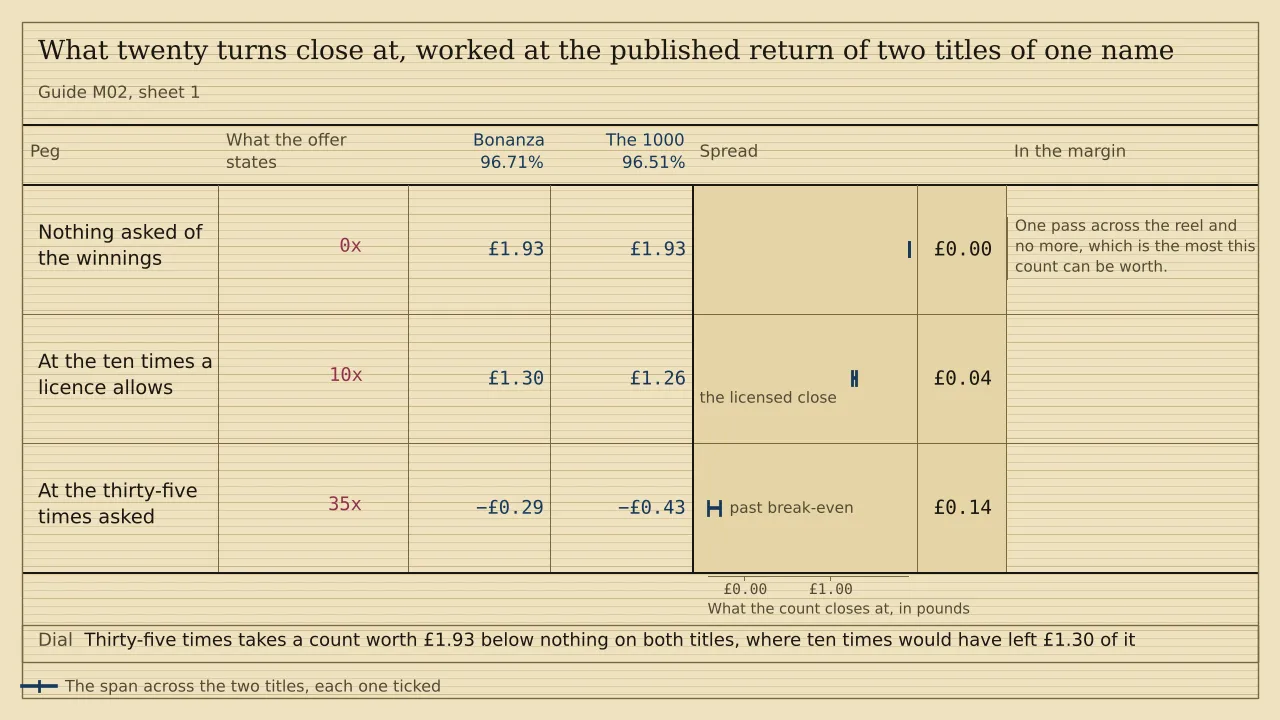
The two inks on the drawing carry the division this whole site turns on. A figure the reel states about itself, and a figure that has already been through the reel, are weights that count towards the result. A figure an offer states on its own, a count of turns or a multiple, weighs nothing at all until the reels have been through it. That is why the card above reads from left to right as it does: the machine’s figure never moves, the offer’s figures move freely, and everything in the right-hand column is the product of the two.
7
What twenty turns of this reel can actually do
An expectation of £1.93 says nothing about the shape of the thing, and the shape is published too, so here it is. The reel runs 5 reels and 3 rows across 10 paylines layout in the game’s own data. Its feature opens on 3, 4 or 5 scatters and awards 10, 15 or 20 turns in return the studio’s page, matched by the game, which is worth noticing on this card of all cards: the count in the headline is exactly what the reel’s own top trigger hands a player who reaches it without paying anybody anything.
Inside the feature a wild collects whatever money symbols are showing. Those symbols reach 2,000 times one stake, and a fourth wild both retriggers the round for 10 further turns and moves a multiplier up a ladder of 2x, then 3x, then 10x the studio’s own description. The reel’s hard ceiling in a single round stands at 2,100 stakes. Priced at the supposed ten pence that is £210.00, and £10,500 where a licensed cycle takes its £5.00 maximum.
How often that ceiling arrives is the one rate the game publishes: 1 in 3,880,481 turns the top-round rate the game’s data reports. Twenty turns is therefore one 194,024th of the rate at which the biggest single round is reached, and a reader would need to be handed that count of twenty turns 194,024 times over to have turned the ceiling’s own frequency once. No other hit rate is published by anybody: the game’s data carries no base-game frequency and no frequency for the feature, and the figures that circulate for the second of those are more than half as far apart again as the smaller of the two.
Nor is there a published figure for how widely the outcomes spread. The studio states no volatility for this title or for any of the thirty-six in the family, the word appears on none of its pages, and nothing in the game’s data makes room for one. Where this card needs to say something about dispersion it says the paytable, 2,100 times the stake as a single-round ceiling, and the top rate of 1 in 3,880,481 turns, because those are published and an adjective is not. Nor may the reel adapt itself: a licensed build has to deliver outcomes that follow the theoretical probabilities, with no compensation of one result by another, and the rules and odds of a game stay put while it is being played RTS 7A and 7D. Nothing about a run of turns, won or lost, bears on the turn after it.
8
Every figure on this card, sorted into read and supposed
Because other cards on this site refer back to this one, the inventory is printed rather than implied. Read off the game sheet, which is the only source of fact here about the reel or the studio: the return of 96.71 per cent, agreed between the studio’s own page and the session data the game receives; the layout of 5 reels and 3 rows across 10 paylines; a stake range running 0.10 to 250.00 and the default spin of £2.00, both from the game’s data because the studio’s page states no range; the single-round ceiling at 2,100 times the stake; the rate of 1 in 3,880,481 turns; the feature trigger of 3, 4 or 5 scatters for 10, 15 or 20 turns; the retrigger of 10 more on every fourth wild; the ladder of 2x, 3x and 10x; the money symbol ceiling of 2,000 times the stake; and 96.51 per cent for the second title in the table.
Read off the regulatory sheet, which is the only source here for a rule: the two cycle ceilings, £5.00 and £2.00, with the instrument they come from; the pace floor that limits a licensed build to 1,440 cycles an hour; the bar on turbo and quick spin; the bar on any automatic run of cycles; the ten-times ceiling on staking bonus funds, dated 19 January 2026; the duty that puts an account of the chances in front of a player before they commit, and the disjunction inside that duty which means no licensed site is actually obliged to print a return as a percentage; and the bars on adaptive behaviour and on altering a game in play.
Supposed by this card, and belonging to nobody else: the price of ten pence a turn, which is a real figure of the game’s range but a choice to spend it there; the multiple of thirty-five times, which is of the order this part of the market asks; and the weighting of one. Everything else on the card is arithmetic performed on those two lists. Nobody here has played this reel, no outcome has been observed, and there is no figure above that came from anywhere but a published source or a stated supposition.
The separation matters more than it looks. A card that read a return off a regulator, or a licence condition off a game’s information screen, would have mixed two kinds of fact that answer different questions, and the mixture is the commonest way a figure on a page of this sort turns out to be unsourceable when somebody finally goes looking. The two sheets are kept apart for that reason and are cited apart throughout.
9
What an expectation is not, and what this card declines to settle
An expectation is an average over the machine’s own mathematics, and a single count of twenty turns is nowhere near long enough for an average to mean much. The honest statement of the £1.93 is that it averages a distribution whose single likeliest result is nothing whatever, whose largest is 2,100 times one stake, and whose shape between those two is described by a paytable rather than by any figure the studio publishes. A reader who takes £1.93 as a forecast of their own twenty turns has misread the arithmetic in the direction the arithmetic most often gets misread.
Three further things this card does not claim. It does not say what any cashier’s version of this reel returns, because the only return it has is the one the studio publishes for the title and that is the figure used throughout. It does not price the window a count has to be used inside, the cap a cashier may put on what can be withdrawn from the winnings, or the maximum stake a cashier may allow while a requirement is outstanding, because none of those is published by anybody and all of them are terms that change when somebody changes them. And it makes no claim at all about how often the feature opens, that rate being absent from the game’s data and disputed among the sources that state one.
What the card does claim is narrow and checkable: that at ten pence a turn, supposed, twenty turns put £2.00 across a reel the studio puts at 96.71 per cent, that £1.93 comes back in expectation, that thirty-five times those winnings is £67.55 of staking costing £2.22 at the same published figure, and that the close is therefore 29 pence below nothing. Each of those steps can be checked against the sheet it came from, and any reader who disagrees with the result can say which step they disagree with, which is the whole purpose of printing the steps.
10
Twenty turns, read back as money, as minutes and as expectation
As money, at the supposed ten pence: £2.00 of staking, £1.93 of expected winnings, £67.55 of staking asked afterwards, £2.22 of expected cost in the asking, and 29 pence of deficit at the end of it. As minutes: 50 seconds for the advertised count itself and at least 28 minutes and 10 seconds for the staking that follows, with every cycle in both separately committed to and nothing permitted to hurry them. As expectation: −£0.29 at the multiple priced here, nothing at all at 30.40 times, and £1.30 at the ten times a licensed cashier would have been held to.
Those are the same twenty turns throughout. The count never changed, the reel never changed, and the whole of the variation came from two figures the headline does not carry: what one turn costs and what the winnings are asked to do afterwards. That is the method this site applies to everything it weighs, and this card is the one it was built to demonstrate.
The last figure is the one worth carrying away. A count of twenty turns, on the reel this domain is named after, at the price and the multiple set out above, is worth less than nothing in expectation, and it would have been worth £1.30 under the ceiling a British licence imposes. The difference is £1.59, and it is not a penalty anybody charged the reader: it is simply what a multiple above the break-even does to a sum of winnings when it crosses a reel whose published return is below a hundred per cent. Every other card on this site is doing a version of the same sum.
Questions
- What are 20 free spins with no deposit on Big Bass Bonanza worth?
- At the ten pence a turn supposed on this card, twenty turns stake £2.00 and return £1.93 in expectation at the published 96.71 per cent. With winnings staked thirty-five times, the £67.55 of turnover costs £2.22 at the same figure, so the package closes at 29 pence below nothing.
- What is the published RTP of Big Bass Bonanza?
- 96.71 per cent. The studio prints it as the single item in the basic game information on its own page for the title, and the configuration a session opens with reports the identical figure in its return field. Those two primary sources agree exactly for this title.
- How much staking does a 35 times requirement on twenty spins actually involve?
- The multiple attaches to the winnings, so thirty-five times £1.93 is £67.55 of turnover. At the supposed ten pence a turn that is 676 turns, and no licensed build runs more than 1,440 cycles an hour, so it occupies at least 28 minutes and 10 seconds.
- At what play-through would twenty free spins be worth nothing?
- At 30.40 times, which is one divided by the share this reel keeps of every pound put through it. That share is 3.29 points where the published return reads 96.71 per cent. Below 30.40 times the expectation is positive and above it the expectation is negative, so the thirty-five times priced here sits 4.60 times past the line.
- Would a British licensed cashier be allowed to ask for thirty-five times?
- No. A ceiling of ten times over sits on bonus funds at any licensed site, dated 19 January 2026. Worked at that ceiling the same twenty turns close at £1.30 rather than 29 pence below nothing, so the difference the licence makes on this card is £1.59.
- How many spins does the Big Bass Bonanza feature award?
- Three, four or five scatters open it for 10, 15 or 20 turns, and every fourth wild retriggers it with 10 more while lifting a multiplier through 2x, then 3x, then 10x. Those figures stand on the studio’s page for this title and in the game’s own data, which agree.
- What is the maximum win on Big Bass Bonanza?
- 2,100 times the stake in a single round, from the game’s own data rather than from the studio’s page, which states none. Where a turn costs the supposed ten pence that is £210.00. The rate at which it arrives is published as 1 in 3,880,481 turns.
- How volatile is Big Bass Bonanza?
- No volatility figure is published for it or for any other title in the family, the studio prints the word nowhere at all, and the game’s data carries no field for one. What can be quoted instead is the paytable, 2,100 times the stake as a single-round ceiling, and a top rate of 1 in 3,880,481 turns.