Figures read 20 October 2026 Card T09, weigh-in 1
10 free spins, and the two figures that decide what they come to
Ten turns at 10p lay £1.00 over Big Bass Bonanza and a published 96.71 per cent hands £0.97 of it back. Attach a twenty-times requirement to the winnings and the award closes at £0.33. Now move one figure at a time. Raise the price of a turn to the 2.00 the default coin value makes, and the close becomes £6.61, twenty times the size and the same kind of number. Put the price back and raise the requirement to forty times instead, and the close becomes −£0.31, much the same size and no longer the same kind. Two figures the headline never prints, and they do not do the same job.
What the machine states 96.71 per cent The sheet puts this title at that figure and two primary sources state it alike, at claims 20 and 21. It is the only term in the expression that belongs to the machine, and on this card it is held still while the other two are moved. What the offer states 10 turns at 20 times Ten turns handed over, and the winnings to be staked twenty times before any of the money may leave. The count is in the headline. The multiple is in the terms, and of the two it is the one that decides whether the answer is positive. What the two make when multiplied £0.33 What ten turns are worth once the requirement has been paid for, at 10p a turn, a price this report chose and names wherever it is used. Change the price and this figure moves in proportion; change the multiple and it changes character.
Offers of this kind, weighed against the same reel
The destinations below are paid placements. Registering through one of them earns this publisher a fee, and the scale is not told which destination is which: a figure on the card would read identically either way.
-
01The Weigh-In
Betportal
Three deposits, 35x
What the reel states96.71 per centBig Bass BonanzaWhat the offer advertises€15.00150 turns at 10cWhat the two make€0.00No turns of this reelThe reel
Build of the reelBig Bass BonanzaReturn it publishes96.71 per centStake it accepts on one turn10c to €250.00The offer
Turns advertised150 turnsTurns valued at the cheapest turn this reel sells, no worth for one being stated anywhere in the offerPrice of one turn10cthe smallest stake the reel accepts, this operator publishing no figure of its ownCredit as a sumunpublishedCredit waiting on a paymentstated300% over three deposits, up to €1,000Advertised, priced€15.00150 turns of this reelHung on it
Play-through35 timesthe bonusCredited towards it100 per centnobody has published a share, so the whole of a stake is credited, which is the kindest reading availableCeiling on winningsstatedFive times the bonusLargest stake while it runs€5.00under the largest stake the reel accepts, so part of the machine's own range is shut off while the credit runsQualifying payment€20.00200 turns of this reel at the price above, and it enters no weightThe dial, read at every return this reel is published at Return Breaks even at Staking asked Costs Weight In turns 96.71 per centpriced out 30.4 times 5,077 turns −16.70 €0.00 No turns No Great Britain licence
Licence held in Anjouan, Comoros, by BetPortal Gaming Ltd and Excite Ultra Media Ltd, numbered ALSI-202601040-FI2.
Open the offer at Betportal, opens in a window of its own -
02The Weigh-In
WinBeast
Five deposits and a free bet
What the reel states96.71 per centBig Bass BonanzaWhat the offer advertises€50.00500 turns at 10cWhat the two make€0.00No turns of this reelThe reel
Build of the reelBig Bass BonanzaReturn it publishes96.71 per centStake it accepts on one turn10c to €250.00The offer
Turns advertised500 turnsTurns valued at the cheapest turn this reel sells, no worth for one being stated anywhere in the offerPrice of one turn10cthe smallest stake the reel accepts, this operator publishing no figure of its ownCredit as a sumunpublishedCredit waiting on a paymentstatedFive matched deposits of 50% to 100%, each up to €1,000, with a €650 free betAdvertised, priced€50.00500 turns of this reelHung on it
Play-through40 timesthe bonus and the winnings from the spinsCredited towards it100 per centnobody has published a share, so the whole of a stake is credited, which is the kindest reading availableCeiling on winningsstated€100 a batch of spinsQualifying payment€20.00200 turns of this reel at the price above, and it enters no weightThe dial, read at every return this reel is published at Return Breaks even at Staking asked Costs Weight In turns 96.71 per centpriced out 30.4 times 19,342 turns −63.64 €0.00 No turns No Great Britain licence
Licence held in Curaçao, by a company the site does not name.
Open the offer at WinBeast, opens in a window of its own -
03The Weigh-In
EliteSpin
Five deposits, 40x
What the reel states96.71 per centBig Bass BonanzaWhat the offer advertises£50.00500 turns at 10pWhat the two make£0.00No turns of this reelThe reel
Build of the reelBig Bass BonanzaReturn it publishes96.71 per centStake it accepts on one turn10p to £250.00The offer
Turns advertised500 turnsTurns valued at the cheapest turn this reel sells, no worth for one being stated anywhere in the offerPrice of one turn10pthe smallest stake the reel accepts, this operator publishing no figure of its ownCredit as a sumunpublishedCredit waiting on a paymentstatedFive matched deposits of 50% to 100%, each up to £1,000Advertised, priced£50.00500 turns of this reelHung on it
Play-through40 timesthe bonus and the winnings from the spinsCredited towards it100 per centnobody has published a share, so the whole of a stake is credited, which is the kindest reading availableCeiling on winningsstatedFive times the bonusQualifying payment£20.00200 turns of this reel at the price above, and it enters no weightThe dial, read at every return this reel is published at Return Breaks even at Staking asked Costs Weight In turns 96.71 per centpriced out 30.4 times 19,342 turns −63.64 £0.00 No turns No Great Britain licence
Licence held in Costa Rica, by PrimeTier Limited.
Open the offer at EliteSpin, opens in a window of its own -
04The Weigh-In
Crown Jewelz
200% on the first
What the reel statesNO RETURN RECORDEDBig Bass BonanzaWhat the offer advertises£15.00150 turns at 10pWhat the two makeNOT WEIGHEDNot weighed, for want of the play-through multiple as a number.The reel
Build of the reelBig Bass BonanzaReturn it publishes96.71 per centStake it accepts on one turn10p to £250.00The offer
Turns advertised150 turnsTurns valued at the cheapest turn this reel sells, no worth for one being stated anywhere in the offerPrice of one turn10pthe smallest stake the reel accepts, this operator publishing no figure of its ownCredit as a sumunpublishedCredit waiting on a paymentstated200% up to £1,000 with 50 cash spins, then 150% twice with 50 cash spins eachAdvertised, priced£15.00150 turns of this reelHung on it
Play-throughunpublishedCredited towards it100 per centnobody has published a share, so the whole of a stake is credited, which is the kindest reading availableCeiling on winningsunpublishedQualifying payment£20.00200 turns of this reel at the price above, and it enters no weightNo Great Britain licence
Licence held in Curaçao, number not verified, by a company the site does not name.
Open the offer at Crown Jewelz, opens in a window of its own
Of everything in a row, the weight alone was worked out here; the rest was copied. It comes off E = B × (1 − W × (1 − RTP) ∕ g), in which W is the play-through, g the portion of a stake this reel is credited with towards it, RTP the figure the machine publishes about itself, and B the credit still standing when the condition arrives. A batch of turns gives part of itself up before that moment, each turn having staked its own value and taken the machine's return on it, while credit handed over as a sum gives up nothing yet, nothing having been staked with it. Beyond the break-even multiple the condition costs more than it has to work on, and the dial rests at nothing rather than swinging below the pin: a condition cannot take out more than arrived.
No return is kept in this software. Each one is copied off one named machine, build by build, which is why a row may carry several and why the break-even multiple is different from row to row. That multiple is the credited portion of a stake divided by the machine's house edge, so crediting the whole stake on a build published at 96 per cent puts break-even at twenty-five times, and nothing asked for above twenty-five times survives being cleared. A creel holding several settings is read at all of them and the distance between the ends is printed, because the build an operator chose to run is published nowhere a reader can get at.
Turns are not money until a turn has a price. An operator stating what one of its own turns is worth supplies it, and the row credits the operator with having said so. Otherwise the cheapest turn this reel sells supplies it, which is a figure off the machine and not an estimate, no cheaper turn being on sale, and again the row names its source. Everything below that line moves when the price moves. On a row advertising turns and no credit, halve the price and the weight halves while the count of turns the weight buys does not budge, which is as plainly as it can be shown that a count of turns and a quantity of money are different things.
A qualifying payment belongs to the reader. The card prices it in turns, that being the useful thing to know, and no weight is allowed near it. Where a figure has no business existing, one of three words stands instead. Stated marks a condition set down in words, costing something, offering nothing to subtract. Unpublished marks a condition set down nowhere whatever. Unpriced marks a count of turns that is published plainly enough while nothing anywhere says what one of them is worth. None of the three conceals an estimate, and no operator is credited on this card with a figure it never gave.
Two columns of this card are pinned by rules that a Great Britain licence writes and a licence from elsewhere does not. The play-through column: Social Responsibility Code 5.1.1 bars a licence holder from asking more than ten times the bonus funds, so any multiple above ten times on this card is one a British licence would never have let through. The stake column: regulation 5(2) of the Gambling Act 2005 (Operating Licence Conditions) (Amendment) Regulations 2025, made on 25 February 2025, caps the total an individual may stake on any one game cycle at £5, and at £2 for anybody under 25. That cap is attached to a remote casino operating licence and not to the machine, which means a reader who steps outside the licence meets the reel's own stake range with nothing on top of it. Remote technical standard 14D requires a minimum of two and a half seconds from the time a game is started until the next game cycle can be commenced. That one is addressed to the machine rather than to the money, and no column here reports it. Gamstop Online reaches exactly as far as the British licence reaches, that being the condition the scheme was built on, so an offer licensed outside it stands outside the scheme by construction and a registration made with the scheme does not reach as far as this offer. The National Gambling Helpline answers on 0808 8020 133, 24 hours a day, every day of the year.
Conditions quoted in a row are quoted in the wording of the operator that published them, and each row carries the date it was checked. The earliest date on this card is 27 October 2026. A reader is bound by an operator's own terms in full, never by a line of this card.
1
Two numbers the headline does not print
A count of turns is a quantity of nothing. Ten of them might be worth a pound or fifty, might leave a reader ahead or behind, and the headline that names them supplies not one of the figures that settle it. Two do. One is the price of a single turn, which an offer sometimes fixes and more often leaves to whatever the reel is set at when the turns land. The other is the multiple the terms attach to the winnings, which has to be staked through before any of it may be drawn out.
This report has priced eight other awards of the same family and the same two figures have done all the work on every one of them. What has not been said plainly until now is that the two work in different dimensions, and that treating them as interchangeable quietly spoils the answer. A price is a scale. A multiple is a verdict. Double the first and the answer doubles. Double the second and the answer may stop being an answer about profit at all.
The distinction matters because the two are advertised in opposite directions. An offer that wants to look generous raises the count and says nothing about the price, because a hundred turns reads better than ten whatever each one costs. An offer that wants to look generous also lowers the headline multiple and says nothing about what the multiple is applied to. A reader given a count and a multiple and no price has been handed the sign of the result without its size. A reader given a count and a price and no multiple has been handed the size without the sign.
What follows takes one award of ten turns and moves each of the two figures in turn, holding everything else where it was, so that the shape of each movement can be seen on its own. The arithmetic is the same arithmetic the rest of the section uses. Only the question is new.
2
What ten turns stake, and what a requirement leaves
Start with the award standing still. Ten turns at 10p put £1.00 across the reel. A published 96.71 per cent returns £0.9671 of every pound laid over it claims 20 and 21, so the expected winnings before anything further happens are £0.97. The price of ten pence is this report’s own supposition and is the floor of the stake range the game’s data gives, a range whose head is 250.00 and which is spread over ten lines claim 25.
Then the requirement arrives. Read the expression outwards from the middle: W is the twenty times the terms ask, RTP is whatever published figure the reel takes the staking at, g is what the offer counts a round of that reel as worth a whole round, where the terms say nothing, and B is the £0.97 that ten turns return before any of it is staked again. Written out that is E = B × (1 − W × (1 − RTP) ∕ g), and at twenty times it closes at £0.33.
Thirty-three pence out of a pound of exposure the reader never had to find. It is a positive figure and it stays positive, and the reason is worth naming before the rest of the card pulls it apart. The multiple at which the expression comes to nothing is one divided by the house’s own margin, so on this reel it is 1 divided by 0.0329, which is 30.4 times. Twenty is under it. Forty is over it.
| The title the ten turns run on | Published return | Break-even play-through | What £1.00 of stake is worth |
|---|---|---|---|
| Big Bass Bonanza | 96.71 per cent | 30.4 times | £0.33 |
| Big Bass – Keeping it Reel | 96.07 per cent | 25.4 times | £0.21 |
| What the choice of reel comes to | 0.64 of a point | 5.0 times fewer | £0.12 |
Twelve pence between two reels on a pound of exposure, which is better than a third of the larger of the two answers. The second title is worth a second look for a reason unconnected with the money: Big Bass – Keeping it Reel publishes 10,000 times the stake as the reach of one round, against the original’s 2,100 claims 27 and 74. So the reel that pays back less on average reaches very much further on one round. Return and reach are separate published figures that move independently, and a count of turns tells a reader neither.
3
Moving the price, and watching only the size move
Hold the count at ten, hold the requirement at twenty times, hold the reel at 96.71 per cent, and move nothing but what one turn costs. Three prices are worth taking, and every one of them is a figure somebody else set. Ten pence is the floor of the published range. Two pounds is what the default coin value makes across the ten lines claim 25. Five pounds is where a British licence stops a single round of a slot SI 2025 No. 215, reg 5(2). What sits between the first two of those is deliberately left alone: the data gives the two ends of the range, a count of twenty-eight selectable coin values and the default, and it names none of the steps between them, so a rung part way up the ladder would be this report’s invention rather than the machine’s figure.
At ten pence the award closes at £0.33. At two pounds it closes at £6.61. At five pounds it closes at £16.54. Set those beside the prices that produced them and the pattern is not a pattern so much as an identity: the prices stand as one to twenty to fifty, and so do the closes, to the penny the rounding allows.
Multiply the price of a turn by any number you like and the close is multiplied by the same number, which is why a count of turns with no price beside it names no quantity at all
Nothing surprising has happened. The price enters the arithmetic once, in the stake, and the stake multiplies through everything after it. What is worth noticing is what did not happen. Across a fifty-fold change in the price of a turn, the award stayed profitable in expectation and stayed profitable by exactly the same proportion of what was laid over the reel. Thirty-three pence on a pound. Sixteen pounds and fifty-four pence on fifty. The reader at the top of that ladder is risking fifty times as much of somebody else’s money and keeping fifty times as much of the expected value, and the two cancel out of any judgement about whether the offer is worth taking.
Which is the first half of the finding, and it is a release rather than a restriction. A reader who does not know the price of a turn still knows whether the award is worth having. They simply do not know what it is worth.
4
Moving the multiple, and watching the sign go
Now put the price back at ten pence and leave it there, and move the other figure instead. Ten times, twenty times, thirty times, forty times: four multiples of the kind these terms attach, none of them unusual, all of them applied to the same £0.97 the ten turns are expected to produce.
At ten times the award closes at £0.65. At twenty times it closes at £0.33. At thirty times it closes at £0.01. At forty times it closes at minus £0.31. The first three differ in size. The fourth differs in what it is.
The whole distance from £0.65 to minus £0.31 is ninety-six pence, which is less than what ten turns stake, and somewhere inside that distance the offer stops being worth taking
The crossing is at 30.4 times, which is where the staking a requirement demands destroys precisely as much as the winnings were worth. That figure is not an opinion. It is one divided by the margin between a published return and a hundred per cent, and on this reel the margin is 3.29 points. A requirement under 30.4 times leaves a positive figure however small. A requirement over it leaves a negative one however large the award looked.
Notice the thirty-times row. One penny. An award of ten turns cleared at thirty times on this reel is worth a single penny in expectation, which is a tenth of what one turn of it costs, and a reader who took it would have staked £29.01 of their own winnings to arrive there. The arithmetic does not say that nobody should take it. It says that the headline count, the published return and the multiple together produced a figure smaller than the smallest coin the machine accepts, and that none of the three figures looked like trouble on its own.
5
Where three reels of the family cross over
The crossing moves with the reel, because it is built out of the published return and nothing else. Take three titles of the family with three different figures and the same award runs three different courses through the four multiples.
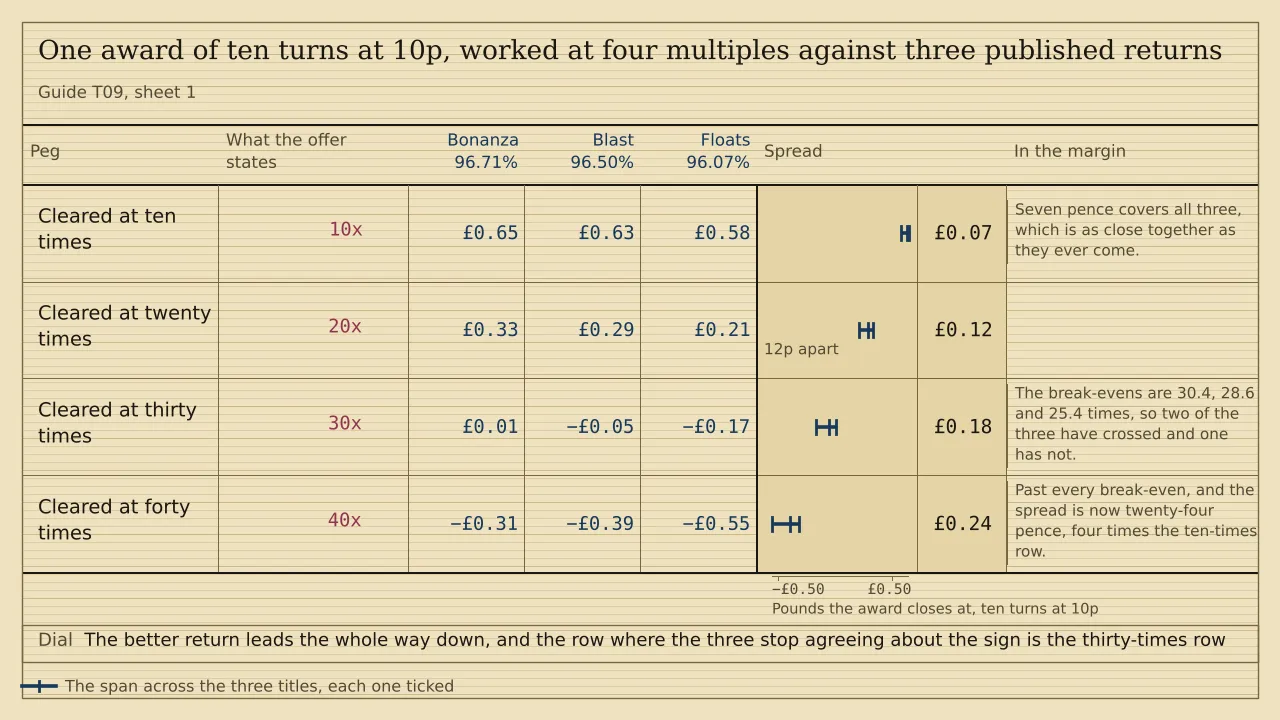
Two things fall out of the picture, and only one of them was expected. The expected one is that the better return stays ahead down the whole ladder. The unexpected one is the width of the span strip. At ten times the three titles lie 7p apart. At twenty times they lie 12p apart. At thirty times, 18p. At forty times, 24p. The choice of reel is worth more the heavier the requirement, and it is worth more in a straight line, because a multiple applies the difference between two returns as many times over as it asks the winnings to be staked.
The other thing in the picture is the row where the signs stop agreeing. At thirty times the original is a penny to the good and the other two are already under water, by 5p and by 17p. Three titles of the same family, the same count of turns, the same price, the same requirement, and two of the three have crossed over while the third has not. The break-evens are 30.4 times, 28.6 times and 25.4 times, which is the whole of the explanation.
No price appears anywhere in that reasoning, and no second ladder is drawn at a second price, for a reason worth stating rather than leaving to be noticed. Draw the same sheet at two pounds a turn instead of ten pence and every weight on it is twenty times larger and the picture is identical in shape, with the same row changing sign in the same place. A drawing whose only content is a scale factor is a drawing of nothing.
6
Why no price a reader can set reaches the sign
It is worth doing properly, because the result is stronger than an observation about four prices. Write out what the credit actually is. B is the count of turns times the price of a turn times the published return, since that is what the turns are expected to produce. Put that into the house expression and the price stands outside the bracket, multiplying everything in it, and appears nowhere inside.
A price is a positive number. Multiplying by a positive number changes how big a quantity is and never whether it is above or below nought. So the sign of the answer is decided entirely by what is in the bracket, and what is in the bracket is the multiple, the published return and the weighting. The price is not among them.
The price of a turn multiplies the whole expression and sits nowhere inside it, so it can make an award worth fifty times more and cannot make a bad award a good one
That is the half of the ground this section had got wrong until this card, and the three pages it would have contradicted are on the shelf beside it. The flagship priced a count with no price attached and found that a range was the honest answer. The card on fifty turns with the requirement deleted found the deletion worth the award multiplied by the requirement and again by the house’s margin. The card on twenty turns worked the dead band at the foot of a balance and found it one stake wide at every rung. Not one of those three would survive a page that let a price decide a sign, and all three stand unharmed under a page that keeps the two apart.
There is a practical form of it for a reader standing in front of an offer. If the only thing in doubt is the price of a turn, the question of whether to take the award is already settled and only the size of the answer is open. If the multiple is in doubt, nothing is settled at all.
7
The one other term that does reach the sign
One term inside the bracket has been sitting quietly at one all the way down this card, and it deserves its own paragraph because it reaches the sign exactly as the multiple does. That term is g, what an offer counts a round of a given reel as worth against the requirement. Where the terms are silent this report takes it as a whole round, which is the assumption every figure above rests on and the assumption most likely to be wrong in a reader’s disfavour.
The arithmetic is simple and unkind. Counting a round at half a round does not halve anything; it doubles the requirement, because the winnings have to cross the reel twice as often to satisfy the same multiple. In the expression the weighting divides the multiple, so a twenty-times requirement counted at half is a forty-times requirement wearing a smaller number. On this reel that is the difference between £0.33 and minus £0.31, which is to say the difference between an offer worth taking and one that is not.
Solve for the weighting at which a given multiple crosses over and the answer is the multiple times the margin. A ten-times requirement on this reel turns negative at a weighting of 0.329, a twenty-times one at 0.658, and a thirty-times one at 0.987, which is to say that a thirty-times requirement on this reel is under water at any weighting at all short of the whole round arithmetic on claims 20 and 21.
Two honest limits on that. The first is that this report has no published figure for what any offer counts this reel at, and none of the grounds it works from supplies one, so the whole of the paragraph above is a statement about the expression rather than about any offer in the world. The second is that it is not recorded anywhere in the material behind this site whether a ceiling placed on a play-through is a ceiling on the multiple as written or on the multiple as weighted, and the two are not the same quantity. Where a figure cannot be sourced this site says so rather than supplying one.
8
Both figures are regulated, and the sign more tightly
Both of the two figures this card has been separating are the subject of British rules, and the rules treat them very differently, which is a useful check on whether the distinction is a real one or an invention of this page.
The price is capped. A licensed round of an online slot is held to £5, with a lower ceiling of £2 over a player under twenty-five SI 2025 No. 215, reg 5(2). That is a ceiling on the size of everything downstream of it and it leaves every sign on this card exactly where it stands: the fifty-pound ladder of entry three simply stops at its fourth rung, and the award is as worth taking at the top of what remains as it was at the bottom.
The multiple is capped too, and the cap is the interesting one. A British licensee may ask no more than ten times a bonus before the money can be withdrawn, under SR Code 5.1.1, in force from the nineteenth of January 2026. Set that beside the break-evens on the drawing above. Across the thirty-five slots the slowest crosses over at 25.3 times and the original at 30.4, and the one row of the thirty-six that is not a slot crosses lower than either, at 22.2 arithmetic on claims 75d and 75e. Ten times is a long way under every one of them.
No requirement a British licensee may write passes ten times a bonus, and the slowest break-even anywhere in this family is 22.2 times, so inside the licence no award of this shape can be made negative by its own requirement
That is a stronger protection than it sounds, and it is placed on the axis that decides the sign rather than on the one that decides the size. A reader inside the licence may be offered an award worth very little. They cannot, on this family of reels, be offered one worth less than nothing on account of the multiple alone. A cap of five pounds on the price could never have achieved that, because no price can reach a sign.
No duty above binds the cashier behind an award of this shape, which sits outside any British licence, and the three worth pricing fall on the two axes this card has been keeping apart. A licensed round of a slot is held to £5 in Britain, with a £2 ceiling over a player under twenty-five, which bounds the credit from above and leaves the sign where it was. The ceiling over a play-through is the one that would have mattered, and out here the multiple is whatever an operator writes down, so the forty-times column of this card and the weighting of entry seven are both live. The third is the duty to leave an offer’s terms plain and reachable, which on this card is the difference between a reader who knows which of the two figures is in doubt and a reader who knows neither. A single registration with Gamstop Online closes what a reader holds at any operator Britain licenses, and the scheme is explicit in its own terms that its reach ends there.
9
What the award is worth once both have been read
Ten turns at ten pence on Big Bass Bonanza under a twenty-times requirement are worth £0.33 in expectation, and that single figure needed three numbers to produce, only one of which the offer’s headline carried. The published return did the least work of the three. The price fixed how big the answer was. The multiple fixed what sort of answer it was.
The count itself did almost nothing. Ten turns is a unit of exposure and not a unit of money, and until a price is written beside it the figure names no quantity. Ten turns is also very little time: a licensed round may not be sold at under 2.5 seconds to the round RTS 14D, so the whole award is twenty-five seconds of play at its quickest, against a requirement that may ask thirty pounds of staking to clear.
So the test a reader can apply to an award of this shape has two steps and they are not interchangeable. First read the multiple against the reel’s break-even, because that settles whether the thing is worth taking and no price will overturn it. Second read the price against the count, because that settles what taking it is worth. Doing the second first produces a confident figure attached to the wrong verdict, which is the most expensive mistake available on a page of this kind.
And the figure that has not appeared in either step is the one the headline shouts. Ten, fifty, a hundred: the count scales with the price and does nothing else, so an offer that doubles its count and halves its price has handed over an identical award. The two figures that matter are both somewhere further down the terms.
Questions
- What are ten free turns actually worth
- £0.33 at 10p a turn on Big Bass Bonanza under a twenty-times requirement. The ten turns lay £1.00 over the reel, a published 96.71 per cent returns £0.97 of it, and the requirement takes the rest. Big Bass – Keeping it Reel publishes 96.07 per cent, and there the same award leaves £0.21.
- Does the price of a turn change whether the offer is worth taking
- No. It changes only by how much. The price multiplies the whole expression and appears nowhere inside the bracket that carries the sign, so raising it from 10p to 2.00 makes the same award worth twenty times more and cannot turn a bad one good.
- Which figure decides whether the answer goes under nought
- The multiple the terms attach to the winnings, read against the reel’s break-even. On this title the break-even is 30.4 times, so twenty times leaves £0.33, thirty times leaves £0.01 and forty times leaves minus £0.31, all at the same price.
- How is the break-even multiple worked out
- One divided by the margin between the published return and a hundred per cent. On 96.71 per cent the margin is 3.29 points, which gives 30.4 times. On 96.50 per cent it gives 28.6 and on 96.07 per cent 25.4, so a worse reel crosses over sooner.
- Is the count of turns worth anything on its own
- Not by itself. The count sets exposure rather than money, so ten turns names a quantity only once a price stands beside it. An offer that doubles its count and halves its price has changed nothing whatever about what it is handing over.
- What a game weighting does to these figures
- It divides the multiple, so counting a round at half a round turns a twenty-times requirement into a forty-times one. On this reel that is the difference between £0.33 and minus £0.31. No published figure says what any offer counts this reel at, and this card assumes a whole round throughout.
- Does a British licence stop a requirement going past break-even
- On this family of reels, yes. Ten times is the most a licensee may ask of a bonus, and the slowest break-even in the family is 22.2 times, which belongs to the one row that is not a slot; the slots themselves run from 25.3 upwards. Nothing of the sort constrains an offer written outside that licence.
- Why does the better paying reel not reach as far
- Because a published return and a published ceiling are separate figures. Big Bass Bonanza publishes 96.71 per cent and one round reaching 2,100 times the stake; Big Bass – Keeping it Reel publishes 96.07 per cent and 10,000 times. A count of turns tells a reader neither one.