Figures read 20 October 2026 Card L07, weigh-in 1
Nothing asked of two hundred turns, and the hours that ask it anyway
Take every condition off a grant and the arithmetic has one step left in it. Two hundred turns on Bigger Bass Bonanza, whose maker publishes 96.71 per cent for it, commit £24.00 of stake at the twelve pence that title’s own range begins at, and the expected winnings are £23.21. With no multiple written against them, £23.21 is also the close. So the question this card is left with is not what the grant is worth but how long it stays worth that, because a reader who carries on at the same reel pays the identical toll a clause would have charged, and 1,934 further turns come to exactly what a licensed clause could have asked. That count holds whatever a turn costs.
What the machine states 96.71 per cent Bigger Bass Bonanza, from its entry in the family table and from the flat field its own session response carries. On this card the figure is doing two separate jobs: it turns the granted turns into winnings once, and it sets the rate at which any later turn eats them. What the offer states 200 turns, nothing asked Two hundred turns released against a ten pound payment, with no play-through on the winnings and no ceiling on them. Set down here as the sort of thing advertised at this end of the market, and taken from no account. What the two make when multiplied £23.21 The winnings and the close together, which only happens where no multiple stands between the two. Worked at a turn costing 12p, the foot of the range that title publishes, and named again wherever it is spent below.
Grants with no play-through, weighed against the same reel
The destinations below are paid placements. Registering through one of them earns this publisher a fee, and the scale is not told which destination is which: a figure on the card would read identically either way.
-
01The Weigh-In
Betportal
Three deposits, 35x
What the reel states96.71 per centBig Bass BonanzaWhat the offer advertises€15.00150 turns at 10cWhat the two make€0.00No turns of this reelThe reel
Build of the reelBig Bass BonanzaReturn it publishes96.71 per centStake it accepts on one turn10c to €250.00The offer
Turns advertised150 turnsTurns valued at the cheapest turn this reel sells, no worth for one being stated anywhere in the offerPrice of one turn10cthe smallest stake the reel accepts, this operator publishing no figure of its ownCredit as a sumunpublishedCredit waiting on a paymentstated300% over three deposits, up to €1,000Advertised, priced€15.00150 turns of this reelHung on it
Play-through35 timesthe bonusCredited towards it100 per centnobody has published a share, so the whole of a stake is credited, which is the kindest reading availableCeiling on winningsstatedFive times the bonusLargest stake while it runs€5.00under the largest stake the reel accepts, so part of the machine's own range is shut off while the credit runsQualifying payment€20.00200 turns of this reel at the price above, and it enters no weightThe dial, read at every return this reel is published at Return Breaks even at Staking asked Costs Weight In turns 96.71 per centpriced out 30.4 times 5,077 turns −16.70 €0.00 No turns No Great Britain licence
Licence held in Anjouan, Comoros, by BetPortal Gaming Ltd and Excite Ultra Media Ltd, numbered ALSI-202601040-FI2.
Open the offer at Betportal, opens in a window of its own -
02The Weigh-In
WinBeast
Five deposits and a free bet
What the reel states96.71 per centBig Bass BonanzaWhat the offer advertises€50.00500 turns at 10cWhat the two make€0.00No turns of this reelThe reel
Build of the reelBig Bass BonanzaReturn it publishes96.71 per centStake it accepts on one turn10c to €250.00The offer
Turns advertised500 turnsTurns valued at the cheapest turn this reel sells, no worth for one being stated anywhere in the offerPrice of one turn10cthe smallest stake the reel accepts, this operator publishing no figure of its ownCredit as a sumunpublishedCredit waiting on a paymentstatedFive matched deposits of 50% to 100%, each up to €1,000, with a €650 free betAdvertised, priced€50.00500 turns of this reelHung on it
Play-through40 timesthe bonus and the winnings from the spinsCredited towards it100 per centnobody has published a share, so the whole of a stake is credited, which is the kindest reading availableCeiling on winningsstated€100 a batch of spinsQualifying payment€20.00200 turns of this reel at the price above, and it enters no weightThe dial, read at every return this reel is published at Return Breaks even at Staking asked Costs Weight In turns 96.71 per centpriced out 30.4 times 19,342 turns −63.64 €0.00 No turns No Great Britain licence
Licence held in Curaçao, by a company the site does not name.
Open the offer at WinBeast, opens in a window of its own -
03The Weigh-In
EliteSpin
Five deposits, 40x
What the reel states96.71 per centBig Bass BonanzaWhat the offer advertises£50.00500 turns at 10pWhat the two make£0.00No turns of this reelThe reel
Build of the reelBig Bass BonanzaReturn it publishes96.71 per centStake it accepts on one turn10p to £250.00The offer
Turns advertised500 turnsTurns valued at the cheapest turn this reel sells, no worth for one being stated anywhere in the offerPrice of one turn10pthe smallest stake the reel accepts, this operator publishing no figure of its ownCredit as a sumunpublishedCredit waiting on a paymentstatedFive matched deposits of 50% to 100%, each up to £1,000Advertised, priced£50.00500 turns of this reelHung on it
Play-through40 timesthe bonus and the winnings from the spinsCredited towards it100 per centnobody has published a share, so the whole of a stake is credited, which is the kindest reading availableCeiling on winningsstatedFive times the bonusQualifying payment£20.00200 turns of this reel at the price above, and it enters no weightThe dial, read at every return this reel is published at Return Breaks even at Staking asked Costs Weight In turns 96.71 per centpriced out 30.4 times 19,342 turns −63.64 £0.00 No turns No Great Britain licence
Licence held in Costa Rica, by PrimeTier Limited.
Open the offer at EliteSpin, opens in a window of its own -
04The Weigh-In
Crown Jewelz
200% on the first
What the reel statesNO RETURN RECORDEDBig Bass BonanzaWhat the offer advertises£15.00150 turns at 10pWhat the two makeNOT WEIGHEDNot weighed, for want of the play-through multiple as a number.The reel
Build of the reelBig Bass BonanzaReturn it publishes96.71 per centStake it accepts on one turn10p to £250.00The offer
Turns advertised150 turnsTurns valued at the cheapest turn this reel sells, no worth for one being stated anywhere in the offerPrice of one turn10pthe smallest stake the reel accepts, this operator publishing no figure of its ownCredit as a sumunpublishedCredit waiting on a paymentstated200% up to £1,000 with 50 cash spins, then 150% twice with 50 cash spins eachAdvertised, priced£15.00150 turns of this reelHung on it
Play-throughunpublishedCredited towards it100 per centnobody has published a share, so the whole of a stake is credited, which is the kindest reading availableCeiling on winningsunpublishedQualifying payment£20.00200 turns of this reel at the price above, and it enters no weightNo Great Britain licence
Licence held in Curaçao, number not verified, by a company the site does not name.
Open the offer at Crown Jewelz, opens in a window of its own
Of everything in a row, the weight alone was worked out here; the rest was copied. It comes off E = B × (1 − W × (1 − RTP) ∕ g), in which W is the play-through, g the portion of a stake this reel is credited with towards it, RTP the figure the machine publishes about itself, and B the credit still standing when the condition arrives. A batch of turns gives part of itself up before that moment, each turn having staked its own value and taken the machine's return on it, while credit handed over as a sum gives up nothing yet, nothing having been staked with it. Beyond the break-even multiple the condition costs more than it has to work on, and the dial rests at nothing rather than swinging below the pin: a condition cannot take out more than arrived.
No return is kept in this software. Each one is copied off one named machine, build by build, which is why a row may carry several and why the break-even multiple is different from row to row. That multiple is the credited portion of a stake divided by the machine's house edge, so crediting the whole stake on a build published at 96 per cent puts break-even at twenty-five times, and nothing asked for above twenty-five times survives being cleared. A creel holding several settings is read at all of them and the distance between the ends is printed, because the build an operator chose to run is published nowhere a reader can get at.
Turns are not money until a turn has a price. An operator stating what one of its own turns is worth supplies it, and the row credits the operator with having said so. Otherwise the cheapest turn this reel sells supplies it, which is a figure off the machine and not an estimate, no cheaper turn being on sale, and again the row names its source. Everything below that line moves when the price moves. On a row advertising turns and no credit, halve the price and the weight halves while the count of turns the weight buys does not budge, which is as plainly as it can be shown that a count of turns and a quantity of money are different things.
A qualifying payment belongs to the reader. The card prices it in turns, that being the useful thing to know, and no weight is allowed near it. Where a figure has no business existing, one of three words stands instead. Stated marks a condition set down in words, costing something, offering nothing to subtract. Unpublished marks a condition set down nowhere whatever. Unpriced marks a count of turns that is published plainly enough while nothing anywhere says what one of them is worth. None of the three conceals an estimate, and no operator is credited on this card with a figure it never gave.
Two columns of this card are pinned by rules that a Great Britain licence writes and a licence from elsewhere does not. The play-through column: Social Responsibility Code 5.1.1 bars a licence holder from asking more than ten times the bonus funds, so any multiple above ten times on this card is one a British licence would never have let through. The stake column: regulation 5(2) of the Gambling Act 2005 (Operating Licence Conditions) (Amendment) Regulations 2025, made on 25 February 2025, caps the total an individual may stake on any one game cycle at £5, and at £2 for anybody under 25. That cap is attached to a remote casino operating licence and not to the machine, which means a reader who steps outside the licence meets the reel's own stake range with nothing on top of it. Remote technical standard 14D requires a minimum of two and a half seconds from the time a game is started until the next game cycle can be commenced. That one is addressed to the machine rather than to the money, and no column here reports it. Gamstop Online reaches exactly as far as the British licence reaches, that being the condition the scheme was built on, so an offer licensed outside it stands outside the scheme by construction and a registration made with the scheme does not reach as far as this offer. The National Gambling Helpline answers on 0808 8020 133, 24 hours a day, every day of the year.
Conditions quoted in a row are quoted in the wording of the operator that published them, and each row carries the date it was checked. The earliest date on this card is 27 October 2026. A reader is bound by an operator's own terms in full, never by a line of this card.
1
Two hundred turns at a twelve pence floor
The reel weighed here is Bigger Bass Bonanza, and the first thing to settle about it is not its return but the price of entry. Its own session response runs the coin steps across twelve lines rather than ten lines and coin steps, off that response, so the cheapest turn it will sell is 12p and not the 10p most of the family starts at. This card therefore spends 12p a turn supposed, at that title’s own floor, and says so again in each later sentence that spends it, because a worked example resting on a turn the machine does not offer is pricing a purchase nobody can make.
Two hundred turns at that price put £24.00 across the reel. None of the £24.00 is the reader’s: it is the grant, and what comes back out of it is what the arrangement is about. Against the 96.71 per cent printed for this title, the expected sum coming back is £23.21, and the 79 pence between £24.00 and £23.21 is the reel’s share, taken before any condition has been written, read or argued about.
That 79 pence is worth looking at once, because it is the only subtraction this arrangement performs on its own. Every other figure below is the same subtraction repeated on a larger turnover, which is the whole of what a play-through is and the whole of what carrying on at the machine is. A reader who understands the 79 pence needs nothing else explained.
| The price of one turn | Why the reel sells it | What two hundred turns commit |
|---|---|---|
| 12p | the foot of this title’s own range, twelve lines at the smallest coin | £24.00 |
| £240.00 | the head of that same range, which no licensed cycle reaches | £48,000.00 |
The second row shows what the first one is a choice inside, and it is also where this card says what it cannot do. Between those two ends the sheet gives this title no list of steps and no default either, so a price quoted anywhere in the middle would be a turn nobody here can show the reel sells. A licensed cycle is capped at £5.00, which sits inside the range as money without having to be a step of it, since £5.00 across twelve lines is not a coin value anybody has published. So everything below is worked at the foot, which is confirmed, and the head is printed to show how wide a choice the offer never mentions really is.
2
The close when nothing is asked, which is the whole of it
The house expectation on this site is E = B × (1 − W × (1 − RTP) ∕ g), and the plainest way to meet it is on a card where one of its letters is nought. W here is nought, the grant asking no play-through at all. B is the £23.21 those two hundred turns should produce and not the £24.00 they put across the reel, which is where a spins headline most often misleads itself. RTP is the maker’s 96.71 per cent for this title, and g, the weight a slot is granted towards a requirement, never gets to do anything on this card, there being no requirement for it to weigh a term of the grant, not of the reel.
With W at nought the bracket collapses to one and the close is B. So £23.21 is the expected close of this arrangement, and it is the largest close any grant of two hundred turns at 12p can have, since every condition anybody could attach can only subtract. That is the sentence the headline is selling, and it is true.
It is also the end of what the offer contributes. Once the multiple is gone the only figures left in the arithmetic belong to the reel, and the family does not hold them still. Two titles are sold from twelve pence rather than ten, because both run their coin steps across twelve lines, and the returns their maker prints for the pair are not the same figure.
| The title the turns run on | Published return | Break-even play-through | What 200 turns at 12p are worth |
|---|---|---|---|
| Bigger Bass Bonanza | 96.71 per cent | 30.4 times | £23.21 |
| Bigger Bass Blizzard – Christmas Catch | 96.08 per cent | 25.5 times | £23.06 |
| What the choice between them moves | 0.63 of a point | 4.9 times | £0.15 |
Fifteen pence, on a grant of two hundred turns, is what the whole published distance between the two twelve-line titles is worth while nothing is asked. That is the point of putting the table here rather than later: with no multiple in the arithmetic the return is applied exactly once, so the family’s spread arrives at the reader divided by nothing. The break-even column is where the two figures stop being near neighbours, and what lives in that gap is the subject of everything below.
3
One toll charged two ways, by the clause and by the turn
A play-through and a decision to carry on are the same transaction wearing two different labels. Both put money across a reel returning less than the whole, and 3.29 points of anything crossing it stays behind. The difference is only who wrote the sentence: a clause says how much turnover has to happen, and a reader staying at the machine supplies turnover without being asked.
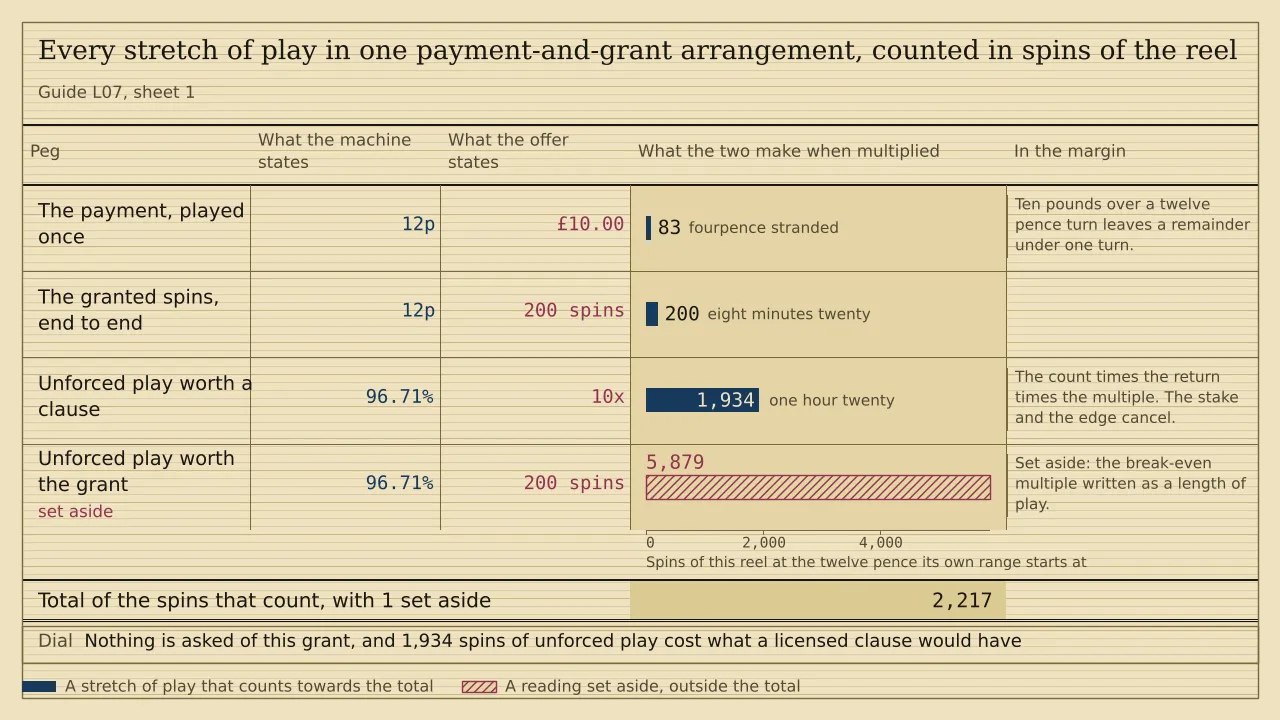
Price them both and the identity is exact. A ten-times clause on this grant would require £232.10 of turnover, which costs £7.64 at 3.29 points and would leave £15.57 of the £23.21 standing. Now take the same reel with no clause on it: one turn at 12p costs a hair under four tenths of a penny in expectation, being twelve pence times the reel’s share. Divide £7.64 by that and the answer is 1,934 turns. A reader who played 1,934 turns of their own accord, with nothing obliging them to, has paid what the clause would have charged, to the penny.
Two things about that figure are worth more than the figure. The first is that the price of a turn drops out of it. The clause’s cost rises with the stake because the turnover does, and the cost of one unforced turn rises with the stake by exactly the same factor, so the two cancel: the count is 1,934 at 12p, 1,934 at the top end of the range this title publishes, and 1,934 at every price the reel sells in between. The second is that the reel’s own share drops out too. It appears once in the clause’s bill and once in the per-turn bill, and the division removes it. What is left is a count of turns multiplied by a published return multiplied by a multiple, and nothing else at all.
1,934 turns of play nobody asked for cost what a ten-times clause would have cost on this grant, and the figure does not move when the price of a turn moves
4
The absent clause, priced in turns instead of pounds
Section three settles the method, so the rest is arithmetic. The count of unforced turns that costs what a clause of W times would cost is the granted count times the published return times W. On two hundred turns at 96.71 per cent that comes to 193.42 turns for every single time the clause asks, which is the most portable small figure on this card: each extra multiple a cashier might have written is worth a hundred and ninety-three turns of staying put, give or take a third of one.
| The clause this grant does not carry | Turnover it would require | What it would take from £23.21 | Unforced turns that cost the same | Time at the floor under a cycle |
|---|---|---|---|---|
| Ten times, the most a licensed clause may ask | £232.10 | £7.64 | 1,934 turns | 1 hour 20 minutes |
| Twenty times | £464.20 | £15.27 | 3,868 turns | 2 hours 41 minutes |
| Forty times | £928.40 | £30.54 | 7,736 turns | 5 hours 22 minutes |
The third row is the one that shows why the deletion matters at all. Forty times would take £30.54 out of a grant holding £23.21, so the close would be a cost of £7.33 and the reader would be finishing the condition with their own money. The grant cannot pay that bill, which is why a large multiple is not a smaller gift but an arrangement of another kind altogether. Deleting the multiple removes that, and removes it completely.
What the deletion does not remove is the reel. Read down the fourth column instead of the third and the three clauses become one hour twenty, two hours forty-one and five hours twenty-two of ordinary play at the fastest a licensed build may be driven. A reader who takes the grant, keeps the £23.21 and then spends an afternoon at the same title has handed back what the harshest of the three clauses would have taken, with nobody having written a word of it down.
5
Where the whole grant goes, and why it is break-even in disguise
Carry the column one step further and it arrives somewhere exact. Keep adding unforced turns and the expected close falls by four tenths of a penny each time until there is nothing left to fall, and the turn on which it runs out is turn 5,879. That is a little under four hours and five minutes of unbroken play, measured at the pace ceiling a licence imposes, starting from the moment the grant finished.
5,879 is not an arbitrary number. The count of unforced turns is the granted count times the return times the multiple, so setting the whole grant as the bill means setting the multiple to the one value that empties it, and that value is the reciprocal of the reel’s share. It is the break-even play-through, 30.4 times on this title, which the returns table above has been carrying since entry two. Two hundred turns times 96.71 per cent times 30.4 is 5,879.
So break-even, which every other card on this domain meets as a multiple a cashier might write, turns up here as a length of play. On a grant with no clause on it the break-even figure has not stopped being relevant: it has changed units. It is the number of turns after which an unconditional grant has been given back, and on the lower of the two twelve-line titles it is 4,902 turns rather than 5,879, because a bigger share per turn empties the same grant sooner.
That is the answer to the ground this card stands on. Every condition has been removed and the outcome is still not good, and the reason is not that the arithmetic is hiding anything. The arithmetic is as good as it gets: £23.21 out of £24.00, nothing asked, nothing capped. The outcome is not good because what the clause used to supply, besides a bill, was a moment at which the arrangement was over. Delete it and the arrangement has no end written into it anywhere, and the reel charges four tenths of a penny a turn for however long that takes.
6
Eight minutes to hand over, four hours to undo
Both of the clocks on this card come from the same rule and run in opposite directions. A licensed build holds 2.5 seconds under the interval from one cycle to the next, wants its own fresh press for each of them, and may not play itself the pace floor, RTS 14D. Two hundred turns therefore cannot be used in less than 500 seconds, so the advertised part of this arrangement is eight minutes and twenty seconds long at the outside pace.
The same floor caps an hour at 1,440 turns, and 1,440 turns at 12p is £172.80 of turnover, on which the reel’s expected share is £5.69. So an hour of unforced play at this title and this price costs £5.69 of a grant worth £23.21, which is a shade under a quarter of it an hour. Four hours and five minutes is the whole of it, as entry five works out, and the ratio between the two clocks is the finding: the thing being advertised takes eight minutes to deliver and a little over four hours to cancel.
Neither clock is a prediction about a reader. They are both ceilings on pace, which is the useful direction for a bound to run in: a reader who plays more slowly has a longer session and identical arithmetic, and a reader who wants the four hours over faster is not permitted to have that on a licensed build. No reel has been played by anybody here and not one figure rests on watching one.
Every clause in the last three entries runs the other way once the cashier behind the grant holds no Great Britain licence, which is where an arrangement of this shape comes from, and the duties that make the arithmetic above work leave at the same moment. Three of them bear on the clocks directly. The floor under a cycle is why an hour holds 1,440 turns and no more, so without it the four hours of entry five shrink to whatever the client allows, and the £5.69 an hour becomes a rate nobody can state. The bar on a build playing itself is the reason those turns have to be committed to one by one, which is the only thing standing between an unforced 5,879 turns and an afternoon that happens by itself. And the ceiling on one cycle, which is £5.00 and £2.00 again below the age of twenty-five, is why 240.00 a turn is not a price a British player may pay at all, and why the twelve pence at the other end of the range is the only one of the two this card can use. Lift the three and the identity in entry three still holds, since it is arithmetic, but not one of its inputs is bounded any more. A fourth duty keeps the published return a fact about the reel in front of the reader rather than a figure from a sheet nobody opens, since the chances of winning have to be reachable before anybody commits. Self-exclusion runs on the same licence: registering once closes a reader’s accounts at every operator Britain licenses, and the scheme’s own terms say it reaches no further than that.
7
What the ten pounds is doing, and what it is not
The payment is a qualifying condition rather than a price, and the distinction decides where it is allowed to appear. Ten pounds handed to a cashier is still the reader’s ten pounds: it can be staked, and on a licensed site it can be taken back out without a cap on the amount. So it does not belong in the product column of this card, and what does belong there is the only part of it the reel touches.
At 12p a turn, ten pounds buys 83 whole turns and leaves fourpence standing under the price of one, which the arithmetic simply cannot spend. Eighty-three turns put £9.96 across the reel, and at 96.71 per cent they are expected to hand back £9.63, so one pass of the payment through this title is expected to cost 33 pence. That 33 pence is the payment’s real contribution to the weighing, and it is about one part in seventy of what the grant hands over.
Two ratios follow and both are worth keeping. The arrangement sells twenty turns for every pound of payment, which is a number a reader can carry to any offer of this shape and test. And the grant’s expected yield is £2.32 for every pound paid in, which is the figure that makes an unconditional grant attractive and which is perfectly real. What it is not is durable: it is £2.32 a pound at the instant the two hundredth turn ends, £1.75 a pound an hour later and nothing at all after four hours and five minutes, with nobody having broken a promise anywhere along the way.
There is one quantity left that no sum on this card can reach, and the honest thing is to name it rather than to fill it. How widely the outcome of two hundred turns is spread about the expected £23.21 is a property of this reel, and no spread is published for any title in the family. What is published is the ceiling: 4,000 times the stake on this title the win limit, off the session data, which at 12p is £480.00, or 20.7 times what the whole grant is expected to yield. A single turn that can be worth twenty grants is the shape of the answer, and the frequency that would turn that shape into a figure is not something the maker states for this title.
8
What an unconditional grant is actually selling
Collect it. Two hundred turns at the twelve pence this title is sold from commit £24.00 and are expected to return £23.21. Nothing is asked of the £23.21, so £23.21 is the close, and it is the best close a count of that size can have. The qualifying ten pounds is expected to cost 33 pence on one pass of the same reel. Run the identical grant on the other twelve-line title, published 0.63 of a point lower, and the close is £23.06, so the choice between the two is worth fifteen pence. Eight minutes and twenty seconds uses the grant up; four hours and five minutes of play nobody asked for hands the expected close back.
So what is being sold is two hundred turns and a decision. The turns are worth what the arithmetic says and the decision is worth whatever a reader’s own stopping point is worth, and the second of those is the larger figure by some distance. A clause asking ten times would have taken £7.64; an hour and twenty minutes of carrying on takes the same £7.64. A clause asking forty times would have taken more than the grant holds; five hours and twenty-two minutes of carrying on takes the same. The offer has deleted the bill and left the price list in place.
None of that makes the deletion worthless, and the arithmetic will not support saying so. A multiple is compulsory and an afternoon is not, and that difference is real money to a reader who leaves. What the arithmetic will support is the narrower claim, which is that the deleted condition is the only part of this arrangement a reader cannot choose, and everything it used to decide is now theirs to decide instead, at the same rates. The reel’s share does not know whether a turn was required or merely available.
And one figure has not appeared anywhere above, deliberately. Nothing here states the chance of the feature round turning up across two hundred turns, since no arrival rate for it stands on the maker’s pages or in a session’s own data, and the two figures in circulation on review sites disagree with one another. The identity in entry three was built so that it needs no such figure: a count of turns, a published return and a multiple are the whole of it. A card about how long a balance lasts can be written without the rate, and this one is.
Questions
- What do 200 no-wagering spins come to in money
- At the twelve pence Bigger Bass Bonanza is sold a turn from, two hundred turns stake £24.00 and should hand back £23.21 against the 96.71 per cent its maker publishes. With no multiple on the winnings that £23.21 is the close as well as the yield, which is the best a count of that size can do.
- Why is the figure £23.21 rather than £24.00
- Because a turn is worth what the reel gives back rather than what it takes. Two hundred turns at 12p commit £24.00, of which the published return holds back 79 pence, so the arithmetic opens at £23.21. That gap sits inside every count advertised anywhere and no condition has to be written for it to apply.
- Is a no wagering grant better than one with a play-through
- On the close, yes, and by a stated amount: ten times would have taken £7.64 of this grant and forty times would have taken £30.54, which is more than it holds. The qualification is that an hour and twenty minutes of play nobody asked for costs the same £7.64, so the advantage lasts exactly as long as a reader’s decision to stop does.
- How long is a grant of two hundred spins, start to finish
- Five hundred seconds, or eight minutes and twenty seconds, at the pace ceiling a licence puts on a build, a fresh press being wanted for every cycle and 2.5 seconds standing under the interval between two. That is the whole advertised part of it. The four hours and five minutes afterwards are nobody’s requirement.
- Does the price of a turn change how long the advantage lasts
- Not in turns, only in money. A larger stake makes the grant worth more and makes each later turn cost more by the same factor, so the count of unforced turns that cancels a given clause is 1,934 at twelve pence and 1,934 at any other price the reel sells. What moves with the stake is the pounds, never the count.
- Which Big Bass title does a twelve pence turn belong to
- Two titles do. The pair sold from twelve pence run their coin steps over twelve lines where most of the family runs them over ten, so 0.12 is where their ranges open and 0.10 is where the rest of the slots open. Their published returns are 96.71 and 96.08 per cent, and the distance between the pair is fifteen pence on this grant.
- What does the ten pound deposit cost in this arrangement
- Thirty-three pence, if it is played once through the same reel. Ten pounds buys 83 whole turns at 12p with fourpence stranded beneath the price of one, those 83 turns stake £9.96, and 96.71 per cent gives back an expected £9.63. The payment stays the reader’s own throughout, so it has no place in what the grant is worth.
- Does break-even matter when there is no wagering requirement
- It does, in different units. Break-even is 30.4 times on this title, and two hundred turns times the published return times 30.4 is 5,879, which is the number of unforced turns after which the whole expected close has gone back. On the lower-returning twelve-line title the same figure is 4,902 turns.
- How likely is the bonus round inside two hundred turns
- Nobody publishes a figure that would answer that. No arrival rate for the round appears on the maker’s pages or in the data a session hands the game, and the two rates quoted on review sites do not agree with each other. No count on this card rests on one, which is why the arithmetic here is built from a count, a return and a multiple only.
- Which duties does a British licence attach that a grant of this kind drops
- Six of them bear on the sums above: a 2.5-second floor under one cycle, the bar on a build running itself, the pair of ceilings on what one cycle may take, the duty to leave the chances of winning somewhere a reader can reach, the ten-times limit no licensed clause may exceed, and a standing place on the register of self-exclusions Britain runs.