Figures read 20 October 2026 Card C08, weigh-in 1
Free £10 no deposit, and the counter that will not pay out ten pounds
Twelve times a credit of £10.00 is £120.00 of staking, and on Bigger Bass Bonanza, whose studio page prints 96.71 per cent, the reel is expected to take £3.95 of that and leave £6.05. Both figures are beside the point. A counter that will not send a payment smaller than twenty pounds has already settled this offer, because ten pounds was never going to become twenty, and the requirement decides only how far short it finishes.
What the machine states 96.71 per cent The figure printed for Bigger Bass Bonanza, a title that carries one flat return where most of the family carries one for every bet mode, and which sells no bonus-buy at all. Its turns start at 0.12 rather than at the ten pence most of the family opens on. What the offer states £10.00 at 12 times Ten pounds with nothing paid in and twelve times that sum to be turned over. A third term decides the page and goes unquoted in any headline: the smallest payment the counter will make, supposed here at twenty pounds because no source either sheet reaches publishes one. What the two make when multiplied £6.05 Where the credit stands after £120.00 has gone over a reel at that figure, with turns bought at the 0.12 this title starts from. It is the expected close, and entry one explains why that is not the expected worth.
Ten pound credits advanced against no payment
The destinations below are paid placements. Registering through one of them earns this publisher a fee, and the scale is not told which destination is which: a figure on the card would read identically either way.
-
01The Weigh-In
Betportal
Three deposits, 35x
What the reel states96.71 per centBig Bass BonanzaWhat the offer advertises€15.00150 turns at 10cWhat the two make€0.00No turns of this reelThe reel
Build of the reelBig Bass BonanzaReturn it publishes96.71 per centStake it accepts on one turn10c to €250.00The offer
Turns advertised150 turnsTurns valued at the cheapest turn this reel sells, no worth for one being stated anywhere in the offerPrice of one turn10cthe smallest stake the reel accepts, this operator publishing no figure of its ownCredit as a sumunpublishedCredit waiting on a paymentstated300% over three deposits, up to €1,000Advertised, priced€15.00150 turns of this reelHung on it
Play-through35 timesthe bonusCredited towards it100 per centnobody has published a share, so the whole of a stake is credited, which is the kindest reading availableCeiling on winningsstatedFive times the bonusLargest stake while it runs€5.00under the largest stake the reel accepts, so part of the machine's own range is shut off while the credit runsQualifying payment€20.00200 turns of this reel at the price above, and it enters no weightThe dial, read at every return this reel is published at Return Breaks even at Staking asked Costs Weight In turns 96.71 per centpriced out 30.4 times 5,077 turns −16.70 €0.00 No turns No Great Britain licence
Licence held in Anjouan, Comoros, by BetPortal Gaming Ltd and Excite Ultra Media Ltd, numbered ALSI-202601040-FI2.
Open the offer at Betportal, opens in a window of its own -
02The Weigh-In
WinBeast
Five deposits and a free bet
What the reel states96.71 per centBig Bass BonanzaWhat the offer advertises€50.00500 turns at 10cWhat the two make€0.00No turns of this reelThe reel
Build of the reelBig Bass BonanzaReturn it publishes96.71 per centStake it accepts on one turn10c to €250.00The offer
Turns advertised500 turnsTurns valued at the cheapest turn this reel sells, no worth for one being stated anywhere in the offerPrice of one turn10cthe smallest stake the reel accepts, this operator publishing no figure of its ownCredit as a sumunpublishedCredit waiting on a paymentstatedFive matched deposits of 50% to 100%, each up to €1,000, with a €650 free betAdvertised, priced€50.00500 turns of this reelHung on it
Play-through40 timesthe bonus and the winnings from the spinsCredited towards it100 per centnobody has published a share, so the whole of a stake is credited, which is the kindest reading availableCeiling on winningsstated€100 a batch of spinsQualifying payment€20.00200 turns of this reel at the price above, and it enters no weightThe dial, read at every return this reel is published at Return Breaks even at Staking asked Costs Weight In turns 96.71 per centpriced out 30.4 times 19,342 turns −63.64 €0.00 No turns No Great Britain licence
Licence held in Curaçao, by a company the site does not name.
Open the offer at WinBeast, opens in a window of its own -
03The Weigh-In
EliteSpin
Five deposits, 40x
What the reel states96.71 per centBig Bass BonanzaWhat the offer advertises£50.00500 turns at 10pWhat the two make£0.00No turns of this reelThe reel
Build of the reelBig Bass BonanzaReturn it publishes96.71 per centStake it accepts on one turn10p to £250.00The offer
Turns advertised500 turnsTurns valued at the cheapest turn this reel sells, no worth for one being stated anywhere in the offerPrice of one turn10pthe smallest stake the reel accepts, this operator publishing no figure of its ownCredit as a sumunpublishedCredit waiting on a paymentstatedFive matched deposits of 50% to 100%, each up to £1,000Advertised, priced£50.00500 turns of this reelHung on it
Play-through40 timesthe bonus and the winnings from the spinsCredited towards it100 per centnobody has published a share, so the whole of a stake is credited, which is the kindest reading availableCeiling on winningsstatedFive times the bonusQualifying payment£20.00200 turns of this reel at the price above, and it enters no weightThe dial, read at every return this reel is published at Return Breaks even at Staking asked Costs Weight In turns 96.71 per centpriced out 30.4 times 19,342 turns −63.64 £0.00 No turns No Great Britain licence
Licence held in Costa Rica, by PrimeTier Limited.
Open the offer at EliteSpin, opens in a window of its own -
04The Weigh-In
Crown Jewelz
200% on the first
What the reel statesNO RETURN RECORDEDBig Bass BonanzaWhat the offer advertises£15.00150 turns at 10pWhat the two makeNOT WEIGHEDNot weighed, for want of the play-through multiple as a number.The reel
Build of the reelBig Bass BonanzaReturn it publishes96.71 per centStake it accepts on one turn10p to £250.00The offer
Turns advertised150 turnsTurns valued at the cheapest turn this reel sells, no worth for one being stated anywhere in the offerPrice of one turn10pthe smallest stake the reel accepts, this operator publishing no figure of its ownCredit as a sumunpublishedCredit waiting on a paymentstated200% up to £1,000 with 50 cash spins, then 150% twice with 50 cash spins eachAdvertised, priced£15.00150 turns of this reelHung on it
Play-throughunpublishedCredited towards it100 per centnobody has published a share, so the whole of a stake is credited, which is the kindest reading availableCeiling on winningsunpublishedQualifying payment£20.00200 turns of this reel at the price above, and it enters no weightNo Great Britain licence
Licence held in Curaçao, number not verified, by a company the site does not name.
Open the offer at Crown Jewelz, opens in a window of its own
Of everything in a row, the weight alone was worked out here; the rest was copied. It comes off E = B × (1 − W × (1 − RTP) ∕ g), in which W is the play-through, g the portion of a stake this reel is credited with towards it, RTP the figure the machine publishes about itself, and B the credit still standing when the condition arrives. A batch of turns gives part of itself up before that moment, each turn having staked its own value and taken the machine's return on it, while credit handed over as a sum gives up nothing yet, nothing having been staked with it. Beyond the break-even multiple the condition costs more than it has to work on, and the dial rests at nothing rather than swinging below the pin: a condition cannot take out more than arrived.
No return is kept in this software. Each one is copied off one named machine, build by build, which is why a row may carry several and why the break-even multiple is different from row to row. That multiple is the credited portion of a stake divided by the machine's house edge, so crediting the whole stake on a build published at 96 per cent puts break-even at twenty-five times, and nothing asked for above twenty-five times survives being cleared. A creel holding several settings is read at all of them and the distance between the ends is printed, because the build an operator chose to run is published nowhere a reader can get at.
Turns are not money until a turn has a price. An operator stating what one of its own turns is worth supplies it, and the row credits the operator with having said so. Otherwise the cheapest turn this reel sells supplies it, which is a figure off the machine and not an estimate, no cheaper turn being on sale, and again the row names its source. Everything below that line moves when the price moves. On a row advertising turns and no credit, halve the price and the weight halves while the count of turns the weight buys does not budge, which is as plainly as it can be shown that a count of turns and a quantity of money are different things.
A qualifying payment belongs to the reader. The card prices it in turns, that being the useful thing to know, and no weight is allowed near it. Where a figure has no business existing, one of three words stands instead. Stated marks a condition set down in words, costing something, offering nothing to subtract. Unpublished marks a condition set down nowhere whatever. Unpriced marks a count of turns that is published plainly enough while nothing anywhere says what one of them is worth. None of the three conceals an estimate, and no operator is credited on this card with a figure it never gave.
Two columns of this card are pinned by rules that a Great Britain licence writes and a licence from elsewhere does not. The play-through column: Social Responsibility Code 5.1.1 bars a licence holder from asking more than ten times the bonus funds, so any multiple above ten times on this card is one a British licence would never have let through. The stake column: regulation 5(2) of the Gambling Act 2005 (Operating Licence Conditions) (Amendment) Regulations 2025, made on 25 February 2025, caps the total an individual may stake on any one game cycle at £5, and at £2 for anybody under 25. That cap is attached to a remote casino operating licence and not to the machine, which means a reader who steps outside the licence meets the reel's own stake range with nothing on top of it. Remote technical standard 14D requires a minimum of two and a half seconds from the time a game is started until the next game cycle can be commenced. That one is addressed to the machine rather than to the money, and no column here reports it. Gamstop Online reaches exactly as far as the British licence reaches, that being the condition the scheme was built on, so an offer licensed outside it stands outside the scheme by construction and a registration made with the scheme does not reach as far as this offer. The National Gambling Helpline answers on 0808 8020 133, 24 hours a day, every day of the year.
Conditions quoted in a row are quoted in the wording of the operator that published them, and each row carries the date it was checked. The earliest date on this card is 27 October 2026. A reader is bound by an operator's own terms in full, never by a line of this card.
1
The answer is nought, and the requirement did not produce it
This card puts its finding first because the finding arrives before the arithmetic does. Measured in money a reader could actually be sent, a ten pound credit advanced against no payment is expected to be worth nothing at all, and the reason has nothing to do with the staking attached to it.
A counter that pays nothing out beneath twenty pounds is the term doing the work. Twenty pounds is this card’s own figure for it, picked as a common size out here because nothing better exists: no claim on either sheet names a least payment at all. Take the supposition as written and look at what the offer starts with. Ten pounds. The sum needed to collect anything is twice that, and the credit has not been staked yet.
Which means the expected close and the expected worth are two different quantities on this page, and only the second of them is money. Entry three works the close properly and gets £6.05. A balance of £6.05 cannot be sent anywhere. Neither can one of £9.00, or £15.00, or £19.99, so the arithmetic that every other card in this section performs stops being the arithmetic that decides anything, and the honest figure to carry away is nought.
The rest of the card is then worth writing for three reasons. The close is still worth knowing, because it says what fraction of the headline survives the requirement. The tile the staking crosses still moves the close, and entry five prices the move. And the distance between what the credit is and what the counter wants is a quantity the machine can be asked about, which entry six does, because the machine is the only thing on this page capable of closing it.
2
The turn this reel sells, which is not the one the family sells
This domain prices a turn at ten pence as a rule, that being where the stake range opens on the original and on most of the family. It is not available here. Bigger Bass Bonanza runs twelve lines rather than ten, and its coin steps multiply out to a range opening at 0.12 and reaching 240.00 claim 74, so the cheapest turn here costs twelve pence, and a card spending ten pence on this title would be pricing a purchase the machine does not offer.
That is not a quibble about two pence. It changes every count on the page. £120.00 of staking is 1,000 turns at twelve pence where it would have been 1,200 at ten, and the ten pound credit itself buys 83 turns where it would have bought a hundred. The sums in money are untouched, since a reel takes its published share of whatever crosses it however the crossing is cut up, but every statement about how long something takes moves with the stake.
Put the same obligation on each of the three floors the family publishes and the money never moves while the clock does. At ten pence £120.00 is 1,200 turns and fifty minutes; at the 0.12 charged here it is a thousand turns and 41 minutes 40 seconds; at the 0.20 the Megaways titles open on it is 600 turns and twenty-five minutes. Half an hour separates the ends of that, on one sum of staking, with every published return untouched. A count of turns is a length of time before it is anything else, and the length is set by a figure the offer does not choose.
1,000 turns at the cheapest this title sells, which is 41 minutes and 40 seconds of play before the credit is anybody’s
The clock comes from the rule book rather than from the machine. The floor beneath a cycle is 2.5 seconds RTS 14D, so a thousand of them occupy 2,500 seconds whatever else happens. Nothing may take the turns in one instruction either, so the forty-one minutes are forty-one minutes of deliberate separate acts.
Only four of the thirty-five slots in this family sell a turn at anything other than ten pence, and this is one of them claim 75f. The two twelve-line titles open at 0.12 and the pair of Megaways titles at 0.20. A reader moving between tiles inside one family, as the lobby invites, is moving between three different prices for the same advertised count of turns, with no headline anywhere mentioning it.
3
What twelve times costs anyway, worked in full
Twelve times ten pounds is £120.00 of staking. The reel holds back 3.29 points of everything that goes across, and on £120.00 that is £3.95, leaving £6.05 of the credit expected to be standing when the obligation has been discharged. Three fifths of the headline survives, which by the standards of this section is generous.
The house line once more, where g stands for whatever rate the terms credit a named slot at:
E = B × (1 − W × (1 − RTP) ∕ g)
Taking the letters in the order this card fills them: g is one, the title counting at face unless the terms say otherwise; RTP is 96.71 per cent; B is ten pounds and W is twelve. That output is £6.05, and it stands in the third column at the head of this card.
Per advertised pound the requirement costs 39.48 pence and leaves 60.52, which is the clearest way to carry a multiple around. Doubling it to twenty-four times would cost 78.96 pence in the pound and leave 21.04, and tripling it to thirty-six would put the close 18.44 pence below nothing, the credit having been emptied at 30.4 times. Those three readings sit on one straight line, because the cost of a requirement rises exactly as the requirement does once the return is fixed. What the line cannot tell a reader is whether the answer can be collected, which is the subject of this card and belongs to a figure the line does not contain.
Set that against the multiple at which the credit would be expected to come to nothing. One divided by the 3.29 points this reel holds gives 30.4, so a requirement would have to be two and a half times heavier than this one before the credit was expected to be exhausted. Twelve times is a mild condition by any measure available on this site, and it is attached to a credit worth nought. The two facts sit together without difficulty, which is the whole point of separating the close from the worth.
4
Strike the requirement out altogether and read the answer again
The cleanest test of what a clause is doing is to remove it and see what moves. Set the requirement to nothing, so that the credit may be withdrawn the moment it lands, and the expected close becomes the face value: ten pounds exactly, with the reel never getting a turn to work on it.
The answer is still nought. Ten pounds is beneath the smallest payment supposed here, so a credit with no condition whatever attached to it cannot be collected either. An offer advertised with no wagering, which this part of the market treats as the strongest thing it can say about a credit, would change the close by £3.95 and change what a reader can take away by nothing at all.
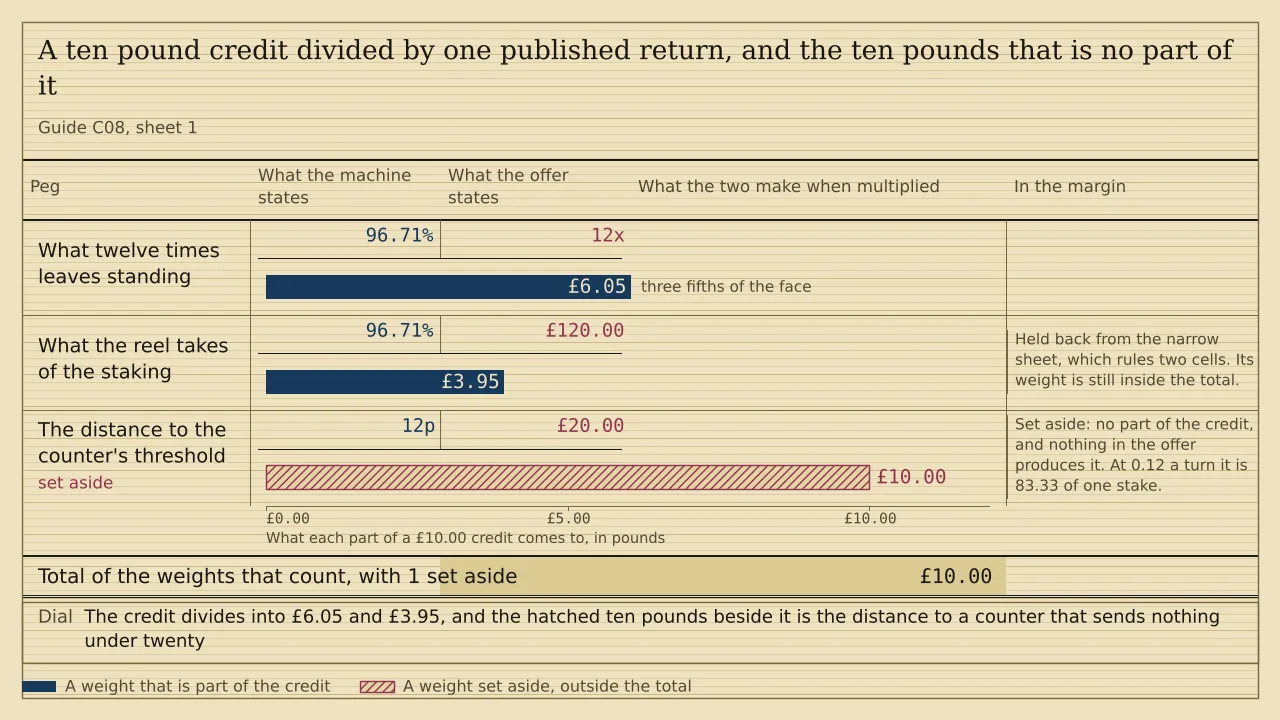
Read the drawing as a division rather than as a sum. Everything inside the double rule is the ten pounds a reader was offered, split by one published figure into a part that survives the condition and a part that does not. The hatched cell is the part nobody advertises: a second ten pounds, equal to the whole offer, which has to come from somewhere before any of the first ten pounds turns into money.
And this is where a credit of this size parts company with the larger ones in this section. On a credit big enough to clear the counter in expectation, a requirement is a tax on something a reader would otherwise have had. Here it is a tax on something that was not going to be collected either way, which makes the usual comparison between a lighter multiple and a heavier one meaningless at this size. Both are conditions on nought.
5
Two tiles with twelve lines each, and the 0.63 points between
The family’s two twelve-line titles make a cleaner comparison than most, because everything else about them matches. Both run five reels by four rows, both carry twelve lines, both start at 0.12 and stop at 240.00, and both cap a round at 4,000 times the stake claim 74. What separates them is the published return: 96.71 per cent on the title in the head of this card and 96.08 on Bigger Bass Blizzard – Christmas Catch.
So the same £120.00 of staking costs £3.95 on one and £4.70 on the other, and the credit finishes at £6.05 or £5.30. The tile is worth 75 pence on this offer, an eighth of the close, and it is the one quantity in the entry a reader picks.
| The title weighed | Published return | Break-even play-through | The offer asks | What £10.00 is worth |
|---|---|---|---|---|
| The twelve-line title in the head | 96.71 per cent | 30.4 times | 12 times | £6.05 |
| The other twelve-line title | 96.08 per cent | 25.5 times | 12 times | £5.30 |
| What the tile decides | 0.63 points of return | 4.9 times | no change | £0.75 |
Beyond the return, the two twelve-line titles agree on everything the sheets record about them. Five reels by four rows, twelve lines apiece, a range from 0.12 to 240.00 and a round stopping at 4,000 times the stake. Two machines built alike in every published respect but one, and the one is worth 75 pence here. A reader who wanted a reason to prefer either would find, on the studio’s own pages and in the game’s own data, exactly one figure to go on.
Both rows finish under the counter’s threshold, so the table prices a choice that cannot alter the outcome, and printing it anyway is the point. A reader comparing tiles is doing something real, worth 75 pence here and worth pounds on the bigger credits elsewhere in this section. A reader comparing tiles on a ten pound credit is optimising the part of the offer that was never going to decide it.
One figure in that table belongs to the reel in a way the others do not. Break-even answers to the published return alone, falling from 30.4 times to 25.5 as the return drops 0.63 points, a swing of nearly five times the credit between two tiles built to the same specification in every other published respect. Nothing an offer writes can move that figure, and no offer in this part of the market mentions that it exists.
6
What the reel would have to add, and when it would have to add it
If ten pounds is to become twenty, the reel has to supply the difference, and the difference is ten pounds. At the 0.12 this title charges for a turn that is 83.33 of one stake, which is the machine’s own unit and the only honest way to size the demand.
The machine publishes what it can do in one round. A round of either twelve-line title stops at 4,000 times the stake claim 74, which at twelve pence is £480.00, a limit the sum wanted is a forty-eighth of. The demand is small against the machine’s own range. It is total against the credit, since it is the entire face value over again.
Then comes the part that belongs to this card alone. The addition has to arrive early enough to survive. A balance that doubles on the last turn of the requirement is collectable; one that doubles on its first turn still has 999 turns of staking ahead of it, and the reel expects to take 3.29 points of all of it. Arriving at twenty pounds and still holding twenty pounds when the obligation ends are two different events, and the requirement charges for the distance between them.
Timing is the part of this nobody can shop for, and it can be priced exactly. Ten pounds arriving on the first turn leaves £119.88 of staking still to cross, which the reel expects to take 3.29 points of, or £3.94. The same ten pounds arriving on the last turn is taken whole, so the hour at which a reel pays decides £3.94 of what the payment is worth, which is better than half of what the requirement costs in total. No term anywhere in the offer mentions that, and no reader chooses it.
What would make the question answerable is a rate: how often a round of the needed size turns up. That figure has no publisher. No page of the studio’s carries a trigger frequency for any title, and the data behind the game has nowhere to keep one claim 105, which leaves the size of the demand priced and its frequency not.
One number would change the answer, and it is not one the offer prints. A counter whose smallest payment were five pounds would pay the expected close out without difficulty, since £6.05 clears five pounds with £1.05 to spare. So the whole question is whether the threshold sits above or below £6.05, and a figure no source publishes is the figure deciding whether an advertised ten pounds is ten pounds or nothing. That is the cost of an unpublished term: not that it is large, but that a reader cannot tell which side of it they are on until the staking is finished.
Solve it in the credit instead and the picture completes itself. At twelve times on this reel a credit keeps 60.52 pence in the pound, so a face of £33.05 is the size that would reach a counter wanting twenty. That is better than three times the sum on offer, which is the plainest statement this card can make of what a ten pound credit is: not a small version of a workable offer, but a figure on the wrong side of a line nobody prints.
7
Four licensed duties, none of which reaches the deciding term
Every page on this domain prices what a British licence would have changed. On a credit of this size the exercise has an unusual answer: three duties move a figure, a fourth moves the clock, and not one of them touches the term that settled the page in entry one.
A cashier advancing ten pounds on these terms holds no Great Britain licence, and four of that licence’s duties bear on the figures above. Wagering on a licensed incentive stops at tenfold the bonus funds. That ceiling has been live since 19 January 2026, so the obligation would be £100.00 and not £120.00, the expected cost £3.29 and not £3.95, and the close £6.71 and not £6.05, which puts it at 66 pence here and leaves the answer where it found it. No licensed slot accepts more than £5.00 in one game cycle, nor more than £2.00 where the account belongs to somebody under twenty-five, so £120.00 could cross in twenty-four turns rather than a thousand, which empties the forty-one minutes out of the obligation and takes nothing off its cost. Identity has to be established before a licensed cashier lets anybody play at all, and playing with a bonus counts as playing for that purpose. An incentive’s terms have to be set out clearly and fairly and be reachable by whoever is offered it, which is a duty to print the threshold and not a duty to set it anywhere. And the threshold itself is governed by none of them: nothing in the rule book names a smallest payment, and the offshore rule book opened in full for this network gives incentives two sentences and no figure of any kind. Registering once with Gamstop Online shuts whatever Britain licenses, which is exactly the reach it does not have out here.
The withdrawal rule a reader may already know runs the other way about. A licensee may not cap what a consumer takes back out of their own money, and an example of the forbidden term is published alongside a code of practice on withdrawal limits. A smallest payment is not a cap, and an offer taking no payment leaves no deposited balance for that rule to act on, so the strongest published protection in this area has nothing here to fasten on.
Which leaves the two figures that decided everything, neither of them regulated and neither of them in a headline. One is the size of the credit. The other is the size of the smallest payment. A reader who knows both can settle the whole question in a subtraction, and the subtraction is the one this card performs.
So the figures to carry away. Ten pounds at twelve times puts £120.00 across Bigger Bass Bonanza at 96.71 per cent, costs £3.95 and leaves £6.05 standing, or £5.30 on the family’s other twelve-line title at 96.08. Both stand beneath a threshold supposed at twenty pounds, so the worth of the offer is nought and the credit that would reach that threshold in expectation is £33.05. One thousand turns at the 0.12 this reel starts from is forty-one minutes and forty seconds, and the reel would have to add 83.33 of one stake, early, for any of it to matter.
Questions
- What is £10 free with no deposit actually worth?
- In money that could be sent to a reader, nought. Twelve times the credit leaves £6.05 expected to be standing where the studio’s page prints 96.71 per cent, and a counter that sends nothing beneath twenty pounds cannot pay that out. The smallest payment is this card’s own supposition, no claim on either sheet naming one.
- Would a no wagering version of the same offer be better?
- It would be worth £3.95 more and still come to nothing. With the requirement struck out the credit stands at its face value of ten pounds, which is half of what the counter is supposed to want before it will send anything, so the condition everybody compares was never the condition that decided it.
- Why is a turn on this title twelve pence rather than ten?
- Because Bigger Bass Bonanza runs twelve lines rather than ten, and the coin steps in the game’s own data multiply out to a range from 0.12 to 240.00. Only four of the thirty-five slots in the family sell a turn at anything but ten pence: the twelve-line pair at 0.12 and the Megaways pair at 0.20.
- How long does £120 of staking take on this reel?
- One thousand turns, which is 41 minutes and 40 seconds. The floor beneath a cycle is 2.5 seconds, so a thousand of them occupy 2,500 seconds whatever else happens, and nothing may take the turns in a single instruction.
- How much would the reel have to add before anything could be collected?
- Ten pounds, which is the face value over again, or 83.33 of one stake at the 0.12 this title charges. A round of either twelve-line title stops at 4,000 times the stake, a limit the sum wanted is a forty-eighth of, and how often such a round arrives is published by nobody.
- How large would the credit have to be to reach the counter?
- £33.05 at this multiple on this reel, where a credit keeps 60.52 pence in the pound. Better than three times the sum advertised, so the gap is not a matter of an offer being slightly smaller than a reader would like.
- Does it matter which Big Bass tile the staking is done on?
- By 75 pence here. The two twelve-line titles match on layout, lines, stake range and the cap on a round, and differ by 0.63 points of published return, so £120.00 costs £3.95 on one and £4.70 on the other. Both leave the credit under the threshold.
- Why will a counter not send ten pounds?
- Because the terms let it, and no published rule says otherwise. The rule a reader is likeliest to know bars a cap on money they put in themselves and drew back out, which is the opposite object, and this offer takes no payment, so no deposited balance exists for it to reach. No rule on either sheet names a least payment at all.